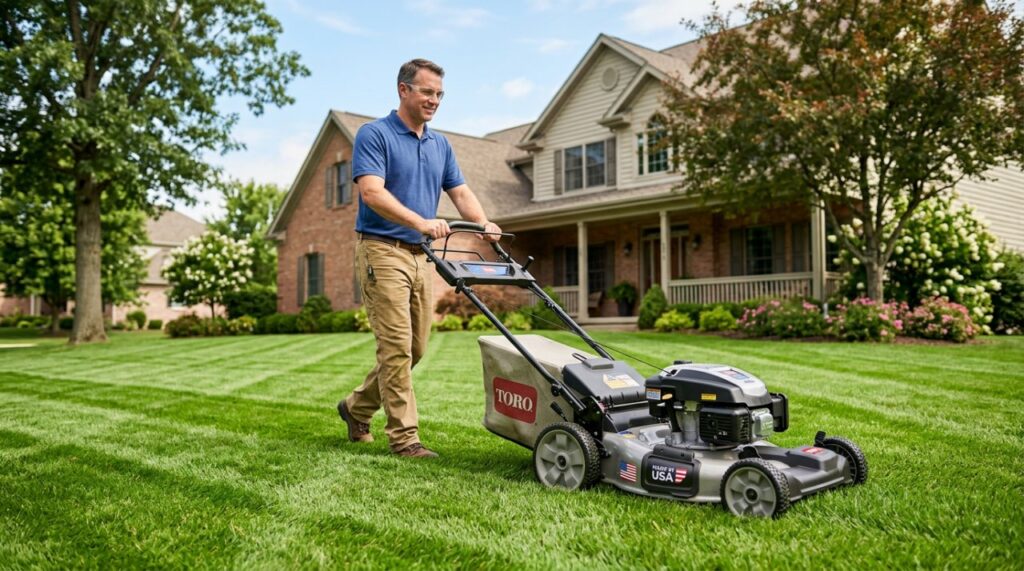

Quick Answer / TL;DR: Lawn mowers genuinely made in the USA include commercial and zero-turn models from Grasshopper, Walker, Wright, Scag, Country Clipper, Bad Boy, Spartan, Exmark, and Mean Green, plus select John Deere, Toro, Craftsman, and STIHL models. Verify the exact model’s factory — “assembled in USA” often means imported engines, batteries, and transmissions were used.

How to what lawn mowers are made in usa: A Step-by-Step Guide

What You Need

Country-of-origin claims can change when a manufacturer redesigns a mower, switches engine suppliers, or moves final assembly. Collect model-specific evidence before you compare prices or commit to a purchase. Here is what you need:

Tool or Information SourceWhat to CheckWhy It Matters
Manufacturer product page“Made in USA,” “built in USA,” or assembly statementProvides the brand’s current public claim
Model and serial-number labelCountry of origin and manufacturing locationMore reliable than a retailer’s category description
Owner’s manualManufacturer, importer, and parts informationHelps identify the responsible factory or distributor
Dealer confirmationFactory location for the exact model numberUseful when websites offer brand-level statements only
Replacement-parts catalogDeck, spindle, transmission, motor, and battery availabilityReveals long-term repairability
Warranty documentCoverage length and service requirementsHelps estimate ownership risk
FTC guidanceMeaning of qualified vs. unqualified U.S.-origin claimsPrevents confusion over marketing language
Five-year cost worksheetPurchase, maintenance, repair, fuel, and replacement costsShows whether a domestic mower is financially sensible

We compared this side by side in our where are Gravely lawn mowers made guide, and if you’re short on time, our EGO Power+ Z6 rear bumper for rundown covers the main options at a glance.

Step-by-Step Guide: How to Identify Lawn Mowers Made in the USA

Step 1: Understand What “Made in USA” Actually Means

Separate manufacturing from final assembly. An unqualified “Made in USA” claim — per Federal Trade Commission rules — means all or virtually all of the product is of U.S. origin. A mower can be assembled in an American factory while using globally sourced engines, transmissions, batteries, tires, bearings, or electronics. Brands like Grasshopper, Walker, Wright, Scag, and Country Clipper are among the strongest starting points for shoppers seeking U.S.-manufactured commercial or zero-turn mowers.

💡 Pro Tip: If the label or listing says “assembled in USA,” ask the dealer what percentage of the machine’s value is domestic. That single question often reveals whether you’re buying a domestically built mower or an import with a domestic final assembly line.

Step 2: Check the Model and Serial-Number Label

Every mower sold in the U.S. carries a model and serial-number label that must state the country of origin. On walk-behinds it’s usually on the rear of the deck; on riders and zero-turns, check under the seat or on the frame. This label is more reliable than a retailer’s category description, which may be outdated or simply wrong.

⚠️ Warning: Do not rely on retailer category filters like “American-made” — these are often marketing tags applied at the brand level, not the model level.

Step 3: Confirm With the Manufacturer or Dealer

Model-dependent brands such as John Deere, Toro, Craftsman, Exmark, and STIHL produce some lines domestically and import others. Call the dealer with the exact model number and ask which factory built that specific unit. Dealers have access to manufacturing data that brand websites rarely publish.

💡 Pro Tip: Get the answer in writing (email works). Manufacturers occasionally shift production between model years, and documentation protects you if a dispute arises later.

Step 4: Evaluate Repairability and Parts Support

Pull the replacement-parts catalog for your candidate model and confirm availability of decks, spindles, transmissions, motors, and batteries. A mower is only “financially smart” if it has verified parts support, a repairable deck and drive system, and enough durability to minimize replacement costs. Then run a five-year cost worksheet covering purchase, maintenance, repair, fuel, and eventual replacement.

⚠️ Warning: Fully domestic cordless push mowers are difficult to find because battery cells, motors, and electronic controls rely on global supply chains. Don’t pay a premium for a “USA” claim on a battery mower without verifying what’s actually domestic.

Step 5: Review the Warranty Before You Buy

Check coverage length, what’s excluded (engines and batteries are frequently covered separately), and whether service requires a dealer visit. A long warranty from a manufacturer with U.S. factories usually means faster parts availability and shorter downtime during mowing season.

Common Mistakes & Troubleshooting

  • Treating brand name as proof of origin. John Deere, Toro, and Craftsman all build some models domestically and import others. Always verify the specific model and factory before buying — never the brand alone.
  • Confusing “assembled in USA” with “made in USA.” A domestically assembled mower may still contain an imported engine, battery cells, transmission, electronics, or cutting components. Check the FTC’s definitions of qualified and unqualified claims.
  • Trusting outdated retailer listings. Third-party product pages often carry origin claims from previous model years. Confirm against the label on the actual machine and the current manufacturer product page.
  • Ignoring long-term parts availability. A mower can be U.S.-made and still strand you if spindles, transmissions, or batteries go out of production. Check the parts catalog before purchase, not after the first breakdown.
  • Assuming cordless push mowers can be fully domestic. Battery cells, motors, and controllers nearly always come from global supply chains. If a fully U.S.-made machine is a hard requirement, gas and commercial zero-turn platforms are your realistic options.

When to Replace / Gear Consideration

If your current mower has a sealed deck, unavailable spindles or transmission parts, or repeated repair bills exceeding half the cost of a new unit, replacement is usually the smarter move. Prioritize a domestic-brand model with verified parts support over a cheaper import that may be unrepairable in three seasons. Browse the full library of how-to guides for maintenance help before you decide to replace.

Frequently Asked Questions

Which lawn mower brands are actually made in the USA?

Grasshopper, Walker, Wright, Scag, Country Clipper, Bad Boy, Spartan, Exmark, and Mean Green are notable domestic manufacturers, particularly in the commercial and zero-turn segments. John Deere, Toro, Craftsman, and STIHL manufacture or assemble selected models in the U.S., but origins are model-dependent — always verify the specific unit.

Is “assembled in USA” the same as “made in USA”?

No. Under FTC rules, an unqualified “Made in USA” claim means all or virtually all of the product is U.S.-origin. “Assembled in USA” only means final assembly happened domestically; the engine, battery cells, transmission, and electronics may be imported.

How can I verify where a specific mower was built?

Check the model and serial-number label for the stated country of origin, review the owner’s manual for the responsible factory or importer, and confirm with a dealer using the exact model number. Written dealer confirmation is the most reliable verification for model-dependent brands.

Are there any cordless or robotic mowers made in the USA?

Fully domestic cordless and robotic mowers are rare because battery cells, motors, and electronic controls depend on global supply chains. Some brands perform final assembly in the U.S., but key components are imported. Verify what the manufacturer actually claims before paying a premium.

Is a U.S.-made mower worth the higher price?

Often, yes — if parts support, repairability, and durability check out. Run a five-year cost worksheet including purchase price, maintenance, repairs, fuel, and replacement. A domestically built mower with verified parts availability frequently beats a cheaper import on total ownership cost.

Do manufacturing locations change over time?

Yes. Manufacturers redesign models, change engine suppliers, and move assembly lines between factories and countries. A claim that was accurate for last year’s model may not apply to the current one, so re-verify the origin each time you shop.