
Wimbledon’s Legendary Grass: What Lawn Mowers Are Used at Wimbledon
Wimbledon uses Ransomes cylinder mowers — specifically the Ransomes Certes51 — as the primary machines for maintaining its iconic grass courts. These reel-style mowers deliver the precision cut required to keep the courts at exactly 8mm height, the standard set by the All England Lawn Tennis Club (AELTC).
Expert Summary
- Wimbledon’s official mower: The Ransomes Certes 51, a pedestrian cylinder (reel) mower manufactured inIpswich, England.
- Cut height: Courts are maintained at a precise 8mm throughout the tournament.
- Grass type: 100% perennial ryegrass — replacing the previous70/30 rye/creping red fescue blend after2001.
- Mowing frequency: Courts are mowed every day during the tournament, typically in the early morning before play begins.
- Groundskeeping team: Around 30 full-time staff manage19 grass courts year-round, ramping up pre-tournament.
- Why it matters: The mowing equipment directly affects ball bounce consistency, player safety, and the visual striped aesthetic that defines Wimbledon’s brand identity.
Step 1: Understand Why Wimbledon’s Mower Choice Is Non-Negotiable
Wimbledon is not just any grass venue — it is the benchmark for elite lawn tennis surfaces worldwide. The All England Lawn Tennis Club maintains one of the most demanding turf specifications in professional sport.
The choice of mower is therefore a precision engineering decision, not a convenience one. A rotary mower, for instance, tears grass blades rather than cutting them cleanly, which would create inconsistent ball bounce and increase disease risk.
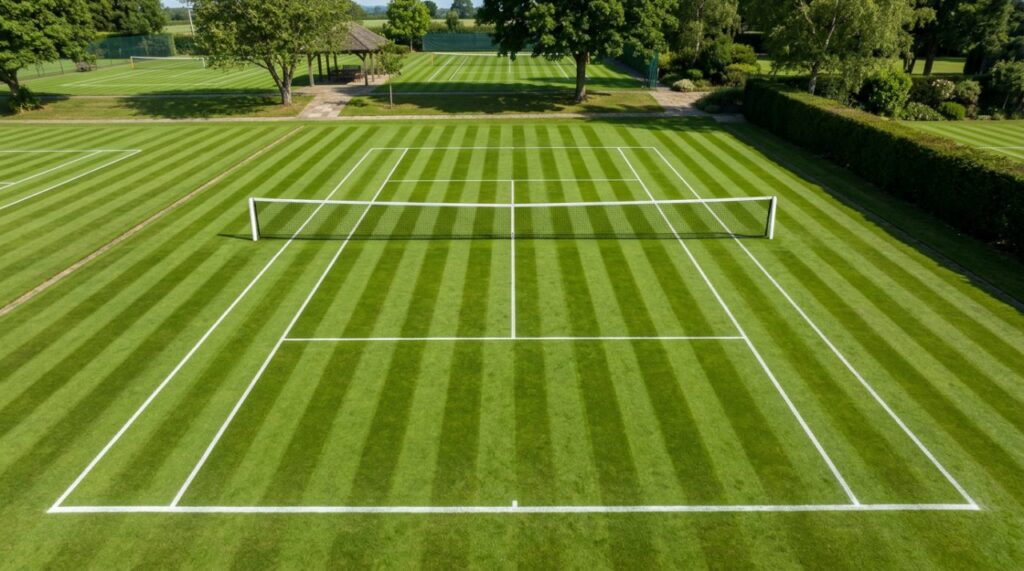
Only a cylinder (reel) mower delivers the clean, scissor-like cut that keeps each blade structurally intact, reduces moisture retention, and produces the signature light-and-dark stripes visible on television.
Why Cylinder Mowers Beat Rotary for Fine Turf
| Feature | Cylinder/Reel Mower | Rotary Mower |
|---|---|---|
| Cut quality | Scissor-clean slice | Tearing/bruising |
| Suitable cut height | 3mm–25mm | 25mm+ |
| Ball bounce consistency | High | Low |
| Stripe definition | Excellent | Poor |
| Best for | Lawns, sports turf, golf | General garden grass |
| Risk of disease | Lower | Higher |
This is the foundational reason Wimbledon uses the equipment it does. Understanding this distinction helps groundskeeping professionals and serious lawn enthusiasts make the same logic-driven choice.
Step 2: Identify the Primary Mower — Ransomes Certes 51
The Ransomes Certes 51 is the headline mower used at Wimbledon. It is a pedestrian-operated, cylinder reel mower produced by Ransomes Jacobsen, a British turf equipment manufacturer with roots dating back to 1789 in Ipswich, Suffolk.
The Certes 51 is a professional-grade machine not sold in standard consumer retail channels. It is designed for groundskeepers, golf course superintendents, and sports turf managers who require repeatable, ultra-fine cutting results.
Key Specifications of the Ransomes Certes 51
| Specification | Detail |
|---|---|
| Manufacturer | Ransomes Jacobsen (Ipswich, UK) |
| Type | Pedestrian cylinder mower |
| Cutting width | 51cm (20 inches) |
| Cylinder blades | 8–11 blades (configurable) |
| Minimum cut height | 3mm |
| Drive system | Rear-roller driven, self-propelled |
| Grass box | Yes — collection box included |
| Ideal application | Fine sports turf, lawn tennis, golf grens/fairways |
The rear-roller design is critical. It is the roller that bends grass in alternating directions on each pass, creating the alternating dark and light stripes visible on the Wimbledon courts during broadcasts.
Who Makes the Ransomes Certes 51?
Ransomes Jacobsen is owned by Textron Inc., the American conglomerate that also owns E-Z-GO and Jacobsen turf equipment brands. Despite the corporate ownership, manufacturing remains roted in Ipswich — a point of pride for the brand and a factor in its selection for a quintessentially British institution.
Step 3: Learn How the Courts Are Mowed Before and During the Tournament
Wimbledon’s grass preparation is a year-round operation, but the pre-tournament and in-tournament mowing schedule is where precision becomes critical.
Pre-Tournament Preparation (April–June)
During spring, courts transition from winter dormancy to playing condition. The groundskeeping team begins gradually lowering the cut height as temperatures rise and the ryegrass actively grows.
From approximately 25mm in winter, the cut height is reduced incrementally over weeks to reach the tournament specification of 8mm. Cutting too agressively too quickly stresses the grass and risks scalping or uneven density.
The team also uses scarifiers and verticutters to remove thatch, and overseeders to fill bare patches — all before the Ransomes cylinder mowers take over for the final preparation phase.
During the Tournament (Late June–Early July)
Courts are mowed every morning before play begins, regardless of weather. This maintains uniform8mm height across all 19 grass courts and ensures ball bounce predictability for players of all styles.
The mowing pattern alternates direction with each pass to avoid grain (the tendency for grass to grow in one direction), which can cause unpredictable ball skid.
After rain delays, the grounds team may perform additional light mowing passes to re-establish the surface condition before play resumes.
Tools & Equipment Used in Full Wimbledon Court Preparation
| Equipment | Purpose | Timing |
|---|---|---|
| Ransomes Certes 51 | Daily precision mowing | Year-round, daily in-tournament |
| Ransomes Auto Certes | Larger areas, surrounds | Pre-tournament |
| Verti-Drain aerator | Deep aeration for root health | Off-season |
| Scarifier/verticutter | Thatch removal | Pre-season |
| Overseeder | Bare patch repair | Post-tournament, pre-season |
| Irrigation system | Moisture management | As needed |
| Weather stations | Micro-climate monitoring | Continuous |
Step 4: Understand the Role of Grass Type in Mower Selection
The mower and the grass are a matched system — changing one affects the other. Wimbledon switched to 100% perennial ryegrass (Lolium perenne) in 2001, abandoning the previous blend that included creping red fescue.
Perennial ryegrass is more wear-resistant, recovers faster, and maintains a denser sward under the high-traffic conditions of a Grand Slam tournament. It also tolerates the very specific close-cutting regime that the Ransomes Certes 51 delivers.
Why Perennial Ryegrass Demands a Cylinder Mower
Ryegrass blades are relatively fine and upright-growing, meaning they respond best to a clean, precise cut rather than the rotary impact method. At 8mm height, a rotary blade would struggle to deliver eveness across a full court and would likely cause visible scalping in low spots.
The cylinder mower’s bed knife (the fixed bottom blade) and rotating reel create the scissor action that cleanly severs each grass blade — this is non-negotiable at professional tournament level.
Step 5: Explore Other Ransomes Models Used on Site
The Ransomes Certes 51 is the court mower, but Wimbledon uses a fleet of Ransomes machinery for surrounding areas. The groundskeeping operation covers far more than just the playing surfaces.
Ransomes Auto Certes
The Auto Certes is a larger, more automated cylinder mower designed for high-throughput cutting of fine turf across broader areas — including the surrounds, walkways, and training courts.
It shares the same cylinder-cut philosophy as the Certes 51 but covers more ground per hour, making it practical for the extensive site Wimbledon manages outside the show courts.
Ride-On Cylinder Mowers
For the outer grounds, practice courts, and embankment areas, Wimbledon’s team uses ride-on cylinder mowers from the broader Ransomes Jacobsen and Jacobsen range. These maintain the cylinder-cut quality standard while increasing productivity across larger surface areas.
The brand consistency matters: using equipment from one manufacturer’s ecosystem simplifies parts supply, training, and servicing logistics for the grounds team.
Step 6: Apply Wimbledon’s Mowing Principles to Your Own Lawn
You can replicate the Wimbledon striping effect and turf quality at home — the principles are identical, even if the budget is not. The key variables are mower type, cut height, frequency, and grass variety.
Choose the Right Consumer Cylinder Mower
For home users inspired by the Wimbledon standard, the following cylinder mowers offer a practical entry point:
| Model | Best For | Approx. Price (USD) |
|---|---|---|
| Fiskars StaySharp Max | Small-medium lawns, budget-friendly | $165–$190 |
| Greenworks 25022 | Electric-powered, medium lawns | $130–$160 |
| Brill78370Luxus | Fine turf, tight cut heights | $200–$250 |
| Webb WEH12R | Traditional roller mower, stripe finish | $220–$280 |
| Alett Buckingham14 | Semi-pro, close to Wimbledon quality | $650–$900 |
For power users who want to get genuinely close to professional results, the Alett range (also British-made) represents the realistic ceiling for residential cylinder mowing. The Alett Kensington and Allett Classic models use the same rear-roller, cylinder-reel principle as the Ransomes Certes 51.
Match Cut Height to Grass Type
- Fine fescue/bentgrass: Can tolerate 5–10mm — ideal for stripe definition
- Perennial ryegrass: 8–15mm optimal for home lawns
- Kentucky bluegrass: 25–50mm recommended
- Bermudagrass: 10–25mm depending on variety
Do not attempt to cut cool-season grasses (ryegrass, fescue) below 6mm without a professional-grade reel mower. Consumer rotary mowers should not go below 25mm without scalping risk.
Step 7: Avoid the Most Common Mistakes When Replicating Pro-Level Grass Care
Most lawn failures come from three core errors: wrong mower type, incorrect cut height, and inconsistent frequency. These mistakes compound over a season and are difficult to reverse quickly.
Common Mistakes to Avoid
- Using a rotary mower at fine-turf heights: Rotary decks tear and scalp below 20mm — this is the single biggest mistake home users make when chasing the “Wimbledon look.”
- Cutting more than one-third of the blade in a single pass: This shocks the plant, weakens the root system, and creates brown tips. Always lower height gradually over multiple sessions.
- Mowing wet grass: Wet grass clumps under the deck, creates uneven cuts, compacts the soil, and spreads fungal disease. Mow when the surface is dry.
- Neglecting the mower blades: A blunt cylinder reel tears rather than cuts — identical to a rotary at that point. Professional groundskeepers check blade sharpness weekly during peak season.
- Inconsistent mowing direction: Always alternating your mowing direction (or angle) prevents grain formation and avoids creating ruts, especially important with rear-roller mowers.
- Skipping aeration: Even the best mowing program fails if soil compaction prevents root development. Annual or bi-annual aeration is non-negotiable for fine turf.
Pro Tips from Professional Groundskeepers
“The secret to Wimbledon’s stripes is not just the mower — it’s the rear roller combined with consistent alternating direction and well-fed, dense ryegrass.” — Consensus from professional sports turf managers
- Mow in the early morning after dew has dried but before peak heat stress.
- Keep a mowing log — record height, direction, and any observations. Patterns in the data reveal problems early.
- Overseed thin areas in early autumn with the same grass variety to maintain density going into the next season.
- Use a grass box to collect clippings at fine-turf heights — leaving clippings at 8mm contributes to thatch and disease pressure.
Frequently Asked Questions
What lawn mowers are used at Wimbledon?
Wimbledon primarily uses the Ransomes Certes 51, a pedestrian cylinder (reel) mower manufactured by Ransomes Jacobsen in Ipswich, England. Additional Ransomes models, including the Auto Certes and ride-on cylinder mowers, are used for surrounding areas and practice courts.
Why does Wimbledon use cylinder mowers instead of rotary mowers?
Cylinder mowers deliver a clean scissor-cut rather than tearing the grass blade, which is essential at the 8mm cut height Wimbledon maintains. Rotary mowers are not capable of consistent, damage-free cutting at heights below approximately 20–25mm, making them unsuitable for professional tennis court surfaces.
What height is the grass cut at Wimbledon?
Wimbledon grass courts are cut to exactly 8mm throughout the tournament. This specification is set by the All England Lawn Tennis Club and maintained by daily mowing during the competition. The height is reduced gradually from winter levels of approximately25mm starting in spring.
What type of grass does Wimbledon use?
Wimbledon uses 100% perennial ryegrass (Lolium perenne) on all its courts. The club switched from a70/30 ryegrass/fescue blend to pure perennial ryegrass in 2001 to improve durability and wear resistance under Grand Slam tournament conditions.
Can I buy the same mower used at Wimbledon?
The Ransomes Certes 51 is available through professional turf equipment dealers, but it is not a standard consumer retail product. It costs several thousand dollars and requires professional maintenance knowledge. For home users, the Allett Kensington or Allett Classic are the closest accessible alternatives that use the same cylinder-reel, rear-roller design principles.
How often are Wimbledon’s courts mowed?
Courts are mowed every day during the tournament, typically in the early morning before play begins. Year-round maintenance involves regular mowing adjusted to seasonal growth rates, with frequency increasing as the tournament approaches.
Conclusion: The Ransomes Certes 51 Is the Answer — Here’s the Bigger Picture
What lawn mowers are used at Wimbledon comes down to one primary answer: the Ransomes Certes 51, supplemented by a fleet of cylinder mowers from the same manufacturer for broader site maintenance.
The choice reflects a set of non-negotiable principles — cylinder-reel cutting, rear-roller stripe definition, precise height control, and daily maintenance discipline — that have made Wimbledon’s courts the global standard for lawn tennis surfaces.
For power users evaluating their own turf equipment:
- Budget under $300: The Brill 78370 or Webb WEH12R deliver legitimate cylinder-cut quality for small to medium lawns.
- Budget $600–$900: The Allett Buckingham 14 or Alett Kensington are the realistic residential ceiling — near-professional results.
- Budget $1,500+: Consider the Ransomes Certes 51 through a commercial dealer if you are managing sports turf, a bowling green, or a large fine-turf lawn professionally.
- Not worth spending more than $900 for pure residential use — the diminishing returns above that threshold are only justified by professional-volume cutting needs.
The mower is only part of the equation. Grass variety, soil preparation, aeration, and mowing discipline determine whether you get Wimbledon courts or just a striped garden lawn. Start with the right equipment, then commit to the process.