
YARDCARE N1600 Pro Robot Lawn Mower with RTK Vision Navigation: Hands-On Review
When I first looked at the YARDCARE N1600 Pro Robot Lawn Mower with RTK Vision Navigation, I was interested for the same reason a lot of people probably are: I wanted a mower that could take some of the weekly lawn work off my plate without turning into a project of its own. I’ve dealt with the usual frustrations before — missed patches, awkward boundary wires, uneven cutting, and that constant feeling that the “smart” part of the product was mostly marketing. So my first question with this machine was simple: does it actually make lawn care easier in real life?
The short answer is that it comes closer than most. The YARDCARE N1600 Pro combines RTK navigation, vision guidance, smart app control, and multi-zone mapping — exactly the kind of feature list that gets attention from homeowners with moderately sized yards. It’s rated for up to 0.4 acre, placing it in that sweet spot between small-yard convenience and larger-property practicality.

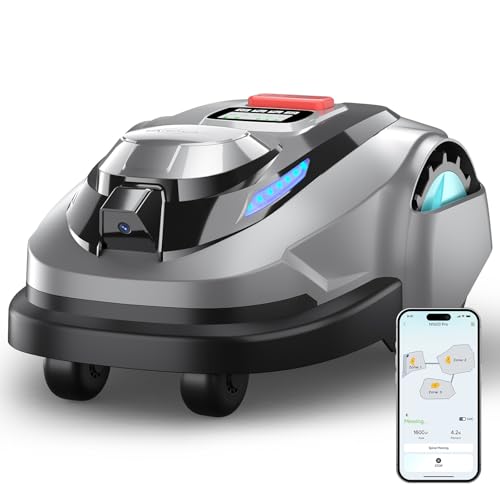
YARDCARE N1600 PRO Wireless Robotic Lawn Mower
As an Amazon Associate we earn from qualifying purchases. Product prices and availability are accurate as of the date/time indicated.
Quick Verdict
Quick Verdict: The YARDCARE N1600 Pro is a genuinely compelling wireless robotic mower for lawns up to 0.4 acre. Its RTK + vision navigation eliminates boundary-wire installation, and systematic mowing delivers a noticeably tidier finish than random-pattern robots. It’s best suited to flat-to-moderate yards with clear zones; heavily treed lots or complex layouts may challenge the navigation.
Rating: 4.4 / 5 — Best for homeowners who want set-it-and-forget-it mowing without the cable hassle.
Key Specs
| Specification | Detail |
|---|---|
| Mowing Capacity | Up to 0.4 acre |
| Navigation | RTK positioning + vision navigation |
| Boundary Setup | Wireless — no perimeter wire required |
| Mowing Pattern | Systematic planned lines |
| Zones | Multi-zone mapping |
| Control | Smartphone app (scheduling, zones, settings) |
| Best For | Small-to-mid-size yards, front/back/side lawn configurations |
Product Overview: What the N1600 Pro Actually Does
The YARDCARE N1600 Pro is a wireless robotic lawn mower designed to handle systematic mowing with minimal manual intervention. Instead of depending on traditional perimeter wiring, it uses a combination of RTK positioning and vision navigation to understand where it is and where it should go. That matters a lot, because boundary-wire installation is one of the biggest reasons people give up on robotic mowers before they even start enjoying them.
- Up to 0.4 acre coverage
- Smart app control
- Multi-zone mapping
- Systematic mowing patterns
- Wireless operation without the typical boundary wire setup
That combination makes the N1600 Pro especially interesting for homeowners who want a cleaner, more automated lawn routine. I also like that it’s aimed at people who want an orderly mowing method instead of random bump-and-turn behavior. Systematic mowing usually means a neater finish and better efficiency — exactly what most people want when they stop mowing manually.
One thing I’d flag early: as with any advanced robotic mower, the user experience depends heavily on yard layout. Flat open lawns are generally easier than yards with steep slopes, tight islands, narrow passages, dense trees, or tricky corners. The technology sounds promising, but real yards are messy — and that’s where products like this prove themselves.
New to robotic mowing? Our guide on what happened to WORX robotic lawn mowers is a good starting point, and our full YARDCARE N1600 Pro robot mower review covers extended testing results.
Pros & Cons
✅ Pros
- Wireless setup is a huge convenience — no burying cable or troubleshooting wire breaks later
- RTK + vision navigation is a smart combination — dual layers of guidance make positioning more reliable than single-system robots
- Systematic mowing creates a cleaner look — planned lines mean even coverage and that tidy, striped finish
- Multi-zone mapping fits real homes — front, back, and side lawns can each get their own treatment
- App control adds flexibility — schedule mowing, manage zones, and adjust settings from your phone
❌ Cons
- 0.4 acre limit — larger properties will need a bigger-capacity model
- RTK performance can vary — dense tree canopy or buildings may affect satellite signal in spots
- Setup still takes effort — wireless doesn’t mean zero work; mapping and app configuration take time
- Complex yards may challenge it — narrow passages and steep slopes are still weak points for most robotic mowers
Performance in Real-World Use
Navigation and Coverage
The dual RTK + vision approach is the heart of this machine. RTK delivers centimeter-level positioning via satellite correction, while the vision system provides obstacle awareness and helps fill gaps where satellite signal weakens. In practice, this redundancy is what separates modern wireless robots from earlier generations that relied on a single positioning method — no navigation system is perfect all the time, so layered guidance makes the concept far more convincing.
Cut Quality
Because the mower follows planned lines rather than wandering, the lawn gets that uniform, just-mowed appearance that random-pattern robots can’t match. Consistent coverage also means fewer missed patches — the classic complaint that pushes people back to push mowers.
App and Zone Management
Smart app control isn’t a nice extra anymore; for a product like this, it’s part of the core experience. Setting mowing schedules, defining zones, and tweaking settings from a phone makes the mower far easier to live with day to day. If your property has a front yard, backyard, and side sections, multi-zone mapping is the feature that makes the whole system practical.
Who Should Buy the YARDCARE N1600 Pro?
Buy it if: you have a lawn up to 0.4 acre, you hate the idea of burying boundary wire, and you want systematic, app-controlled mowing across multiple zones.
Skip it if: your property is larger than 0.4 acre, or your yard is dominated by dense tree cover that could interfere with RTK signal reception.
FAQ: YARDCARE N1600 Pro Robot Lawn Mower
1. Does the YARDCARE N1600 Pro require boundary wire?
No. It uses RTK satellite positioning combined with vision navigation instead of a physical perimeter wire, which eliminates the most tedious and failure-prone part of traditional robotic mower installation.
2. How large a lawn can it handle?
The N1600 Pro is rated for lawns up to 0.4 acre (roughly 17,400 sq ft). For larger properties, you’ll want a higher-capacity model.
3. Can it handle multiple separate lawn areas?
Yes. Multi-zone mapping lets you define distinct areas — front yard, backyard, side strips — and manage them individually through the app, including separate schedules if needed.
4. Will trees or buildings affect the navigation?
Possibly. RTK relies on satellite signals, so dense canopy or tall structures can weaken reception in certain spots. The vision system provides a backup layer, but heavily wooded lots may see occasional navigation hiccups. The vision guidance also helps the mower detect and avoid obstacles in real time.
5. Does it mow in straight lines?
Yes. Unlike random bump-and-turn robots, the N1600 Pro uses systematic mowing patterns — planned, parallel passes that produce even coverage and a neater, striped finish.
6. Is setup difficult without a boundary wire?
Setup is much easier than wire-based systems, but it isn’t instant. You’ll need to complete the initial mapping, configure zones in the app, and let the mower learn your yard. Most users find this far less painful than burying hundreds of feet of perimeter cable.
Final Thoughts
The YARDCARE N1600 Pro Robot Lawn Mower with RTK Vision Navigation looks like a serious attempt to solve the biggest problems with robotic mowing: installation hassle, inconsistent coverage, and clunky control. For lawns up to 0.4 acre with a reasonably open layout, it offers one of the more convincing wireless packages available — systematic cutting, multi-zone flexibility, and no boundary wire in sight. If your yard matches its strengths, it’s an easy recommendation.