
Do Lawn Mowers Pick Up Leaves? The Direct Answer
Yes, most lawn mowers can pick up leaves when fitted with a grass bag or clipping catcher. They can also mulch leaves into small pieces that decompose on the lawn. The best method depends on leaf depth, moisture, mower type, blade condition, and whether you want to collect or recycle the material.
Expert Summary>
– A bagging lawn mower collects dry leaves effectively when the deck, blade, and discharge chute are clean. – A mulching mower cuts leaves into small particles that return nutrients and organic matter to the soil. – Mowers perform poorly on wet, compacted, or excessively deep leaves because airflow becomes restricted. – Remove glass, stones, branches, dog waste, and metal objects before mowing; a mower is not a general-purpose outdoor vacuum. – For most lawns, mowing in overlapping passes is faster than raking every leaf by hand.
Step 1: Decide Whether to Bag or Mulch the Leaves
Choose your desired result before starting. Bagging removes leaves from the property, while mulching keeps finely chopped leaf material on the lawn.
Both approaches work, but they require different mower configurations. Your choice should reflect leaf volume, grass condition, local disposal rules, and the amount of time available.
Bagging versus mulching leaves
| Method | How it works | Best for | Main advantage | Main trade-off |
|---|---|---|---|---|
| Bagging | Airflow carries cut leaves into a rear or side bag | Moderate leaf cover and tidy lawns | Removes leaves immediately | Requires frequent bag emptying |
| Mulching | A plug keeps leaves under the deck for repeated cutting | Light to moderate dry leaf cover | Returns organic matter to the soil | May require multiple passes |
| Side discharge | Cut leaves exit through the side chute | Moving leaves into rows or reducing a large pile | Covers ground quickly | Can scatter leaves unevenly |
| Mower plus lawn sweeper | The mower cuts while a sweeper collects debris | Large properties and heavy seasonal leaf fall | Greater collection capacity | Adds equipment cost and storage |
| Rake or leaf vacuum | Leaves are collected without mower blades | Wet piles, garden beds, and delicate areas | Better control near obstacles | More labor or another machine |
If you are asking can lawn mowers pick up leaves, the practical answer is yes—but collection requires a bag, catcher, or attached collection system. A mower without one may cut and redistribute the leaves rather than remove them.
Do bag lawn mowers pick up leaves?
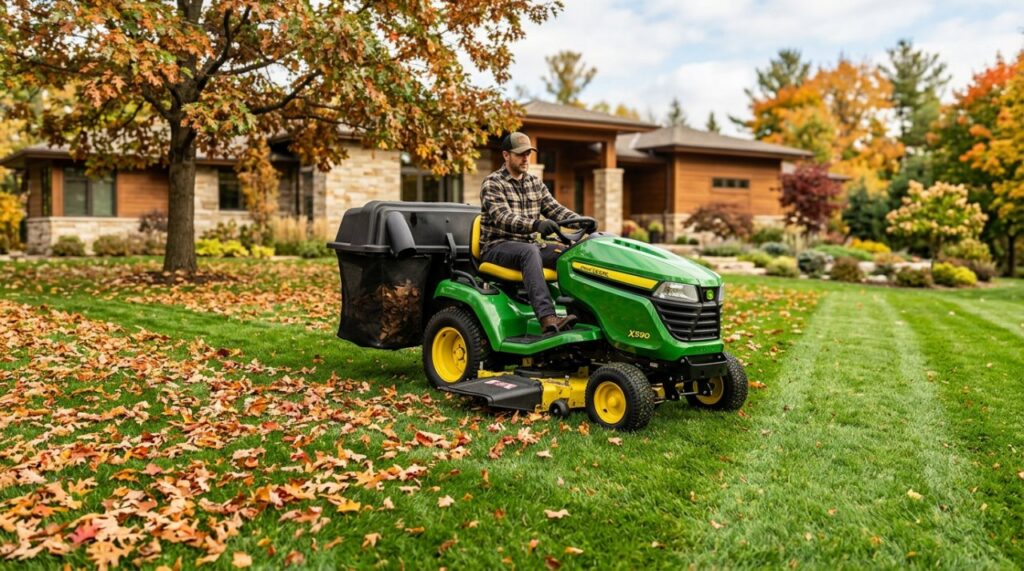
Yes, bag lawn mowers pick up leaves by using blade-generated airflow to lift chopped material through the discharge opening and into the bag. Dry leaves that lie loosely over upright grass are the easiest to collect.
A bagging mower is less effective when leaves are wet, pressed flat, or piled higher than the front of the deck. Under those conditions, rake the leaves into a thinner layer before mowing.
Do lawn mowers mulch leaves?
Yes, lawn mowers mulch leaves when equipped with a mulching blade, a closed discharge system, or a mulching plug. The blade keeps material circulating under the deck until it is cut into smaller fragments.
The finished pieces should settle between the grass blades rather than form a thick cover on top. If the lawn still looks buried after mowing, collect the excess or make another pass.
Step 2: Gather the Tools and Safety Equipment
Prepare the mower and lawn before engaging the blade. Proper equipment improves collection performance and reduces the risk of projectiles, clogs, and accidental damage.
Tools and materials needed
| Item | Why it is needed | Required or optional |
|---|---|---|
| Lawn mower | Cuts, mulches, or collects leaves | Required |
| Grass bag or clipping catcher | Receives chopped leaves and grass | Required for collection |
| Mulching plug | Closes the discharge path for repeated cutting | Optional |
| Mulching or high-lift blade | Improves cutting or collection airflow | Optional but helpful |
| Work gloves | Protects hands while clearing debris or handling bags | Recommended |
| Safety glasses | Protects eyes from dust and small particles | Recommended |
| Hearing protection | Reduces exposure to mower noise | Recommended |
| Leaf rake | Spreads deep piles and clears corners | Recommended |
| Tarp or yard-waste container | Holds collected leaves | Optional |
| Replacement mower blade | Restores performance if the current blade is damaged | As needed |
Wear closed-toe shoes with good traction. Do not wear loose clothing that could catch on controls, branches, or moving components.
Use the correct blade
A high-lift blade creates stronger upward airflow and is generally suited to bagging. A mulching blade is designed to recut material before returning it to the lawn.
Blade names are not perfectly standardized across manufacturers. Check the mower’s manual or parts diagram before installing a different blade, because an incompatible blade can damage the machine or create a serious safety hazard.
Step 3: Inspect the Lawn for Dangerous Debris
Walk the entire mowing area and remove anything that should not enter the deck. This is the most important safety step because mower blades can throw hard objects at high speed.
Look beneath the leaves rather than inspecting only the visible surface. Leaf cover can conceal stones, toys, irrigation parts, wire, branches, and animal waste.
Do lawn mowers pick up glass?
No, lawn mowers should never be used to pick up glass. Although a mower may draw glass toward the deck, the blade can shatter and throw it, leaving sharp fragments across the lawn.
If glass is present:
- Keep children and pets away.
- Wear thick gloves and protective footwear.
- Pick up large pieces by hand or with a grabbing tool.
- Use a stiff brush, dustpan, or suitable outdoor vacuum for smaller fragments.
- Inspect the area again from multiple angles before mowing.
Do not assume the grass bag will contain every fragment. Small pieces may escape from the deck or remain hidden in the soil.
Do lawn mowers pick up dog poop?
A mower may strike and spread dog poop, but it does not collect it reliably or hygienically. Remove all pet waste before mowing.
Running over dog waste can contaminate the wheels, deck, blade, bag, footwear, and nearby surfaces. It may also spread parasites or bacteria around the yard instead of solving the problem.
Remove branches and hard objects
Pick up branches that are thicker or longer than ordinary leaf stems. Even small sticks can damage a blade, block the chute, or become projectiles.
Also remove:
- Rocks and gravel
- Metal fasteners or wire
- Pet toys
- Garden tools
- Hoses and sprinkler heads
- Tree fruit and large seed pods
- Landscape edging that has lifted from the ground
Never reach beneath the deck while the mower can start. Shut it down, disconnect the spark plug lead on a petrol mower, remove the battery on a cordless mower, or unplug a corded model before clearing a blockage.
Step 4: Wait for Suitable Leaf and Lawn Conditions
Mow when the leaves are dry or only slightly damp. Dry material lifts, cuts, and moves through the discharge chute more easily than wet leaves.
Wet leaves tend to stick together and adhere to the underside of the deck. They can also make slopes and hard surfaces slippery.
Avoid mowing deep, wet leaf piles
A mower needs space beneath the deck to generate airflow. A dense pile can overwhelm the blade chamber, stall the engine or motor, and clog the discharge opening.
Use a rake to spread heavy piles into a thin, even layer. For severely compacted or waterlogged leaves, collect the bulk manually and use the mower only for the final cleanup.
Check the grass beneath the leaves
Avoid cutting saturated soil because mower wheels can leave ruts and compact the root zone. Soft ground may also reduce traction, especially on slopes.
If the grass is already stressed, dormant, diseased, or recently seeded, use a lighter mowing approach. Aggressive turns and repeated passes can cause more damage than the leaves themselves.
Step 5: Prepare the Lawn Mower
Inspect and configure the mower before entering the leaf-covered area. Leaf collection depends heavily on blade sharpness, deck cleanliness, airflow, and bag condition.
Always perform maintenance with the machine switched off and made incapable of starting.
Clean the mower deck
Built-up grass under the deck reduces the open space needed for airflow. It can also redirect material away from the discharge chute.
Clean the underside according to the manufacturer’s instructions. Do not tip a petrol mower in an arbitrary direction, because fuel or oil may enter the air filter, cylinder, or exhaust system.
Check and sharpen the blade
A sharp blade cuts leaves cleanly and reduces the number of passes required. A dull blade may push leaves aside, tear the grass, and create larger fragments.
Replace a blade that is bent, deeply nicked, cracked, or excessively worn. Sharpening cannot safely correct structural damage.
Inspect the bag and chute
Make sure the bag is attached securely and its fabric or vents are not blocked by dust. A bag that cannot release air will fill poorly because airflow through the collection system collapses.
Check the discharge chute for packed grass or old leaf material. Clear it only after disabling the mower’s starting system.
Set the mowing height
Begin with a higher deck setting than you would use for routine grass cutting. A higher setting reduces the amount of material entering the deck at once and helps the mower pass over uneven leaf cover.
If the first pass succeeds without clogging or stalling, lower the deck slightly for a finer second pass. Never remove an excessive amount of grass merely to collect leaves.
Step 6: Mow the Leaves in Controlled Passes
Start at the edge and mow slowly in straight, overlapping rows. A steady pace gives the blade enough time to lift, cut, and move the leaves.
Overlap each pass slightly so the mower processes material left along the deck edge. Listen for changes in engine or motor speed, which may indicate overloading.
Use two passes for heavier leaf cover
For a moderate layer, the most reliable method is:
- Make the first pass at a higher deck setting.
- Reduce your forward speed in dense areas.
- Empty the bag before it becomes tightly packed.
- Make a second pass in a different direction.
- Inspect the lawn for clumps or uncut leaves.
Cross-mowing helps lift leaves flattened during the first pass. It also produces a more even mulching result.
Work from light cover toward heavy cover
Begin in an area with fewer leaves to confirm that the mower is collecting correctly. This lets you identify a blocked chute, loose bag, dull blade, or unsuitable deck setting before entering a large pile.
If the mower repeatedly stalls or leaves strips of material behind, stop and reduce the leaf depth. Forcing the machine through a pile wastes time and increases wear.
Empty the bag frequently
A full bag becomes heavy and restricts airflow. Collection performance often declines before the bag appears completely full.
Turn off the mower and wait for all moving parts to stop before removing the catcher. Carry the bag using its intended handles, especially when it contains damp material.
Step 7: Handle Pine Needles and Difficult Debris Separately
Treat pine needles differently from broad leaves because their shape and position make them harder to lift. A mower can collect some needles from turf, but results vary widely.
Needles that sit loosely on short, dry grass are easier to bag. Needles embedded in thick turf, thatch, mulch, gravel, or exposed roots often remain behind.
Will lawn mowers pick up pine needles?
Yes, lawn mowers may pick up pine needles when a strong bagging system and high-lift blade create sufficient airflow. However, a rake, lawn sweeper, or outdoor vacuum is usually more reliable for heavy needle accumulation.
Avoid lowering the mower excessively to reach embedded needles. Cutting the grass too short can scalp the lawn without meaningfully improving collection.
Keep pine needles out of unsuitable areas
Do not drive the mower into gravel, bark mulch, or exposed tree-root zones to collect needles. The blade may strike stones, mulch, edging, or roots.
Use a rake or vacuum near:
- Tree trunks
- Garden beds
- Gravel paths
- Retaining walls
- Fences
- Irrigation equipment
- Exposed surface roots
Step 8: Decide What to Do With the Collected Leaves
Reuse clean leaves when practical instead of treating all of them as waste. Chopped leaves can become compost, garden mulch, or an approved municipal yard-waste material.
Do not reuse leaves contaminated by glass, chemicals, diseased plant material, or animal waste.
Add leaves to compost
Dry leaves are a carbon-rich compost ingredient. Mix them with nitrogen-rich material such as fresh grass clippings rather than creating a dense, leaf-only mat.
Chopped leaves break down faster than whole leaves because they have more exposed surface area. Keep the pile aerated and moist, but not waterlogged.
Use chopped leaves as garden mulch
Apply a modest layer around established plants while keeping material away from stems and trunks. Thick, compacted leaf layers can limit air and water movement.
Some leaf types mat more readily than others. Shredding them before application reduces this problem.
Follow local disposal rules
If composting is not suitable, place leaves in an approved yard-waste bag, bin, or collection area. Rules vary by municipality and property type.