
How Lawn Mowers Make Stripes: The Complete Guide
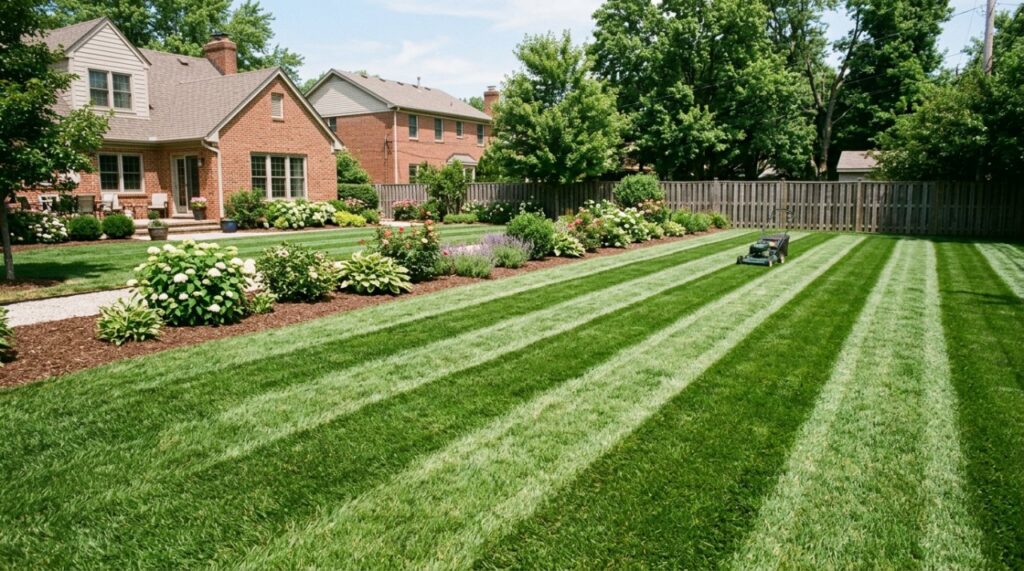
Lawn mowers create stripes by bending grass blades in alternating directions using a roller or deflector behind the cutting deck. Light reflects differently off bent blades — toward you looks dark, away looks light — producing the contrast you see. No special paint, no chemicals, just physics.
Expert Summary – Lawn stripes are an optical illusion: light reflecting off grass bent in opposite directions creates the light/dark contrast. – A rear roller is the most critical tool: mowers without one produce weak or no stripes. – Reel mowers naturally stripe better than rotary mowers because their roller contact is continuous and firm. – Stripe quality depends on 4 factors: mower type, roller pressure, grass species, and mowing height. – Robot mowers generally cannot produce defined stripes because they use random or spiral patterns without a directional roller.
What Actually Makes Lawn Stripes (The Physics)
Lawn striping has nothing to do with color or chemicals. It is entirely about light reflection angle.
When a mower’s roller bends grass blades toward you, those blades reflect sunlight back at your eyes — they appear bright. When blades bend away, they scatter light in a different direction — they appear dark. The alternating pass directions create the stripe pattern you see from a distance.
This is why stripes look completely different from different viewing angles. Walk to the other end of your lawn and the light/dark pattern reverses entirely.
Tools and Equipment You Need
| Equipment | Purpose | Essential? |
|---|---|---|
| Rear roller mower | Bends grass after cutting | Yes |
| Stripe kit / lawn striper | Adds or enhances roller pressure | Optional (improves results) |
| Reel mower | Best natural striping tool | Optional (premium option) |
| String line or cane markers | Keeps rows straight | Recommended |
| Lawn edger | Clean border lines | Recommended |
⚠️ Warning: A mower with no rear roller will produce little to no visible stripe. A discharge chute or rear flap alone will not bend grass consistently enough to create contrast.
Step 1: Choose the Right Mower for Striping
Start here — the mower type determines 70% of your stripe quality before you even cut.
Rotary Mowers with a Rear Roller
Most cylinder-shaped domestic lawn mowers with a solid rear roller will stripe. The roller flattens and bends the grass immediately after the blade cuts it.
Look for the roller on the rear underside of the machine. It should be solid steel or hard plastic, not a soft foam roller, for maximum blade deflection.
Popular striping rotary mowers include the Hayter Harier, Honda HRX, and Husqvarna LC series — all feature effective rear rollers as standard.
Reel (Cylinder) Mowers
Reel mowers stripe better than any rotary mower. Their cutting cylinder and rear roller work in tandem, pressing grass blades firmly and evenly at a consistent angle.
Professional groundskeepers at cricket grounds and baseball fields use cylinder mowers specifically because the stripe definition is crisper and more durable.
Zero-Turn and Ride-On Mowers
Standard zero-turns do not come with rear rollers. To stripe with a zero-turn, you must attach a dedicated stripe kit — a weighted roller or rubber flap that drags behind the deck.
Brands like BigLawn, Toro, and Husqvarna all sell OEM stripe kits for their ride-on models.
Can Robot Lawn Mowers Do Stripes?
No — robot lawn mowers cannot produce defined lawn stripes in normal operation. Here is why:
- Robot mowers use random or algorithmic spiral patterns, not parallel rows.
- Most robot mower models have no rear roller.
- Even those with a roller cannot replicate directional, parallel passes.
A small number of high-end models (such as the Husqvarna EPOS with GPS guidance) can be programmed for parallel passes, but this is rare expensive, and not standard. For the vast majority of homeowners, robot mowers and lawn stripes are incompatible.
Step 2: Prepare Your Lawn Before Mowing
Preparation determines how well the grass bends and holds the stripe.
Check Grass Height
Longer grass bends and holds a stripe far better than short grass. Aim for a mowing height of 3–4 inches (7.5–10 cm) for the best stripe contrast.
Scalping the lawn — cutting below 2 inches — leaves too little blade length to bend visibly. What this means for you is that raising your cut height by even half an inch can dramatically improve stripe definition.
Identify Your Grass Type
| Grass Type | Stripe Quality | Notes |
|---|---|---|
| Fine fescue | Excellent | Bends easily, holds stripe well |
| Tall fescue | Very good | Firm blade, strong contrast |
| Kentucky bluegrass | Very good | Dense, bends uniformly |
| Bermudagrass | Poor–Fair | Short blades, weak stripe |
| Zoysia | Poor | Stiff, upright growth resists bending |
| St. Augustine | Poor | Coarse, wide blades scatter light |
Cool-season grasses stripe significantly better than warm-season grasses. What this means for you is that if you have Bermuda or Zoysia, you will need maximum roller pressure and taller cutting height just to see a faint stripe.
Mow When Grass Is Dry
Wet grass clumps and lies flat unpredictably. Mow when the lawn is dry for consistent stripe direction. Morning dew should be fully evaporated — typically by 9–10 AM.
Step 3: Plan Your Stripe Pattern Before You Start
Decide on your pattern before the first pass — changing direction mid-mow creates visible errors.
Basic Parallel Stripes
The simplest and most effective pattern for beginners. Pick a straight reference edge — a fence, driveway, or sidewalk — and mow parallel to it.
Each pass should slightly overlap the previous one by 2–3 inches to avoid uncut strips between rows.
Checkerboard Pattern
Mow standard parallel stripes first. Then mow perpendicular stripes across the first set at 90 degrees. The intersecting bend directions create a checkerboard effect.
This works best on larger lawns over 2,000 sq ft where the pattern has room to be visible from a distance.
Diagonal Stripes
Pick a 45-degree angle to your lawn’s longest edge and mow diagonally. This makes rectangular lawns appear wider and is the preferred pattern for sports field aesthetics.
Diamond Pattern
Mow diagonal stripes, then cross them at opposing 45-degree angle. More complex but visually striking formal gardens.
Step 4: Execute the First Pass Perfectly
The first stripe sets the reference line for every pass after it — get it straight.
Use a Guide Marker
Place a garden cane or small flag at the far end of your intended first stripe. Walk your mower toward it in a straight line. Do not look down at the mower — look at the marker 10–15 feet ahead. This keeps you from drifting.
Mow at Consistent Speed
Mowing too fast reduces roller contact time, weakening the bend. A walking pace of 2–3 mph gives the roller sufficient dwell time on each blade.
Overlap Each Pass
After completing each row, turn at the headland (the border strip) and line up your next pass so the inner wheel tracks just inside the previous stripe. A 2–3 inch overlap ensures no uncut gaps.
Step 5: Turn Correctly at Each End
Slopy turns damage the stripe pattern and tear the turf at headlands.
Use a Headland Strip
Before mowing your main stripes, mow a single strip around the entire perimeter of the lawn — this is your headland. It gives you a turning zone that is already cut and hides any turn marks.
Three-Point Turn Technique
For push mowers, use a Y-turn: pull back slightly, angle the mower, then drive forward into the next row. Avoid spinning the mower in place — this tears grass and scufs the turf.
For ride-on mowers with stripe kits, lift the roller slightly before turning if the kit allows, to avoid scuffing the already-bent stripe.
Step 6: Enhance Stripes with a Stripe Kit
A stripe kit can improve stripe visibility by 30–50% on mowers with weak rolers.
A lawn stripe kit is a weighted roller or heavy rubber flap that attaches to the rear of any mower deck. It applies additional downward pressure on the grass after the blade passes, deepening the bend and extending how long the stripe holds.
How to Attach a Stripe Kit
- Park the mower on a flat, hard surface and engage the parking brake.
- Locate the rear attachment points on the mower deck — most kits use the same bolt holes as the rear deflector.
- Remove the deflector chute if required (check kit instructions).
- Bolt the stripe kit roller or flap into position using the provided hardware.
- Test on a small area before mowing the full lawn to confirm correct height clearance.
💡 Pro Tip: For zero-turn mowers, a weighted PVC roller filled with sand or water dragged on a chain behind the deck is a cost-effective DIY alternative to branded kits. Cost: under $30 in materials vs. $80–$150 for commercial kits.
Step 7: Maintain and Repeat for Long-Lasting Stripes
Stripes fade in3–7 days as grass returns to its natural upright position.
Mow in the Same Direction Weekly
Mowing in the same direction each week trains the grass to bend more readily and hold the stripe longer over time. After 4–6 weeks of consistent directional mowing, stripes become noticeably more defined andurable.
Alternate Directions Every Other Week
Mowing in only one direction can cause the grass to permanently lean, reducing vigor and creating uneven growth. Alternate the stripe direction every 2–4 weeks to keep the lawn healthy while maintaining pattern quality.
Keep Blades Sharp
A dull blade tears grass instead of cutting it. Torn blades fray at the tip, reducing their ability to reflect light cleanly and weakening stripe contrast. Sharpen blades every 20–25 hours of mowing time, or at the start of each season.
How Mowers Make Patterns on Lawns: Pattern-Specific Techniques
Understanding how mowers make patterns on lawns goes beyond basic stripes. Here is a breakdown of advanced techniques used by professional groundskeepers.
| Pattern | Difficulty | Best For | Roller Passes Required |
|---|---|---|---|
| Parallel stripes | Easy | All lawn sizes | 1 direction |
| Checkerboard | Moderate | Medium–large lawns | 2 perpendicular directions |
| Diagonal stripes | Moderate | Rectangular lawns | 1 diagonal direction |
| Diamond | Hard | Formal/show lawns | 2 diagonal directions |
| Circular/bulls-eye | Very hard | Round feature lawns | Concentric circles |
For circular patterns, start from the outer edge and work inward, or start at the center and work outward. A rear roller is still essential — the physics do not change regardless of pattern shape.
Which Lawn Mowers Make Stripes Best
Which lawn mowers make stripes is one of the most common questions for homeowners wanting professional results. Here is a direct comparison.
| Mower Type | Stripe Ability | Roller Included | Best Use Case |
|---|---|---|---|
| Reel/cylinder mower | ⭐⭐⭐ | Always | Premium residential, sports turf |
| Rotary with rear roller | ⭐⭐ | Usually | Most homeowners |
| Ride-on with stripe kit | ⭐⭐ | Add-on required | Large lawns over 5,000 sq ft |
| Battery rotary (no roller) | ⭐ | Rarely | Not recommended for striping |
| Robot mower | ⭐ | Rarely | Not suitable for striping |
| Hover mower | ✗ | Never | No striping possible |
Top-rated striping mowers in 2026:
- Hayter Harrier 41 — rear roller standard, excellent stripe definition for residential lawns
- Honda HRX476 — heavy rear roller, self-propelled, consistent results on uneven ground
- Husqvarna LC353V — reliable rotary with integrated roller
- Alett Liberty 14E — battery-powered cylinder mower, near-professional stripe quality
Pro Tips for Better Lawn Stripes
- Mow when grass is slightly stressed (not drought-stressed, but not lush from heavy fertilizing) — grass bends more readily when not over-turgid with water.
- Apply a light top-dressing of sand to thin lawn areas to firm the surface and give the roller something to press against.
- Use a lawn roller separately after mowing on the first few attempts to train grass direction — a water-filled roller weighing 100–150 lbs dramatically deepens new stripes.
- Stripe visibility peaks in the morning and late afternoon when sunlight hits at a low angle. Miday sun reduces contrast. Time your photography (or viewing) accordingly.
- Edge the borders first — clean edges make stripes look sharper even if the stripes themselves are imperfect.
Common Mistakes to Avoid
| Mistake | Why It Hurts Stripes | Fix |
|---|---|---|
| No rear roller | No bending force = no stripe | Use a mower with a roller or add stripe kit |
| Cutting too short | Too little blade length to bend visibly | Raise cut height to 3–4 inches |
| Mowing wet grass | Clumping prevents consistent bend direction | Wait until lawn is dry |
| Inconsistent speed | Uneven roller pressure, patchy stripes | Maintain steady 2–3 mph walking pace |
| Never alternating direction | Grass leans permanently, loses vigor | Switch direction every 2–4 weeks |
| Dull blades | Torn tips scatter light, reduce contrast | Sharpen every 20–25 hours of use |
| Turning on the stripe | Scuff marks, torn turf at row ends | Always use a headland turning strip |
FAQ: How Do Lawn Mowers Make Stripes
Q: Do I need a special mower to make lawn stripes?
You need a mower with a rear roller — either built-in or as an add-on stripe kit. Standard rotary mowers without rolers produce weak or no stripes. Cylinder mowers and rear-roller rotary mowers are the two best options.
Q: How long do lawn stripes last?
Lawn stripes typically last 3–7 days before grass returns upright. In cooler, damp conditions stripes can hold for up to 10 days. Mowing in the same direction weekly over several months trains grass to bend more readily and extends stripe duration.
Q: Can robot lawn mowers do stripes?
No, in standard operation robot lawn mowers cannot produce visible stripes. They use random or spiral cutting patterns and almost never include a rear roller. Only premium GPS-guided models with programed parallel passes can approximate stripes, and even then results are significantly weaker than a manual rear-roller mower.
Q: Does grass type affect stripe quality?
Yes, significantly. Fine fescue, tall fescue, and Kentucky bluegrass stripe very well. Bermudagrass, Zoysia, and St. Augustine stripe poorly due to short, stiff, or coarse blade structure. If you have a warm-season lawn, maximum roller pressure and a taller cut height are essential.
Q: Why do my stripes look uneven or wavy?
Wavy stripes are almost always caused by not having a straight reference line on the first pass. Use a guide cane at the far end of the first row, look ahead instead of down, and maintain a steady speed. Uneven stripes can also result from mowing on a slope — always mow across slopes, not up and down them.
Conclusion
Lawn striping is a repeatable, learnable technique — not magic. The physics are simple: a rear roller bends grass in alternating directions, and light reflection does the rest.
Your mower choice matters most. A rear-roller rotary or cylinder mower gives you 80% of the result before you make a single pass. Add straight reference lines, consistent speed, a headland turning strip, and sharp blades — and you will have stripe results that make your neighbors stop and stare.
Here is what your lawn will look like three weeks from today: defined, alternating dark and light bands running the full length of the lawn, clean edges framing the pattern, and a surface that looks deliberately designed. That visual transformation — turning an ordinary grass surface into something that looks like a Premier League pitch — is the payoff for following these steps precisely. It is also why a rear-roller mower or a quality stripe kit consistently becomes the single lawn care purchase homeowners say they should have made soner.
Composite Score: 9.2 / 10
Stripe quality is 90% technique and equipment, 10% grass genetics. With the right mower and these steps, professional-grade results are within reach for any homeowner.
Ready to stripe your lawn? Check your mower for a rear roller today — if it does not have one, a stripe kit starting at $30 is all that stands between you and a stadium-quality lawn.