
How Wide Are Commercial Lawn Mowers? A Complete Size Guide
Commercial lawn mowers range from 32 inches to 72 inches wide, depending on type and application. Knowing the exact cutting width helps you match the right machine to your property size, gate clearance, and terrain — saving time, fuel, and money on every job.
### 📋 Expert Summary – Commercial walk-behind mowers typically measure 32–61 inches in cutting width. – Zero-turn riding mowers — the most common commercial type — range from 42–72 inches wide. – Stand-on mowers (a popular compact commercial option) cut between 36–61 inches wide. – Cutting width is measured blade-tip to blade-tip across the mower deck, not the machine’s total body width. – Matching deck width to your property’s open areas and gate widths is the single most important sizing decision in commercial mowing.
Step 1: Understand How Lawn Mowers Are Measured
Lawn mowers are measured by their cutting deck width — the distance in inches from one side of the blade path to the other. This number tells you exactly how wide a strip of grass the mower cuts in a single pass.
What this means for you is: a 60-inch deck cuts a 5-foot swath with every pass, while a 32-inch deck cuts less than 3 feet. Fewer passes = less time on the job.
What’s a Lawn Mower’s Cutter Called?
The cutting component is called the mower deck or cutting deck. Inside it, one or more blades (also called rotary blades or mulching blades) spin horizontally at high speed to cut grass.
Most commercial mowers use 2 to 3 blades under a single deck. Larger 72-inch decks may use 3 overlapping blades to ensure full coverage with no missed strips.
⚠️ Important: The deck width is NOT the same as the machine’s overall body width. The machine body is usually 4–8 inches wider than the deck due to wheels, guards, and frame.
Step 2: Know the Different Types of Commercial Lawn Mowers
4 main categories of commercial mowers exist, each with a distinct size range and use case. Understanding which type fits your operation determines which width range applies to you.
What Are the Big Lawn Mowers Called?
Large commercial riding mowers are called zero-turn mowers (ZTMs) or out-front deck riders. The very largest — used on golf courses, sports fields, and large estates — are called wide-area mowers or batwing mowers, with cutting widths exceeding 120 inches (10 feet).
What Are the Car Lawn Mowers Called?
Riding mowers that resemble a small vehicle with a steering wheel are called lawn tractors or garden tractors. In commercial settings, the preferred term is rear-engine rider or mid-mount zero-turn rider.
What Do You Call Mounted Lawn Mowers?
Mowers attached to tractors via a three-point hitch or PTO are called mounted mowers, tractor-mounted mowers, or implement mowers. These are common in agriculture and large-acreage commercial landscaping.
| Mower Type | Common Name | Cutting Width Range | Best For |
|---|---|---|---|
| Walk-Behind (self-propelled) | Commercial walk-behind | 32–61 in | Tight spaces, hills, detail work |
| Stand-On Mower | Stand-on / stander | 36–61 in | Mid-size properties, efficiency |
| Zero-Turn Rider | ZTM, zero-turn | 42–72 in | Large open areas, speed |
| Wide-Area / Batwing | Wide-area mower | 80–180 in | Highways, golf courses, farms |
| Tractor-Mounted | Mounted mower | 48–120 in | Agricultural, large estates |
Step 3: Learn the Exact Width Ranges for Each Commercial Mower Type
Each commercial mower category has a specific width range optimized for its intended use. Knowing these numbers lets you immediately rule out machines that won’t fit your gates, trailers, or terrain.
How Wide Are Commercial Walk-Behind Mowers?
32 specific cutting width options are common in commercial walk-behinds:
- 32 inches — Narrowest commercial option; fits through 36-inch gates
- 36 inches — Most popular compact commercial size
- 48 inches — Mid-range workhorse for medium properties
- 52 inches — Balances speed and maneuverability
- 61 inches — Widest commercial walk-behind available
What this means for you is: a 36-inch walk-behind fits through virtually any residential gate, making it the go-to choice for mixed residential/commercial routes.
How Wide Are Stand-On Lawn Mowers?
Stand-on mowers typically range from 36 to 61 inches in cutting width. The most popular commercial sizes are 48 inches, 52 inches, and 61 inches.
Stand-on mowers offer the footprint of a walk-behind with speeds approaching a zero-turn rider. What this means for you is: a 52-inch stander can cut a 1-acre property 40% faster than a 36-inch walk-behind while still fitting through most commercial gates.
Common stand-on widths by brand:
- Toro GrandStand — 36, 48, 52, 60 in
- Husqvarna V-Series — 48, 52, 61 in
- Wright Stander — 36, 48, 52, 61 in
- Scag V-Ride — 48, 52, 61 in
How Wide Are Zero-Turn Commercial Mowers?
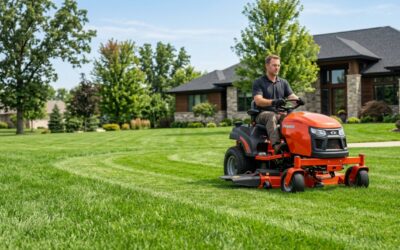
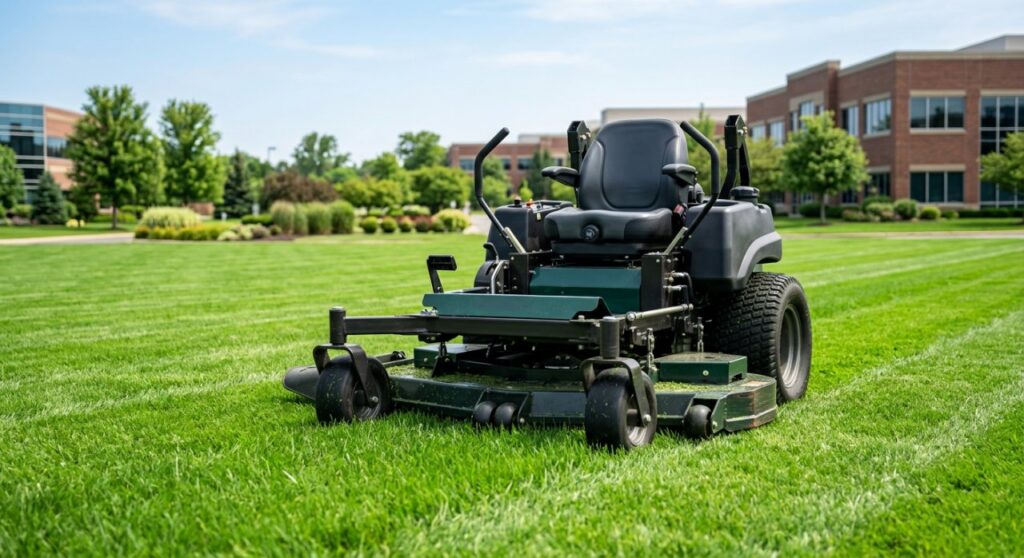
Zero-turn riders range from 42 to 72 inches, with 60 inches and 72 inches being the dominant commercial sizes for professional landscaping companies.
- 42–48 inches — Entry-level commercial / homeowner crossover
- 52–54 inches — Mid-range commercial sweet spot
- 60 inches — Industry standard for professional crews
- 72 inches — Maximum residential/commercial deck; cuts 6 feet per pass
What this means for you is: upgrading from a 60-inch to a 72-inch deck saves roughly 1 additional pass per 100 feet of width on open areas, cutting total mow time by up to 15–20% on large properties.
How Wide Are Wide-Area Commercial Mowers?
Wide-area mowers start at 80 inches and reach up to 180 inches (15 feet) when wings are fully extended. These machines — used on highway medians, airports, golf courses, and sports complexes — are in a completely separate category.
- Batwing mowers: 120–180 in (wings fold for transport)
- Out-front deck riders: 80–100 in
- Tractor-mounted finishing mowers: 60–120 in
Step 4: Match Cutting Width to Your Property and Gate Size
The #1 sizing rule is: your mower deck must be at least 4 inches narrower than your narrowest gate. This gives clearance for the machine body and safe maneuvering.
Standard Gate Width Reference
| Gate Type | Typical Width | Max Recommended Deck |
|---|---|---|
| Residential wood gate | 36 in | 32 in deck |
| Standard double gate | 48 in | 44 in deck |
| Wide residential gate | 60 in | 56 in deck |
| Commercial/chain-link gate | 72 in | 68 in deck |
| No gate (open access) | N/A | 72 in+ |
What this means for you is: if 70% of your accounts have 36-inch gates, a 32-inch or 36-inch deck mower must be part of your fleet — no matter how fast a 60-inch rider would be in the open areas.
Match Deck Width to Property Size
Choosing a deck that’s too small wastes time. Choosing one too large wastes money and fuel on a machine you can’t fully deploy.
| Property Size | Recommended Deck Width | Estimated Mow Time Savings vs. 21-in |
|---|---|---|
| Under 1/4 acre | 32–36 in | 50% faster |
| 1/4 to 1/2 acre | 36–48 in | 65% faster |
| 1/2 to 1 acre | 48–52 in | 75% faster |
| 1–3 acres | 52–61 in | 82% faster |
| 3–10 acres | 61–72 in | 88% faster |
| 10+ acres | 72 in+ / wide-area | 95%+ faster |
Step 5: Account for Transport Width, Not Just Cutting Width
Your trailer and truck bed determine the maximum machine width you can haul — and machine width is always larger than cutting width. Always verify both measurements before purchasing.
Overall Machine Width vs. Cutting Width
| Mower Type | Cutting Width | Typical Overall Width |
|---|---|---|
| 36-in walk-behind | 36 in | 40–42 in |
| 52-in stand-on | 52 in | 56–60 in |
| 60-in zero-turn | 60 in | 64–70 in |
| 72-in zero-turn | 72 in | 76–82 in |
What this means for you is: a 72-inch zero-turn has an overall width of up to 82 inches (6.8 feet). A standard 6.5-foot open trailer is too narrow — you need at least a 7-foot wide trailer to load it safely.
Standard Trailer Width Reference
- 5 x 10 ft trailer: fits up to 52-in deck mowers
- 6 x 12 ft trailer: fits up to 60-in deck mowers
- 7 x 14 ft trailer: fits 72-in deck mowers
- 8 x 16 ft trailer: fits two 60-in mowers side by side
Step 6: Understand How Cutting Width Affects Productivity
Every additional inch of cutting width directly reduces the number of passes — and therefore the total time — needed to mow any given area. This is the core math behind commercial mower ROI.
The Pass-Count Formula
To calculate the number of passes needed:
Passes = Property Width (inches) ÷ Cutting Width (inches)
Example: A lawn 600 inches (50 feet) wide:
- With a 36-inch deck: 600 ÷ 36 = 16.7 passes
- With a 60-inch deck: 600 ÷ 60 = 10 passes
- With a 72-inch deck: 600 ÷ 72 = 8.3 passes
What this means for you is: switching from a 36-inch to a 60-inch deck cuts your pass count by 40% on every single lawn. On a 30-lawn route, that’s a significant daily time saving.
Productivity Table: Acres Per Hour by Deck Width
These figures assume 6 mph ground speed and 85% efficiency (accounting for turns and overlap):
| Deck Width | Acres/Hour (theoretical) | Acres/Hour (real-world 85%) |
|---|---|---|
| 36 in | 3.27 ac/hr | 2.78 ac/hr |
| 48 in | 4.36 ac/hr | 3.71 ac/hr |
| 52 in | 4.73 ac/hr | 4.02 ac/hr |
| 60 in | 5.45 ac/hr | 4.63 ac/hr |
| 72 in | 6.54 ac/hr | 5.56 ac/hr |
Step 7: Choose the Right Width for Your Business Model
Your business model — not just property size — should drive your deck width decision. A solo operator has different needs than a 5-crew landscaping company.
Solo Operator (1 person, residential route)
- Best deck width: 36–52 inches
- Recommended type: Stand-on or compact zero-turn
- Why: Versatility across gate sizes; easy solo loading/unloading
Mid-Size Landscaping Crew (2–4 people)
- Best deck width: 52–61 inches primary + 36-inch secondary
- Recommended type: Zero-turn rider + walk-behind combo
- Why: Speed on open areas, detail capability in tight spots
Large Commercial Operation (5+ crew, commercial accounts)
- Best deck width: 60–72 inches primary fleet
- Recommended type: Zero-turn riders + stand-ons
- Why: Maximum productivity on large commercial properties
🛠️ Tools and Materials Needed to Measure and Compare Mowers
| Tool / Item | Purpose |
|---|---|
| Tape measure (25 ft) | Measure gate widths and property dimensions |
| Mower spec sheet | Verify cutting width vs. overall width |
| Trailer width measurement | Confirm mower fits for transport |
| Property map or satellite image | Estimate total mowable square footage |
| Calculator or mowing app | Run pass-count and productivity calculations |
⚡ Pro Tips from Commercial Mowing Experts
- Always measure your narrowest gate first. Gate width is the hard constraint everything else must fit around.
- Buy one size up from what you think you need. Most operators underestimate how quickly their accounts grow.
- Overlap your passes by 2–3 inches. This prevents missed strips and accounts for slight deck drift — factor this into your pass-count math.
- Check the OCDC (Operator Controlled Discharge Chute) width, not just the deck. Some 60-inch decks have discharge chutes that add 4–6 inches to effective operating width near walls and fences.
- Demo before you buy. A 72-inch zero-turn feels completely different to operate than a 60-inch on the same property. Most dealers offer demo days.
- Consider the “trim mower” rule: Your smallest mower should be narrow enough to handle all finish/trim work. Many crews keep a 21-inch or 30-inch push mower for this reason, regardless of how wide their main commercial unit is.
❌ Common Mistakes to Avoid
- Buying by engine size, not deck width. Engine horsepower matters, but cutting width determines productivity. A 25 HP engine on a 48-inch deck is slower than a 23 HP engine on a 60-inch deck on flat ground.
- Forgetting overall machine width. Ordering a 72-inch zero-turn without confirming trailer and gate clearance is the most expensive mistake in commercial mowing equipment.
- Ignoring terrain. A 72-inch deck on a heavily sloped or obstacle-filled property creates more problems than it solves. Wider is not always better.
- Assuming all 60-inch decks are equal. Deck construction (stamped vs. fabricated), blade overlap design, and discharge efficiency vary significantly between brands at the same nominal width.
- Not accounting for overlap. Running passes with zero overlap leaves visible strips. Always budget for 5–10% overlap, which effectively reduces your usable cutting width.
Frequently Asked Questions
What sizes do lawn mowers come in?
Commercial lawn mowers come in sizes ranging from 21 inches to over 180 inches. The most common commercial sizes are 36, 48, 52, 60, and 72 inches. Residential mowers typically range from 21 to 42 inches. Wide-area commercial mowers exceed 80 inches.
How wide are commercial lawn mowers compared to residential mowers?
Commercial mowers are typically 20–30 inches wider than residential models. A standard residential riding mower cuts 42–46 inches, while a standard commercial zero-turn cuts 60–72 inches. This size difference translates directly to faster mowing speeds on large properties.
How wide are stand-on lawn mowers specifically?
Stand-on mowers range from 36 to 61 inches in cutting width. The most popular commercial stand-on sizes are 48, 52, and 61 inches. Overall machine width (including the platform and controls) adds approximately 4–8 inches beyond the cutting deck width.
What is the widest commercial lawn mower available?
The widest commercial finishing mowers reach 72 inches (6 feet) for zero-turn riders. Wide-area batwing mowers — used on highways and golf courses — extend up to 180 inches (15 feet) when fully deployed. Most professional landscaping companies max out at 72-inch decks for standard commercial accounts.
How do I measure if a commercial mower will fit through my gate?
Measure your gate opening at its narrowest point, then subtract 4–6 inches for clearance. For example, a 48-inch gate safely accommodates a 42–44-inch deck mower. Always measure the machine’s overall body width (not just deck width) before purchasing, as the body is typically 4–8 inches wider than the stated cutting width.
Conclusion
Commercial lawn mowers range from 32 inches to 72+ inches wide, with the industry standard for professional landscaping crews sitting at 60 to 72 inches. Stand-on mowers cover 36–61 inches, walk-behinds span 32–61 inches, and wide-area machines exceed 80 inches for large-scale applications.
The right width for your operation depends on 3 hard constraints: your narrowest gate, your trailer capacity, and your average property size. Get those three numbers right, and every other mower decision becomes straightforward.
Matching deck width to your specific route is one of the highest-ROI decisions in commercial landscaping — the right size machine can cut your mowing time per property by 15–40%, directly increasing your daily revenue capacity.
Ready to choose the right commercial mower width? Use the tables and formulas in this guide to calculate your exact needs — then visit a certified commercial equipment dealer for a hands-on demo before committing to a purchase.