
Are Lawn Mowers 12 Volt? The Complete Guide to Lawn Mower Battery Systems
Most lawn mowers are not 12 volt — but many are. The answer depends entirely on the type of mower. Riding mowers and zero-turn mowers almost universally use 12-volt batteries, while electric push mowers use higher-voltage lithium-ion packs ranging from 24V to 120V. Knowing your mower’s voltage prevents costly mistakes when buying a replacement battery.
⚡ Expert Summary
- Riding lawn mowers and garden tractors use 12-volt lead-acid batteries — the same standard as most cars and trucks.
- Gas-powered push mowers with electric start may use either a 12V battery or a smaller 6-volt battery, depending on the brand and model year.
- Battery-powered electric mowers (e.g., EGO, Greenworks, Ryobi) use lithium-ion packs rated at 40V, 56V, 80V, or higher — these are NOT 12-volt systems.
- Corded electric mowers use standard 120V AC household current and have no onboard battery at all.
- Always verify your mower’s voltage by checking the owner’s manual, battery label, or manufacturer’s spec sheet before purchasing a replacement.
Step 1: Understand the Different Types of Lawn Mower Battery Systems
The first step is knowing which category your mower falls into. Lawn mower voltage is not one-size-fits-all — it varies dramatically by mower type, engine size, and intended use.
There are four main categories of lawn mower power systems, and each has a completely different voltage profile.
1 Riding Mowers and Garden Tractors (12V Standard)
Riding mowers almost always use a 12-volt battery. This is the most consistent rule in the entire mower market.
Brands like John Deere, Husqvarna, Cub Cadet, Troy-Bilt, and Craftsman all equip their riding mowers with 12V lead-acid batteries — either flooded, AGM (Absorbed Glass Mat), or gel type.
The 12V battery in a riding mower serves a specific purpose: it powers the electric starter motor, the ignition system, the headlights, and any electric blade engagement (PTO) clutch.
2 Gas Push Mowers With Electric Start (6V or 12V)
Gas push mowers with electric start use either 6-volt or 12-volt batteries — this is where most confusion begins.
Older models and smaller-engine mowers (under 140cc) often used 6-volt batteries. Newer models from brands like Honda, Toro, and Briggs & Stratton have largely shifted to 12-volt systems for consistency.
The key takeaway: do not assume your gas push mower is 12 volt. Always check the label on the existing battery or consult the owner’s manual.
3 Battery-Powered Electric Push Mowers (40V–120V Lithium-Ion)
Battery-electric mowers use high-voltage lithium-ion packs — none of them are 12 volt.
These systems are designed for motor efficiency and runtime, not just starting an engine. Common voltages include:
| Brand | Battery Voltage | Battery Platform |
|---|---|---|
| EGO Power+ | 56V | ARC Lithium |
| Greenworks | 40V / 80V | G-MAX / Pro |
| Ryobi | 40V | 40V HP |
| Milwaukee | 18V (×2 = 36V) | M18 |
| DeWalt | 20V / 60V FlexVolt | FlexVolt |
| Makita | 18V (×4 = 36V) | LXT |
| Kobalt | 40V / 80V | Gen3 |
These voltages are nominal ratings — actual cell voltage is slightly different, but the nominal figure is what matters for compatibility.
4 Corded Electric Mowers (No Battery)
Corded mowers plug into a standard 120V AC outlet and carry no onboard battery whatsoever.
There is no voltage question to answer here. If your mower has a power cord, it runs on household current and battery replacement is irrelevant.
Step 2: Identify Whether Your Specific Mower Uses a 12-Volt Battery
The safest way to confirm your mower’s voltage is to physically inspect the battery or check three reliable sources.
Don’t guess — the wrong battery voltage can damage your starter motor or simply not fit the battery compartment.
1 Check the Battery Label Directly
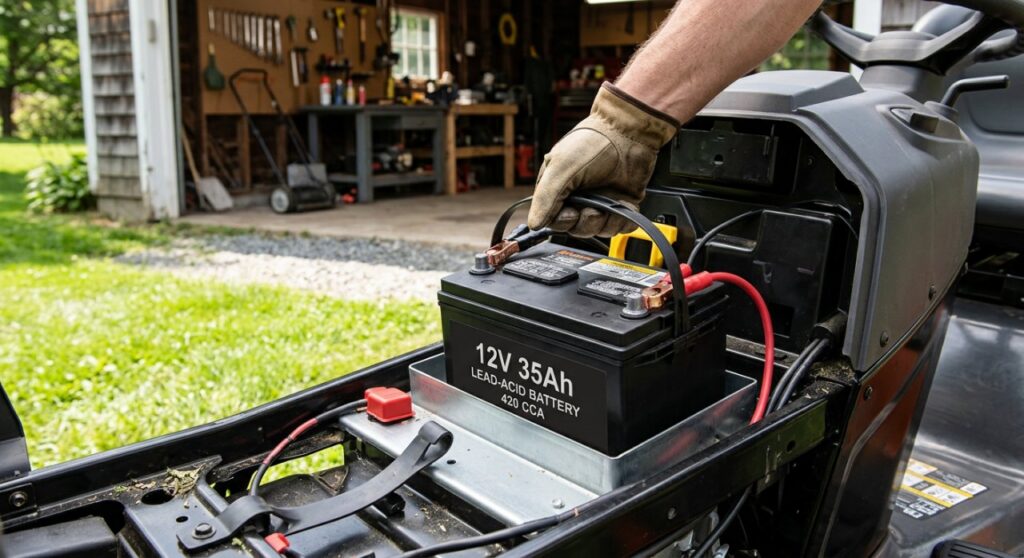
Open the battery compartment and read the label on the existing battery. Every battery manufactured for consumer use displays its voltage clearly — usually as “12V,” “6V,” or the lithium-ion nominal voltage.
Look for:
- “12V” printed on the battery case
- CCA (Cold Cranking Amps) rating — this appears only on 12V and 6V lead-acid batteries, not lithium packs
- Amp-hour (Ah) rating — present on all battery types
2 Consult the Owner’s Manual
The owner’s manual lists the exact battery specification under the “Maintenance” or “Specifications” section.
If you’ve lost your manual, download a free PDF from the manufacturer’s website using your mower’s model number (found on a sticker under the seat or on the deck).
3 Search by Model Number Online
Enter your mower’s model number into the manufacturer’s parts lookup tool — this shows the exact OEM battery part number and its voltage.
Reliable lookup tools:
- John Deere Parts: parts.deere.com
- Husqvarna Parts: husqvarna.com/us/parts-and-accessories
- Toro Parts: toro.com/en/parts
- Briggs & Stratton: briggsandstratton.com/na/en_us/parts.html
Step 3: Understand Why Riding Mowers Use 12-Volt Batteries Specifically
Riding mowers use 12V batteries because this voltage is the established standard for small-engine starting systems — the same reason cars, ATVs, and motorcycles use 12V.
This isn’t arbitrary. There are engineering and practical reasons behind it.
1 The Lead-Acid 12V Standard Is Universal
A 12-volt lead-acid battery delivers enough cranking power to start a single-cylinder or twin-cylinder gasoline engine reliably.
The 12V standard also means:
- Replacement batteries are widely available at auto parts stores, big-box retailers, and online
- Charging systems are simple — a basic trickle charger or automotive battery charger works
- Jump-starting is possible using a car battery or jump pack
2 12V Powers All Electrical Accessories
Beyond starting the engine, the 12V system runs every electrical component on a riding mower.
This includes headlights, hour meters, electric PTO clutches, fuel gauges, and seat safety switches. A 6V system would require completely different wiring and components — making 12V the only practical choice for feature-rich riding mowers.
3 Battery Capacity Matters As Much As Voltage
Two 12V batteries can have very different performance if their amp-hour (Ah) ratings differ.
A typical riding mower battery is 12V, 30Ah — enough to start the engine reliably and run accessories for hours. Replacing it with a lower-Ah battery may cause premature failure or weak starting in cold weather.
Step 4: Determine If Your Push Mower Has a 6-Volt or 12-Volt Battery
This is the most common source of confusion: does a lawn mower have a 6 or 12 volt battery?
Here’s a practical decision tree to find out without guessing.
1 Check the Physical Battery Size
6-volt and 12-volt batteries are physically different sizes — a 12V battery is noticeably larger.
| Feature | 6-Volt Battery | 12-Volt Battery |
|---|---|---|
| Typical size | Small, compact | Larger (similar to motorcycle battery) |
| Cell count | 3 cells | 6 cells |
| Common use | Older/smaller push mowers | Riding mowers, newer push mowers |
| CCA range | 75–150 CCA | 150–300+ CCA |
| Availability | Specialty stores | Auto parts, hardware stores |
2 Identify the Engine Brand and Year
The engine manufacturer often determines battery voltage more than the mower brand.
- Briggs & Stratton engines with Intek series (190cc+): typically 12V
- Honda GCV series engines: typically 12V on electric-start models
- Kawasaki small engines: 12V standard
- Older Tecumseh engines: may use 6V on models pre-2005
3 Use a Multimeter to Test Voltage
If there’s no label and you can’t find the manual, use a digital multimeter to measure voltage directly.
Steps:
- Set the multimeter to DC Voltage (20V range)
- Touch the red probe to the positive terminal, black to negative
- A fully charged 12V battery reads 12.6–12.8V
- A fully charged 6V battery reads 6.3–6.4V
- A discharged battery reads lower — but the ratio (roughly 2:1) still identifies which type it is
Step 5: Choose the Right Replacement Battery for Your Mower
Once you’ve confirmed the voltage, match three specifications: voltage, amp-hours (Ah), and terminal configuration.
Getting voltage right is only the first step. A mismatched terminal layout can prevent installation, and the wrong Ah rating can cause premature failure.
1 Match the Voltage Exactly
Never substitute a 6V battery where a 12V is required, or vice versa. The starter motor and charging system are calibrated for a specific voltage. Using the wrong voltage will either fail to start the engine or damage electrical components.
2 Match or Exceed the Amp-Hour Rating
The Ah rating determines how long the battery can deliver power. You can safely use a battery with a higher Ah rating than the original — it will last longer between charges. Never go significantly lower.
3 Verify Terminal Position (U1L vs. U1R)
Riding mower batteries come in U1L (left positive) and U1R (right positive) configurations. Installing the wrong orientation can result in cables that don’t reach the terminals.
Check your original battery’s terminal layout before ordering a replacement.
4 Recommended Battery Types for Riding Mowers
| Battery Type | Pros | Cons | Best For |
|---|---|---|---|
| Flooded Lead-Acid | Lowest cost, widely available | Requires maintenance, can spill | Budget-conscious buyers |
| AGM (Absorbed Glass Mat) | Spill-proof, vibration resistant, longer life | Higher cost | Most riding mower owners |
| Lithium-Ion (LiFePO4) | Lightweight, longest lifespan, fast charge | Highest upfront cost | Premium/frequent-use mowers |
| Gel | Spill-proof, deep cycle capable | Sensitive to overcharging | Specialty/older mowers |
Step 6: Charge and Maintain Your 12-Volt Lawn Mower Battery
Proper charging and seasonal storage are the two biggest factors in how long a 12V lawn mower battery lasts.
Most riding mower batteries last 3–5 years with proper care, or as few as 1–2 seasons with neglect.
1 Use the Right Charger
Use a charger rated for your battery type — a standard automotive charger works for flooded lead-acid, but AGM and gel batteries require a charger with an AGM/gel mode.
Avoid fast chargers (above 10A) for mower batteries — slow trickle charging at 2–4A is ideal and extends battery life significantly.
2 Store the Battery Properly in Winter
Remove the battery from the mower at the end of the season and store it in a cool, dry location above freezing.
Connect it to a battery maintainer (float charger) throughout winter storage. Brands like Battery Tender, NOCO Genius, and Deltran make reliable maintainers for under $30.
3 Test Battery Health Each Spring
Before the first mow of the season, test the battery’s voltage and load capacity with a battery tester.
A battery that reads 12.6V at rest but drops below 9.6V under load is failing and should be replaced before it leaves you stranded mid-mow.
⚠️ Common Mistakes to Avoid
- Assuming all mowers are 12 volt — gas push mowers may be 6V; electric mowers are 40V–120V lithium
- Buying by voltage alone — ignoring Ah rating, CCA, and terminal position leads to poor fit or weak performance
- Using a car battery charger on an AGM battery without checking modes — can permanently damage the battery
- Leaving the battery in the mower all winter — cold temperatures and self-discharge can kill a battery in one season
- Jumping a mower battery with a running car — a running car’s alternator can push too much voltage; use the car engine off or a dedicated jump pack
- Ignoring corrosion on terminals — even minor corrosion increases resistance and causes hard starting; clean terminals with baking soda and a wire brush annually
🔧 Tools and Materials Needed
| Item | Purpose | Where to Buy |
|---|---|---|
| Digital multimeter | Test battery voltage | Hardware store, Amazon |
| Battery terminal cleaner / wire brush | Remove corrosion | Auto parts store |
| Battery load tester | Test cranking capacity | Auto parts store |
| AGM-compatible battery charger | Safe, correct charging | Amazon, auto parts store |
| Battery maintainer (float charger) | Winter storage | Amazon, hardware store |
| Safety gloves and glasses | Protection from battery acid | Hardware store |
| Wrench set (8mm–10mm) | Remove/install battery terminals | Hardware store |
💡 Pro Tips From the Field
- Pro Tip 1: When shopping for a replacement 12V riding mower battery, check auto parts stores first — they often carry Group U1 batteries at lower prices than mower-specific packaging from dealer parts departments.
- Pro Tip 2: AGM batteries are worth the extra $10–$20 over flooded lead-acid for most homeowners — they’re sealed, vibration-resistant, and last significantly longer in the mower’s high-vibration environment.
- Pro Tip 3: If your mower cranks slowly even with a good battery, check the battery cables for corrosion or loose connections before buying a new battery — a bad connection mimics a dead battery perfectly.
- Pro Tip 4: LiFePO4 lithium batteries in the U1 form factor now exist for riding mowers and can last 8–10 years. Brands like Antigravity, Dakota Lithium, and Bioenno offer drop-in replacements — worth considering if you’re replacing a battery for the second time.
- Pro Tip 5: Most riding mower charging systems output 13.5–14.5V when the engine runs — this is normal and will slowly recharge the battery during operation, similar to a car alternator.
Frequently Asked Questions
Are most lawn mowers 12 volt batteries?
Most riding lawn mowers use 12-volt batteries — this is the overwhelming standard for gas-powered riding equipment. However, gas push mowers may use 6V or 12V depending on model and age, and battery-electric mowers use high-voltage lithium packs (40V–120V) that are entirely different systems. If you own a riding mower from any major brand purchased after 2000, it almost certainly uses a 12V battery.
Does a lawn mower have a 6 or 12 volt battery?
The answer depends on the mower type. Riding mowers: 12 volt, always. Gas push mowers with electric start: 6 volt (older models) or 12 volt (newer models). Battery-electric mowers: 40V–120V lithium-ion, not lead-acid. The fastest way to confirm is to read the label on the existing battery or check your owner’s manual.
Can I use a car battery in my riding lawn mower?
Technically yes — a standard 12V car battery will power a riding mower — but it’s not recommended for long-term use. Car batteries are designed for high burst current (starting) followed by immediate recharging. Mower batteries are designed for sustained use with slower recharge. A car battery in a mower may be physically too large and will wear out faster due to the different discharge cycle demands.
How long does a 12V lawn mower battery last?
A well-maintained 12V riding mower battery lasts 3–5 years on average. AGM batteries typically outperform flooded lead-acid, lasting toward the upper end of that range. LiFePO4 lithium replacements can last 8–10 years. The biggest killers of mower batteries are winter storage without a maintainer and infrequent use that allows deep discharge.
Can I charge my riding mower’s 12V battery with a regular car battery charger?
Yes — if your battery is a standard flooded lead-acid type. Set the charger to a low rate (2–4A) for best results. If your battery is AGM or gel, you must use a charger with a dedicated AGM/gel mode — a standard car charger on high settings can permanently damage these battery types by overcharging.
Conclusion: The Definitive Answer on Lawn Mower Voltage
Are lawn mowers 12 volt? For riding mowers — yes, virtually always. For gas push mowers with electric start — usually 12V on modern models, sometimes 6V on older ones. For battery-electric mowers — no, these use high-voltage lithium systems completely unrelated to the 12V standard.
The practical takeaway is simple:
- Riding mower = 12V lead-acid (confirm terminal layout and Ah rating)
- Gas push mower = check the label (6V or 12V depending on model)
- Battery-electric mower = lithium-ion pack (match brand and voltage platform exactly)
- Corded mower = no battery needed
Before buying any replacement battery, spend 60 seconds checking your existing battery’s label or your owner’s manual. That one step prevents the most common — and most expensive — mistake mower owners make.
Ready to replace your mower battery? Search your mower’s model number at your preferred retailer, confirm the Group U1 voltage and terminal position, and consider upgrading to an AGM or LiFePO4 battery for longer service life and fewer headaches every spring.