
Are Battery Lawn Mowers Lighter Than Gas? Direct Answer
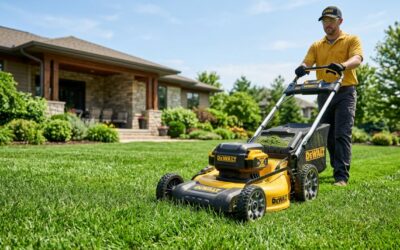
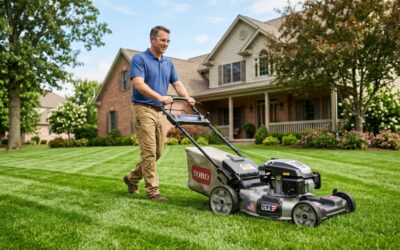
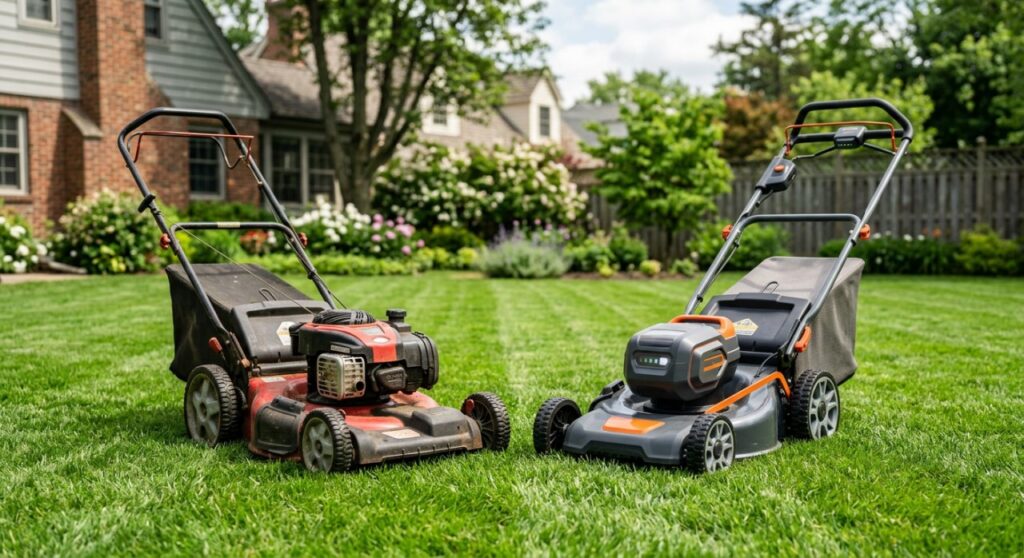
Yes, most battery lawn mowers are lighter than comparable gas mowers. A battery push mower commonly weighs 35–65 pounds, while a gas push mower often weighs 60–100 pounds. However, large batteries, steel decks, and self-propelled systems can make premium cordless models as heavy as gas alternatives.
Expert Summary>
– Battery push mowers commonly weigh 15–35 pounds less than comparable gas models, although specifications vary by deck material and battery size. – A lighter mower is usually easier to push, turn, transport, and store, especially on small or obstacle-filled lawns. – Gas mowers generally provide longer continuous runtime and stronger performance in dense, wet, or overgrown grass. – Battery mowers eliminate gasoline, oil changes, spark plugs, and most engine maintenance, but their batteries eventually require replacement. – The financially smarter option depends on purchase price, lawn size, electricity or fuel costs, repairability, battery replacement cost, and expected service life.
Step 1: Compare Battery and Gas Lawn Mower Weight
Check total operating weight rather than relying on labels such as “lightweight” or “easy to maneuver.” The listed weight should include the battery for a cordless mower and a reasonable amount of fuel for a gas mower.
Typical mower weights provide a useful starting point:
| Lawn mower type | Typical operating weight | Common deck width | Best fit |
|---|---|---|---|
| Corded electric push mower | 30–55 lb | 14–21 in | Small lawns near outlets |
| Battery push mower | 35–65 lb | 16–22 in | Small and medium lawns |
| Battery self-propelled mower | 55–90 lb | 19–22 in | Medium lawns or slopes |
| Gas push mower | 60–90 lb | 20–22 in | Medium lawns and tougher grass |
| Gas self-propelled mower | 75–110+ lb | 20–22 in | Large, sloped, or demanding lawns |
These ranges are not universal specifications. A compact plastic-deck battery mower may weigh under 40 pounds, while a dual-battery model with a steel deck can exceed 80 pounds.
Include the battery or fuel in the comparison
A cordless mower may be advertised using its tool-only weight. The real operating weight can increase by 3–15 pounds after installing one or two high-capacity batteries.
Gas mower listings may also exclude fuel. Gasoline weighs approximately 6 pounds per US gallon, so a half-full tank can add several pounds.
Compare equivalent mower configurations
Do not compare a basic battery push mower with a premium gas self-propelled mower. Match the following features:
- Similar deck width
- Push versus self-propelled drive
- Plastic, aluminum, or steel deck
- Bagging and mulching capability
- Battery and fuel included
- Similar cutting-height range
- Comparable motor or engine performance class
The practical answer to “are electric lawn mowers lighter than gas” is usually yes—but only when equivalent machines are compared.
Step 2: Measure Whether Lower Weight Will Help Your Lawn
Evaluate your terrain, lawn layout, storage space, and physical needs before treating lower weight as an automatic advantage. A lighter mower is easier to handle, but extra weight can improve stability and traction in some conditions.
Choose a lighter mower for frequent turning
Battery mowers are especially convenient on lawns with:
- Trees and planting beds
- Narrow passages
- Tight corners
- Raised borders
- Small sections separated by paths
- Frequent forward-and-reverse movement
Reducing mower weight by 20 pounds can make repeated turns noticeably less tiring. This matters even when both models are self-propelled because the drive system usually does not perform every turn or backward movement.
Consider lifting and storage
A lighter battery mower is easier to:
- Lift over steps or curbs
- Load into a vehicle
- Move through a garage
- Hang or store vertically when permitted
- Carry between disconnected lawn sections
Many battery mowers can be stored vertically because they do not contain gasoline or engine oil. Always follow the manufacturer’s storage instructions, especially regarding battery removal and handle position.
Do not assume lighter always means easier
A light push mower may still require more effort than a heavy self-propelled gas model on a long slope. Drive assistance, wheel design, handle ergonomics, and weight distribution can matter more than the number on the specification sheet.
For sloped lawns, compare traction and propulsion before choosing solely by weight.
Step 3: Check Whether Battery Power Matches Gas Performance
Modern cordless mowers can cut maintained residential grass as well as gas mowers, but gas remains more consistent in prolonged heavy cutting. The right comparison depends on grass density, moisture, mowing frequency, deck design, and available battery capacity.
Are battery-powered lawn mowers as good as gas?
Battery-powered mowers are often as good as gas for:
- Lawns mowed on a regular schedule
- Dry or moderately damp grass
- Small and medium residential lots
- Mulching ordinary weekly growth
- Users who prioritize low noise and simple starting
Gas mowers may be better for:
- Tall or neglected grass
- Dense warm-season turf
- Wet clippings
- Large properties requiring long runtime
- Repeated commercial or near-commercial use
- Areas without convenient charging access
The question “are battery operated lawn mowers better than gas” cannot be answered by voltage alone. A well-designed lower-voltage mower can outperform a poorly designed high-voltage model.
Are electric lawn mowers as powerful as gas?
Electric motors can produce high immediate torque, but cutting performance depends on sustained power at the blade. Battery voltage is not a direct substitute for engine displacement, horsepower, or blade-tip speed.
Examine independent or hands-on performance in:
- Tall-grass cutting
- Mulching quality
- Bag-filling ability
- Motor slowdown under load
- Automatic power adjustment
- Runtime under realistic conditions
Manufacturers sometimes advertise “gas-like power” without defining the grass condition, blade setup, or comparable gas engine. Treat that phrase as marketing unless measurable test conditions are provided.
Do electric lawn mowers cut as well as gas?
Yes, electric mowers can produce an equally clean cut on maintained grass when the blade is sharp and the deck is not overloaded. Gas has an advantage when cutting continuously through unusually thick growth.
Cut quality is affected by:
- Blade sharpness
- Blade lift and shape
- Deck airflow
- Walking speed
- Grass moisture
- Cutting-height reduction
- Motor response under load
A dull gas mower can cut worse than a sharp battery mower. Power source alone does not determine lawn appearance.
Step 4: Calculate Runtime for Your Actual Lawn
Estimate mowing time rather than shopping by acreage claims alone. Advertised coverage usually depends on ideal grass height, terrain, temperature, battery condition, and walking speed.
Tools and information needed
| Item | Why you need it |
|---|---|
| Lawn area measurement | Determines how much grass must be cut |
| Current mowing time | Provides the most realistic runtime target |
| Mower operating weight | Reveals actual handling demands |
| Battery capacity and quantity | Helps estimate usable cordless runtime |
| Charger specifications | Shows how long recovery takes |
| Fuel and electricity prices | Supports lifecycle-cost calculations |
| Battery replacement price | Identifies a major long-term expense |
| Warranty terms | Clarifies financial risk and coverage |
Use mowing time as the main benchmark
If your lawn takes 35 minutes to mow, choose a battery configuration with more than 35 minutes of realistic runtime. A sensible reserve is 20–30%, particularly for thick grass and battery aging.
For a 35-minute job, target approximately 45 minutes of practical runtime. If the mower requires two batteries simultaneously, confirm whether the purchase includes both.
Review charging time
A second battery is useful only if charging and battery rotation support continuous work. Some packs recharge in under an hour with a rapid charger, while others need several hours.
Rapid charging can add convenience, but repeated high-temperature charging may accelerate battery wear. Let a hot battery cool when the manufacturer recommends it.
Account for difficult conditions
Runtime often decreases when:
- Grass is tall, thick, or wet
- The mower is set very low
- Self-propelled drive is used continuously
- The lawn has steep slopes
- Mulching creates heavy blade resistance
- Temperatures are unusually hot or cold
- The battery has lost capacity with age
A mower advertised for a particular acreage may not cover that area under demanding conditions.
Step 5: Calculate the True Five-Year Cost
Add purchase price, energy, maintenance, repairs, and replacement parts to determine whether gas or electric lawn mowers are cheaper. The lowest shelf price is not necessarily the lowest five-year cost.
Use this formula:
Five-year cost = purchase price + energy/fuel + scheduled maintenance + expected repairs + replacement batteries or parts − resale value
Illustrative five-year comparison
The following example uses transparent assumptions rather than universal market prices:
- Lawn mowed 30 times per year
- Five-year total: 150 mowing sessions
- Gas mower uses 0.25 gallon per session
- Gasoline costs $3.50 per gallon
- Battery mower uses 0.75 kWh per session
- Electricity costs $0.17 per kWh
- Battery replacement occurs once during the five-year period
- Labor is excluded because both options require mowing time
| Five-year cost item | Battery mower | Gas mower |
|---|---|---|
| Initial purchase | $500 | $400 |
| Electricity or gasoline | $19 | $131 |
| Oil, spark plug, filter, stabilizer | $0–$25 | $100–$175 |
| Blade sharpening/replacement | $50 | $50 |
| Battery replacement or engine repair reserve | $200 | $150 |
| Illustrative five-year total | $769–$794 | $831–$906 |
Under these assumptions, the battery mower costs approximately $37–$137 less over five years, despite costing $100 more initially.
The result changes if the battery lasts the entire period, costs substantially more to replace, or is shared with other compatible tools. Gas costs also change with fuel price, engine efficiency, and maintenance habits.
Compare a durable product with a cheap 18-month mower
Suppose a durable mower costs $600 and operates for five years with one $200 battery replacement. Its equipment cost is $800, excluding electricity.
Now suppose a low-cost mower costs $250 but fails every 18 months and is not economically repairable:
- Initial mower: $250
- Replacement at month 18: $250
- Replacement at month 36: $250
- Replacement at month 54: $250
- Five-year equipment cost: $1,000
In this simplified scenario, the durable mower saves $200 before considering disposal, shopping time, delivery, or price increases.
A product lasting five years can be financially superior even when its purchase price is more than double that of a product lasting only 18 months.
Are gas or electric lawn mowers cheaper to buy?
Basic corded electric mowers are often the cheapest to buy. Battery mowers may appear inexpensive as bare tools, but the required battery and charger can increase the full system price significantly.
Compare the complete kit:
- Mower
- Required battery count
- Charger
- Bag
- Mulching plug
- Side-discharge accessories
- Extended warranty, if relevant
Do not compare a tool-only battery mower with a ready-to-run gas mower.
Step 6: Evaluate Durability and Repairability
A durable mower should have replaceable wear parts, available service information, and a support network—not merely a long warranty statement. Repairability often determines whether a mower lasts five years or becomes an early replacement.
Inspect the deck and chassis
Common deck materials include:
- Composite or reinforced plastic: Light and resistant to rust, but major impact damage can be difficult to repair.
- Steel: Strong and familiar to repair shops, but heavier and vulnerable to corrosion.
- Aluminum: Corrosion-resistant and durable, but usually more expensive.
A thick composite deck is not automatically less durable than thin steel. Examine construction quality, wheel mounts, handle joints, and height-adjustment hardware.
Confirm replacement-part availability
Check whether these components can be purchased separately:
- Blade
- Wheels
- Handle hardware
- Height-adjustment levers
- Drive belt
- Self-propelled components
- Safety switch
- Battery
- Charger
- Grass bag
- Motor controller or electronic module
A mower with a replaceable battery but no available wheels or control switch is not truly repairable.
Compare battery and engine service risks
Battery mowers have fewer routine maintenance points, but electronic failures can be expensive. Replacement modules may be unavailable or cost enough to make repair uneconomical.
Gas engines require more maintenance but are familiar to many local repair shops. Carburetors, spark plugs, air filters, cables, and ignition parts are often serviceable, although repair labor can exceed the value of a low-cost mower.
Do electric lawn mowers last longer than gas?
Neither power source automatically lasts longer. A well-maintained gas mower can operate for many years, while a quality battery mower can also provide long service if its battery, electronics, and structural parts remain available.
Service life depends on:
- Build quality
- Storage conditions
- Cleaning habits
- Parts availability
- Battery care
- Engine maintenance
- Frequency and intensity of use
- Whether repairs are economically practical
Step 7: Detect Greenwashing and Misleading Claims
Demand measurable weight, runtime, warranty, and lifecycle information instead of accepting vague environmental or performance language. A green claim does not prove that a mower is durable, economical, or repairable.
Watch for “zero emissions” without context
A battery mower produces no exhaust at the point of use, but manufacturing and electricity generation still have environmental impacts. The more precise claim is “zero direct operating exhaust emissions.”
This distinction does not eliminate the practical benefits. Battery mowers still avoid storing gasoline and eliminate direct exhaust around the operator.
Question “maintenance-free” claims
Battery mowers require less engine maintenance, but they are not maintenance-free. Owners still need to:
- Sharpen or replace blades
- Clean the deck
- Inspect wheels and fasteners
- Store batteries correctly
- Keep ventilation openings clear
- Replace worn components
A more accurate claim is “no oil changes, spark plugs, carburetor service, or gasoline storage.”
Convert “up to” runtime into cost per minute
Suppose one mower promises up to 60 minutes but provides 35 minutes in thick grass. A second claims 45 minutes and consistently delivers 40 minutes under the same conditions.
The second mower has the more useful real-world performance despite the smaller headline number.
Calculate battery value as:
Battery cost ÷ realistic runtime minutes = battery cost per minute of initial runtime
A $200 battery delivering 40 realistic minutes costs $5 per minute of runtime capacity. This is not an energy cost; it is a simple way to compare battery-pack value.
Examine warranty exclusions
A five-year tool warranty may not include a five-year battery warranty. For example, a mower could have separate coverage periods for:
- Tool or mower body
- Battery
- Charger
- Commercial use
- Wear parts
- Cosmetic or corrosion damage
A long mower warranty does not guarantee long battery coverage or free replacement for normal capacity loss.
Reject unqualified “more efficient” language
To assess how efficient non-gas-powered lawn mowers are, ask what the manufacturer is measuring:
- Electricity drawn from the outlet
- Energy stored in the battery
- Energy delivered to the motor
- Blade output
- Area cut per charge
- Cost per mowing session
Without a defined metric and test method, “high efficiency” is not a useful buying fact.
Step 8: Decide Whether Battery, Gas, or Corded Electric Is Better
Choose battery for low maintenance and maneuverability, gas for sustained demanding work, and corded electric for the lowest operating complexity on small outlet-accessible lawns. There is no universal winner for every property.
How do gas, electric, and battery-powered lawn mowers compare?
| Factor | Battery cordless | Gas | Corded electric |
|---|---|---|---|
| Typical weight | Low to medium | Medium to high | Lowest |
| Starting | Push-button | Pull or electric start | Push-button |
| Runtime | Limited by battery capacity | Fast refueling | Continuous with power |
| Maintenance | Low | Highest | Lowest |
| Noise | Low | High | Low |
| Heavy grass performance | Moderate to strong | Usually strongest | Model-dependent |
| Initial cost | Medium to high | Medium | Low |
| Operating cost | Low | Highest | Very low |
| Mobility | Excellent | Excellent | Limited by cord |
| Repairability | Varies widely | Often good | Varies |
| Best use | Small to medium lawns | Large or demanding lawns | Small, simple lawns |
Are gas or battery lawn mowers better?
Choose a battery mower when:
- Your lawn can be finished on one charge or planned battery rotation
- You value low weight and quiet operation
- You do not want to store fuel
- You already own compatible batteries
- Your grass is mowed regularly
Choose a gas mower when:
- You mow for long periods without charging breaks
- Grass is frequently tall, wet, or dense
- Fuel availability matters more than charging
- Local engine repair support is strong
- Extra machine weight is acceptable
Are battery lawn mowers better than petrol?
“Petrol” and “gasoline” refer to the same general fuel category in this comparison. Battery mowers are often better for typical suburban lawns, while petrol mowers remain useful for extended runtime and severe cutting conditions.
The financially better choice depends on total ownership cost rather than fuel type alone.
Step 9: Score Each Mower Before Buying
Use a weighted scorecard to compare complete ownership value rather than choosing from one specification. This prevents a low price, high voltage, or vague eco-claim from dominating the decision.
Score each mower from 1 to 5:
| Buying criterion | Suggested weight |
|---|---|
| Realistic cutting performance | 25% |
| Runtime or refueling convenience | 20% |
| Durability and repairability | 20% |
| Five-year ownership cost | 15% |
| Operating weight and handling | 10% |
| Warranty and parts support | 10% |
Multiply each score by its weighting and total the results. Adjust the weights if lifting ability, steep slopes, or heavy grass makes one factor especially important.
Use a break-even calculation
To compare a higher-priced battery mower with a gas mower, use:
Break-even years = additional purchase cost ÷ annual operating savings
If the battery mower costs $150 more but saves $60 per year, its simple break-even point is:
$150 ÷ $60 = 2.5 years
Then add expected battery replacement costs. A battery replacement can delay break-even, while using the same packs in a trimmer, blower, or chainsaw can improve system value.
Pro Tips for Choosing a Lighter, Longer-Lasting Mower
Prioritize measurable performance and support infrastructure over impressive marketing numbers. A modestly specified mower with available parts can be a better five-year investment than a powerful model from a short-lived platform.
- Test handle comfort: A badly positioned handle can make a light mower feel heavy.
- Check battery-platform depth: A broad tool ecosystem improves the usefulness of expensive batteries.
- Price replacement batteries before purchase: Do not assume they will remain inexpensive.
- Inspect the blade: Blade availability and sharpening options directly affect cut quality.
- Choose extra runtime: Avoid operating near the battery’s full limit every week.
- Store batteries indoors: Avoid freezing conditions and extreme heat unless the manual permits them.
- Clean without soaking electronics: Remove clippings according to the manufacturer’s instructions.
- Buy from a serviceable brand: Local parts and repair support can be worth more than a minor discount.
- Check return policies: Real-world maneuverability is difficult to judge from specifications alone.
- Keep receipts and serial numbers: Battery and tool warranties may require separate documentation.
Common Mistakes to Avoid
The most common mistake is comparing headline price or advertised power without matching mower size, included accessories, and expected service life. This can make the apparently cheaper machine cost more over five years.
Comparing bare-tool and kit prices
A bare-tool mower may not include a battery or charger. Adding both can increase the usable purchase price by hundreds of dollars.
Assuming voltage equals cutting power
Voltage describes part of the electrical system, not total cutting performance. Motor design, current delivery, software, blade shape, and deck airflow also matter.
Ignoring battery replacement cost
A replacement battery may be one of the largest lifecycle expenses. Confirm its current price, warranty, and availability before joining a battery platform.
Buying exactly enough runtime
A battery that barely completes a new lawn may fall short after normal aging or during heavy growth. Maintain a 20–30% runtime reserve where practical.
Treating low weight as low quality
Lightweight composite decks can resist corrosion and reduce fatigue. Judge the mower by structural design, warranty, and parts availability rather than weight alone.
Assuming gas is always more powerful
Gas often performs better in prolonged heavy cutting, but well-designed battery mowers can match ordinary residential mowing needs. Compare actual cutting tests, not fuel-type stereotypes.
Assuming electric is always cheaper
Electricity is generally cheaper than gasoline per mowing session, but a costly battery replacement can change the five-year result. Calculate the complete lifecycle cost.
Frequently Asked Questions
Do electric lawn mowers need gas?
No. Corded electric mowers use household electricity, while cordless models use rechargeable battery packs. Neither requires gasoline, engine oil, spark plugs, or carburetor maintenance.
Are cordless electric lawn mowers as powerful as gas?
Some are powerful enough to match residential gas mowers in regularly maintained grass. Gas models generally retain an advantage in prolonged mowing through wet, dense, or badly overgrown turf.
Are gas lawn mowers more powerful than electric?
Gas mowers are often stronger under sustained heavy loads, but they are not automatically better for routine lawns. Many battery mowers provide enough blade power and torque for weekly residential cutting.
Why are electric lawn mowers cheaper than gas lawn mowers?
Corded electric mowers can be cheaper because they do not need an engine, fuel system, or battery pack. Cordless electric mowers are not always cheaper to buy because high-capacity lithium-ion batteries add substantial cost.
Are gas-powered lawn mowers better than electric?
Gas-powered mowers are better for long runtime, rapid refueling, and consistently difficult grass. Electric mowers are often better for lower noise, lighter handling, easier starting, and reduced routine maintenance.
Final Verdict: Is a Battery Lawn Mower a Smart Financial Investment?
A battery mower is usually lighter than a comparable gas mower and can be the financially smarter five-year investment for a regularly maintained small or medium lawn. Its value is strongest when the mower has adequate runtime, replaceable parts, realistic battery pricing, and a platform you can use with other tools.
Gas remains a rational choice for large properties, heavy grass, and uninterrupted operation. Before buying, compare operating weight, five-year cost, battery replacement price, repairability, parts support, and realistic runtime—not just the purchase price or environmental claims.
Use the scorecard and lifecycle-cost formula above to compare your shortlisted models. The best mower is the one that completes your lawn reliably at the lowest practical cost over its full service life.