
Can Electric Lawn Mowers Be Stored Outside? The Short Answer
Electric lawn mowers can be stored outside short-term, but only with proper protection. Leaving one exposed to rain, snow, or extreme cold risks battery damage, rust, and voided warranties. This guide shows you exactly how to store your mower safely — whether you have a garage or not.
Expert Summary
- Electric lawn mowers should not be left uncovered outdoors — moisture penetrates motor housings and battery compartments, causing corrosion and failure.
- Lithium-ion batteries, used in most modern cordless mowers, degrade significantly when stored below 32°F (0°C) or above 104°F (40°C).
- A waterproof mower cover combined with an elevated, ventilated surface reduces outdoor storage risk by up to 80% compared to uncovered storage.
- Short-term outdoor storage (1–3 days) with a cover is generally safe; long-term or winter storage outdoors is not recommended without an enclosed shed or shelter.
- When deciding how to store lawn mowers, indoor options like a garage or shed always extend the machine’s lifespan compared to year-round outdoor exposure.
Why Storage Location Matters for Electric Lawn Mowers
The storage environment directly determines how long your electric mower lasts.
Unlike gas mowers, electric models contain sensitive electronics, sealed motors, and lithium-ion battery packs — all of which are vulnerable to moisture, temperature swings, and UV exposure. A poorly stored mower can fail within one to two seasons, voiding your manufacturer’s warranty in the process.
Can lawn mowers be stored outside at all? Yes — but the answer changes based on climate, duration, and whether the mower is properly prepared and covered.
Tools and Materials You’ll Need
Before you start, gather everything required to store your electric mower safely outdoors.
| Item | Purpose | Estimated Cost |
|---|---|---|
| Waterproof lawn mower cover | Blocks rain, UV rays, and debris | $15–$40 |
| Plastic storage shed or enclosure | Provides full weather protection | $150–$500 |
| Rubber-coated storage hooks | Hang mower vertically to save space | $10–$25 |
| Silica gel packs | Absorb moisture inside cover or shed | $5–$15 |
| Battery storage case | Insulates battery from temperature extremes | $10–$30 |
| Garden hose + brush | Pre-storage cleaning | Already owned |
| Dry cloth / compressed air | Remove moisture from housing | $5–$10 |
| Bungee cords or tie-downs | Secure cover in wind | $5–$10 |
Step 1: Assess Your Storage Options Before Choosing Outdoors
Start here — the right decision depends on your space, climate, and how long you’ll be storing the mower.
Many homeowners ask whether do lawn mowers need to be stored in an enclosed area — and while it’s the gold standard, it’s not always possible. Understanding your options upfront helps you make the best call for your situation.
Indoor vs. Outdoor Storage: A Direct Comparison
| Storage Option | Weather Protection | Battery Safety | Cost | Best For |
|---|---|---|---|---|
| Attached garage | Excellent | Excellent | $0 extra | Most homeowners |
| Garden shed (enclosed) | Very Good | Good | $150–$500 | No garage space |
| Open carport | Moderate | Moderate | $0–$200 | Mild climates only |
| Covered patio | Low–Moderate | Low | $0 | Short-term only |
| Uncovered outdoors | None | None | $0 | Not recommended |
If you have an enclosed garage, shed, or utility room — use it. If you don’t, follow the remaining steps to make outdoor storage as safe as possible.
Step 2: Clean Your Electric Lawn Mower Thoroughly Before Storage
Clean the mower completely before putting it into any storage situation — indoors or outdoors.
Grass clippings retain moisture and accelerate corrosion on the undercarriage, deck, and blade. Skipping this step is the single most common reason mowers rust or develop mechanical issues between seasons.
How to Clean the Deck and Underside
- Disconnect the battery (or unplug for corded models) before doing anything else.
- Tilt the mower on its side — check your manual for the correct direction to avoid oil migration (less relevant for electrics, but good practice).
- Scrape the deck with a plastic putty knife to remove compacted grass and mud buildup.
- Rinse with a garden hose on low pressure — avoid directly spraying the motor housing, electrical connections, or battery port.
- Dry thoroughly with a clean cloth or use compressed air to clear moisture from vents and crevices.
- Inspect the blade for nicks or dull edges — sharpen or replace if needed before the next season.
⚠️ Warning: Never use a pressure washer on an electric mower. High-pressure water forces moisture into sealed housings, causing electrical shorts.
Step 3: Remove or Protect the Battery Correctly
Remove the battery before outdoor storage — this is the single most important step for cordless electric mower longevity.
Lithium-ion batteries are the most expensive and sensitive component in your mower. Leaving a battery inside a mower stored outdoors — especially in winter — dramatically shortens its lifespan. Can lawn mowers stay outside with the battery installed? Technically yes for a day or two, but never long-term.
Battery Storage Do’s and Don’ts
Do:
- Store the battery at 40–80% charge — a full charge speeds degradation during long storage
- Keep the battery indoors in a cool, dry place between 50°F–77°F (10°C–25°C)
- Use a battery storage case if you’re in a very cold or humid climate
- Check the charge every 30–60 days during long-term storage and top off if it drops below 20%
Don’t:
- Store a battery fully discharged — it may never recover full capacity
- Leave it in a hot car, outdoor shed, or direct sunlight during summer
- Store near flammable materials
- Freeze the battery — temperatures below 32°F (0°C) cause permanent capacity loss in most lithium packs
Step 4: Choose the Right Outdoor Cover or Enclosure
Invest in a proper waterproof cover if indoor storage isn’t available — it’s the most affordable protection you can add.
Not all covers are equal. A thin polyester tarp provides minimal protection, while a heavy-duty UV-resistant polyester or Oxford fabric cover designed for lawn mowers will block rain, UV rays, bird droppings, and debris effectively.
What to Look for in a Mower Cover
- Material: 210D–600D Oxford polyester or heavy-duty vinyl for best durability
- Waterproof rating: Look for covers rated waterproof, not just “water-resistant”
- Ventilation strips or mesh vents: Prevent condensation buildup inside the cover
- Tie-down straps or elastic hem: Keeps the cover from blowing off in wind
- UV protection: Prevents housing and plastic parts from cracking over time
- Fit: Choose a cover sized specifically for your mower model for the best seal
Popular models to consider in 2026: Look for covers from brands like Classic Accessories, ShelterLogic, and Greenworks (brand-matched covers for their mowers).
Step 5: Set Up the Outdoor Storage Area Properly
Position the mower on a raised, level, dry surface — never directly on bare ground or grass.
Storing a mower directly on soil or grass traps moisture against the undercarriage and invites pests. Even with a cover, ground contact promotes rust and corrosion faster than almost anything else.
Short-Term Outdoor Storage (1–7 Days)
For brief storage between uses, this minimum setup keeps your mower safe:
- Park the mower on a paved surface — concrete, pavers, or a rubber mat
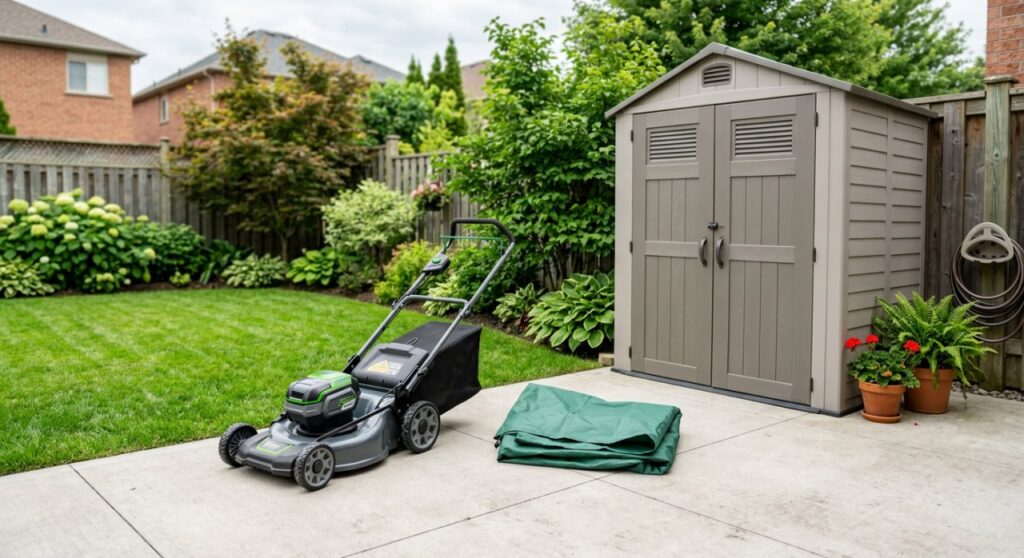
- Cover with a waterproof mower cover and secure with tie-downs
- Remove the battery if rain is expected or if temperatures will drop overnight
- Position out of direct sunlight if possible to reduce UV exposure on plastic housing
Long-Term Outdoor Storage (Weeks to Months)
For seasonal storage or extended periods when you won’t be using the mower:
- Install a plastic resin shed or metal storage cabinet — even a compact 4×2 ft unit is enough for most walk-behind mowers
- Elevate the mower on a rubber mat or wooden pallet inside the shed to prevent floor moisture contact
- Place silica gel packs inside the shed to absorb ambient humidity
- Remove the battery entirely and store it indoors (see Step 3)
- Leave shed vents open slightly — trapped, stagnant air creates condensation, which is worse than fresh air circulation
- Check the mower monthly during winter to catch any issues early
Step 6: Protect Your Mower Against Cold Weather and Snow
Are lawn mowers okay outside in cold weather? The mower body can tolerate cold better than the battery — but prolonged exposure to snow and freeze-thaw cycles still causes damage.
Should lawn mowers be kept outdoors in snow and cold? Only if protected in an enclosed, weatherproof shed. An uncovered or lightly-covered mower left in freezing conditions will experience:
- Cracked plastic housing from freeze-thaw expansion
- Seized wheels from ice buildup
- Corroded metal components from snowmelt and road salt contamination
- Permanent battery damage if the pack was left inside (even if the mower is off)
Cold Weather Storage Checklist
- [ ] Battery removed and stored indoors above 50°F
- [ ] Mower deck cleaned and dried
- [ ] All vents cleared of debris
- [ ] Mower covered with a waterproof cover OR placed in an enclosed shed
- [ ] Mower elevated off concrete or ground surface
- [ ] Blade lightly coated with WD-40 or a silicone spray to prevent rust
- [ ] Drive wheels and pivot points lubricated with a dry lubricant
Step 7: Secure the Storage Area Against Pests and Theft
Secure both the mower and the storage enclosure — outdoor storage creates opportunities for both pest damage and theft that indoor storage doesn’t.
Mice and insects frequently nest in mower decks during winter, chewing through wiring harnesses and clogging vents. Theft of cordless tools and mowers is also a real concern in open-access yards.
Pest Prevention
- Block entry points in your shed with steel wool or foam weatherstripping
- Store no food, birdseed, or organic material in the same shed
- Place mouse bait stations at shed perimeter — not inside where they can die near the mower
- Inspect the mower deck in early spring before the first use of the season
Security Tips
- Use a hardened steel cable lock through the mower’s wheel frame if stored in an open area
- Mark your mower with an engraved serial number or UV security pen
- Consider a small wireless alarm for your storage shed
- Position the shed where it’s visible from your home to deter opportunistic theft
Pro Tips for Smarter Electric Mower Storage
- Wall-mount when possible. Many cordless walk-behind mowers can be hung vertically on wall brackets, freeing floor space and keeping the mower off damp surfaces. Always check your manual — some models should not be stored at an angle.
- Run the battery down slightly before long storage. Store at 40–50% charge, not full. Most modern Greenworks, EGO, Ryobi, and Kobalt mower batteries last significantly longer when stored partially discharged.
- Tape over the battery port. If you’ve removed the battery, a piece of painter’s tape over the port keeps dust and insects from entering the housing during outdoor storage.
- Take photos before storing. A quick photo of the mower’s condition each fall makes it easy to spot new damage when you pull it out in spring.
- Check the warranty terms. Many manufacturers — including EGO Power+, Greenworks, and Husqvarna — void battery warranties for damage caused by improper outdoor storage. Know your policy before assuming coverage.
Common Mistakes to Avoid
These are the most frequent errors homeowners make when figuring out how to store lawn mowers outside:
❌ Leaving the battery installed during long-term storage. This is the top cause of premature battery failure. Always remove and store it indoors.
❌ Skipping the cleaning step. Wet grass clippings trapped under the deck generate heat and moisture even in cold weather, accelerating corrosion.
❌ Using a non-breathable tarp. Standard plastic tarps trap condensation underneath, creating a humid microclimate that’s worse than no cover at all. Use a purpose-made vented mower cover.
❌ Storing directly on soil or grass. Ground moisture wicks directly into the undercarriage. Always use a raised, hard surface.
❌ Assuming “waterproof” means fully sealed. Even a good cover won’t protect a mower from being partially submerged in a flash flood or sitting in standing water. Drainage matters.
❌ Ignoring freeze-thaw cycles. In climates with regular freeze-thaw patterns, water that penetrates cracks during a warm day re-freezes at night and expands, breaking plastic housing over multiple cycles.
❌ Storing a mower with a full battery charge all winter. Lithium-ion batteries stored at 100% charge for months experience “calendar aging” at a much faster rate than those stored at 40–50%.
FAQ: Electric Lawn Mower Storage Questions Answered
Can electric lawn mowers be kept indoors instead of outside?
Yes — and indoors is always the preferred option. A garage, shed, basement, or utility room provides the most protection for both the mower and battery. If space is limited, a wall-mounted storage bracket can keep the mower off the floor and out of the way. Can electric lawn mowers be kept indoors? Absolutely — there are no fumes or fuel hazards like gas mowers, making them safe for any indoor space.
Can you leave lawn mowers outside overnight?
Yes, for one or two nights with a cover — but not as a habit. A waterproof cover handles occasional overnight exposure well. Repeated overnight outdoor storage without protection accelerates housing degradation and risks moisture intrusion. If you’ll be leaving it out regularly, invest in a proper storage shed.
Do lawn mowers need to be stored in an enclosed area for winter?
For long-term winter storage, an enclosed area is strongly recommended. Open-air storage with just a cover leaves the mower exposed to freeze-thaw cycles, snow accumulation, and wind-driven moisture. A plastic resin shed costing as little as $150–$200 provides adequate enclosed protection for most climates.
Can lawn mowers be left outside in rain?
A brief rain shower is unlikely to cause immediate damage if the mower has a cover. However, prolonged rain exposure — especially without a cover — allows water to enter the battery compartment, motor housing, and electrical connectors. Never store a corded electric mower outdoors uncovered in wet conditions.
How long can a cordless electric mower sit in a shed unused?
With the battery removed, a cordless electric mower can sit unused for 6–12 months without issues. The mower body itself has no fuel or fluids to degrade. The battery should be checked every 4–6 weeks during storage and kept between 40–80% charge to maximize its usable lifespan.
Conclusion
Can electric lawn mowers be stored outside? Yes — but only with the right preparation and protection. The short version: remove the battery, clean the deck, use a vented waterproof cover, and elevate the mower off the ground. For anything beyond a few days, an enclosed shed is worth the investment.
Electric mowers are simpler to store than gas models — no fuel to drain, no oil to change. But their lithium-ion batteries demand more care than most homeowners expect. Treat battery storage as the non-negotiable step, and the mower body will take care of itself with basic protection.
If you’re still deciding where to store your mower this season, start with the comparison table in Step 1 and work through each step based on your specific setup. A small upfront effort in August saves you from an expensive replacement decision by 2026.