
Does Briggs and Stratton Make Lawn Mowers?
1 clear answer: Briggs & Stratton primarily makes gasoline engines, not most complete lawn mowers sold under its own name. What this means for you is that you will usually find a Briggs & Stratton engine installed on a mower made and branded by another manufacturer.
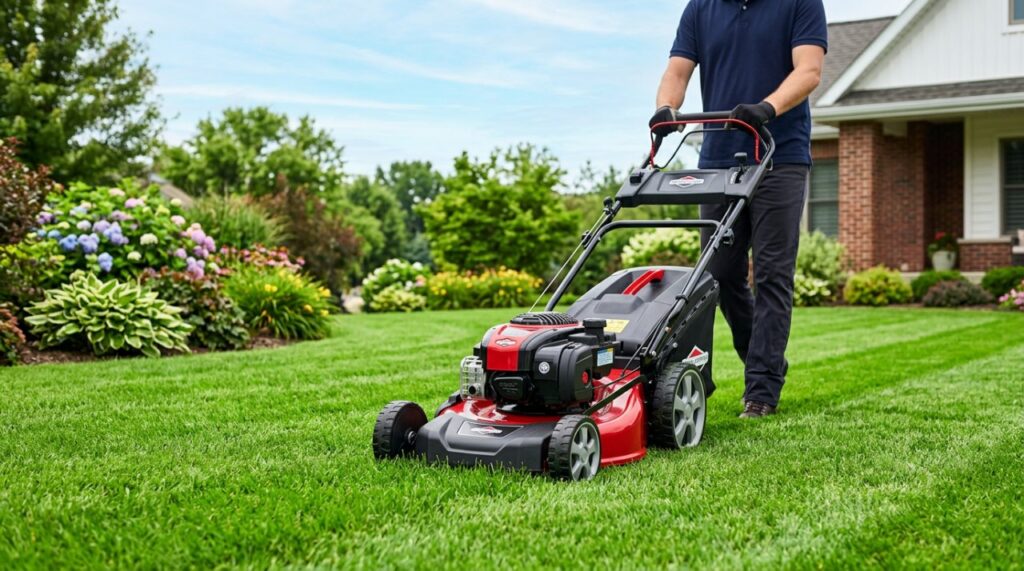
The company has also owned or supported outdoor-power-equipment brands, including Snapper and Simplicity, at different points in its history. Brand ownership, manufacturing arrangements, and product availability can change, so the mower’s model label remains more reliable than its marketing description.
Expert Summary>
– Briggs & Stratton is best known as an engine manufacturer rather than a current standalone lawn mower brand. – Lawn mower brands may install Briggs & Stratton engines in selected models while using engines from other suppliers in the same product line. – Craftsman, Toro, Snapper, Murray, Troy-Bilt, Husqvarna, and other brands have used Briggs & Stratton engines, but availability depends on the model and production period. – The most reliable way to identify the engine is to check the engine model, type, and code, not only the mower brand. – Buyers should verify the exact engine on the product specification sheet before purchasing because retailers may use photos or descriptions across several configurations.
How to Interpret the Briggs & Stratton Name on a Lawn Mower
2 separate manufacturers may be involved: one company can build or market the mower, while Briggs & Stratton supplies its engine. What this means for you is that a Briggs & Stratton badge on the engine does not automatically make the entire machine a Briggs & Stratton lawn mower.
A typical gasoline mower combines components from several suppliers:
| Component | Possible Manufacturer | What to Verify |
|---|---|---|
| Engine | Briggs & Stratton | Engine model, type, and code |
| Mower deck and chassis | Mower brand or contract manufacturer | Product model and serial number |
| Transmission | Mower brand or component supplier | Transmission label and part number |
| Blade system | Mower manufacturer | Deck width and blade part number |
| Starter system | Engine or equipment manufacturer | Recoil or electric-start specification |
| Warranty | Engine maker and mower company separately | Warranty documents for both products |
The engine and mower may therefore have separate warranties, parts catalogs, and service networks. Keep both model labels because an engine shop may need different information from a mower-deck repair center.
Step 1: Identify Whether It Is an Engine or Complete Mower
3 labels should be checked: the engine label, mower model label, and retailer specification label. What this means for you is that you should confirm who made each part before ordering parts, requesting service, or comparing prices.
1. Inspect the engine cover
Look for the Briggs & Stratton logo on the recoil starter housing, valve cover, engine shroud, or emissions label. This identifies the engine manufacturer, not necessarily the manufacturer of the full mower.
Common engine-family names may include:
- EX Series
- E Series
- Professional Series
- Intek
- Vanguard
These names describe engine families or product positioning. They do not identify the mower deck, transmission, or complete equipment model.
2. Locate the mower brand
Look for a separate name on the deck, control panel, hood, frame, or product-identification plate. Examples may include Craftsman, Toro, Snapper, Murray, or another outdoor-equipment brand.
A mower displaying both Craftsman and Briggs & Stratton, for example, is normally a Craftsman-branded mower powered by a Briggs & Stratton engine.
3. Separate the model numbers
Record the following information before buying a replacement part:
- Mower brand
- Mower model number
- Mower serial number
- Engine model number
- Engine type number
- Engine code number
The mower model helps identify blades, wheels, cables, belts, and deck components. The engine identifiers help locate carburetor, ignition, starter, filter, gasket, and internal-engine parts.
Step 2: Find What Lawn Mowers Have Briggs and Stratton Engines
4 verification sources provide the strongest answer: the manufacturer’s specification page, retailer listing, mower identification plate, and engine label. What this means for you is that model-specific evidence is more dependable than a general list of mower brands.
The question “what lawn mowers have Briggs and Stratton engines?” cannot be answered accurately by brand alone. Manufacturers often change engine suppliers between model variants, retail channels, and production runs.
1. Search by exact mower model
Enter the full mower model into the manufacturer’s website or a search engine. Add terms such as:
- “engine specifications”
- “parts manual”
- “operator manual”
- “Briggs & Stratton engine”
- “engine model type code”
Avoid searching only for the mower’s family name. A single family can include several deck sizes, starting systems, and engine configurations.
2. Review the official specifications
Look for fields labeled:
- Engine brand
- Engine manufacturer
- Engine displacement
- Engine torque
- Starting system
- Fuel type
If the official page says only “gas engine,” check the downloadable manual or parts diagram. The parts list may identify the installed engine or provide a supplier-specific engine reference.
3. Confirm the physical machine
Online information can become outdated when manufacturers revise products. Inspecting the actual mower is the best option when buying from a dealer, used-equipment seller, or local marketplace.
A product photo is not conclusive evidence. Retailers sometimes reuse images for several variants that look identical but contain different engines.
Step 3: Check Which Lawn Mowers Use Briggs and Stratton Engines
5 brand examples provide a useful starting point: Craftsman, Snapper, Murray, Toro, and Troy-Bilt have offered mower models with Briggs & Stratton engines. What this means for you is that these brands are worth checking, but you must still verify each individual model.
Other manufacturers have also used Briggs & Stratton power in selected equipment. Engine sourcing changes over time, so the following table is a research guide rather than a guarantee.
| Mower Brand | Has Used Briggs & Stratton Engines? | Important Qualification |
|---|---|---|
| Craftsman | Yes | Engine choice varies by model and manufacturer |
| Snapper | Yes | Availability depends on product line and market |
| Murray | Yes | Common on various historical and retail models |
| Toro | Yes | Only selected models and configurations |
| Troy-Bilt | Yes | Verify the exact stock-keeping unit |
| Husqvarna | Yes | More common in certain past product lines |
| Poulan Pro | Yes | Model and production period matter |
| Simplicity | Yes | Often associated with riding equipment |
| Ariens | Yes | Selected historical or market-specific models |
| Other private-label brands | Sometimes | Confirm using the engine label |
This is also the practical answer to “what lawn mowers use Briggs and Stratton engines?” and “which lawn mowers use Briggs and Stratton engines?” The answer is model-specific, not brand-wide.
Step 4: Determine Whether Craftsman Uses Briggs & Stratton Engines
6 words provide the direct verdict: some Craftsman mowers use Briggs & Stratton engines. What this means for you is that the answer to “does Briggs and Stratton make engines for Craftsman lawn mowers?” is yes, but not for every Craftsman mower.
Craftsman is an equipment brand, while the actual mower and engine may be produced by separate companies. Craftsman-branded machines have been made under different manufacturing and licensing arrangements over time.
1. Check the Craftsman product page
Open the specification section and identify the listed engine manufacturer. Do not assume two Craftsman mowers with similar deck designs use the same engine.
Retail-exclusive versions can also have different specifications. Compare the full product number rather than relying on the display name.
2. Read both warranty documents
A Craftsman mower with a Briggs & Stratton engine may include separate coverage for:
- Mower deck and frame
- Engine
- Battery
- Transmission
- Wear components
Confirm which service provider handles each claim. A mower retailer may refer an engine problem to an authorized engine-service center.
3. Match parts to the correct label
Use the Craftsman mower model for deck and chassis parts. Use the Briggs & Stratton model, type, and code for engine parts unless the equipment manual directs you to a mower-specific assembly.
This distinction prevents common ordering errors involving air filters, carburetors, starter motors, and ignition coils.
Step 5: Find Who Sells Briggs & Stratton-Powered Lawn Mowers
7 seller categories may carry them: home-improvement stores, hardware stores, farm stores, outdoor-power dealers, mass retailers, online retailers, and used-equipment sellers. What this means for you is that availability depends more on current inventory than on a single permanent seller list.
People searching “who sells Briggs & Stratton lawn mowers” are usually looking for mowers powered by the company’s engines. Search retailer inventory using both the mower type and engine brand.
1. Search major retail channels
Potential sellers may include:
- Home-improvement retailers
- Independent mower dealers
- Hardware-store networks
- Agricultural and farm-supply stores
- Manufacturer-authorized dealers
- Online equipment retailers
- Local used-equipment marketplaces
Inventory differs by location. A retailer may carry Briggs & Stratton-powered riding mowers while stocking walk-behind mowers with engines from other manufacturers.
2. Filter by engine brand
When available, use a retailer’s “engine brand” filter. Search phrases such as:
- Briggs & Stratton push mower
- Briggs & Stratton self-propelled mower
- Briggs & Stratton riding mower
- Briggs & Stratton zero-turn mower
- Briggs & Stratton replacement engine
For the query “who sells Briggs & Stratton lawn mowers,” the fastest method is to search local inventory and then confirm the engine in the technical specifications.
3. Call before traveling
Ask the seller to read the engine label from the actual machine. This is especially important when the website says specifications are subject to change.
Request the full mower model and engine family before placing a deposit. Save a screenshot or written copy of the specifications if engine brand is a deciding factor.
Step 6: Verify Where Briggs and Stratton Lawn Mowers Are Made
8 separate facts may affect origin: engine assembly, engine components, mower assembly, deck fabrication, transmission production, brand ownership, final packaging, and distribution. What this means for you is that “made in” cannot always be reduced to one country.
The question “where are Briggs and Stratton lawn mowers made?” often combines the engine’s origin with the mower’s origin. These may be different.
Briggs & Stratton has long-standing manufacturing operations in the United States and has also operated within a global supply chain. However, the origin of a specific engine or mower should be verified from its label and current manufacturer disclosures.