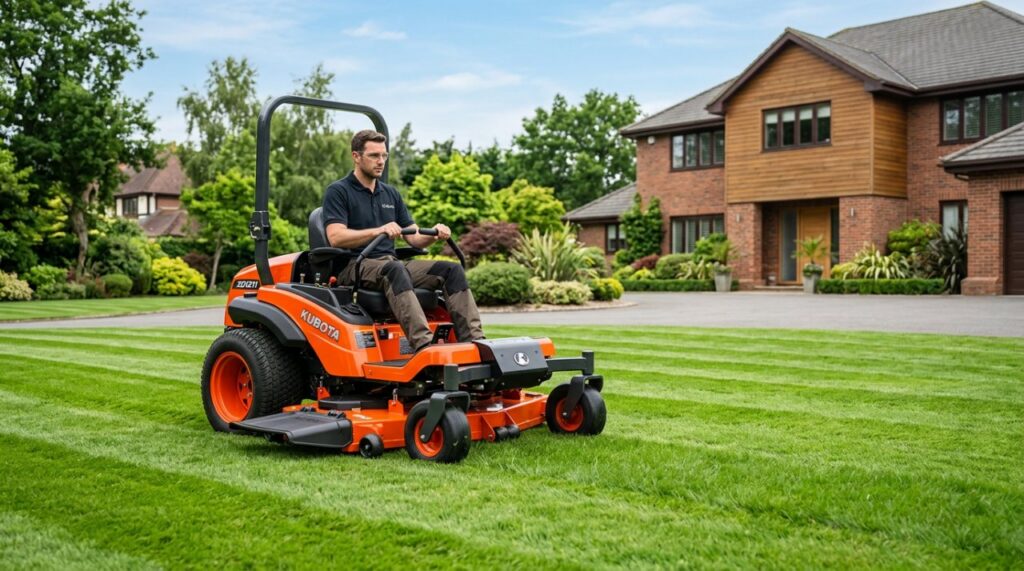

Quick Answer / TL;DR: Yes, Kubota makes lawn mowers — including zero-turn mowers, stand-on mowers, front-mount mowers, and lawn/garden tractors. Kubota focuses on durability, dealer support, and professional-grade performance rather than budget pricing. To buy smart, identify your mower type first, set a budget, then compare models at an authorized Kubota dealer with an on-property demonstration.

Expert Summary: Kubota manufactures and sells its own branded mowers, though some components come from different Kubota facilities and suppliers. The lineup prioritizes durability, dealer support, and commercial-grade cutting performance. Kubota is best suited to large properties, demanding terrain, frequent mowing, and landscaping professionals — not small, flat suburban lots where a budget walk-behind is enough.
New to lawn mower maintenance? Start with our ego power+ z6 rear bumper for. Curious how other brands stack up? Our who makes dewalt lawn mowers guide explains the trade-offs.
What You Need
Before you start comparing Kubota models, gather the following. Preparation here saves hours at the dealership and prevents overspending.
- Accurate property measurements: Total mowing area in acres or square feet, plus slope percentage if any part of your lawn is hilly.
- A list of obstacles: Trees, fences, garden beds, gates, and overhangs — these determine whether you need a zero-turn, front-mount, or tractor.
- A realistic budget range: Include attachments, collection systems, tax, delivery, and financing costs, not just the sticker price.
- Your nearest authorized Kubota dealer: Use Kubota’s official dealer locator. Buying outside the dealer network can void warranty support options.
- Storage check: Confirm your garage or shed dimensions. Zero-turns and front-mounts need significantly more footprint than walk-behinds.
Step-by-Step Guide
Step 1: Confirm What Types of Lawn Mowers Kubota Makes
Identify the mower category before comparing individual models. Kubota offers several kinds of mowing equipment, but it is not primarily known for inexpensive walk-behind mowers designed for tiny suburban yards.
The company’s lineup can vary by country and model year. In the United States, buyers commonly encounter zero-turn mowers, stand-on mowers, front-mount mowers, and lawn or garden tractors.
Kubota mower types at a glance
| Mower type | How it works | Best for | Main trade-off |
|---|---|---|---|
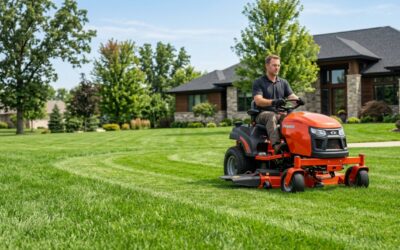
| Zero-turn mower | Uses two steering controls to turn within a very small space | Large lawns, trees, landscaping obstacles | Takes practice to steer smoothly |
| Stand-on mower | The operator stands on a rear platform | Commercial crews and properties with frequent stops | Less comfortable for some homeowners |
| Front-mount mower | Places the cutting deck in front of the operator | Mowing beneath branches, fences, and overhangs | Usually costs more |
| Lawn or garden tractor | Uses a steering wheel and carries the deck beneath the machine | General property care and attachment use | Cannot turn as tightly as a zero-turn |
Step 2: Match the Mower Type to Your Property
- Under roughly 1 acre, flat, open: A Kubota lawn or garden tractor is usually sufficient and more budget-friendly.
- 1–3 acres with trees and beds: A zero-turn mower cuts mowing time dramatically and maneuvers around obstacles.
- Low branches, fences, or undergrowth edges: A front-mount mower reaches where mid-mount decks cannot.
- Commercial or high-frequency mowing: Stand-on or heavy-duty zero-turn models are built for daily use.
Step 3: Compare Costs and Total Ownership Expenses
- Get quotes from at least two authorized dealers — pricing, financing rates, and included service vary by location.
- Ask what’s included: Delivery, first service, PTO shaft, bagging or mulching kits, and warranty registration.
- Calculate the cost per hour of use over 5–10 years. A pricier Kubota often wins when annual mowing hours are high.
- Review financing terms carefully — promotional 0% offers usually exclude certain models or require strong credit.
Step 4: Test Before You Buy
- Sit or stand on the machine. Check seat comfort, control reach, and visibility of the cutting edge.
- Request an on-property demonstration. Most reputable dealers will bring a unit out for serious buyers.
- Ask about local parts stock. Blades, belts, and filters on the shelf matter more than the logo on the hood.
More buying and maintenance walkthroughs live in our how-to guides.
Common Mistakes & Troubleshooting
Mistake 1: Buying More Machine Than You Need
Symptom: You spent commercial-mower money but mow half an acre twice a month. Fix: Match the mower category to annual mowing hours. For small, simple lawns, a basic tractor — or even a quality walk-behind — delivers better value than a zero-turn.
Mistake 2: Ignoring Dealer Proximity
Symptom: Your mower sits unused for weeks waiting on a part or warranty service slot. Fix: Before purchasing, confirm your nearest authorized Kubota dealer stocks common wear parts (blades, belts, filters) and ask about their typical service turnaround time. Kubota’s strength is dealer support — use it.
Mistake 3: Assuming Kubota Models Are Identical Worldwide
Symptom: You researched a model online that your local dealer has never heard of. Fix: Kubota’s lineup varies by country and model year. Always verify the exact model number against your regional Kubota website or dealer catalog before comparing prices.
Mistake 4: Forgetting Attachments in the Budget
Symptom: The mower fits your budget, but the bagger, mulch kit, or snow blade pushes you thousands over. Fix: Price every attachment you’ll need in year one before choosing a model, and confirm compatibility with the specific deck and chassis.
Mistake 5: Skipping the Test Drive
Symptom: Buyer’s remorse over seat comfort, control layout, or noise after delivery — when returns are difficult. Fix: Insist on sitting on (and ideally operating) the exact configuration you intend to buy, including the seat suspension and armrest position you’ll use for hours at a time.
Frequently Asked Questions
Does Kubota actually manufacture its own lawn mowers?
Yes. Kubota designs, manufactures, and sells its own branded mowers, although individual components may be produced at different Kubota facilities or by contracted suppliers. The engines, decks, and final assembly fall under Kubota’s own engineering and quality standards.
Are Kubota lawn mowers worth the higher price?
For large properties, demanding terrain, frequent mowing, or commercial use, Kubota’s durability and dealer support usually justify the premium over entry-level brands. For small, flat suburban lawns with light mowing schedules, a cheaper machine often makes more financial sense.
Does Kubota make walk-behind mowers for small yards?
Kubota’s U.S. lineup centers on riding equipment — zero-turns, stand-ons, front-mounts, and tractors — rather than inexpensive walk-behinds for tiny yards. Homeowners with small properties should compare other brands or step up to a compact Kubota tractor.
How much does a Kubota lawn mower cost?
Prices vary significantly by mower type, engine, cutting width, collection system, and financing terms. Lawn tractors sit at the lower end of the range, while commercial zero-turns and front-mount models cost substantially more. Request quotes from at least two authorized dealers for accurate current pricing.
Where is the safest place to buy a Kubota mower?
An authorized Kubota dealer is the safest option. Dealers handle warranty registration, genuine parts, factory-trained service, and — for serious buyers — on-property demonstrations. Buying secondhand or outside the dealer network can complicate warranty and parts support.
What size Kubota mower do I need for my property?
As a rule of thumb: under 1 acre suits a lawn tractor, 1–3 acres with obstacles suits a zero-turn, and larger or commercial properties justify stand-on or heavy-duty models. Always size the deck to your narrowest gate or passage, and never exceed the machine’s rated slope limit.