
How Did People Cut Grass Before Lawn Mowers?
Before lawn mowers, people controlled grass with grazing animals, hand sickles, scythes, shears, and labor-intensive trimming. Large fields were usually grazed or cut with scythes, while formal lawns required repeated hand cutting, rolling, weeding, and sweeping. The process demanded skill, time, and inexpensive human or animal labor.
Expert Summary>
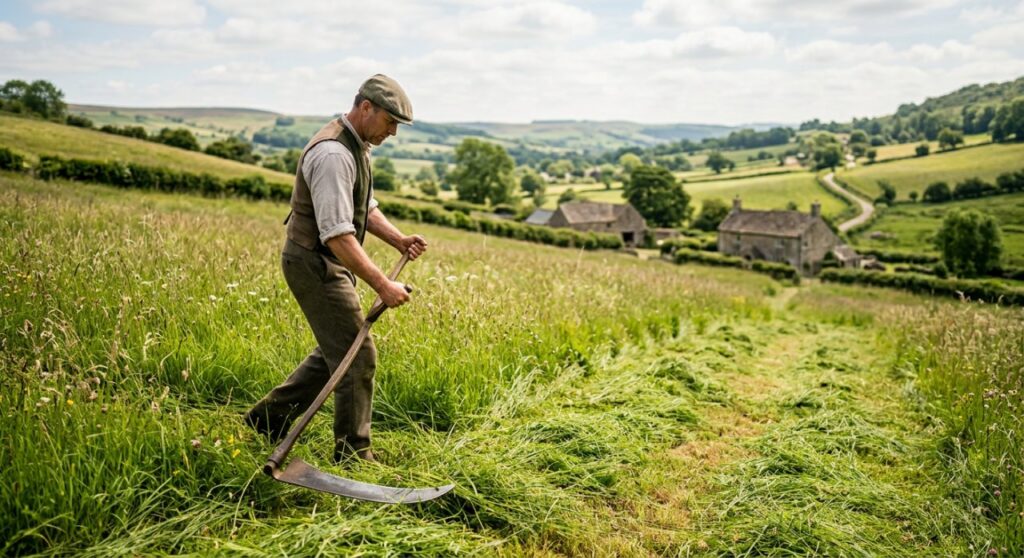
– Before mechanical lawn mowers, sheep, cattle, horses, and other grazing animals provided the cheapest way to control grass across large areas. – The scythe was the main hand tool for cutting meadows and extensive grassy ground because its long blade could clear a broad swath with each stroke. – Formal lawns were maintained with scythes, sickles, edging irons, and large hand shears, often by teams of skilled groundskeepers. – Grass was not historically kept at today’s uniformly short height; many “lawns” looked more like grazed turf, meadow, or closely managed pasture. – Edwin Budding’s 1830 cylinder mower patent made regular, even lawn cutting more practical and helped expand the culture of ornamental lawns.
Tools and Methods Used Before Lawn Mowers
The answer to what did people use before lawn mowers depends on the size and purpose of the land. Grazing worked best for large areas, scythes handled meadows, and shears produced the closest finish around wealthy homes and formal gardens.
| Tool or method | Best use | Cutting quality | Labor required | Main limitation |
|---|---|---|---|---|
| Grazing animals | Estates, commons, parks, pasture | Uneven to moderately short | Low human labor | Animals also trample, fertilize, and selectively graze |
| Scythe | Meadows, orchards, large grassy areas | Moderately even with skill | High | Requires technique and frequent sharpening |
| Sickle | Small patches, edges, weeds, harvesting | Precise but slow | Very high | Short blade limits coverage |
| Grass hook | Banks, rough ground, awkward corners | Rough to moderate | High | Not ideal for a smooth formal lawn |
| Hand shears | Formal lawns, borders, small plots | Close and controlled | Extremely high | Impractical over large areas |
| Edging iron | Lawn boundaries and paths | Clean vertical edge | Moderate | Does not cut the main lawn surface |
| Rolling and sweeping | Surface finishing | Improves appearance | Moderate | Does not replace cutting |
| Controlled burning | Rough vegetation in suitable landscapes | Removes old growth | Variable | Fire risk and unsuitable for ornamental turf |
Step 1: Use Grazing Animals to Control Large Grass Areas
Introduce grazing animals when the goal is to prevent grass from becoming overgrown rather than to create a perfectly level lawn. Before mechanized mowing, this was usually the most economical approach for estates, village commons, parkland, and pasture.
Choose Animals for the Desired Grass Height
Select sheep for relatively close grazing. Sheep bite vegetation near the ground and can produce short turf, although the finish remains less uniform than a mechanically cut lawn.
Cattle remove larger quantities of