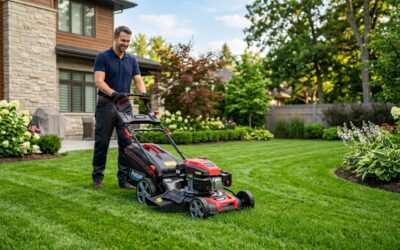

Quick Answer / TL;DR: Yes, 10W-30 is a good oil choice for most four-stroke lawn mower engines, particularly in climates where temperatures range from roughly 40°F to 100°F. It won’t suit every mower or every climate, though—always confirm the viscosity grade in your engine manual before pouring. Two-stroke engines must never use 10W-30.
What You Need
Before you check, add, or change oil, gather the following:
- Your engine manual — the single most authoritative source for approved oil grades
- Dipstick and clean rag — to check the current oil level and condition
- SAE 10W-30 small-engine oil — API service class SF or higher (SJ, SL, or newer)
- Funnel — to avoid spills when topping off
- Oil drain pan and gloves — if you’re doing a full oil change
- Flashlight — to read the oil fill cap and dipstick markings clearly
Preparation: Park the mower on a level surface, disconnect the spark plug wire, and let a hot engine cool for 10–15 minutes so oil drains back to the sump for an accurate reading.
⚠️ Safety Warning: Never tip a mower with the spark plug connected or the air filter side facing down—fuel and oil can flood the carburetor and air filter, and a spark could ignite fumes.
Step-by-Step Guide
Step 1: Confirm Your Engine Is Four-Stroke
Check the fuel cap or manual. If you mix oil into the gasoline, you have a two-stroke engine, and 10W-30 is not applicable—those engines need two-cycle oil mixed at the manufacturer’s ratio. Nearly all modern walk-behind and riding mowers are four-stroke and accept straight engine oil.
💡 Pro Tip: No manual? Look up your engine’s model number (stamped on the shroud or engine block) on the manufacturer’s website—Briggs & Stratton, Honda, and Kawasaki all publish oil specifications online.
Step 2: Match 10W-30 to Your Climate
10W-30 performs best in ambient temperatures between roughly 40°F and 100°F. If you mow consistently above 80°F, straight SAE 30 may be recommended. In colder spring conditions below 40°F, 5W-30 flows better at startup.
Step 3: Check the Current Oil Level and Condition
Remove the dipstick, wipe it clean, reinsert fully, and pull it again. The oil should sit between the FULL and ADD marks and look amber to light brown. Dark, gritty, or milky oil means it’s time for a change regardless of grade.
⚠️ Warning: Overfilling is as harmful as running low. Excess oil can cause smoking, fouled spark plugs, and hydro-lock. Add oil in small increments and recheck after each pour.
Step 4: Add or Change the Oil
To top off, insert a funnel and add 10W-30 slowly until the level reaches FULL. For a full change, run the engine for a minute to warm the oil, disconnect the spark plug, drain the old oil completely, replace with fresh 10W-30 (most walk-behinds hold 15–20 oz; most riders hold 48–64 oz), then reconnect the plug and run the engine briefly to check for leaks.
💡 Pro Tip: Change the oil after the first 5 hours on a new mower, then every 25–50 hours of use—or at least once per mowing season.
Step 5: Dispose of Old Oil Properly
Seal used oil in a labeled container and take it to an auto parts store, service station, or household hazardous waste facility. Never dump it on the ground or in household trash.
Common Mistakes & Troubleshooting
Mistake 1: Using 10W-30 in a two-stroke engine. This starves the engine of lubrication because two-strokes rely on oil mixed into the fuel. Fix: drain the tank, refill with properly mixed two-cycle oil, and never start it again until corrected.
Mistake 2: Ignoring extreme heat. In sustained temperatures above 100°F, 10W-30 can thin out faster than straight SAE 30, increasing wear. Fix: switch to SAE 30 for hot-weather mowing if your manual permits it.
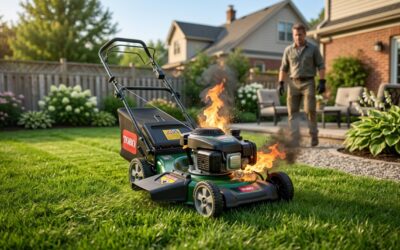
Mistake 3: Overfilling the crankcase. Symptoms include blue-white exhaust smoke, oil leaking from the muffler, and hard starting. Fix: drain oil until the level sits at the FULL mark; if the engine still smokes after an oil correction, run it briefly—the smoke should clear.
Mistake 4: Using automotive oil with friction modifiers. Some car oils contain additives that can harm small flat-tappet engines over time. Fix: buy oil explicitly labeled for four-cycle small engines, or confirm the API rating matches your manual.
Mistake 5: Skipping oil changes because oil “looks fine.” Oil loses detergency and shear stability long before it turns visibly black. Fix: change every 25–50 hours of runtime or once per season, whichever comes first.
Frequently Asked Questions
Can I use 10W-30 in my mower year-round?
In most temperate regions, yes—10W-30 handles spring-through-fall temperatures well. If you mow in sustained heat above 100°F, straight SAE 30 may hold up better, and in cold starts below 40°F, 5W-30 or synthetic 5W-30 protects better. Your engine manual’s viscosity chart is the final word.
Is synthetic 10W-30 better for lawn mowers?
Synthetic 10W-30 offers better cold-start flow, superior high-temperature stability, and longer drain intervals. It costs more but is an excellent choice for commercial use, large properties, or extreme climates—provided your engine manual allows synthetic oil.
What happens if I accidentally used car oil in my mower?
One fill of standard automotive oil rarely causes immediate damage, but friction modifiers can reduce engine braking and long-term wear protection in small engines. Drain and refill with small-engine-rated oil at your earliest convenience.
How much oil does a lawn mower take?
Most walk-behind mowers hold 15–20 ounces (roughly 0.5–0.6 quarts), while riding mower engines typically hold 48–64 ounces (1.5–2 quarts). Always fill to the dipstick’s FULL mark rather than measuring by container alone.
Why is my mower smoking after adding 10W-30?
Blue or white smoke almost always means overfilled oil or spilled oil burning off the engine shroud or muffler. Check the dipstick and drain excess; spilled oil will burn off within a few minutes of running.
Can I mix 10W-30 with SAE 30?
In an emergency, a small top-off won’t harm the engine, but the blended viscosity won’t perform to either specification. Ideally, drain and refill with a single grade matching your climate and manual.