
Why Do Lawn Mowers Have Headlights — The Complete Guide
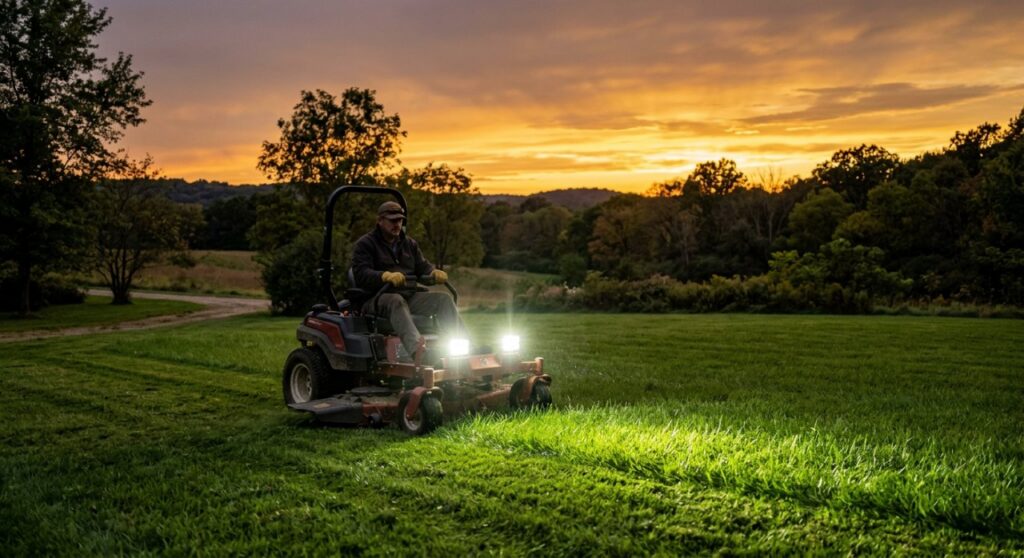
Lawn mowers have headlights primarily to extend usable mowing hours into low-light conditions — early morning, dusk, and sometimes after dark. For large-property owners and commercial landscapers, headlights are a practical safety tool, not a gimmick. They help operators spot obstacles, uneven terrain, and hazards that are invisible in poor light.
⚡ Expert Summary
- Lawn mower headlights exist to allow safe operation during low-light hours — dawn, dusk, and early evening — when visibility drops significantly.
- Riding mowers and zero-turn mowers are the most common types equipped with headlights because they cover large areas where a single session may span multiple hours.
- Commercial landscapers rely on mower headlights to maintain productivity during tight client schedules, especially in summer when multiple jobs happen back-to-back.
- LED headlights are now the industry standard, replacing older halogen bulbs due to their longer lifespan, lower power draw, and brighter output.
- Walk-behind push mowers rarely include headlights because they are used on small residential lots where low-light mowing is uncommon and the operator is closer to the ground.
Step 1: Understand the Core Purpose of Lawn Mower Headlights
Lawn mower headlights solve a real productivity problem: daylight runs out before the job does.
For homeowners with half an acre or more, a single mowing session can take 90 minutes to 3 hours. Add heat, family schedules, and work commitments, and it becomes clear why people start mowing at 6 AM or finish at 8 PM.
Without headlights, mowing in those conditions is genuinely dangerous. Hidden rocks, tree roots, drop-offs, children’s toys, and garden borders can all cause accidents or equipment damage when you can’t see them clearly.
H3: The Three Main Reasons Lawn Mowers Have Headlights
1. Extended Mowing Window
Headlights allow operators to work during the golden hours — before sunrise and after sunset — without compromising safety. This is especially valuable in summer months when daytime heat makes outdoor work uncomfortable.
2. Hazard Detection
A riding mower traveling at 5–8 mph needs sufficient light to stop safely. Headlights illuminate the path ahead, helping the operator identify:
- Sudden terrain drops or drainage ditches
- Hidden debris like rocks, branches, or toys
- Lawn edges and landscaping borders
- Pets or wildlife that have moved into the path
3. Professional Scheduling
Commercial landscaping crews often manage 10–20 properties per day. Headlights give them flexibility to complete jobs in low-light without rescheduling — a direct revenue benefit.
Step 2: Know Which Lawn Mowers Actually Come with Headlights
Not every lawn mower has headlights — the feature is standard on riding mowers and zero-turns but rare on push mowers.
Understanding which machines include headlights helps you shop smarter and set realistic expectations.
H3: Mower Types and Headlight Availability
| Mower Type | Headlights Standard? | Why / Why Not |
|---|---|---|
| Riding Mowers (entry-level) | Sometimes | Budget models may omit them to cut cost |
| Riding Mowers (mid-to-high) | Yes, typically | Standard feature on brands like John Deere, Husqvarna, Cub Cadet |
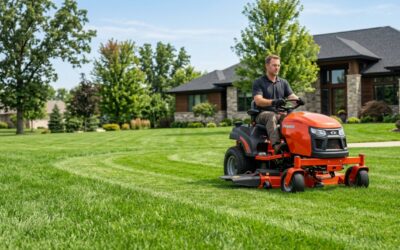
| Zero-Turn Mowers | Yes, most models | Common on residential and commercial ZTRs |
| Lawn Tractors | Yes, most models | Especially those with 18HP+ engines |
| Walk-Behind Push Mowers | Rarely | Short run times, close-up visibility, not needed |
| Robotic Lawn Mowers | Sometimes | Some models use infrared/LED for navigation, not operator use |
| Commercial Stand-On Mowers | Yes | Built for all-day use on professional crews |
Key insight: If you’re shopping a riding mower above the $1,500 price point, headlights are almost always included. Below that threshold, check the specs carefully.
H3: Popular Brands That Include Headlights as Standard
- John Deere — Most E100, S100, and X300 series include dual headlights
- Husqvarna — TS and YT series riding tractors ship with LED headlights
- Cub Cadet — XT1 and XT2 series include headlights on mid-grade and above
- Ariens — IKON and Zoom ZTR series include headlights
- Toro — TimeCutter zero-turns include headlights on most models
Step 3: Learn When to Use Lawn Mower Headlights Effectively
Use headlights any time ambient light drops low enough that you’d hesitate to walk across the lawn confidently — that’s your threshold.
This isn’t just about full darkness. Mowing conditions that benefit from headlights include:
H3: Ideal Conditions for Using Mower Headlights
Early Morning (5:30 AM – 7:30 AM)
Sunrise timing varies by season, but this window offers cooler temperatures, calm wind, and less foot traffic in neighborhoods. Headlights help you navigate until full daylight arrives.
Evening / Dusk (7:00 PM – 9:00 PM)
Summer evenings are a popular mowing time. Dusk creates deceptive low-contrast lighting — your eyes adjust, but depth perception suffers. Headlights compensate for this.
Overcast or Heavily Shaded Lawns
Dense tree canopy or heavily overcast skies can reduce midday light enough that headlights add measurable value on complex properties.
Mowing Large Acreage
On properties of 2+ acres, a mowing job often starts in good light and ends in poor light. Headlights ensure you finish safely without rushing.
H3: When NOT to Use Headlights (Common Misconception)
A widespread myth is that full nighttime mowing is safe with headlights. It is not recommended for most operators because:
- Headlights illuminate forward — not the full 360° hazard zone
- Tire edges, side hazards, and slope changes remain poorly visible
- Fatigue at night increases reaction time and decision errors
- Noise ordinances in most residential areas restrict outdoor equipment use after 9–10 PM
Pro rule: Headlights extend your window by 60–90 minutes at each end of the day. They are not a substitute for full daylight.
Step 4: Maintain Your Lawn Mower Headlights for Maximum Visibility
A poorly maintained headlight provides far less illumination than the bulb’s rated output — clean and check them every 20–30 mowing hours.
H3: Tools Needed for Basic Headlight Maintenance
| Tool / Material | Purpose |
|---|---|
| Microfiber cloth | Clean lens covers without scratching |
| Plastic lens polish (e.g., Meguiar’s PlastX) | Restore cloudy or yellowed plastic lenses |
| Electrical contact cleaner | Clean corroded bulb contacts |
| Multimeter | Test voltage output to headlight circuit |
| Replacement LED bulb kit | Match OEM spec — check owner’s manual for bulb type |
| Dielectric grease | Protect connections from moisture and corrosion |
H3: Step-by-Step Headlight Maintenance Routine
1. Inspect the Lens
Check for cloudiness, cracks, or moisture trapped inside the housing. A cloudy lens can reduce light output by 30–50% — more than most people realize.
2. Clean the Lens
Use a microfiber cloth with warm water and mild soap. For oxidized plastic lenses, apply plastic polish in circular motions, then buff clean.
3. Check the Bulb
With the mower off and key removed, access the bulb housing (refer to your owner’s manual). Inspect the bulb for blackening or broken filaments. LED bulbs rarely fail suddenly — gradual dimming usually signals the end of life.
4. Test the Circuit
Turn the mower on and activate the headlights. If one or both don’t illuminate, use a multimeter to test the circuit. Check the headlight fuse first — it’s the fastest fix and the most overlooked.
5. Replace if Needed
Match the bulb type exactly. Most modern riding mowers use 12V LED bulbs in a BA15S or T10 socket. Aftermarket LED upgrades are widely available and often outperform OEM halogen replacements.
6. Apply Dielectric Grease
Before reassembling, apply a thin layer of dielectric grease to the bulb contacts and connector pins. This prevents corrosion and ensures consistent electrical contact over time.
Step 5: Upgrade Your Mower with Aftermarket Headlights (If Yours Lacks Them)
If your riding mower didn’t come with headlights, you can add them — the process is straightforward and costs $30–$150 depending on the kit.
H3: What to Look for in an Aftermarket Headlight Kit
Not all kits are equal. Prioritize these features:
- Weatherproof rating (IP67 or higher) — mowers operate in rain, dew, and mud
- LED technology — longer lifespan and less drain on the mower’s charging system than halogen
- Universal mounting bracket — allows fitment to most riding mower hoods
- Plug-and-play wiring harness — reduces installation complexity
Avoid cheap halogen kits that draw high current — older mower charging systems may not handle additional load without flickering or battery drain.
H3: Basic Installation Steps for Aftermarket Mower Headlights
- Identify your mower’s accessory power output — most have a 12V accessory port or can be tapped from the battery
- Choose a mounting location — typically on the hood front or grille
- Drill pilot holes (if no existing mount points) and secure the bracket with stainless hardware to prevent rust
- Route wiring away from moving parts, hot exhaust, and blade engagement linkage
- Connect to a switched circuit so lights turn off with the key — this prevents battery drain
- Test before covering wiring with conduit or loom
Budget estimate for a quality retrofit: $45–$120 for a dual LED kit with switch and wiring harness.
Pro Tips: Getting the Most from Lawn Mower Headlights
Tip 1: Aim the Beams Correctly
Most riders don’t realize mower headlights are adjustable. Angle them slightly downward to illuminate the ground 10–15 feet ahead, not into the sky. This dramatically improves ground-level obstacle detection.
Tip 2: Supplement with a Personal Headlamp
Even with good mower headlights, wearing a lightweight headlamp when mowing at dusk gives you lateral visibility the fixed beams can’t provide. A $15 LED headlamp can prevent a $200 blade replacement.
Tip 3: Upgrade to LED Even If Your Mower Has Halogen
If your mower shipped with halogen bulbs, swapping to LEDs is a 10-minute upgrade that typically doubles light output and triples bulb life. Match the socket type and voltage.
Tip 4: Mark Your Hazards Before Low-Light Mowing
Before mowing in low-light conditions, do a quick daylight walk of the property. Mark irrigation heads, landscape stakes, or hidden drainage covers with small orange flags. Headlights illuminate moving obstacles — they won’t save you from ones you already knew were there.
Tip 5: Check Local Noise Ordinances
In most residential areas, power equipment is restricted to daytime hours — typically 7 AM to 9 PM. Headlights enable low-light mowing, but local ordinances may restrict when you can actually use them. Know your local rules before scheduling a 6 AM session.
Common Mistakes to Avoid
Mistake 1: Assuming Headlights Make Full Night Mowing Safe
Headlights improve safety in low-light conditions — they do not replicate daylight. Mowing in complete darkness remains high-risk regardless of headlight quality.
Mistake 2: Ignoring a Flickering Headlight
Flickering usually means a loose connection or failing bulb. Left unchecked, it can signal a larger charging system issue. Fix it early — a $5 bulb is cheaper than a $150 voltage regulator.
Mistake 3: Using High Beams in Foggy or Dewy Conditions
Morning dew and fog scatter bright light directly back at the operator. In those conditions, angled-down, lower-intensity light is more effective than maximum brightness.
Mistake 4: Installing Undersized Wiring for Aftermarket Kits
Using wire that’s too thin for the amperage draw causes voltage drop, poor light output, and potential overheating. Always match or exceed the wire gauge specified in the kit instructions.
Mistake 5: Skipping the Fuse Check First
When headlights stop working, most owners go straight to the bulb. Check the fuse first — it takes 30 seconds and is the cause of the problem at least 40% of the time.
Frequently Asked Questions
Do all lawn mowers have headlights?
No — headlights are standard on most mid-range and high-end riding mowers and zero-turns, but rare on walk-behind push mowers. Budget riding mowers under $1,200 sometimes omit them to reduce cost. Check the spec sheet before purchasing if headlights are important to you.
What is the point of headlights on lawn mowers?
The point is to extend safe operating hours into low-light conditions — early morning and evening — and to illuminate hazards like rocks, drop-offs, and obstacles that are hard to see in poor light. For large-property owners and commercial operators, this translates directly into more flexible scheduling and fewer equipment-damage incidents.
Can I mow at night with lawn mower headlights?
Headlights make low-light mowing safer but are not designed for full nighttime operation. They illuminate the path ahead but leave blind spots on the sides and rear. Most experts and equipment manufacturers recommend limiting headlight use to 60–90 minutes before sunrise or after sunset, not complete darkness.
How long do lawn mower headlight bulbs last?
LED headlight bulbs typically last 10,000–25,000 hours, while older halogen bulbs last 500–1,000 hours. For most homeowners mowing 50 hours per season, a quality LED bulb will last the lifetime of the mower. Halogen bulbs may need replacement every 3–5 years under typical use.
Can I add headlights to a lawn mower that doesn’t have them?
Yes — aftermarket LED headlight kits are widely available for $30–$150 and can be installed in 30–60 minutes with basic tools. Look for IP67-rated weatherproof kits with plug-and-play wiring. Connect them to a switched 12V circuit so they turn off with the ignition.
Conclusion
Lawn mowers have headlights for a straightforward reason: large lawns, busy schedules, and seasonal light windows don’t always align with peak daylight hours. Headlights extend safe mowing time into dawn and dusk, reduce hazard incidents, and give commercial operators the flexibility to meet client demands without rescheduling.
For homeowners, the key takeaways are simple:
- Check that your riding mower includes headlights before you buy — especially if you manage more than half an acre
- Maintain lenses and bulbs every 20–30 operating hours for consistent output
- Use headlights to extend your day, not to replace daylight
- If your mower lacks headlights, a quality aftermarket kit is an easy, affordable upgrade
Whether you’re finishing a lawn at dusk or starting before the summer heat kicks in, a properly maintained set of mower headlights pays for itself in safety, convenience, and fewer equipment repairs.