
Are Lawn Mowers Road Legal? The Short Answer
Are lawn mowers road legal? Usually, ordinary push mowers and riding lawn mowers are not legal for normal road use. A mower may be allowed to cross a road or travel a short distance for agricultural or maintenance work, but local rules may require registration, insurance, lights, reflectors, and a valid driver’s license.
Expert Summary
>
– Most lawn mowers are not street legal because they were designed for private property, not public-road safety standards.
– A mower may qualify as an agricultural vehicle, maintenance vehicle, or slow-moving vehicle, depending on its design, use, and local law.
– Crossing a road is often treated differently from driving along it, but permission is never automatic.
– Public-road use may require registration, insurance, lights, reflectors, brakes, and a slow-moving vehicle emblem.
– The safest answer must come from your local motor vehicle authority, police department, or road agency because rules vary by location.
Step 1: Identify What Type of Lawn Mower You Have
Classify the mower before checking road rules. The law may treat a push mower, riding mower, zero-turn mower, and commercial tractor-style mower very differently.
The key question is not simply whether the machine cuts grass. Authorities usually consider how it moves, how it is constructed, and why it is being operated on a public road.
Distinguish between push and riding lawn mowers
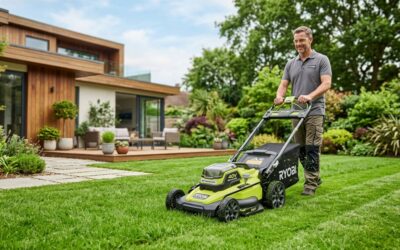
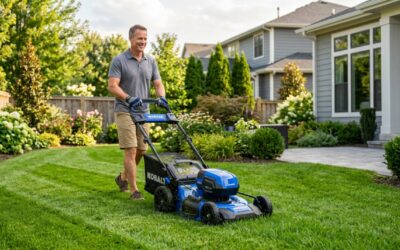
A push mower is a walk-behind machine controlled by a person on foot. It is generally treated as equipment rather than a road vehicle.
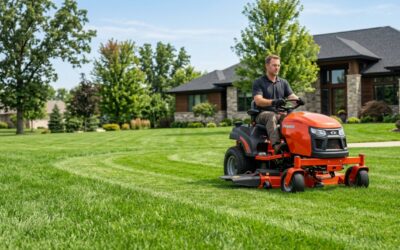
A riding lawn mower has a seat and carries its operator. Although it can move under its own power, that does not automatically make it a legal motor vehicle.
Recognize zero-turn mowers
A zero-turn mower can rotate in a very tight circle by controlling its drive wheels independently. Think of it like a shopping cart that can pivot almost in place.
Zero-turn mowers are particularly unsuitable for road use because their steering systems are designed for lawns, not stable travel at traffic speeds. Many also lack road tires, suspension, turn signals, mirrors, and adequate lighting.
Check whether it is a garden tractor
A garden tractor is a heavier riding machine that may accept attachments such as plows, trailers, or spreaders. It may look closer to a small agricultural tractor, but appearance alone does not establish legal road status.
The machine’s official classification on its manufacturer paperwork matters more than what it resembles.
Separate lawn tractors from agricultural tractors
An agricultural tractor is built primarily for farm work, such as pulling implements or operating field equipment. Some jurisdictions grant agricultural tractors limited road privileges.
A lawn tractor used only to maintain a residential yard usually does not receive the same exemption. Calling a mower “farm equipment” does not legally turn it into farm equipment.
| Machine type | Typical purpose | Usually road legal? | Main concern |
|---|---|---|---|
| Push mower | Small residential lawns | No | Not designed as a vehicle |
| Riding lawn mower | Residential or commercial mowing | Usually no | Missing road-safety equipment |
| Zero-turn mower | Fast, precise mowing | Usually no | Steering and stability limitations |
| Garden tractor | Mowing and light property work | Usually no | Classification varies |
| Agricultural tractor | Farming and pulling implements | Sometimes, with restrictions | Lighting, registration, and slow speed |
| Municipal mowing machine | Roadside or public-land maintenance | Sometimes, when authorized | Employer permits and safety equipment |
Step 2: Determine Whether the Route Is a Public Road
Confirm who owns and controls the route. Lawn mower restrictions are usually much stricter on public roads than on private driveways, fields, gated communities, or closed work sites.
A public road is a route maintained or regulated by a government authority and generally open to public traffic. It may include neighborhood streets, county roads, state highways, and public alleys.
Check private-property use
You can generally operate a lawn mower on your own property with fewer vehicle-law restrictions. However,