
Understanding the “Cut to Edge” Capabilities of Robot Mowers
Most standard robot lawn mowers do not naturally cut to the very edge of a lawn, typically leaving a 4 to 6-inch strip of uncut grass. This gap exists primarily due to safety regulations that require blades to be positioned far from the outer chassis to prevent injury. However, you can achieve a perfect edge by selecting specialized “Cut-to-Edge” models or optimizing your lawn’s physical perimeter.
Achieving a clean finish reduces the need for manual string trimming and ensures your automated system provides a truly hands-off experience. By understanding the hardware limitations and implementing specific landscaping strategies, you can eliminate the “halo effect” of long grass around your yard.
Expert Summary: Achieving Perfect Robot Mower Edges
- Safety First: Standard mowers have centered blades for safety; specialized models like the Worx Landroid use offset blade disks to reach closer to the boundary.
- Landscaping is Key: Creating a flush-level border using bricks or pavers allows the mower to “overhang” the edge, cutting every blade of grass.
- Wire Calibration: Precise placement of the perimeter wire (often 10–26cm from the edge) determines how much uncut grass remains.
- Model Selection: Look for models with an Edge Cut mode or dual-linkage cutting systems that specifically target the perimeter during the final pass.
The Technical Reality: Why Most Mowers Leave a Gap
To understand how to fix the edging problem, you must first understand why it exists. Most robotic mowers, such as the Husqvarna Automower or Gardena Sileno, feature blades mounted in the center of the machine. This design ensures that if a child or pet reaches toward the mower, the protective plastic housing prevents contact with the spinning blades.
Because the blades are several inches away from the edge of the plastic shell, the mower cannot physically reach grass growing right against a wall or a raised flower bed. While software updates have improved how mowers follow the boundary wire, the physical distance between the blade tip and the edge of the chassis remains the primary bottleneck.
| Mower Category | Typical Edge Gap | Best Use Case |
|---|---|---|
| Centered Blade Models | 4 – 8 inches | Open lawns with flush borders |
| Offset Blade Models | 1 – 2 inches | Yards with many walls or fences |
| RTK/GPS Mowers | Variable (Software controlled) | Large properties with no physical borders |
| Manual Override Models | < 1 inch | High-precision suburban yards |
How to Get Your Robot Lawn Mower to Cut to the Edge
Achieving a professional finish requires a combination of the right hardware and smart lawn preparation. Follow these steps to minimize or eliminate manual trimming.
Step 1: Select a Mower with “Cut-to-Edge” Hardware
Prioritize models designed specifically with offset cutting disks. Unlike standard mowers, these units have blades positioned to one side of the machine, allowing them to sweep much closer to the perimeter.
- Worx Landroid: Renowned for its Cut-to-Edge technology, which uses an offset disk to get within 2 inches of obstacles.
- Robomow: Features a unique heavy-duty blade that extends beyond the wheelbase on certain models.
- Mammotion Luba: Utilizes dual-blade systems and high-precision RTK-GNSS to navigate edges with centimeter-level accuracy.
Step 2: Install the Perimeter Wire with Precision
Measure the distance from your lawn’s edge to the wire exactly as specified in your manual. Most brands provide a “ruler” or gauge in the box to help you.
- Against Walls: Place the wire further away (usually 30-35cm) to prevent the mower from scuffing its shell against the hard surface.
- Against Flush Paths: Place the wire closer (usually 10-15cm). This allows the mower to drive one wheel onto the path, ensuring the blades reach the very edge of the grass.
- Corner Optimization: Avoid 90-degree turns. Instead, use two 45-degree angles to help the mower navigate the corner without getting stuck or leaving a patch of grass in the vertex.
Step 3: Create a “Mowing Strip” or Flush Border
Modify your landscaping to accommodate the mower’s physical dimensions. This is the most effective way to ensure a 100% “cut to edge” result regardless of which mower model you own.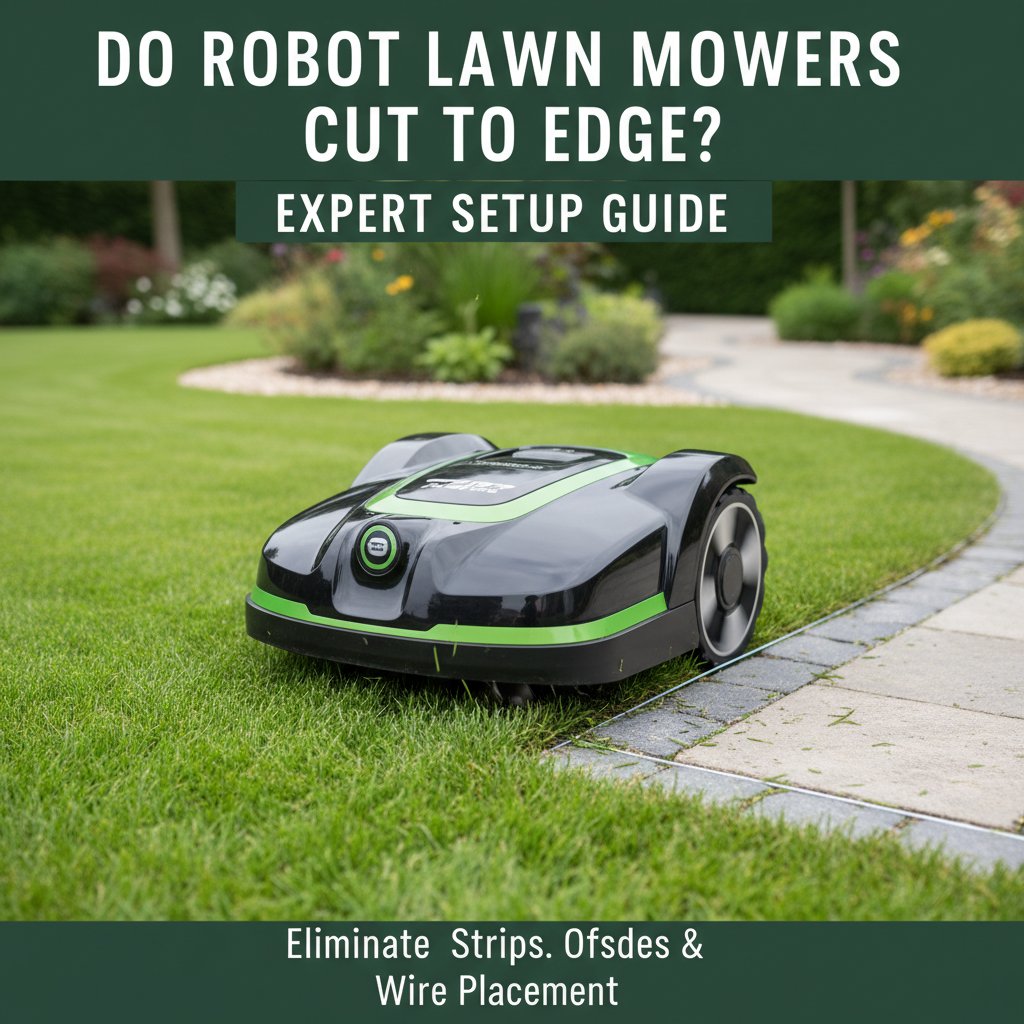
- Install Pavers: Lay a line of flat bricks or paving stones at the same level as the soil around the perimeter.
- Width Matters: Ensure the strip is at least 4 to 6 inches wide.
- The Result: The robot mower will drive its outer wheel onto the pavers, allowing the blades to cut the grass that grows right at the edge of the stone. This eliminates the need for a string trimmer entirely.
Step 4: Configure the “Edge Cut” Software Settings
Access your mower’s mobile app to enable specific perimeter behaviors. Many modern robots have a dedicated “Edge Cut” routine.
- Frequency: Set the mower to perform an “Edge Cut” at least twice a week. In this mode, the mower follows the boundary wire exactly before starting its random or systematic mow.
- Overdrive Distance: Some high-end models allow you to adjust how many inches the mower “overdrives” the wire. Increasing this by just 1-2 inches can drastically improve the finish near flower beds.
Tools and Materials Needed for Perfect Edging
If you are setting up a new installation or retrofitting an old one, having the right materials is essential for success.
| Tool/Material | Purpose | Recommended Type |
|---|---|---|
| Boundary Wire | Defines the cutting area | 14-gauge heavy-duty wire |
| Lawn Edging Pavers | Creates a flat “driving” surface | Flat concrete or brick |
| Wire Pegs | Secures wire to the ground | Plastic or biodegradable stakes |
| Digital Caliper/Ruler | Ensures precise wire placement | Standard metric/imperial ruler |
| Rubber Mallet | Drives pegs without breaking them | 16 oz. mallet |
Pro Tips for a Cleaner Lawn Perimeter
- Maintain the Edge Manually Once: Before your first robot mow of the season, use a manual edger to create a clean vertical cut between the grass and the border. This prevents “creeping” grass from growing over the wire.
- Check for Wire “Heaving”: Over time, soil can expand and contract, pushing the boundary wire upward. If the wire is too high, the mower might cut it. Ensure it is pegged every 2-3 feet.
- Manage Foliage: Keep low-hanging branches or overhanging bushes trimmed. If a bush blocks the mower’s “headspace,” it will turn away before it reaches the wire, leaving an uncut patch.
- Use Multi-Zone Settings: If your lawn has a narrow passage or a complex edge, create a “Zone” in the app specifically for that area and increase the mowing frequency there.
Common Mistakes to Avoid
- Installing Wire Too Deep: If you bury the wire more than 2-3 inches deep, the signal may weaken, causing the mower to “hunt” for the edge, resulting in a jagged cut.
- Ignoring the “Safety Buffer”: Never place the wire so close to a drop-off (like a pool or a steep retaining wall) that the mower could slip over the edge. Always leave at least 12 inches of level ground.
- Using Thin Wire: Cheap, thin wire breaks easily when the ground freezes or when you perform aeration. Invest in thick-jacketed boundary wire to avoid signal loss.
- Neglecting Blade Sharpness: Dull blades tear the grass at the edge rather than cutting it. This leads to brown, frayed tips that are more visible at the perimeter of the lawn.
Frequently Asked Questions (FAQ)
Can a robot mower cut right up to a brick wall?
No, most robot mowers will leave a 3 to 5-inch gap against a brick wall to prevent the machine from scratching itself. To fix this, you should install a flat mowing strip of pavers at the base of the wall.
Which robot mower is best for edging?
The Worx Landroid series is widely considered the best for edging due to its patented Cut-to-Edge offset blade design. High-end RTK mowers like the Mammotion Luba also offer superior precision through satellite navigation.
How do I stop my robot mower from leaving a “halo” of grass?
The “halo” is caused by the mower turning around before it reaches the edge. To stop this, you must either install a flush border that the mower can drive over or adjust the boundary wire closer to the edge (if the terrain allows).
Do I still need a string trimmer if I have a robot mower?
In most cases, yes. Unless you have a perfectly flat lawn with mowing strips around every single obstacle and wall, you will likely need to trim the edges manually once every 2-4 weeks.
Conclusion
While the dream of a 100% maintenance-free lawn is possible, it requires careful planning. Most robot lawn mowers do not cut to the edge out of the box due to safety-driven design limitations. However, by choosing a model with offset blades, precisely calibrating your boundary wire, and installing flush lawn borders, you can virtually eliminate the need for manual trimming.
By investing a little time in “robot-proofing” your landscape today, you ensure a pristine, professional-looking lawn that manages itself all season long. Ready to upgrade your lawn? Start by measuring your current perimeter gaps and considering a mowing strip installation this weekend.
**
**
**
**