

Quick Answer: Choose an electric mower for yards under 1/2 acre, flat terrain, and low maintenance. Choose a gasoline mower for large properties over 1/2 acre, steep hills, or thick, overgrown grass. Electric saves up to $200 annually on fuel and oil, while gas offers unlimited runtime and higher torque for difficult conditions.
Gas vs. Electric: The Complete 2026 Comparison
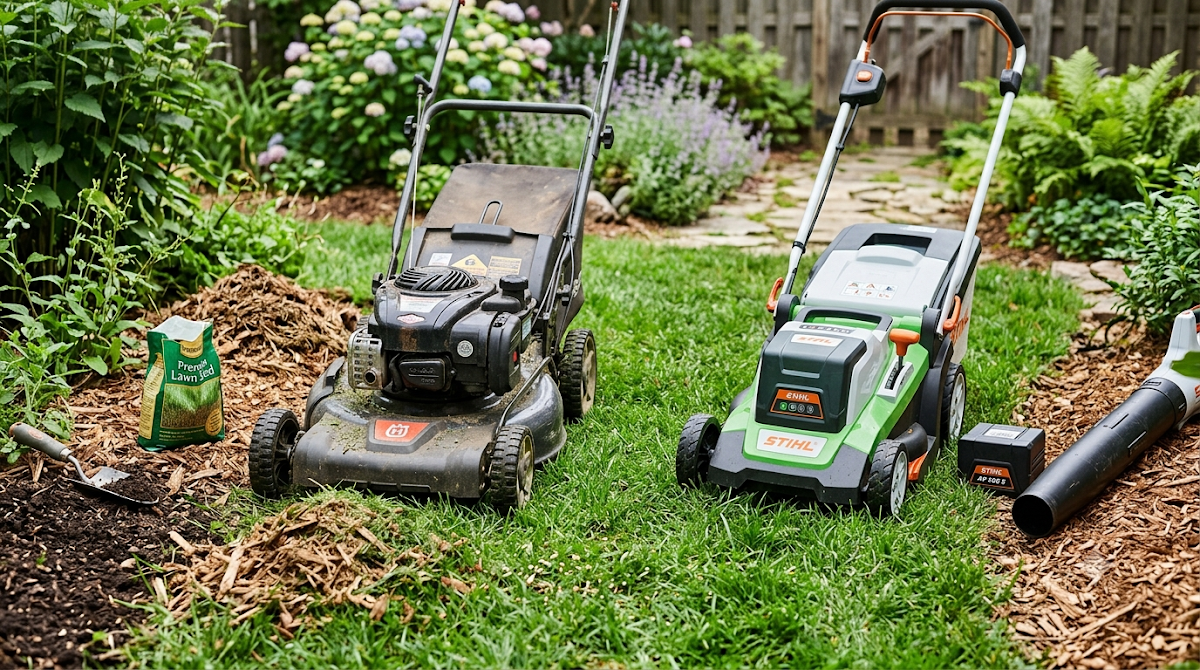
The lawn care industry has reached a tipping point. With national gasoline prices hovering around $4.09 per gallon and electric battery technology delivering 60+ minutes of runtime on a single charge, homeowners face a genuinely difficult choice. This guide cuts through the marketing noise to give you the technical specifications, real-world performance data, and decision framework you need to select the right mower for your specific situation.
Steven W. Halloway, a master turfgrass agronomist with over two decades of experience, breaks down every factor that matters: from cutting precision and grass health to long-term operating costs and environmental impact.
Side-by-Side Technical Comparison

The following table provides the precise metrics that separate these two mower categories. Use these numbers to match a mower to your yard’s specific demands.
| Feature | Gasoline Mower | Battery Electric Mower | Corded Electric Mower |
|---|---|---|---|
| Best For | Lawns 1/2 acre+, hills, thick grass | Lawns 1/4 to 1/2 acre, flat to moderate terrain | Lawns under 1/4 acre, flat terrain only |
| Cutting Width | 21″ to 30″ | 17″ to 21″ | 14″ to 17″ |
| Runtime | Unlimited (refuel as needed) | 45 to 75 minutes per charge | Unlimited (corded) |
| Weight | 70 to 100 lbs | 40 to 65 lbs | 30 to 50 lbs |
| Noise Level | 95 to 105 dB (loud conversation) | 60 to 75 dB (normal conversation) | 55 to 70 dB (quiet conversation) |
| Starting Method | Pull-cord or electric start | Push-button instant start | Push-button instant start |
| Annual Fuel Cost | $150 to $300+ (at $4/gal) | $15 to $30 (electricity) | $10 to $20 (electricity) |
| Annual Maintenance | $80 to $150 (oil, filters, spark plugs) | $0 to $25 (blade sharpening only) | $0 to $25 (blade sharpening only) |
| Upfront Cost | $250 to $600 | $300 to $700 (battery included) | $108 to $250 |
| Typical Lifespan | 10 to 15 years with maintenance | 7 to 10 years (battery replacement at year 5-7) | 5 to 8 years |
| Emissions | High (CO, NOx, particulates) | Zero at point of use | Zero at point of use |
Gasoline Lawn Mowers: The Power Advantage
Gas mowers remain the undisputed champion for demanding conditions. A typical 160cc to 190cc four-stroke engine produces significantly more torque than even the best battery-powered motors, which matters when you’re cutting through thick St. Augustine grass, tall fescue that hasn’t been mowed in two weeks, or navigating uneven terrain with embedded roots.
Gasoline Mower Strengths:
Unlimited runtime means you never stop mid-job to recharge. For properties exceeding half an acre, this alone can save 30 to 45 minutes per mowing session. Higher torque output handles dense, wet, or overgrown grass without bogging down or leaving uneven cuts. Wider cutting decks (21″ to 30″) cover more ground per pass, reducing total mowing time on large lawns. Proven durability in commercial and residential settings with parts readily available at any hardware store.
Gasoline Mower Weaknesses:
Regular maintenance is non-negotiable: oil changes every 50 hours, air filter replacement annually, spark plug service, and fuel stabilizer for winter storage. Noise levels between 95 and 105 dB can disturb neighbors and require hearing protection during extended use. At current gas prices ($4.09/gallon national average), a typical homeowner spends $150 to $300 per season on fuel alone. Starting can be frustrating, especially with older pull-cord models in cold weather.
Electric Lawn Mowers: The Convenience Revolution
Battery technology has matured dramatically. Modern 56V to 80V lithium-ion batteries deliver consistent power throughout the entire discharge cycle, unlike older lead-acid models that lost strength as they drained. Most premium battery mowers now include two batteries, effectively doubling runtime to 90+ minutes.
Electric Mower Strengths:
Push-button starting eliminates the pull-cord frustration entirely. Operating costs drop to $15 to $30 per season compared to $150 to $300 for gas. Zero emissions at the point of use improves air quality in your yard and eliminates exhaust fumes. Noise levels between 60 and 75 dB allow early morning or evening mowing without disturbing neighbors. Lower weight (40 to 65 lbs) reduces fatigue and makes storage easier, especially for older homeowners or those with physical limitations. Virtually maintenance-free beyond annual blade sharpening.
Electric Mower Weaknesses:
Limited runtime requires planning for larger yards. Battery degradation over 5 to 7 years means eventual replacement costs of $100 to $200. Narrower cutting decks (17″ to 21″) increase total mowing time on bigger properties. Less torque than gas engines can struggle with thick, tall, or wet grass. Corded models restrict movement to approximately 100 feet from the outlet, creating tripping hazards and limiting practical use to small, flat yards.
The True Cost Analysis: 5-Year Ownership Comparison
Understanding the total cost of ownership requires looking beyond the sticker price. Here’s a realistic five-year breakdown for a typical homeowner mowing a quarter-acre lawn weekly during a 25-week season:
| Cost Category | Gas Mower | Battery Electric Mower |
|---|---|---|
| Purchase Price | $350 | $450 |
| Fuel/Electricity (5 years) | $875 | $112 |
| Maintenance (5 years) | $500 | $75 |
| Battery Replacement (year 6) | N/A | $150 |
| Total 5-Year Cost | $1,725 | $787 |
| Annual Average | $345 | $157 |
The electric mower saves approximately $938 over five years, even accounting for battery replacement. This gap widens further in states with higher gas prices, such as California ($5.92/gallon) or Hawaii.
Decision Framework: Which Mower Matches Your Yard?
Use this diagnostic checklist to identify the optimal mower type for your specific situation:
| Your Situation | Recommended Mower | Reasoning |
|---|---|---|
| Under 1/4 acre, flat, minimal obstacles | Corded or Battery Electric | Lowest cost, lightest weight, sufficient runtime |
| 1/4 to 1/2 acre, flat to moderate slope | Battery Electric (56V+ with 2 batteries) | Best balance of convenience and capability |
| 1/2 to 1 acre, moderate terrain | Battery Electric (80V) or Gas | Electric works if terrain is manageable; gas for thick grass |
| Over 1 acre, any terrain | Gas Mower | Unlimited runtime essential; wider cutting decks available |
| Steep hills or uneven terrain | Gas Mower | Higher torque prevents bogging down on inclines |
| Thick, overgrown, or wet grass | Gas Mower | Superior torque handles demanding conditions |
| Noise-sensitive neighborhood | Battery Electric | 60-75 dB vs 95-105 dB for gas |
| Budget-conscious, small yard | Corded Electric | Starting at $108, lowest total cost of ownership |
| Eco-conscious homeowner | Battery Electric | Zero emissions; pair with solar panels for true zero-carbon mowing |
Expert Tips for Maximizing Your Mower Investment
Regardless of which type you choose, these agronomic best practices will protect your lawn’s health and extend your mower’s lifespan:
Blade Maintenance: Sharpen mower blades every 20 to 25 hours of use or at least twice per season. Dull blades tear grass rather than cutting it cleanly, creating brown tips that increase disease susceptibility. A sharp blade produces a clean cut that heals within 24 hours.
Cutting Height: Follow the one-third rule: never remove more than one-third of the grass blade in a single mowing session. For most cool-season grasses, maintain a height of 3 to 4 inches. Warm-season grasses like Bermuda perform best at 1.5 to 2.5 inches.
Mowing Pattern: Alternate your mowing direction each week to prevent soil compaction and encourage upright grass growth. This simple habit produces a healthier, more uniform lawn over time.
Battery Care (Electric Owners): Store batteries indoors during extreme temperatures. Lithium-ion batteries perform optimally between 50\u00b0F and 80\u00b0F. Avoid depleting batteries completely; recharge when 20% capacity remains to maximize battery lifespan.
Winter Storage (Gas Owners): Add fuel stabilizer to the tank before winter storage, run the engine for 5 minutes to circulate the treated fuel, then change the oil and remove the spark plug for inspection. This prevents carburetor gumming and ensures easy spring startup.
Frequently Asked Questions
Can electric mowers handle thick, tall grass as well as gas mowers?
Modern 80V battery mowers handle moderately thick grass effectively, but they still fall short of gas mowers in truly demanding conditions. If your grass exceeds 6 inches in height or you’re cutting through dense, wet growth, a gas mower’s superior torque (typically 5 to 8 ft-lbs vs. 3 to 5 ft-lbs for electric) will produce a cleaner, more consistent cut without bogging down. For best results with any mower, follow the one-third rule and mow regularly rather than letting grass grow excessively tall between sessions.
How long do electric mower batteries actually last before needing replacement?
Quality lithium-ion batteries in premium electric mowers (EGO, Greenworks, Ryobi 40V+) typically retain 80% of their original capacity after 500 to 800 charge cycles, which translates to 5 to 7 years of weekly mowing for most homeowners. Battery replacement costs range from $100 to $200 depending on voltage and capacity. To maximize battery lifespan, avoid complete discharge, store at room temperature, and use the manufacturer’s recommended charger.
Is it worth switching from gas to electric if my current gas mower still works?
The financial break-even point typically occurs within 2 to 3 years when switching from an older gas mower to a battery electric model. If your current gas mower requires significant repairs (carburetor rebuild, new pull-cord assembly, or engine work exceeding $150), switching to electric makes immediate financial sense. If your gas mower runs reliably and you have a large or challenging yard, continue using it until it reaches end-of-life, then evaluate whether electric technology has advanced enough to meet your needs at that point.
Do electric mowers cut grass as well as gas mowers for lawn health?
Cut quality depends more on blade sharpness and mowing habits than power source. A well-maintained electric mower with a sharp blade produces cuts indistinguishable from gas mower cuts on appropriate grass types and conditions. The key factors for lawn health are cutting at the correct height (3 to 4 inches for cool-season grasses), following the one-third rule, and mowing when grass is dry. Electric mowers’ lighter weight can actually benefit lawn health by reducing soil compaction on softer ground. For related insights, see our detailed guide on Mulch Installation Cost 2025.