
Quick Answer: A grub is the C-shaped larval stage of beetles like Japanese, June, and masked chafers that live underground and feed on grass roots. In healthy lawns, treat preventatively in late spring (when soil temps hit 55\u00b0F) or curatively in late summer when you confirm 10+ grubs per square foot.
What Is a Grub? The Complete Identification Guide
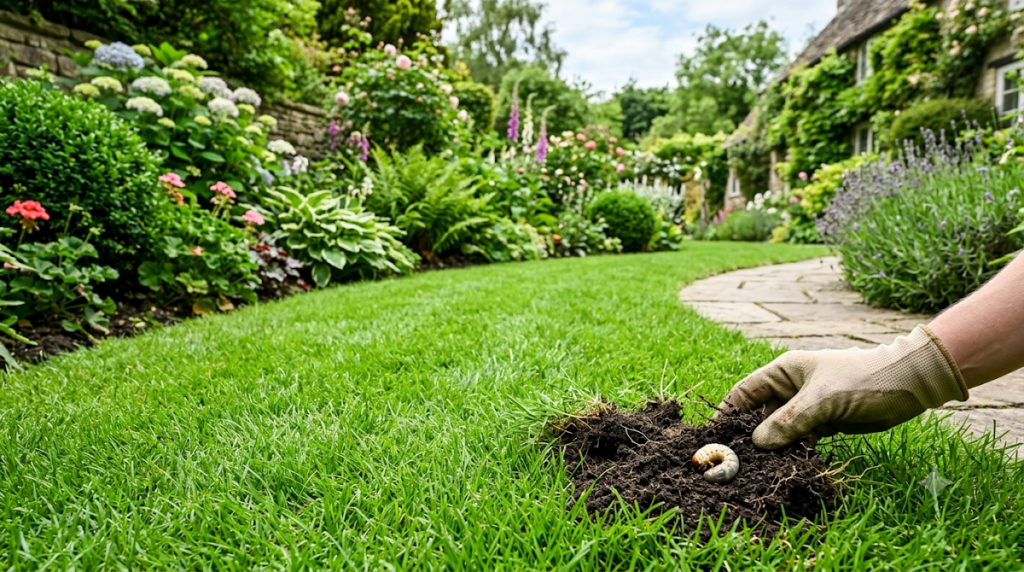
A grub is the soft-bodied, milky-white larval stage of scarab beetles. These C-shaped pests hatch from eggs laid in your soil, then spend weeks feeding on grass roots just beneath the surface. While a few grubs are harmless, a population spike can destroy a lawn in days.
Understanding the grub’s biology, visual traits, and life cycle is the foundation of effective control. Treating at the wrong stage wastes money and leaves your turf vulnerable.
What Do Grubs Look Like?
Grubs have a distinctive, unmistakable appearance. Adult grubs are \u00be to 1 inch long with a creamy white body, a brownish-orange head capsule, and three pairs of legs near the front. When disturbed, they curl into a tight “C” shape\u2014this is the classic identification feature that separates grubs from caterpillars, earthworms, or millipedes.
Newly hatched grubs are tiny (about \u215b inch) and translucent. They darken and grow over 3\u20135 weeks, molting through three instars before pupating.
Common Grub Species Comparison
| Species | Adult Beetle | Grub Size | Peak Feeding | Common Regions |
|---|---|---|---|---|
| Japanese beetle | Metallic green/bronze, \u00bd in | Up to 1 in | Late summer | Eastern & central US |
| June beetle | Reddish-brown, 1 in | Up to 1\u00bc in | Fall & spring | Widespread |
| European chafer | Tan/brown, \u00bd in | Up to \u00be in | Fall | Northeast, Midwest |
| Masked chafer | Tan with darker head | Up to 1 in | Late summer | Southeast, Midwest |
| Billbug (lookalike) | Dark weevil, not a beetle | Legless, white | Late spring | Widespread |
Pro Tip: Billbug larvae are legless and straight, not C-shaped. If you find those, grub treatments won’t work\u2014you need a different insecticide class.
Signs of a Grub Infestation (Diagnostic Checklist)
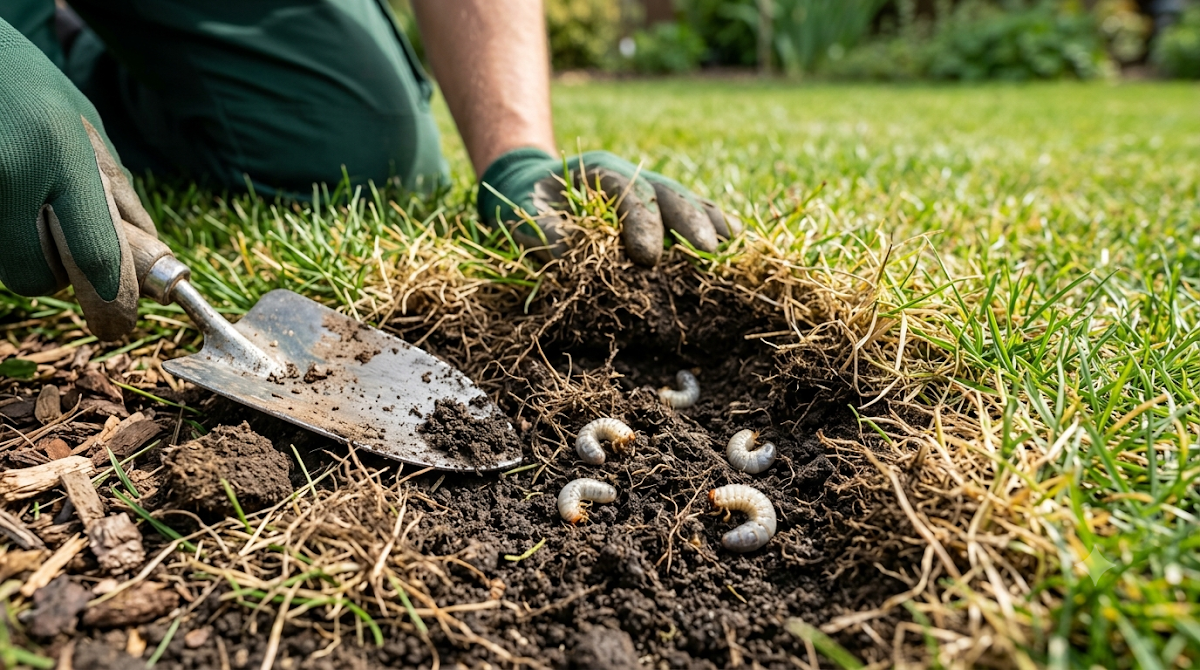
Grubs feed on roots, which means the visible damage looks like drought stress but doesn’t recover with water. Watch for these five warning signs:
- Spongy, rolled-up turf: The sod lifts like a loose carpet because roots are severed.
- Irregular brown patches: Damage appears in mid-summer or early fall, not during a drought.
- Animal digging: Skunks, raccoons, and crows tear up your lawn to feast on the protein-rich grubs.
- Birds pecking: A sudden flock of grackles or starlings feeding at dawn is a red flag.
- Easy root pull: Dead turf pulls up like carpet, revealing shredded roots and white grubs underneath.
How to Scout for Grubs (The Exact Method)
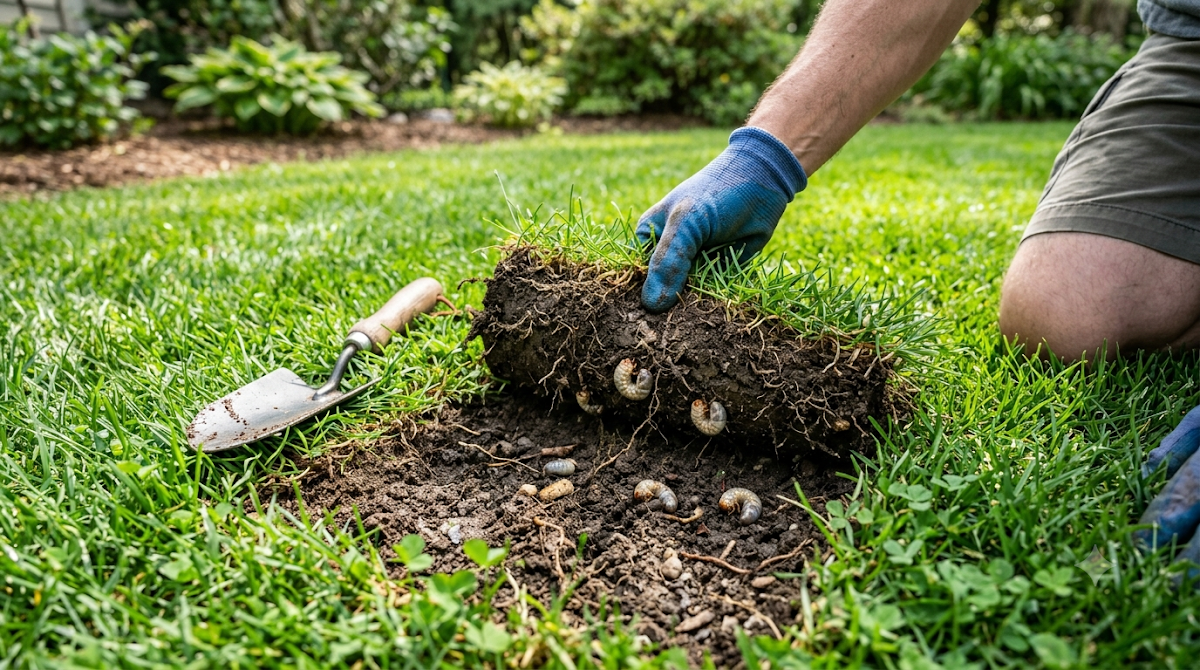
Don’t guess\u2014sample. Here’s the professional scouting procedure:
- Choose a hot, sunny day. Warm soil brings grubs closer to the surface, improving accuracy.
- Cut a 1-square-foot patch of turf on three sides with a sharp spade, about 3 inches deep. Hinge the flap back.
- Count the grubs in the soil and root zone.
- Repeat at 5\u201310 locations across the lawn, especially near the damage edges.
- Replace the sod and firm it down.
Action Threshold: 0\u20135 grubs per square foot = no treatment needed. 6\u20139 = monitor and improve turf health. 10+ = treat immediately.
How to Get Rid of Grubs (Step-by-Step Protocol)
Step 1: Confirm the Damage Is Grubs
Scout using the method above. Skip chemicals if you don’t hit the 10-grub threshold. Misdiagnosis is the #1 cause of wasted pesticide applications.
Step 2: Choose the Right Product Type
There are two distinct approaches, and using the wrong one fails:
| Category | Active Ingredients | Best Timing | How It Works |
|---|---|---|---|
| Preventative | Chlorantraniliprole, imidacloprid, thiamethoxam | April\u2013June (soil 55\u201365\u00b0F) | Kills young larvae as they hatch |
| Curative | Carbaryl (Sevin), trichlorfon (Dylox) | Late summer (soil 65\u201375\u00b0F) | Fast knockdown of active grubs |
Step 3: Apply Correctly
- Irrigate lightly (\u00bd inch) the day before to move the product into the root zone.
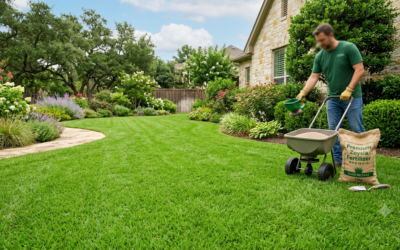
- Calibrate your spreader to the label rate\u2014never guess.
- Apply to a dry lawn for even granule distribution.
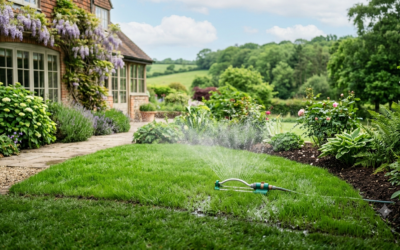
- Water in immediately with \u00bd\u20131 inch of irrigation within 24 hours.
- Keep pets and kids off until the product dries completely.
Safety Check: Wear gloves, long sleeves, and a mask when handling granular insecticides. Store products away from children and follow local disposal rules.
Step 4: Support Lawn Recovery
Grub control doesn’t regrow grass\u2014it just stops the killing. After treatment:
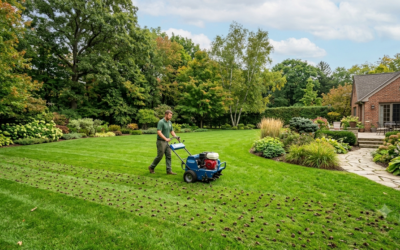
- Aerate compacted areas to stimulate root regrowth.
- Overseed bare patches in early fall (with Kentucky bluegrass or fescue, depending on region).
- Fertilize with a balanced formula (10-10-10) to rebuild turf density.
- Water deeply but infrequently to encourage deep rooting.
When to Treat for Grubs (Life Cycle Timing)
The single most critical factor in grub control is timing. Here’s the exact lifecycle timeline:
Late Spring (Soil 55\u201365\u00b0F): Adult beetles emerge, mate, and lay eggs. This is your only window for preventative insecticides.
Mid\u2013Late Summer (July\u2013August): Eggs hatch into tiny first-instar grubs. These are most susceptible to preventative chemicals already in the soil.
Late Summer / Early Fall: Grubs feed aggressively on roots. Use fast-acting curative products now if you see damage.
Fall\u2013Winter: Grubs burrow deep and go dormant. Do not treat\u2014products won’t reach them.
Early Spring: Grubs briefly feed before pupating, but damage is often minimal. Curative treatments work best in late summer.
What If You Already Have Damage?
If it’s early fall and you’re confident grubs are present, use a curative product immediately. If you missed the curative window (after soil temps drop below 55\u00b0F), wait until next spring. A late preventative application is wasted money\u2014the product won’t degrade in time to catch next year’s hatch.
Expert Troubleshooting
My Lawn Isn’t Recovering After Treatment
Grubs may not be your only problem. Drought damage, fungal disease (brown patch), or heavy thatch can mimic grub damage. Re-scout and check for fungal mycelium at the soil line before applying more chemicals.
It Rained After I Applied Preventative
Heavy rain (over 1 inch) within 24 hours can wash granules away or too deep. If your product was watered into the soil and you get a downpour within 2 days, consider a repeat application at half rate.
When to Call a Professional
Call a certified pest control operator when you have over 20 grubs per square foot, your lawn is more than 50% damaged, or you’ve treated twice without improvement. Professionals can apply restricted-use products and verify the diagnosis with soil sampling.
FAQs
Are grubs harmful to humans or pets?
No. Grubs do not bite, sting, or transmit disease to people or pets. The risk comes from insecticides, not the grubs themselves. However, dogs may eat grubs while digging\u2014this is generally harmless but can cause mild stomach upset.
How do I know if my lawn has grubs without digging?
The most reliable indicator is wildlife behavior. If skunks, raccoons, or birds tear up your lawn in a patchwork pattern during late summer, you almost certainly have grubs beneath the surface. You can also tug on dead turf\u2014if it peels back like carpet with roots shredded, grubs are the likely culprit.
Will grubs kill my lawn completely?
Yes, if left unchecked. A severe infestation (10+ per square foot) can destroy roots faster than the grass can recover, especially in warm-season lawns. However, healthy, deeply rooted grass can often survive moderate feeding because the crown (the growth point) remains intact even when roots are damaged.
Do grub killers work immediately?
Only curative products (carbaryl, trichlorfon) act fast\u2014typically killing grubs within 24\u201348 hours of watering in. Preventative products (chlorantraniliprole, imidacloprid) are slow-acting by design; they build up in the soil and kill young grubs as they hatch, which takes weeks. Pair the product type with your situation. For related insights, see our detailed guide on Grass Clippings as Mulch.