
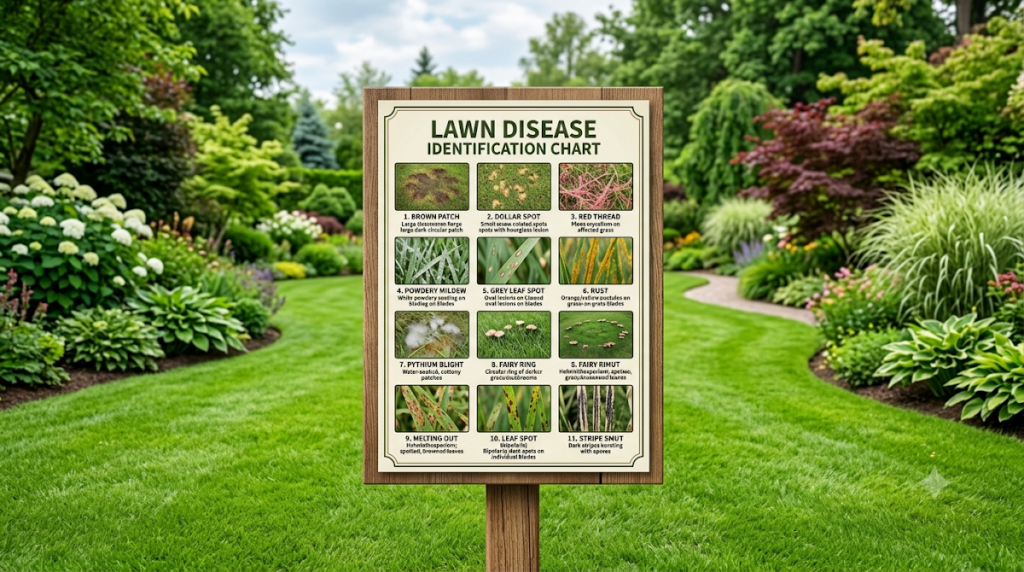
Quick Answer: Identify your lawn disease by pattern, color, and timing. Look for circular brown patches (Brown Patch, 65\u201385\u00b0F), silver-dollar spots with tan centers (Dollar Spot, 60\u201380\u00b0F), or pink cottony threads (Red Thread, 40\u201370\u00b0F). Match blade symptoms to our chart below, then treat with the correct fungicide or cultural fix within 7\u201310 days for best results.
Why Disease Identification Matters
Misdiagnosing a lawn disease is more expensive than not treating it at all. A fungicide for Brown Patch won’t touch Fairy Ring, and the wrong cultural practice\u2014like raising mower height for shade\u2014can worsen Dollar Spot. This guide gives you the precise visual cues, environmental triggers, and treatment timing for the 11 most common turf diseases in the United States. Bookmark it, print it, and keep it in your shed.
Step 1: Read the Environment First
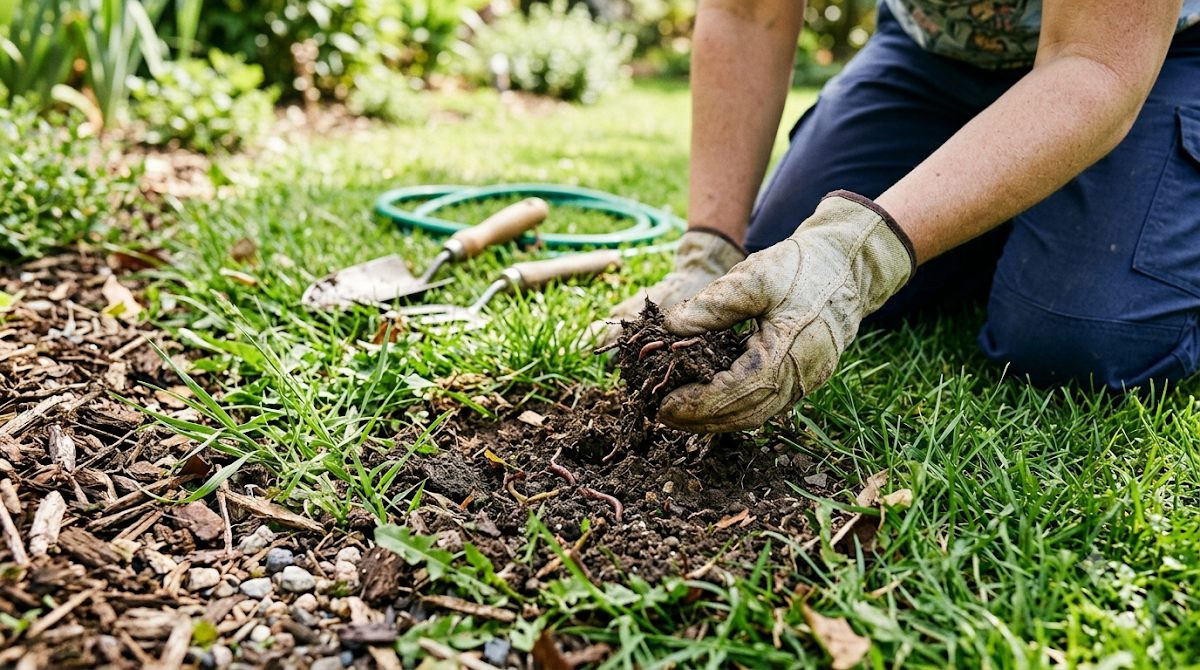
Before you inspect a single blade, collect three data points. Soil temperature at 2 inches depth (use a meat thermometer or soil probe), recent rainfall or irrigation patterns, and mowing height. These three factors alone eliminate half the diseases on this list. Most turf pathogens are temperature-specific: Pythium thrives above 80\u00b0F, while Red Thread appears only when soil is below 70\u00b0F. Record these numbers, then work through the diagnostic table below.
Step 2: Match Symptoms to Our Diagnostic Table
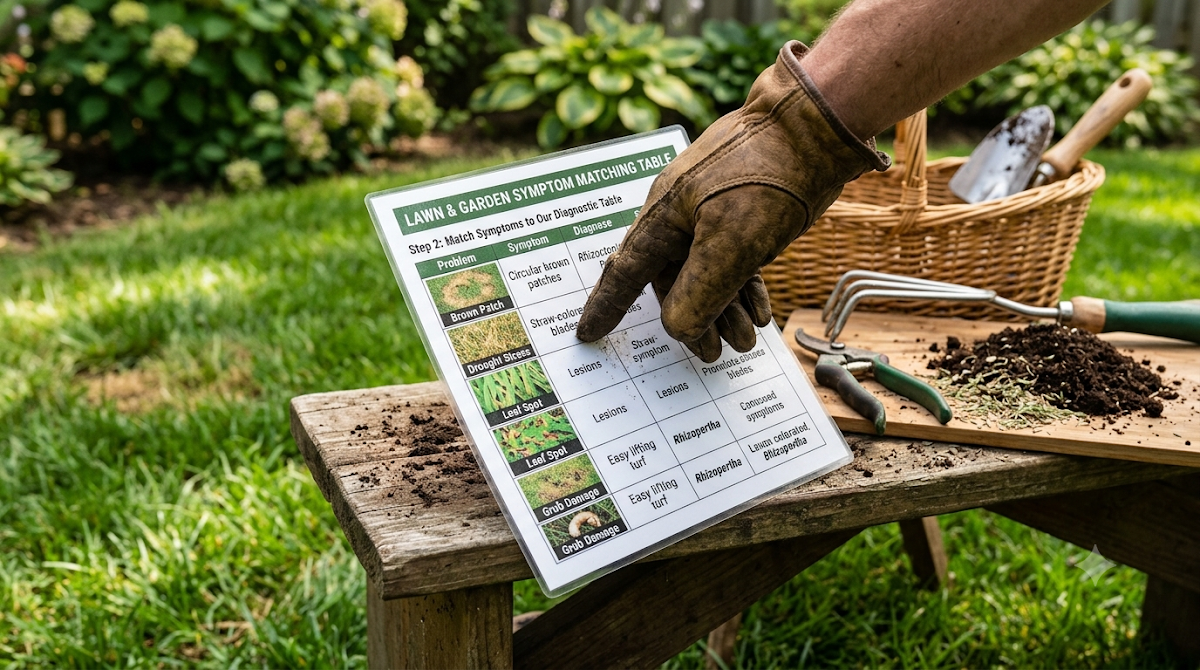
| Disease | Patch Shape & Size | Blade Appearance | Active Soil Temp | Key Trigger |
|---|---|---|---|---|
| Dollar Spot | Circular, 2\u20136 in. (silver dollar) | Tan/bleached center, reddish-brown border | 60\u201380\u00b0F | Low nitrogen, heavy dew |
| Red Thread | Irregular, 2 in.\u20132 ft. | Pink or red cottony threads on tips | 40\u201370\u00b0F | Nitrogen deficiency, cool wet springs |
| Brown Patch | Circular, 1\u20133 ft. (frogs-eye center) | Dark, water-soaked rings; brown collapsed center | 65\u201385\u00b0F | Excess nitrogen, night irrigation |
| Large Patch | Irregular, 2\u201310 ft. (Zoysia/St. Aug.) | Yellow-orange border, tan center | 60\u201380\u00b0F | Warm-season grass, fall/winter |
| Yellow Patch | Circular, 1\u20133 ft. | Yellow-orange margins, no blight | 35\u201355\u00b0F | Heavy thatch, snow cover |
| Pythium Blight | Irregular streaks, 2\u20136 in. | Greasy, dark, matted; white fuzz at dawn | 80\u201395\u00b0F | Poor drainage, 90% humidity |
| Fairy Ring | Arc or full circle, 1\u201312 ft. | Dark green ring, mushrooms/toadstools | Any (mostly summer) | Underground organic matter |
| Gray Leaf Spot | Irregular, 1\u20134 in. | Oval spots with purple/brown border | 75\u201385\u00b0F | St. Augustine, heavy nitrogen |
| Fusarium Blight | Crescent/circular, 6 in.\u20133 ft. | Reddish-brown crown rot | 75\u201390\u00b0F | Heat stress, compacted soil |
| Powdery Mildew | Diffuse, no defined border | White/gray powder on upper blades | 60\u201370\u00b0F | Shade, poor air circulation |
| Spring Dead Spot | Circular, 6 in.\u20133 ft. | Sunken, bleached; roots dead | 50\u201365\u00b0F (spring) | Bermudagrass, winter injury |
Step 3: Precise Identification Workflow (Dollar Spot Example)
Here’s the exact 4-step procedure I use in the field to confirm a suspected Dollar Spot infection. The same workflow applies regardless of which disease you suspect.
1. Measure patch diameter. Dollar Spot patches are 2\u20136 inches across\u2014smaller than a coffee saucer. If your patch exceeds 8 inches, suspect a different pathogen.
2. Examine the blade at 10\u00d7 magnification. Look for the hourglass lesion: a tan center constricted between two darker brown bands across the leaf blade, not at the base. This is the disease’s fingerprint.
3. Check for morning mycelium. At dawn, before dew evaporates, run your fingers through the affected area. Dollar Spot produces white, cobweb-like fungal threads that disappear by 10 AM. If you see pink threads instead, it’s Red Thread.
4. Verify soil temperature and history. Confirm soil is 60\u201380\u00b0F, and review your last three nitrogen applications. Dollar Spot is a classic sign of low-nitrogen stress. If you’ve applied less than 4 lbs of N per 1,000 sq ft per year, this is almost certainly your culprit.
Step 4: Treat by Category, Not by Name
Diseases cluster into two treatment families. Foliar diseases (Dollar Spot, Red Thread, Gray Leaf Spot, Powdery Mildew) live on the leaf blade. Treat these with contact fungicides like chlorothalonil or iprodione, applied to dry foliage with a spreader-sticker adjuvant. Root/crown diseases (Brown Patch, Large Patch, Pythium, Spring Dead Spot) attack the crown and roots. These require systemic fungicides\u2014propiconazole or azoxystrobin\u2014followed by 0.5 inches of irrigation to move the chemical to the root zone.
Troubleshooting Common Mistakes
Mowed too early after treatment? Wait 48 hours after a contact fungicide application before mowing; systemic products need a full 72 hours. Mowing early removes the protective layer and spreads spores to clean turf.
Wet weather delaying your spray? Contact fungicides fail in rain. Skip the application and let the blade surface dry for 24 hours. Instead, apply a systemic product on the soil surface\u2014it absorbs through roots regardless of leaf wetness. Never spray in wind above 10 mph.
Patches returning despite treatment? You’re likely treating symptom, not cause. Re-treat with a different fungicide class (alternate triazoles and strobilurins) and test soil pH. Many “recurrences” are actually cultural issues\u2014thatch above 0.5 inches or potassium deficiency\u2014mimicking disease symptoms.
FAQ
Q: How can I tell if I have a lawn disease or just a fungal problem like dry patch?
A: Press a 4-inch screwdriver into the affected area. If it penetrates easilyestr, your problem is disease. If it resists, you have dry patch from hydrophobic soil\u2014no fungicide will help. Water with a wetting agent instead.
Q: Should I apply fungicide preventively before symptoms appear?
A: Only for Pythium and Large Patch, which cause permanent damage within 24\u201348 hours of infection. Skip preventive sprays for Dollar Spot and Red Thread; these only occur with improper nitrogen levels and recover with a 0.5 lb/1,000 sq ft nitrogen application.
Q: Is lawn disease contagious to my other plants or pets?
A: Lawn fungi are turf-grass-specific. They won’t infect your tomatoes or landscaping shrubs)Skip, but some species produce mycotoxins. Keep children and pets off infected areas for 24 hours after fungicide application, and always wash garden tools with 10% bleach between areas to avoid spreading spores.
Q: When should I call a professional turf expert?
A: If patches exceed 12 inches in diameter despite two correct fungicide applications, or if you have more than 30% turf loss, stop treating. A professional needs to do a soil test and lab culture\u2014DIY guessing at that stage wastes money and risks permanent lawn replacement.
Final Checklist for Resilient Turf
- Mow at 3\u20134 inches for cool-season grass; never remove more than \u2153 of blade height.
- Sharpen mower blades monthly\u2014dull blades tear grass, inviting infection.
- Water deeply (1 inch weekly) early morning, never at night.
- Test soil annually; keep pH 6.0\u20137.0 for most grasses.
- Aerate compacted soil each fall to reduce thatch buildup.
With this chart and workflow, you can confidently diagnose and treat any of the 11 common diseases. When in doubt, the environment\u2014soil temperature, moisture, and blade symptoms\u2014will always point you to the right answer. For related insights, see our detailed guide on Sprinkler Repair Cost.