

Quick Answer: No, you should not mow wet grass. Wet grass tears instead of cutting cleanly, spreads fungal diseases like brown patch, clogs mower decks, and creates dangerous slip hazards. Wait 24\u201348 hours after rain until grass blades are dry and the soil surface is firm before mowing.
Should You Mow Wet Grass? The Short Answer Is No
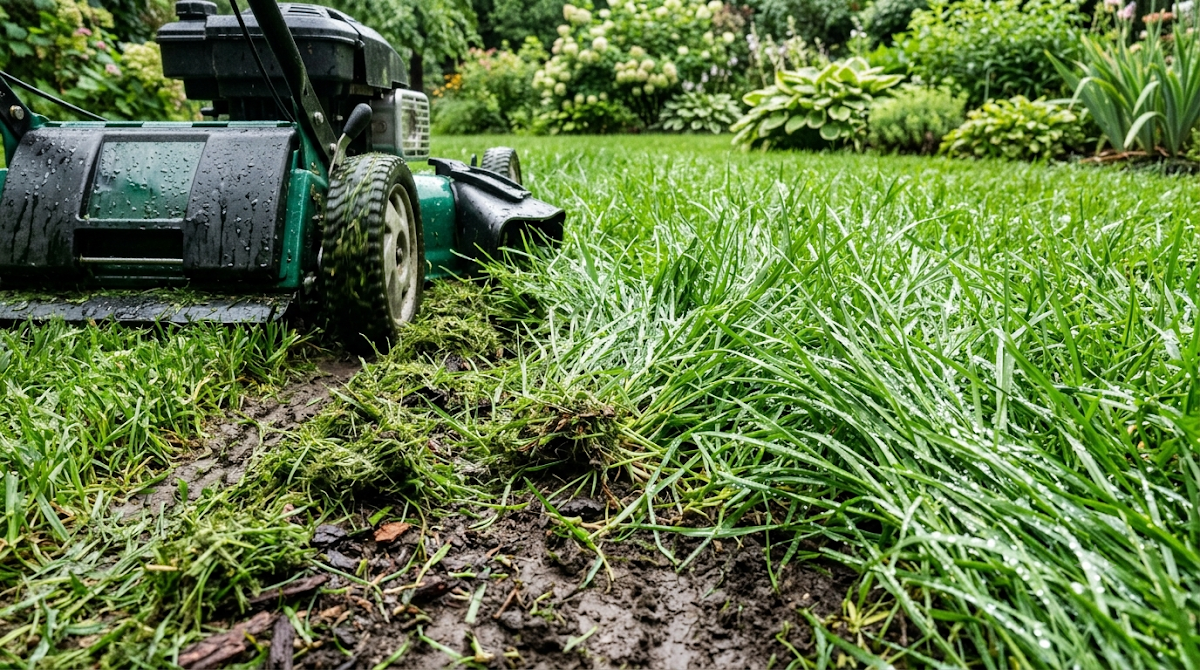
Every homeowner has faced this dilemma: rain is forecast for tomorrow, your grass is already pushing past the ideal height, and the morning dew hasn’t burned off yet. Can you just push through it and mow wet grass? The answer is a firm no \u2014 and the reasons go far deeper than a messy-looking lawn.
As a turfgrass agronomist with over two decades of field experience, I have seen firsthand how a single mow on saturated turf can undo months of careful lawn management. Wet grass creates a cascade of problems \u2014 from torn blade tissue and soil compaction to mower deck corrosion and serious personal injury risk. Below, I break down exactly why mowing wet grass is harmful, how long you should wait after rain, and what to do if you truly have no other option.
7 Scientific Reasons You Should Never Mow Wet Grass
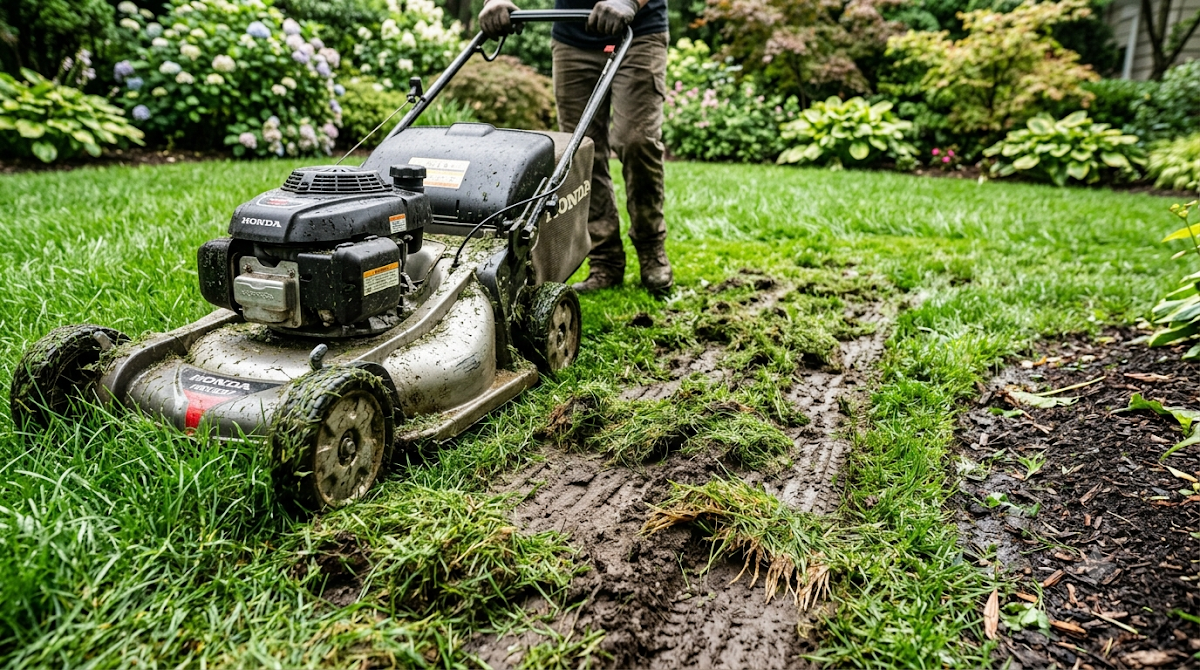
Wet grass is not just an inconvenience \u2014 it is a genuine threat to your lawn’s long-term health. Here are the primary reasons, ranked by severity of turf damage.
1. Wet Grass Tears Instead of Cutting Cleanly
When grass blades are saturated with water, they become heavy and limp. Instead of standing upright for a clean cut, they bend and flatten under the mower’s weight. The blade passes over them without slicing, or worse, tears the tissue raggedly. These torn ends turn brown within 24\u201348 hours as the damaged cells lose moisture \u2014 a condition called “leaf tip desiccation.” A clean cut on dry grass heals in hours; a tear on wet grass leaves the plant vulnerable for days.
2. Mowing Wet Grass Spreads Lawn Diseases
Fungal pathogens thrive in moisture. When you mow wet grass, your mower blades and deck become vectors, picking up spores from infected areas and depositing them across the entire lawn. Common diseases spread this way include:
\u2022 Brown patch (Rhizoctonia solani) \u2014 thrives in warm, wet conditions above 80\u00b0F soil temperature
\u2022 Dollar spot (Clarireedia jacksonii) \u2014 spreads rapidly through contact with wet clippings
\u2022 Pythium blight \u2014 can devastate cool-season lawns in a single season if spread by mowing
The risk is especially high when soil temperatures are between 65\u201385\u00b0F and humidity exceeds 80%.
3. Soil Compaction from Mower Weight on Wet Ground
Saturated soil has no structural integrity. When a mower \u2014 weighing 80 to 120 pounds \u2014 rolls across wet turf, it compresses the soil particles together, eliminating the air pockets that roots need to breathe. Compacted soil reduces water infiltration by up to 50%, restricts root growth, and creates standing water puddles. The damage may not be visible immediately, but over a single season of wet mowing, you will notice thinning turf and increased weed pressure as grass roots struggle to penetrate the hardened surface.
4. Mower Deck Clogging and Mechanical Damage
Wet grass clippings are sticky. They clump together and adhere to the underside of the mower deck, the discharge chute, and the bagging system. This buildup restricts airflow, reduces cutting efficiency by up to 40%, and forces the engine to work harder \u2014 increasing fuel consumption by 15\u201325%. Over time, trapped moisture accelerates rust and corrosion on steel decks, shortening the life of your mower significantly.
5. Safety Hazards: Slips, Falls, and Electrical Risk
Wet grass is one of the most slippery surfaces in a residential landscape. Walking behind a push mower or riding a zero-turn on wet turf dramatically increases the risk of slips and falls. If you use an electric mower, wet conditions also raise the risk of electrical shock, especially with corded models. Even gas-powered mowers can become dangerous when wet grass clogs the discharge chute and the operator reaches in to clear it \u2014 often while standing on slick ground.
6. Poor Mulching and Clipping Distribution
Modern mulching mowers are engineered to recirculate dry clippings and distribute them evenly across the lawn, where they decompose and return nitrogen to the soil. Wet clippings defeat this system entirely. They clump in heavy mats that smother the grass beneath, block sunlight, trap moisture against the crown, and create ideal conditions for fungal growth. If you bag your clippings, wet grass is significantly heavier \u2014 a full bag can weigh two to three times more than dry clippings, making disposal more difficult.
7. Uneven Cut and Poor Lawn Appearance
Because wet grass bends rather than stands, the mower cuts at inconsistent heights. Some blades are cut short while others are missed entirely. Once the grass dries and springs back upright, the lawn reveals a patchy, uneven appearance with visible wheel tracks and striping. This unevenness is not just cosmetic \u2014 it creates areas of varying grass height that promote uneven growth patterns and make future mowing more difficult.
How Long Should You Wait After Rain Before Mowing?
The waiting period depends on several factors. Use this diagnostic table to determine when your lawn is ready:
| Condition | Wait Time | How to Test |
|---|---|---|
| Light rain or morning dew | 2\u20134 hours | Walk across the lawn \u2014 if your shoes stay dry, it is safe to mow |
| Moderate rain (under 0.5 inches) | 24 hours | Press your thumb into the soil \u2014 if it springs back without leaving an indentation, the surface is firm enough |
| Heavy rain (over 0.5 inches) | 24\u201348 hours | Perform the “shoe test” \u2014 walk 20 steps; if the soles of your shoes are wet, wait longer |
| Sustained rain or waterlogged soil | 48\u201372 hours | Use a soil moisture meter \u2014 mow only when the top 2 inches read below 60% moisture capacity |
| Early morning dew only | Wait until 10:00 AM\u201312:00 PM | Dew typically evaporates by mid-morning on sunny days above 65\u00b0F |
Pro tip: The best time to mow is between 10:00 AM and 4:00 PM, when morning dew has evaporated and before evening moisture settles. This window gives you the driest grass and the safest conditions.
What to Do If You Absolutely Must Mow Wet Grass
Sometimes the schedule leaves you no choice \u2014 a storm is coming, you have a weekend-only window, or a property deadline demands it. If you must mow wet grass, follow these damage-reduction steps:
Step 1: Raise your mower deck. Set the cutting height 1\u20132 inches higher than your normal setting. This reduces the amount of wet tissue the blade contacts and minimizes clumping. For most cool-season grasses, mow at 3.5\u20134 inches instead of the standard 2.5\u20133 inches.
Step 2: Ensure your blades are razor-sharp. A dull blade tears dry grass; on wet grass, it shreds it. Sharpen or replace mower blades before mowing wet turf. Blades should be able to slice through a piece of paper cleanly \u2014 if they cannot, they are too dull.
Step 3: Switch to side discharge mode. Mulching and bagging both fail with wet clippings. Side discharge allows the wet clippings to scatter rather than clump. Avoid discharging clippings into garden beds or against fences, where wet clumps will smother plants.
Step 4: Mow slowly and overlap passes. Reduce your ground speed by 30\u201350%. Wet grass requires more blade contact time for a clean cut. Overlapping passes by 4\u20136 inches compensates for blades that bend and escape the first pass.
Step 5: Clean your mower immediately after. Wet clippings left on the deck will rust the metal and breed bacteria. Use a garden hose to spray the underside of the deck, then run the mower for 30 seconds to fling out remaining moisture. Dry the deck with a towel if possible.
What Happens If You Already Mowed Wet Grass?
If you have already mowed wet grass and are seeing brown tips, clumped clippings, or wheel tracks, here is how to mitigate the damage:
\u2022 Brown, ragged tips: These will grow out within 7\u201314 days. Do not mow again until the tips recover. Apply a light dose of nitrogen fertilizer (0.5 lb per 1,000 sq ft) to accelerate regrowth.
\u2022 Clumped wet clippings: Rake them up by hand or use a leaf blower to break them apart. Leaving wet clumps will kill the grass beneath within 3\u20135 days.
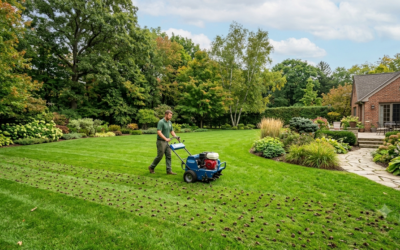
\u2022 Wheel track compaction: Aerate the affected areas with a core aerator within 2 weeks. This restores air flow to the root zone and helps the turf recover.
\u2022 Signs of fungal disease: Apply a broad-spectrum fungicide immediately. Look for circular brown patches, white fungal threads, or a musty smell in the thatch layer.
Frequently Asked Questions
Can you mow grass that has morning dew on it?
Light morning dew is generally acceptable to mow through, especially if you wait until mid-morning (10:00 AM or later) when the sun has begun to dry the grass. The key test is simple: walk across the lawn in your mowing shoes. If the soles come away dry or only slightly damp, the grass is dry enough to cut cleanly. If your shoes are visibly wet or leaving footprints in the turf, wait another 1\u20132 hours.
Is it okay to mow wet grass with a riding mower?
A riding mower is actually worse on wet turf than a push mower because it weighs significantly more \u2014 typically 400 to 700 pounds. This additional weight increases soil compaction dramatically. If you must use a riding mower on wet grass, choose the driest path possible, avoid making tight turns (which tear wet turf), and raise the deck to its highest practical setting. However, a push mower or self-propelled walk-behind is always the safer choice on wet ground.
How long after rain can you mow Bermuda grass versus fescue?
Bermuda grass, a warm-season grass with aggressive rhizomes, recovers faster from wet mowing damage than tall fescue. Bermuda can tolerate mowing 24 hours after moderate rain, while tall fescue \u2014 with its deeper but more sensitive root system \u2014 should wait a full 48 hours. Zoysia grass falls in between at approximately 36 hours. Regardless of species, the shoe test remains the most reliable field indicator.
Does mowing wet grass cause more thatch buildup?
Yes. Wet clippings are heavier and more cohesive than dry clippings. When mulched, they tend to mat together in the thatch layer rather than decomposing individually. Over multiple wet mowing sessions, this accelerates thatch accumulation to over 1 inch \u2014 the threshold where thatch begins to harbor pests, block water, and starve the root zone of nutrients. If you regularly mow in wet conditions, plan to dethatch your lawn once per year using a power dethatcher set to remove no more than 0.5 inches at a time.
Steven W. Halloway is a certified turfgrass agronomist and the founder of GardenReview.us. With over 20 years of experience in lawn science and landscape management, he helps homeowners make data-driven decisions about lawn care. For related insights, see our detailed guide on Fertilizer for Bermuda Grass.