
Quick Answer: The best fertilizer for bermudagrass is a slow-release nitrogen blend (like 16-4-8 or 15-0-15) applied at 1 lb of nitrogen per 1,000 sq ft. Fertilize only when soil temps hit 65\u00b0F (spring green-up) through late summer. Stop nitrogen 6\u20138 weeks before first frost. Always follow a soil test.
Why Bermudagrass Has Unique Fertilizer Needs
Bermudagrass (Cynodon dactylon) is a warm-season grass that thrives on heat and sunlight. Unlike cool-season grasses (fescue, bluegrass) that feed in spring and fall, bermudagrass does its heavy feeding during summer’s heat. Understanding this growth cycle is the key to choosing the right fertilizer\u2014and avoiding costly mistakes like forcing growth too early or too late.
Bermudagrass requires 2 to 4 pounds of actual nitrogen per 1,000 square feet per growing season. This nitrogen should be split across 3 to 5 applications, never dumped all at once. Over-fertilizing causes thatch buildup, disease pressure, and excessive growth that requires frequent mowing.
The 3 Numbers on the Bag: N-P-K Explained
Every fertilizer bag shows three numbers (e.g., 16-4-8). These represent the percentage of Nitrogen (N), Phosphorus (P), and Potassium (K) by weight. For bermudagrass, nitrogen drives green growth and density. Phosphorus supports root development (often already sufficient in established lawns). Potassium builds drought and disease tolerance.
| Nutrient | Role in Bermudagrass | When It Matters Most |
|---|---|---|
| Nitrogen (N) | Leaf growth, color, density | Late spring through summer |
| Phosphorus (P) | Root establishment, seedling vigor | New lawns, spring establishment |
| Potassium (K) | Drought tolerance, disease resistance, winter hardiness | Late summer and fall |
Pro tip: For an established bermudagrass lawn, choose a fertilizer with low or zero phosphorus (the middle number). Many states restrict phosphorus use because it causes algae blooms in waterways. A 15-0-15 or 16-0-8 formula is ideal for mature lawns.
Best Fertilizer Types for Bermudagrass
1. Slow-Release Nitrogen (Best Overall)
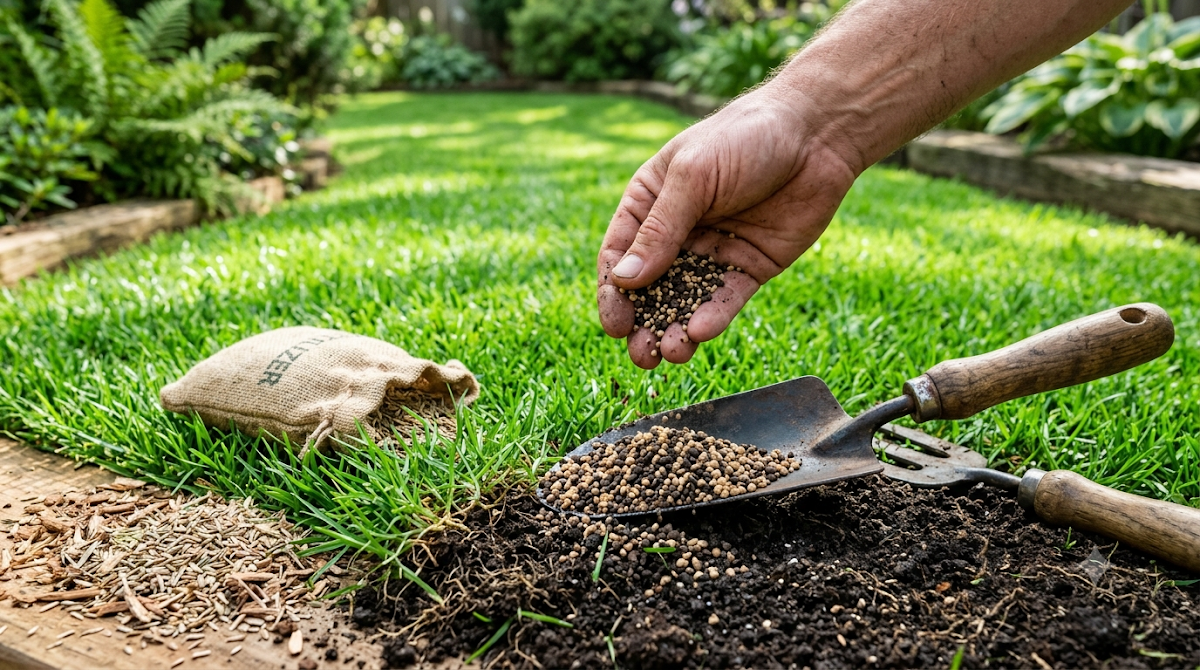
Slow-release (or controlled-release) nitrogen feeds your lawn steadily over 6\u201310 weeks. This prevents the “spike and crash” growth pattern of fast-release fertilizers. Look for products containing sulfur-coated urea, polymer-coated urea, or methylene urea. These are ideal for summer applications because they resist volatilization (nitrogen loss as gas) in high heat.
2. Fast-Release Nitrogen (For Quick Green-Up)
Fast-release nitrogen (like urea or ammonium sulfate) greens up bermudagrass within days. Use it only in early spring to jumpstart green-up, or for a quick color boost before an event. Never use fast-release nitrogen in midsummer heat\u2014it can burn the grass and volatilize quickly.
3. Organic Fertilizers (Slow and Safe)
Organic options like composted poultry litter, milorganite, or alfalfa meal release nutrients slowly as soil microbes break them down. They improve soil structure and won’t burn, but they’re lower in nitrogen concentration, so you’ll need to apply more product. Organic fertilizers work best in spring and fall when soil temperatures are moderate.
When to Fertilize Bermudagrass (Exact Timing)
Timing is everything. Fertilizing too early wastes money and encourages weed growth. Fertilizing too late prevents the grass from hardening off for winter.
Spring: Wait for 65\u00b0F Soil Temperature
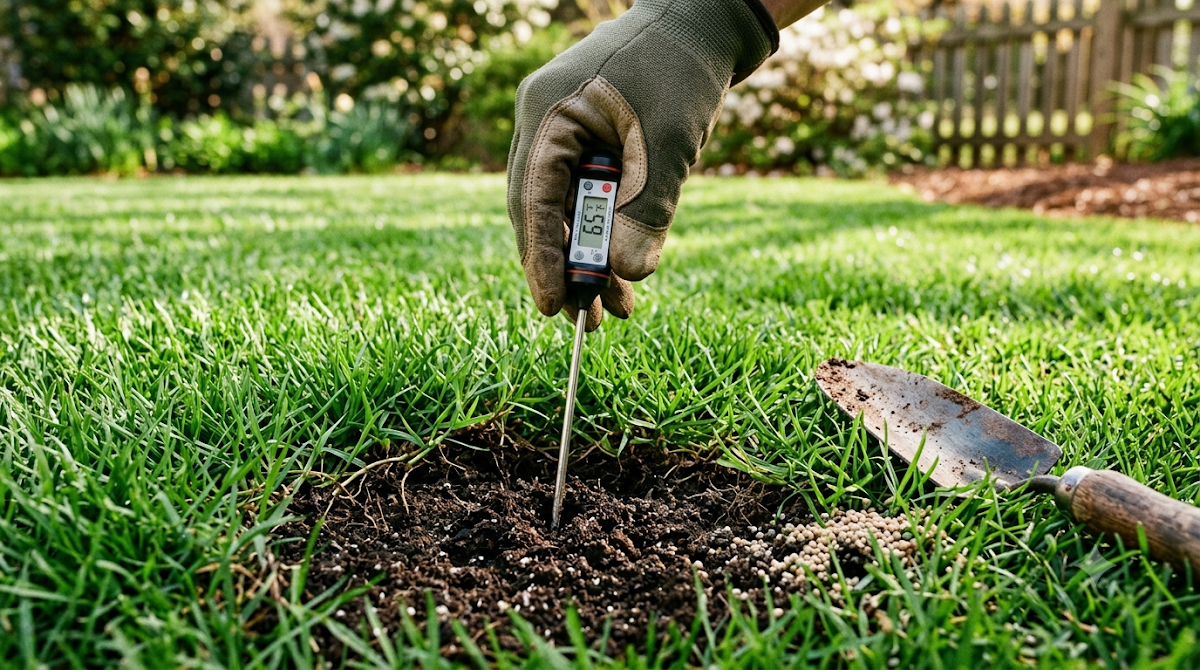
Do not fertilize when bermudagrass is still dormant (tan/brown). Wait until soil temperature at a 2-inch depth reaches 65\u00b0F consistently\u2014usually mid-April to mid-May in the transition zone. At this point, the grass is about 50% green. Apply 0.5 to 1 lb of nitrogen per 1,000 sq ft using a slow-release formula. This supports the spring green-up without feeding winter weeds.
Check your soil temperature: Use a soil thermometer, or check your local university extension’s online soil temperature map. A rough rule of thumb: when daytime highs are consistently in the 80s\u00b0F, soil is likely ready.
Summer: The Main Feeding Window
Summer is when bermudagrass grows most aggressively. Apply 1 lb of nitrogen per 1,000 sq ft every 4\u20136 weeks from June through August. This totals 2\u20133 lbs of nitrogen for the season. Use a balanced slow-release fertilizer like 16-4-8 or 15-0-15. Water deeply after application (0.25\u20130.5 inch) to move nutrients into the root zone.
Fall: Potassium Only, No Nitrogen
Stop nitrogen applications 6\u20138 weeks before your average first frost date. In the transition zone, that’s typically mid-August to early September. Instead, apply a 0-0-50 or 0-0-60 potassium-only fertilizer (or a low-nitrogen winterizer like 5-10-31) in late September. Potassium strengthens cell walls, improving cold tolerance and winter survival.
Step-by-Step Fertilizer Application
Follow these exact steps for even, safe application:
- Test your soil first. Collect samples from 4\u20136 spots, 4 inches deep. Send to your local extension office. Adjust your fertilizer choice based on results.
- Mow to 1.5\u20132 inches. Bermuda should be mowed short before fertilizing so granules reach the soil. Remove clippings if they’re thick.
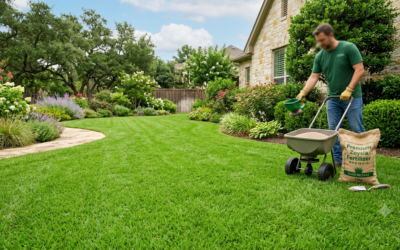
- Calibrate your spreader. Set your drop or broadcast spreader according to the bag’s setting. Test on a hard surface (driveway) to check coverage.
- Apply in a crosshatch pattern. Spread half the product walking north-south, the other half east-west. This prevents striping.
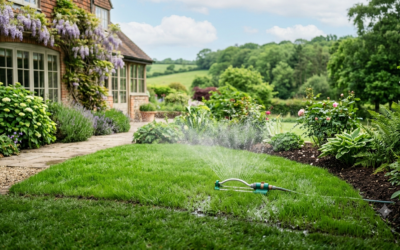
- Water in immediately. Apply 0.25\u20130.5 inch of water within 24 hours. This dissolves granules and prevents leaf burn.
- Sweep hard surfaces. Brush fertilizer off sidewalks and driveways\u2014it washes into storm drains and pollutes waterways.
Expert Troubleshooting
What If You Fertilized Too Early?
If you applied nitrogen while the lawn was still dormant, you’ve likely fed winter weeds (henbit, chickweed) and wasted money. Don’t panic. The nitrogen will sit in the soil and become available as soil warms. Simply skip your next scheduled spring application to avoid overfeeding. If weeds exploded, apply a pre-emergent herbicide at the correct timing for your region.
Wet Weather Delays
Heavy rain can wash fertilizer off slopes and into low spots, causing patchy growth. If rain is forecast within 24 hours, delay application\u2014you can’t control where water carries the granules. If you already applied and got a downpour, don’t reapply. Instead, monitor for yellowing in high spots (where nutrients washed away) and spot-treat with a liquid fertilizer in 2\u20133 weeks.
Fertilizer Burn (Yellow or Brown Streaks)
Burn appears as yellow or brown stripes matching your spreader pattern. Flush the area with 1 inch of water immediately to dilute salts. The grass will recover in 2\u20133 weeks. Prevent this by using slow-release formulas and never applying when the lawn is drought-stressed or when temps exceed 90\u00b0F.
Frequently Asked Questions
1. Will fertilizer bring bermudagrass out of dormancy?
No. Fertilizer does not break dormancy\u2014soil temperature does. Bermudagrass goes dormant when soil temps drop below 55\u00b0F and wakes when they rise above 65\u00b0F. Applying nitrogen to dormant grass feeds weeds and risks nitrogen loss through volatilization. Wait for consistent 65\u00b0F soil temps before your first spring application.
2. How often should I fertilize bermudagrass?
Plan for 3 to 5 applications per season: one in late spring (green-up), two to three in summer (every 4\u20136 weeks), and one potassium-only application in early fall. Total nitrogen should be 2\u20134 lbs per 1,000 sq ft. More frequent, lighter applications produce more consistent growth than fewer heavy ones.
3. Is 10-10-10 good for bermudagrass?
10-10-10 is acceptable but not ideal for established bermudagrass. The phosphorus (middle number) is unnecessary for mature lawns and can build up in soil, potentially harming beneficial fungi. A better choice is a low-phosphorus formula like 15-0-15 or 16-4-8. If 10-10-10 is all you have, use it at half the recommended rate and supplement with potassium in fall.
4. What’s the best fertilizer for new bermudagrass sod or seed?
New bermudagrass needs phosphorus for root establishment. Use a starter fertilizer like 10-20-10 or 18-24-6 at planting time, worked into the top 2 inches of soil. After establishment (6\u20138 weeks), switch to your regular maintenance schedule. For seeded lawns, wait until the third mowing before applying nitrogen.
Final Checklist for a Healthy Bermuda Lawn
- \u2705 Soil test every 2\u20133 years
- \u2705 First nitrogen application at 65\u00b0F soil temp
- \u2705 1 lb N per 1,000 sq ft per application
- \u2705 Slow-release nitrogen in summer
- \u2705 No nitrogen after 6\u20138 weeks before first frost
- \u2705 Potassium-only application in early fall
- \u2705 Water in within 24 hours
- \u2705 Mow at 1.5\u20132 inches, never remove more than 1/3 of blade
Fertilizing bermudagrass isn’t complicated once you understand its growth cycle. Match your feeding schedule to soil temperature, choose the right N-P-K ratio, and always water in your applications. Your lawn will reward you with dense, deep-green growth all summer long. For related insights, see our detailed guide on Hydro Seeding.