
Quick Answer: Hydroseeding is a cost-effective lawn establishment method that sprays a slurry of seed, mulch, fertilizer, and water onto prepared soil. It costs 50\u201380% less than sod, delivers uniform coverage, and produces visible germination in 5\u201314 days. Ideal for slopes, large areas, and erosion-prone sites, hydroseeding creates stronger root systems than sod while allowing full customization of grass blends.
Hydroseeding has become the preferred method for homeowners, contractors, and municipalities seeking a fast, affordable, and reliable way to establish new lawns. Unlike traditional broadcasting or expensive sod installation, hydroseeding combines precision technology with biological science to deliver superior results.
This comprehensive guide explains exactly how hydroseeding works, its measurable benefits, when to use it, and how to ensure optimal results\u2014whether you’re seeding a residential backyard or stabilizing a commercial construction site.
What Is Hydroseeding and How Does It Work?
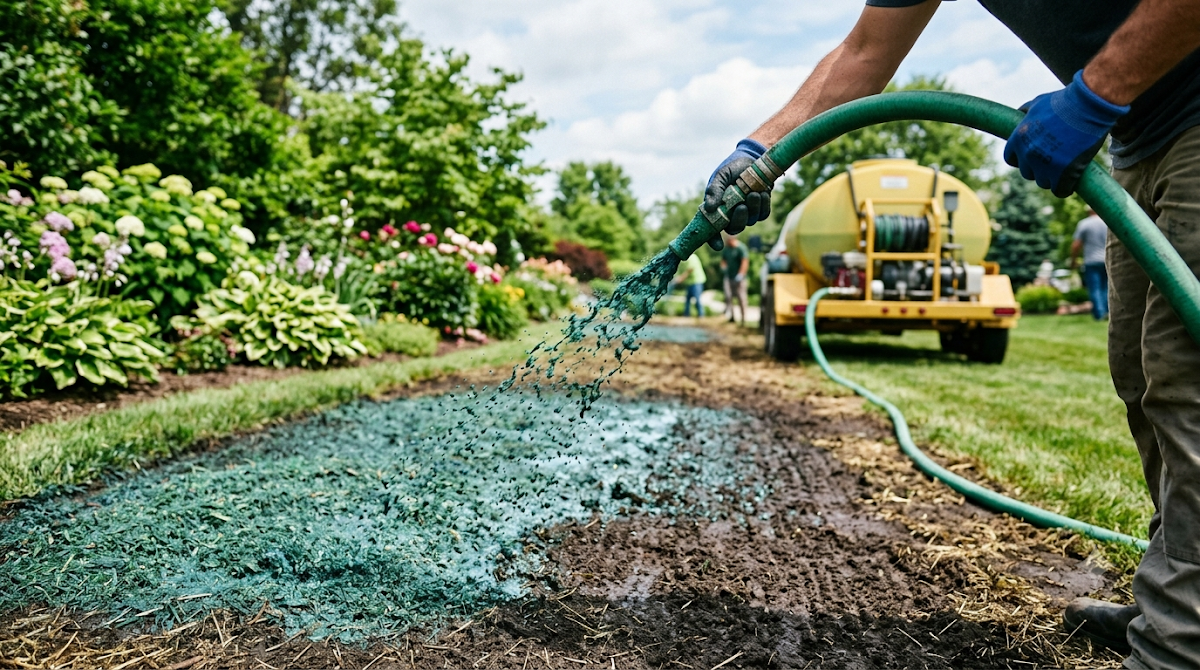
Hydroseeding (also called hydraulic mulch seeding) is a specialized lawn establishment process that uses a pressurized sprayer to apply a homogeneous slurry mixture directly onto prepared soil. The slurry typically contains:
- Grass seed: Custom-selected for your climate zone, sun exposure, and soil conditions
- Wood fiber or cellulose mulch: Creates a protective blanket that retains moisture and regulates temperature
- Starter fertilizer: Provides immediate nutrients to support germination
- Tackifier (binding agent): Glues the mixture to soil, preventing washout on slopes
- Water: Activates the mixture and provides initial hydration
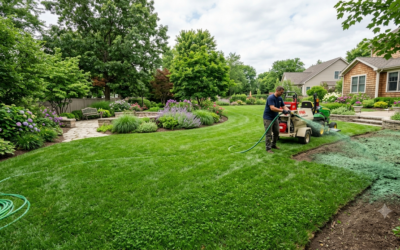
The equipment\u2014a hydroseeder truck or trailer-mounted unit\u2014agitates the slurry continuously to maintain consistency, then applies it at rates of 1,000\u20132,000 gallons per acre depending on the project specifications.
6 Measurable Benefits of Hydroseeding
1. Dramatic Cost Savings: 50\u201380% Less Than Sod
Hydroseeding delivers the most significant advantage in upfront cost. Here’s a direct comparison for a typical 5,000-square-foot residential lawn:
| Method | Cost Per Sq Ft | Total (5,000 sq ft) | Time to Full Establishment |
|---|---|---|---|
| Hydroseeding | $0.07\u2013$0.21 | $350\u2013$1,050 | 6\u20138 weeks |
| Professional Sod | $0.77\u2013$1.50+ | $3,850\u2013$7,500+ | Immediate (roots establish in 2\u20133 weeks) |
| Traditional Broadcast Seeding | $0.02\u2013$0.06 | $100\u2013$300 | 8\u201312 weeks (higher failure rate) |
For large commercial properties or municipal projects spanning 50,000+ square feet, hydroseeding savings become even more substantial\u2014often exceeding $20,000 compared to sod.
2. Uniform Coverage Without Patchy Spots
Traditional broadcast seeding creates uneven distribution, leading to thin areas and bare patches. Hydroseeding’s pressurized application ensures consistent seed density across the entire lawn. The mulch component holds seeds in place, preventing clustering and gaps. The result is a lawn that looks professionally manicured from the first mowing.
3. Stronger Root Systems Than Sod
While sod provides instant green coverage, its roots must establish in new soil\u2014a process that takes 2\u20133 weeks and often creates a visible seam between sod rolls. Hydroseeded grass germinates directly in your native soil, developing roots that penetrate deeply from day one. Studies show hydroseeded lawns develop root systems 30\u201340% deeper than sod within the first growing season, resulting in superior drought tolerance and long-term resilience.
4. Faster Germination Than Traditional Seeding
The mulch blanket in hydroseeding creates a microclimate that accelerates germination. Depending on grass species and conditions:
- Ryegrass (perennial): Visible green shoots in 5\u20137 days
- Fescue (tall): Germination in 7\u201314 days
- Bluegrass (Kentucky): Germination in 14\u201321 days (requires consistent moisture)
- Bermuda grass: Germination in 7\u201314 days (warm-season)
Traditional seeding without mulch protection often takes 21\u201330 days for initial germination and suffers higher failure rates due to bird predation, wind displacement, and moisture loss.
5. Superior Erosion Control on Slopes
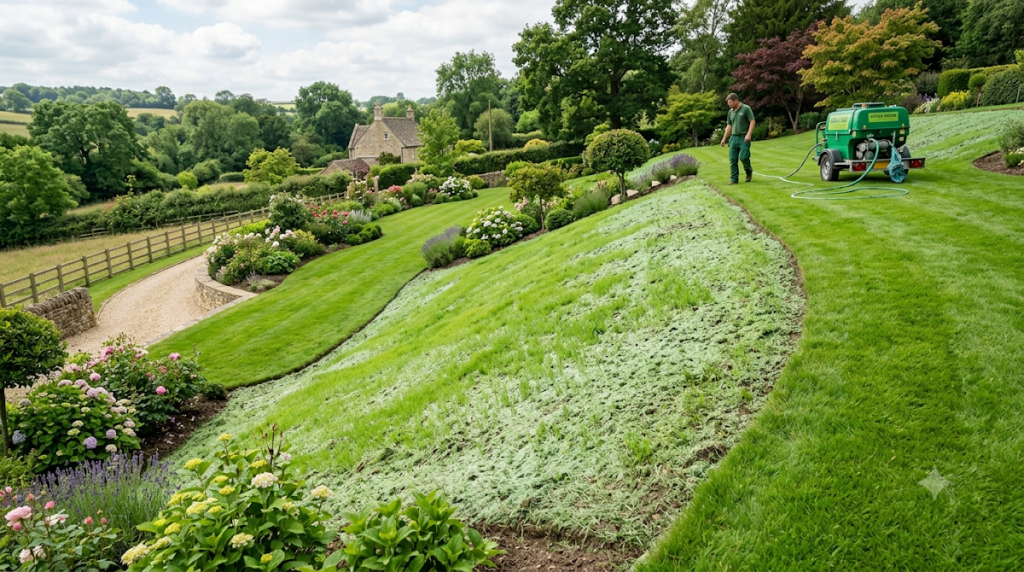
Hydroseeding excels where other methods fail: steep slopes, hillsides, and erosion-prone areas. The tackifier in the slurry bonds the mulch to soil at angles up to 45 degrees, preventing seed washout during rain events. This makes hydroseeding the standard choice for:
- Highway and road construction projects
- Residential hillside landscaping
- Post-construction site restoration
- Lakefront and riverbank stabilization
6. Complete Customization of Grass Blends
Unlike sod, which is limited to whatever grass varieties the grower produces, hydroseeding allows you to specify exact seed blends tailored to your conditions. A professional applicator can mix sun-loving Bermuda grass for exposed areas with shade-tolerant fine fescue under trees\u2014all in a single application. This flexibility ensures optimal performance across diverse microclimates within your property.
When to Choose Hydroseeding: Optimal Timing and Conditions
Timing is critical for hydroseeding success. Apply seed when conditions favor germination and root establishment:
| Grass Type | Ideal Soil Temperature | Best Application Window | Air Temperature Range |
|---|---|---|---|
| Cool-season (fescue, bluegrass, ryegrass) | 50\u201365\u00b0F (10\u201318\u00b0C) | Early fall (Aug\u2013Oct) or early spring (Mar\u2013May) | 60\u201375\u00b0F |
| Warm-season (Bermuda, zoysia, centipede) | 65\u201375\u00b0F (18\u201324\u00b0C) | Late spring through summer (Apr\u2013Jul) | 75\u201390\u00b0F |
Critical success factors:
- Soil preparation: Soil must be graded, loosened to 4\u20136 inches depth, and free of debris
- Moisture availability: Plan irrigation for 2\u20133 light waterings daily (15\u201320 minutes each) until germination, then transition to deeper, less frequent watering
- No rain forecast for 48 hours: Heavy rain immediately after application can wash away slurry before tackifier bonds
- Avoid extreme heat: Temperatures above 90\u00b0F stress new seedlings and increase water requirements
Hydroseeding vs. Sod vs. Broadcast Seeding: Complete Comparison
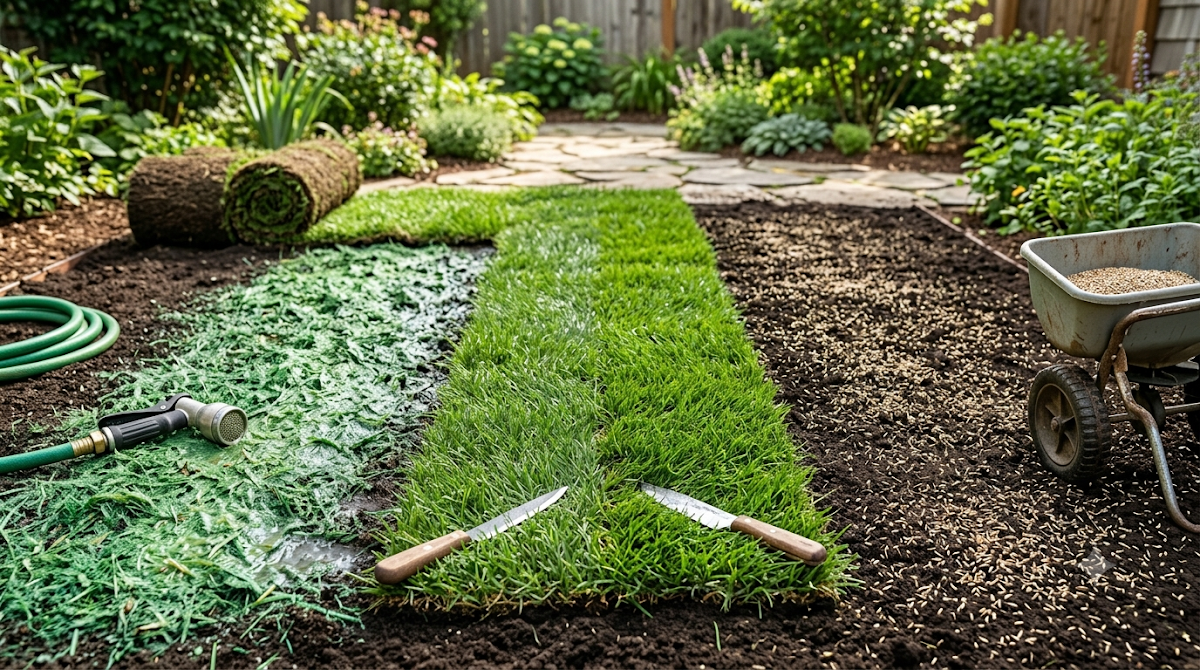
| Factor | Hydroseeding | Sod | Broadcast Seeding |
|---|---|---|---|
| Upfront cost | Low ($0.07\u2013$0.21/sq ft) | High ($0.77\u2013$1.50/sq ft) | Lowest ($0.02\u2013$0.06/sq ft) |
| Time to green | 5\u201321 days | Immediate | 21\u201330 days |
| Root establishment | Deep, native soil integration | Shallow initially; must adapt | Deep, but uneven coverage |
| Coverage uniformity | Excellent | Good (seam visibility) | Poor to moderate |
| Erosion control | Excellent (with tackifier) | Moderate (can lift on slopes) | Poor without erosion blankets |
| Customization | Full seed blend control | Limited to grower offerings | Full seed blend control |
| Labor required | Professional application | Professional installation | DIY-friendly |
| Best for | Large areas, slopes, budget-conscious projects | Instant results, small areas, high-visibility spaces | Small DIY projects, overseeding |
Step-by-Step: What to Expect During Hydroseeding
Step 1: Site Preparation (1\u20132 days before application)
- Remove existing vegetation, rocks, and debris
- Grade soil to ensure proper drainage (minimum 1\u20132% slope away from structures)
- Till or loosen top 4\u20136 inches of soil
- Apply soil amendments if needed (lime for acidic soil, compost for poor soils)
- Rake smooth and firm surface with a lawn roller
Step 2: Hydroseeding Application (1\u20132 hours for average residential lawn)
- Applicator mixes slurry on-site to your specifications
- Even application across entire lawn area at 1,500\u20132,000 gallons per acre
- Multiple passes ensure consistent coverage
- Edges and borders receive extra attention
Step 3: Post-Application Care (First 3 Weeks)
- Water 2\u20133 times daily for 15\u201320 minutes each (keep mulch moist, not saturated)
- Do not walk on treated areas for 2\u20133 weeks
- Do not mow until grass reaches 3\u20134 inches tall
- First mowing should remove no more than 1/3 of blade height
Step 4: Establishment Phase (Weeks 4\u20138)
- Transition to deeper, less frequent watering (1 inch per week total)
- Apply starter fertilizer at 4\u20136 weeks if not included in slurry
- Begin regular mowing schedule once grass reaches 3.5\u20134 inches
- Avoid herbicides or weed control products for 8\u201312 weeks
Expert Troubleshooting: Common Hydroseeding Problems and Solutions
Problem: Seed washed away by heavy rain
Solution: If rain occurs within 48 hours of application, the tackifier may not have bonded properly. Contact your applicator\u2014many offer warranty re-application. For DIY prevention, avoid scheduling hydroseeding when rain is forecast within 72 hours.
Problem: Patchy germination after 2 weeks
Solution: Uneven watering is the most common cause. Ensure sprinklers provide uniform coverage. Thin spots may need spot-seeding with a light mulch cover. If large areas failed, soil compaction or poor seed-to-soil contact may require aeration and re-seeding.
Problem: Weed invasion in new lawn
Solution: Some weed germination is normal. Wait until lawn has been mowed 3\u20134 times before applying any pre-emergent or post-emergent herbicides. Hand-pull large weeds to avoid disturbing new grass roots.
Problem: Mowed too early
Solution: If grass was cut before reaching 3 inches, root development may be stunted. Increase fertilization slightly and maintain consistent watering to help recovery. Avoid mowing again for at least 2 weeks.
Frequently Asked Questions About Hydroseeding
How long does hydroseeded grass last?
With proper establishment and ongoing maintenance, hydroseeded lawns last indefinitely\u2014the same as any well-maintained lawn. The grass is permanent; it’s not a temporary solution. Once roots establish (6\u20138 weeks), the lawn behaves identically to sod or traditionally seeded turf.
Can I hydroseed over existing grass or weeds?
Hydroseeding over existing vegetation is not recommended. The slurry needs direct soil contact for proper germination. Existing grass and weeds compete for nutrients, water, and sunlight, significantly reducing new seed success. Remove or kill existing vegetation and prepare the soil before hydroseeding.
How much does hydroseeding cost for a quarter-acre lawn?
A quarter-acre (approximately 10,890 square feet) typically costs $760\u2013$2,290 for hydroseeding, compared to $8,385\u2013$16,335+ for professional sod installation. Prices vary by region, seed blend selected, and site preparation requirements.
Is hydroseeding environmentally friendly?
Yes. Hydroseeding uses biodegradable wood fiber or cellul