
Quick Answer: Yes, vinegar kills weeds\u2014but only the parts it touches. Household vinegar (5% acetic acid) burns young annual weeds within 24 hours but rarely kills established perennials, which regrow from roots. For best results, use 10\u201330% horticultural vinegar on a sunny day above 60\u00b0F, and expect to reapply every 2\u20133 weeks.
How Vinegar Kills Weeds: The Science of Acetic Acid
Vinegar’s active ingredient, acetic acid, works as a contact herbicide. When sprayed on foliage, the acid penetrates the plant’s cuticle (the waxy outer layer) and disrupts cell membranes. This causes rapid water loss\u2014leaf tissue desiccates, wilts, and turns brown within hours. The visible burn typically appears within 6\u201324 hours on a warm, sunny day.
Critically, acetic acid is non-systemic. It does not translocate through the plant’s vascular system to the roots. This means vinegar kills only the above-ground tissue it physically contacts. Young annual weeds with shallow, undeveloped root systems may die completely because their roots cannot sustain regrowth. Established perennials\u2014dandelions, Canada thistle, bindweed, and horsetail\u2014store energy in deep taproots or rhizomes and will regrow within 1\u20133 weeks.
Does Vinegar Permanently Kill Weeds?
No. Vinegar is a contact burn, not a systemic kill. For permanent control of perennial weeds, you must either combine vinegar with repeated applications (every 2\u20133 weeks to exhaust root reserves) or use a systemic herbicide like glyphosate. Vinegar alone offers temporary, cosmetic control\u2014effective for annual weeds and young seedlings, but a losing battle against deep-rooted perennials.
Which Vinegar Actually Kills Weeds? A Strength Comparison
| Vinegar Type | Acetic Acid % | Kills Young Annuals | Kills Established Perennials | Time to Visible Burn | Best Use |
|---|---|---|---|---|---|
| Household (5%) | 5% | Yes (1\u20132 leaf stage) | No\u2014regrows in 1\u20132 weeks | 24\u201348 hours | Driveway cracks, young seedlings |
| Horticultural (10\u201320%) | 10\u201320% | Yes | Partially\u2014top growth dies, roots survive | 6\u201312 hours | Patios, gravel, fence lines |
| Industrial (20\u201330%) | 20\u201330% | Yes | Yes, with repeat applications | 2\u20136 hours | Large infestations, tough perennials |
| Glyphosate (comparison) | N/A | Yes | Yes\u2014systemic, kills roots | 5\u201310 days | Lawn renovation, permanent control |
Household Vinegar (5% Acetic Acid)
Your kitchen vinegar works, but only on very young weeds with one or two true leaves. At 5% concentration, acetic acid burns foliage but rarely penetrates mature stems or established root systems. Expect regrowth within 7\u201314 days. It’s ideal for spot-treating cracks in sidewalks and driveways where you can reapply frequently.
Horticultural Vinegar (10% to 30% Acetic Acid)
Horticultural vinegar\u2014sold at garden centers and farm supply stores\u2014is 2\u20136 times stronger than kitchen vinegar. At 10\u201320%, it burns mature foliage within hours and can kill young perennials. At 20\u201330%, it’s a serious herbicide capable of killing established weeds, though repeat applications are still needed for deep-rooted species. Warning: 20%+ acetic acid is corrosive. Wear chemical-resistant gloves, safety goggles, and long sleeves. It can cause severe skin burns and permanent eye damage.
The Exact Vinegar Weed Killer Recipe
For maximum efficacy, use this professional-grade recipe:
- Base: 1 gallon of 10\u201320% horticultural vinegar (or 5% household vinegar for young weeds only).
- Surfactant: Add 2 tablespoons of dish soap (e.g., Dawn) or a commercial surfactant like CocoWet. This breaks surface tension so droplets spread and stick to waxy leaves instead of beading off.
- Salt (optional, for hard surfaces only): Add 1 cup of table salt to prevent regrowth in cracks and gravel. Never use salt in garden beds\u2014it sterilizes soil for months.
- Mix: Stir gently in a sprayer. Do not heat or store in metal containers\u2014acetic acid corrodes metal.
How to Apply Vinegar Weed Killer: Step-by-Step
Step 1: Check Weather and Timing
Apply on a dry, sunny day with temperatures above 60\u00b0F and no rain forecast for 24 hours. Weeds must be actively growing to absorb the spray. Cold, dormant weeds resist burn. Ideal window: mid-morning to early afternoon, when dew has evaporated and leaves are fully exposed.
Step 2: Protect Desirable Plants and Yourself
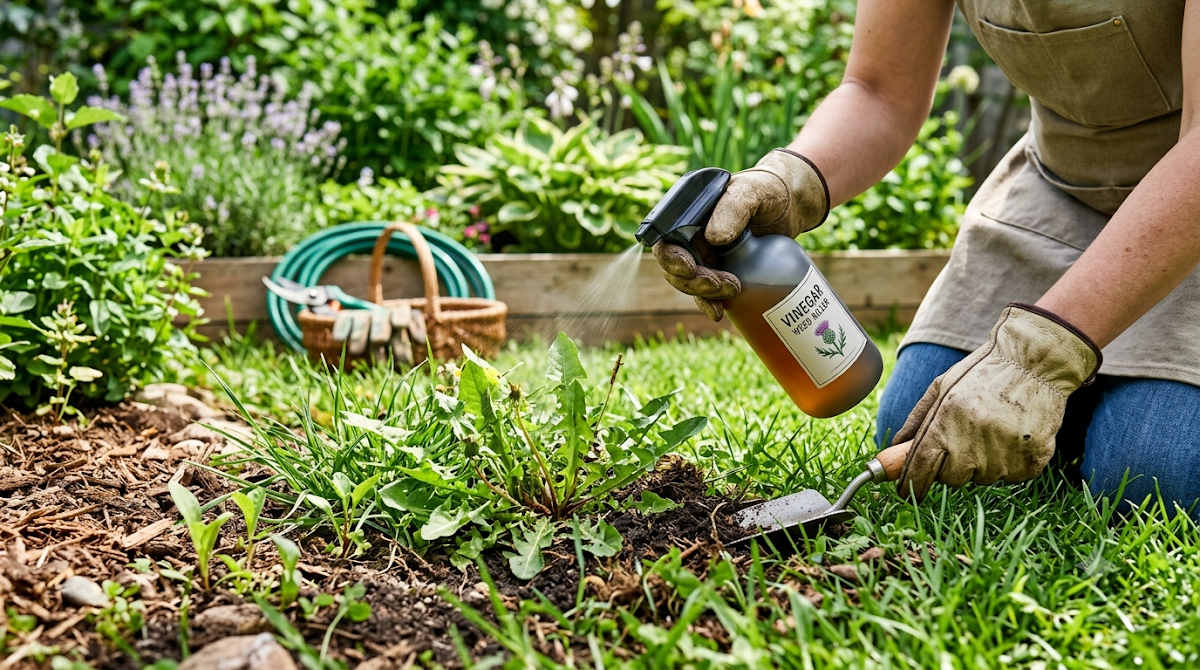
Vinegar is non-selective\u2014it kills grass, flowers, and vegetables on contact. Shield nearby plants with cardboard, plastic sheeting, or a bucket. Wear safety goggles, long sleeves, and chemical-resistant gloves. If using 20%+ vinegar, wear a respirator to avoid inhaling fumes.
Step 3: Spray for Full Leaf Coverage
Use a pump sprayer set to a coarse spray to minimize drift. Hold the nozzle 6\u20138 inches from the weed and saturate all leaf surfaces until dripping\u2014but not runoff. Focus on the newest growth, which absorbs acid fastest. For weeds in cracks, spray directly into the joint.
Step 4: Wait, Inspect, and Reapply
Visible burn appears within 6\u201324 hours. Wait 7\u201310 days, then inspect. If green shoots emerge from the base, reapply. For perennials, repeat every 2\u20133 weeks until the root system is exhausted\u2014typically 3\u20135 applications. Pull dead tops after 2 weeks to prevent regrowth from seeds.
When NOT to Use Vinegar on Weeds
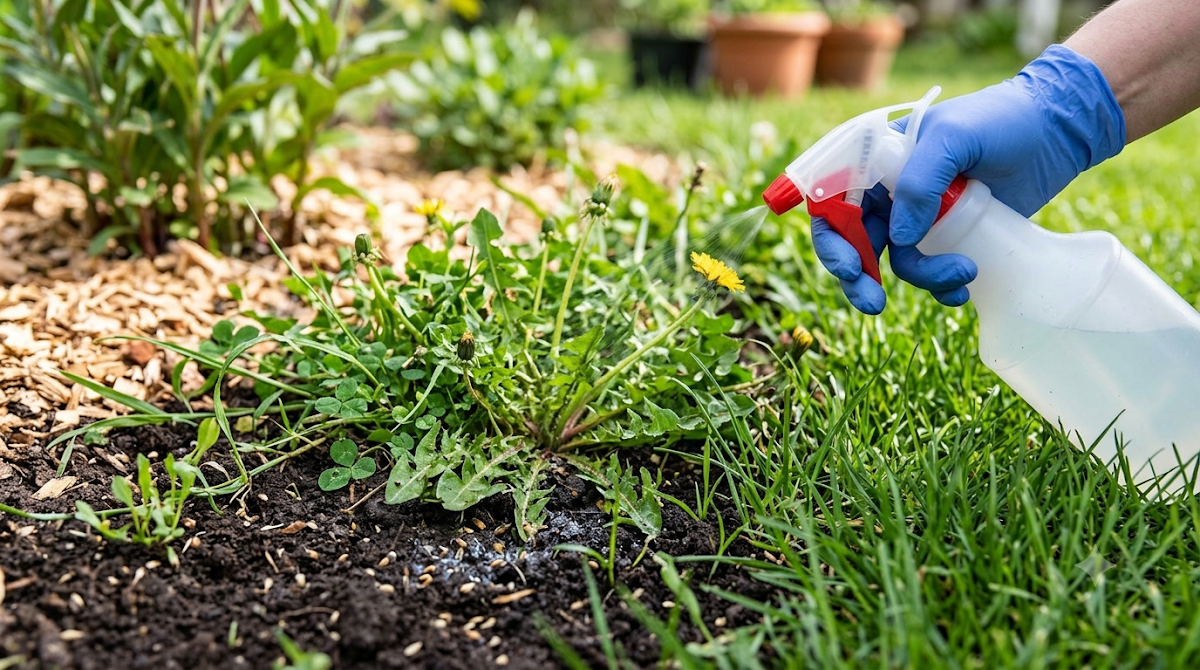
- In your lawn: Vinegar kills grass as readily as weeds. Spot-treating a dandelion in your turf will leave a dead brown patch. Use a selective broadleaf herbicide instead.
- In garden beds: Overspray or runoff damages soil microbiology and acidifies the root zone. Use targeted application or hand-pulling.
- On wet or rainy days: Rain washes acetic acid off leaves before it burns tissue, wasting your effort.
- In cold weather (below 50\u00b0F): Dormant weeds won’t absorb the spray effectively. Wait for a warm spell.
- On windy days: Drift can damage desirable plants 10+ feet away.
Expert Troubleshooting
You Mowed Too Early
If you mowed before spraying, weeds may be too short to absorb enough acid. Wait until weeds have at least 4\u20136 inches of leaf growth before applying. Mowing after treatment (within 3 days) removes the burned tissue before the acid can work deeper\u2014wait 7\u201310 days before mowing treated areas.
Wet Weather Delays
If rain arrives within 24 hours of application, the vinegar is largely wasted. Wait 3\u20135 dry days, then reapply. Do not double the concentration to compensate\u2014this increases drift and soil damage without improving kill rates.
Weeds Keep Coming Back
This is normal for perennials. Vinegar is not systemic. Switch to a systemic herbicide for permanent control, or commit to 3\u20135 repeat applications at 2\u20133 week intervals. For persistent weeds like bindweed, combine vinegar with physical removal of the taproot.
Frequently Asked Questions
Is Vinegar as Effective as Glyphosate?
No. Glyphosate is systemic\u2014it travels through the plant to kill roots, offering permanent control of perennials. Vinegar kills only what it touches above ground. For established dandelions, creeping Charlie, or Canada thistle, glyphosate is significantly more effective. Vinegar wins only for young annuals and eco-conscious spot treatments.
Is Bleach or Vinegar Better for Killing Weeds?
Vinegar, by a wide margin. Bleach (sodium hypochlorite) kills weeds on contact but sterilizes soil for months, preventing anything from growing afterward\u2014including desirable plants. Never use bleach near garden beds or lawns. Vinegar breaks down quickly in soil and is far safer for the environment.
Does Vinegar Kill Weeds Between Pavers?
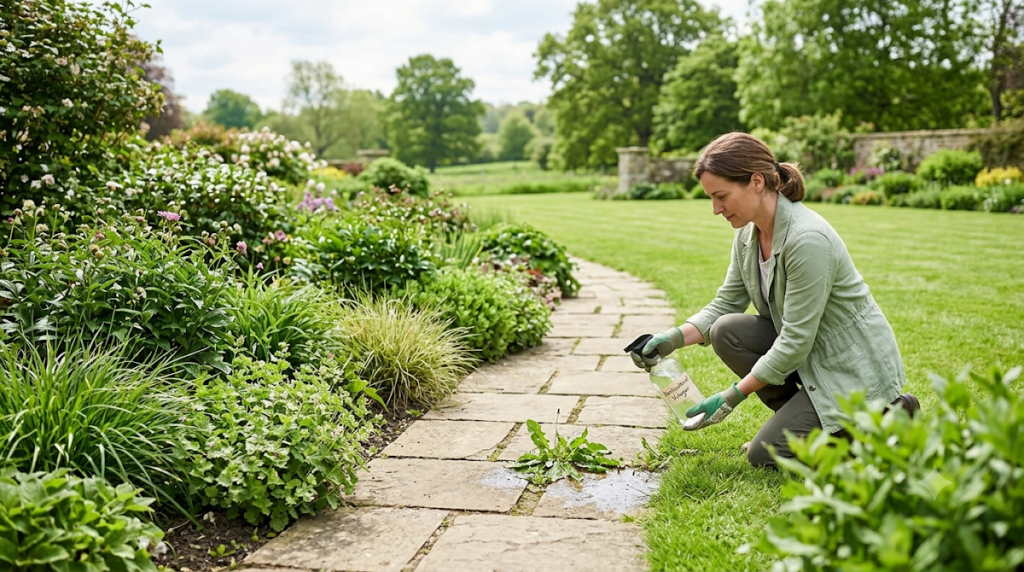
Yes. Vinegar works well in cracks, pavers, and gravel because you’re less likely to hit desirable plants. Apply on a sunny, dry day with full leaf coverage. For weeds rooted deep in joints, expect regrowth\u2014reapply every 2\u20133 weeks or combine with pulling and re-sanding the joints.
How Long Does Vinegar Take to Kill Weeds?
Visible wilting and browning appear within 6\u201324 hours on a warm, sunny day. Complete death of young annuals takes 2\u20133 days. Perennials may appear dead in 24 hours but will regrow from roots within 1\u20133 weeks unless you reapply. Full control of tough perennials requires 3\u20135 applications over 6\u201310 weeks.
Bottom Line: Vinegar Works\u2014With Real Limits
Vinegar is a fast, cheap, eco-friendly contact herbicide for young annual weeds and hard-surface cracks. It is not a permanent solution for established perennials, and it will damage your lawn if sprayed carelessly. Match the vinegar strength to the weed, apply on warm sunny days, and reapply relentlessly. For deep-rooted invaders, combine vinegar with physical removal or switch to a systemic herbicide. For related insights, see our detailed guide on Should You Mow Wet Grass? Expert Guide.