

Quick Answer: Apply pre-emergent granular weed killer when soil temperatures hit 55\u00b0F (4 consecutive days at 2-inch depth). Use a drop spreader for accuracy, apply 10\u201314 days before expected germination, and water in with 0.5 inches of irrigation within 24 hours. One application protects for 8\u201312 weeks. Never aerate for 30 days after application.
What Is a Pre-Emergent Granular Weed Killer?
A pre-emergent granular weed killer is a soil-applied herbicide that creates a chemical barrier in the top 1\u20132 inches of soil. It does not kill existing weeds. Instead, it prevents weed seeds from germinating by inhibiting root and shoot development at the cellular level. Granular formulations use coated fertilizer or inert carriers (typically 0.2%\u20131.5% active ingredient) that break down slowly, releasing the herbicide over 8\u201312 weeks.
Unlike liquid concentrates that require sprayers and precise mixing, granular formulas spread with a walk-behind spreader. This makes them the safest, most foolproof option for homeowners\u2014provided you calibrate correctly and time the application properly.
Active Ingredients: The 3 You Must Know
| Active Ingredient | Common Brands | Half-Life in Soil | Weeds Controlled | Notes |
|---|---|---|---|---|
| Prodiamine (0.48%\u201365%) | Barricade, Quali-Pro, Andersons | 60\u2013120 days | Crabgrass, foxtail, goosegrass, poa annua | Longest residual; best for warm-season lawns |
| Dithiopyr (0.1%\u20130.25%) | Dimension, Sta-Green | 30\u201360 days | Crabgrass (post-emergent on 1\u20132 leaf stage), annual bluegrass | Only pre-emergent with early post-emergent crabgrass activity |
| Pendimethalin (1.0%\u20133.3%) | Scotts Halts, Pendulum | 90\u2013120 days | Crabgrass, spurge, foxtail, barnyardgrass | Most affordable; requires 2 applications for full season |
Pro tip: For northern lawns (cool-season grasses like fescue and bluegrass), use prodiamine or dithiopyr. For southern lawns (Bermudagrass, Zoysia), prodiamine offers the longest residual control per dollar.
When to Apply: Following the Pre-Emergent Weed Preventer Timing Guide
Calendar dates are unreliable across USDA zones. The only scientific trigger is soil temperature at 2 inches depth. Here’s the precise protocol:
- Purchase a soil thermometer (or use your local extension office’s soil temperature map\u2014many states publish daily readings).
- Take readings at 7 a.m. for 4 consecutive mornings, before sun heats the surface.
- When the 4-day average hits 55\u00b0F for crabgrass (or 50\u00b0F for poa annua), apply.
- For split applications, apply the first half at 55\u00b0F and the second half 6\u20138 weeks later.
In practice: Region \u2014 Midwest/New England: April 1\u201320 \u00b7 Mid-Atlantic: March 15\u2013April 5 \u00b7 Southeast: Feb 15\u2013March 15 \u00b7 Southwest: Feb 1\u2013Feb 28 \u00b7 Pacific NW: March 1\u2013April 1. But always verify with actual soil temps\u2014a warm March in Ohio can trigger crabgrass by mid-April.
Step-by-Step Application Procedure
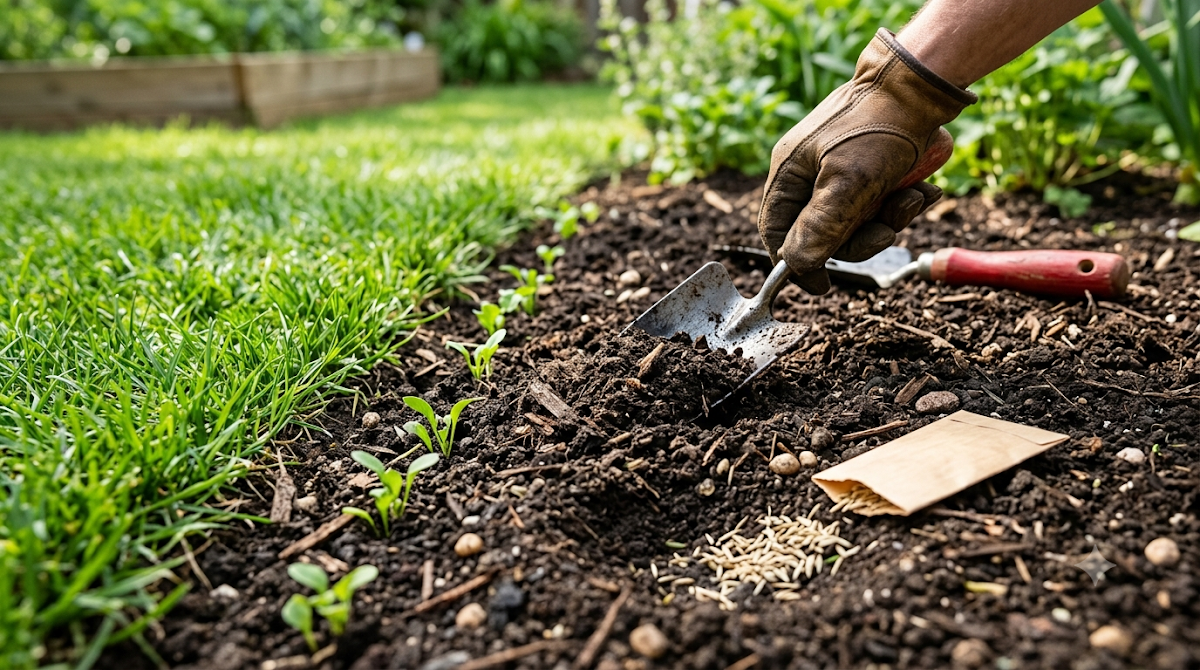
Step 1: Calibrate Your Spreader (Day 1)
Never trust the “bag setting” blindly\u2014spreaders vary. On a hard surface (driveway), mark a 50 ft \u00d7 10 ft area. Weigh 2 lbs of product, spread it over the marked area, sweep it up, and weigh the remainder. The difference tells you your actual application rate. Adjust the spreader opening until you’re within \u00b110% of the label’s target rate (typically 2.3\u20134.6 lbs per 1,000 sq ft).
Safety check: Wear nitrile gloves, a dust mask, and long sleeves. Keep children and pets off treated areas until the product is watered in.
Step 2: Measure Your Lawn Accurately
Use the “rectangle method”: walk the perimeter with a measuring wheel, divide your lawn into rectangles and triangles, and calculate square footage. Do not guess\u2014applying 20% more than label rate wastes money and can stunt turf roots. Applying 20% less leaves weed-control gaps.
Step 3: Spread in a Double-Cross Pattern
Split your measured product in half. Apply the first half in parallel east-west lines, then the second half in perpendicular north-south lines. This overlapping cross pattern eliminates skips and streaks. Walk at a consistent speed\u2014preferably in a measured stride count (e.g., 3 ft per stride).
Step 4: Water In Immediately (Within 24 Hours)
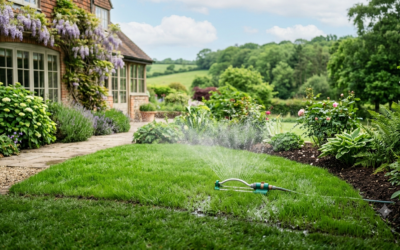
Apply 0.5 inches of irrigation within 24 hours (ideally within 4\u20136 hours). This moves the herbicide into the topsoil where weed seeds germinate. Use a tuna can test: place empty tuna cans in the sprinkler zone; when they fill halfway (0.5 inch), you’re done. Without watering-in, UV light degrades 20\u201340% of the active ingredient within 48 hours.
Step 5: Post-Application Restrictions
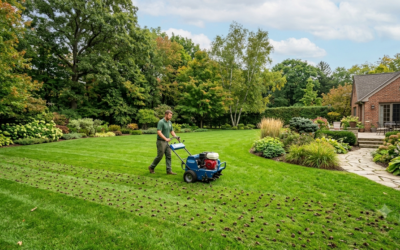
- No aeration or dethatching for 30 days\u2014you’ll break the chemical barrier and create weed-seed entry points.
- No overseeding for 8\u201316 weeks\u2014pre-emergents block grass seed germination too. Wait for the label’s specific re-entry window.
- No mowing until granules are watered in\u2014mower wheels can track product off-target.
Drop Spreader vs. Rotary Spreader
| Feature | Drop Spreader | Rotary (Broadcast) Spreader |
|---|---|---|
| Precision / Placement | Exact, no drift | Broad coverage; some overshoot |
| Best For | Small lawns (<5,000 sq ft); landscape beds | Large lawns (>5,000 sq ft) |
| Coverage Speed | Slower; requires more passes | Faster; 6\u201310 ft swath |
| Risk of Skips | Low (visible lines) | High if paths don’t overlap properly |
| Product Type | All granulars | Uniform, coarse granules only |
Expert Troubleshooting: When Things Go Wrong
You Applied Too Early (Soil Below 50\u00b0F)
Prodiamine and pendimethalin are stable in cold soil; they won’t degrade significantly. But microbial breakdown is slower, so the barrier forms later than expected. Fix: Check soil temp weekly. If you’re still 3+ weeks from germination threshold, apply the second half of a split application at the 55\u00b0F mark to extend coverage.
You Mowed Too Soon After Application
If you mowed before watering-in, clippings may carry granules off-target. Fix: Bag the first mowing and water 0.5 inches immediately. Monitor the lawn edge where mower turned\u2014residual granules may have concentrated at turn-around points, causing phytotoxicity (yellow grass). If you see yellowing, flush with 1 inch of water.
Rain Delay: You Applied, Then It Didn’t Rain or Water
Granules sitting on dry soil for 3+ days lose effectiveness. Fix: Hand-water with a hose-end sprinkler at 0.5 inches if no rain within 48 hours. Do not use a high-pressure spray\u2014it can wash granules into runoff. If 7 days elapsed with no water, re-apply at 50% rate.
Wet-Weather Delay: You Missed the Window
If crabgrass has already emerged (you see 1\u20132 leaf stage), switch to a dithiopyr product\u2014it has early post-emergent activity. For established crabgrass (3+ leaves), apply a post-emergent (quinclorac) after the pre-emergent.
2026 Product Recommendations by Situation
| Situation | Top Pick | Active Ingredient | Rate (per 1,000 sq ft) | Coverage per Bag | Price Range |
|---|---|---|---|---|---|
| Best Overall (Northern Lawns) | Scotts Halts Crabgrass & Grassy Weed Preventer | Pendimethalin 1.0% | 2.3\u20133.7 lbs | 5,000\u201310,000 sq ft | $21\u2013$28 |
| Best for Bermudagrass / Southern | The Andersons 0.48% Barricade (Prodiamine) | Prodiamine 0.48% | 2.5\u20134.6 lbs | 11,630 sq ft | $35\u2013$45 |
| Best Professional-Grade | Quali-Pro Prodiamine 65 WDG | Prodiamine 65% | 0.33\u20130.83 oz | 2,500\u20134,000 sq ft per lb | $80\u2013$110 |
| Best for Landscape Beds | Preen Extended Control (Trifluralin) | Trifluralin 1.47% | 4.2 lbs | 4,000 sq ft | $16\u2013$20 |
| Best Crabgrass + Early Post-Emergent | Sta-Green Dimension (Dithiopyr) | Dithiopyr 0.14% | 0.8\u20131.15 lbs | 5,000 sq ft | $17\u2013$22 |
Verdict: For the money and ease, Scotts Halts remains the best homeowner pick. But if you want the longest residual control and a single spring application to last the whole season, Andersons Barricade (prodiamine) is the superior value.
Frequently Asked Questions
1. Can I overseed after applying pre-emergent granular?
No, not for 8\u201316 weeks depending on the active ingredient. Pro-diamine blocks grass seed germination as effectively as weed seed. If overseeding is in your plan, apply the pre-emergent in early spring (Feb\u2013Mar) and seed in late fall (Sept\u2013Nov). Alternatively, use a formulation with siduron (Tupersan), which is the only pre-emergent safe for use at seeding time.
2. How long does pre-emergent granular last in the soil?
Most granular pre-emergents provide 8\u201312 weeks of effective barrier. Prodiamine offers the longest residual (up to 6 months at high rates), while dithiopyr lasts about 8\u201310 weeks. Pendimethalin typically needs two applications\u2014one in early spring and one 8 weeks later\u2014to cover the full crabgrass germination window.
3. Is pre-emergent granular safe for pets and kids?
Yes, once watered in and dry. Most labels allow re-entry immediately after watering-in (4\u20136 hours to be safe). The granules themselves are inert carriers; the active ingredient binds to soil particles. Keep pets off the lawn while granules are still visible on the surface and for 24 hours after application to avoid ingestion of coated granules.
4. Why is my pre-emergent not working\u2014crabgrass still appeared?
Three causes, in order of likelihood: (1) Too early or too late application\u2014the barrier was formed before or after the germination window. (2) Not watered in properly\u2014sunlight degrades the product. (3) Spreader miscalibration\u2014you applied 30\u201350% less than label rate. Also check: did you aerate within 30 days post-application? That physically breaks the chemical barrier. For related insights, see our detailed guide on Time to Cut Grass.