
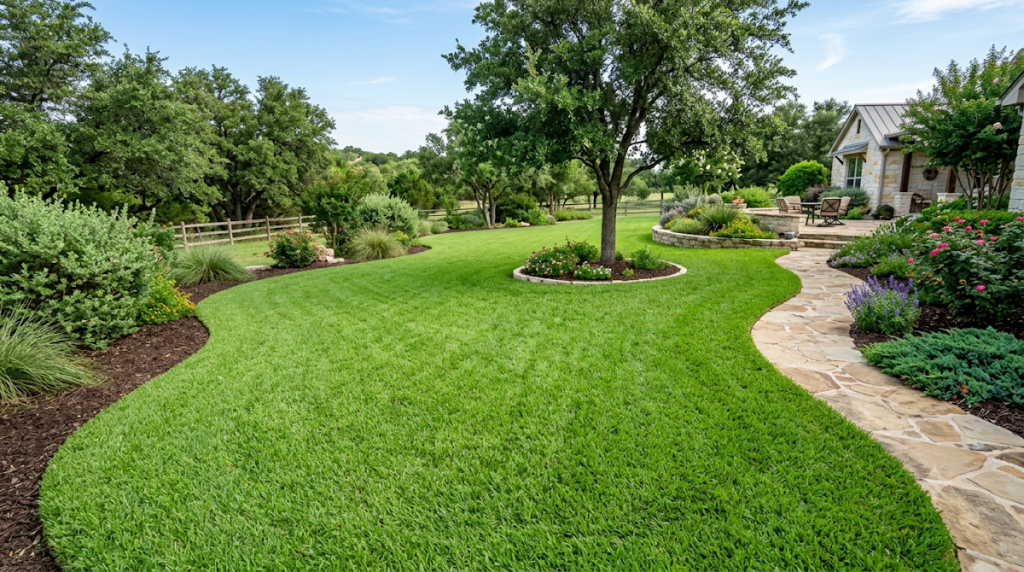
Quick Answer: The best grass seed for Texas is common Bermudagrass (like Sahara or Princess-77) for full-sun, high-traffic lawns, and Buffalograss (like ‘Bowie’ or ‘609’) for low-maintenance, drought-prone yards. For Zone 8-9 lawns with light shade, Zoysiagrass (Zenith, Compadre) seeds work well but need more patience. Avoid seeding St. Augustine\u2014use sod instead.
Why the Best Grass Seed for Texas Isn’t One Size Fits All
Texas spans USDA Hardiness Zones 6a (Panhandle) to 10a (Rio Grande Valley), with rainfall varying from 8 to 60 inches annually. Choosing the best grass seed for Texas means matching your specific microclimate, soil type, and lifestyle. Common Bermudagrass remains the best all-around seed due to its heat, drought, and traffic tolerance\u2014but it’s not perfect for everyone. Here’s the precise breakdown.
The 4 Best Grass Seeds for Texas (Head-to-Head)
| Criterion | Common Bermudagrass | Buffalograss | Zoysiagrass (Zenith/Compadre) | Texas Bluegrass (Thermal Blanket) |
|---|---|---|---|---|
| Sunlight Needed | Full sun (8+ hrs) | Full sun (8+ hrs) | 6+ hrs (light shade OK) | 6+ hrs (tolerates some shade) |
| Drought Tolerance | Excellent (deep roots) | Superb (native, goes dormant) | Good (goes dormant in drought) | Good (needs less water than KBG) |
| Foot Traffic Tolerance | Excellent (self-repairs) | Poor (will thin out) | Good to Excellent | Fair |
| Mowing Height | 0.5\u20131.5 inches | 2.5\u20134 inches | 1\u20132 inches | 2.5\u20133.5 inches |
| Maint. Level | High (weekly mow, fert) | Very Low (mow 1\u20132x/month) | Medium | Medium |
| Establishment Rate (from seed) | Fast (10\u201321 days) | Slow (14\u201330 days) | Slow (21\u201345 days) | Slow (14\u201328 days) |
| Shade Tolerance | Poor | Poor | Good | Good |
| Soil Preference | Wide range; avoid wet clay | Clay/alkaline OK, well-drained | Wide range, sandy-clay | Well-drained, fertile |
| Winter Color | Brown (dormant) | Brown | Brown/gold | Green (stays green in winter) |
| Best For | High activity, full sun | Low maintenance, native, dry soils | Light shade, fine texture | Transition zone, winter color |
Detailed Breakdown of Each Seed Option
1. Bermudagrass (Best Overall Seed for Texas)
Bermudagrass is the #1 choice for lawns over 5,000 sq ft that get full sun owned by people who don’t mind mowing weekly. It thrives when soil temperature is between 65\u00b0F and 75\u00b0F, which in most of Texas means planting from mid-April to August. Use improved seeded varieties like ‘Princess-77’, ‘Sahara’, or ‘Jackpot’ which have finer blades and better cold tolerance than common Bermuda. Important: Seeded Bermuda is not the same as hybrid ‘Tifway 419’ or ‘Celebration’ which are only sold as sod or plugs.
2. Buffalograss (Best Low-Maintenance Seed)
Native to Texas prairies, Buffalograss is a drought-wizard that thrives in Zone 7\u20139 with soil temps of 60\u201380\u00b0F (April to June). It’s a warm-season grass that only needs \u00bd\u2013\u00be inch of water per week once established\u2014about 60% less than Bermuda. However, be aware: it goes fully dormant and tan in the summer if you don’t water it, and it cannot handle heavy foot traffic. For a “plant and ignore” approach, mix ‘Bowie’ or ‘609’ blends with wildflowers for a prairie look.
3. Zoysiagrass (Best for Shade & Soft Texture)
Zoysiagrass has the softest texture and needles less sunlight (6 hours). Seeded varieties like ‘Zenith’ (fastest germ) and ‘Compadre’ (drought tolerant) are your go-to. Soil temp must be consistent at 70\u201380\u00b0F for 2\u20133 weeks\u2014which requires a patient lawn owner. In East Texas’s humid climate, Zoysia excels; in West Texas’s dry zones, it requires irrigation. Caution: It takes 3\u20134 weeks to sprout and 2 full seasons to establish, but the results are lush and low-growing (1\u20132 inches).
4. Texas Bluegrass (Best for Winter Green)
Texas Bluegrass is a Kentucky Bluegrass x Texas Bluegrass hybrid sold as ‘Thermal Blanket’ seed. It’s bred for the “transition zone”\u2014including Central Texas where standard KBG struggles in summer heat. This grass stays green all winter and tolerates heat reasonably well if watered. It works best in Zone 6\u20137 with alkaline and clay soils. It’s not for everyone: it needs medium-high nitrogen and takes 14\u201321 days to germinate. Use it if you want a green winter lawn without overseeding ryegrass.
What About St. Augustinegrass? (Sod Only!)
St. Augustinegrass is a household name in Houston and Dallas, but it cannot be planted from seed. Every commercial cultivar (Raleigh, Palmetto, Floratam) is sterile and must be installed as sod or plugs. If you want a dark-green, shade-tolerant lawn with a coarse texture)Skip seeding\u2014budget for sod installation in late spring instead.
How to Choose the Best Grass Seed for Your Exact Texas Lawn
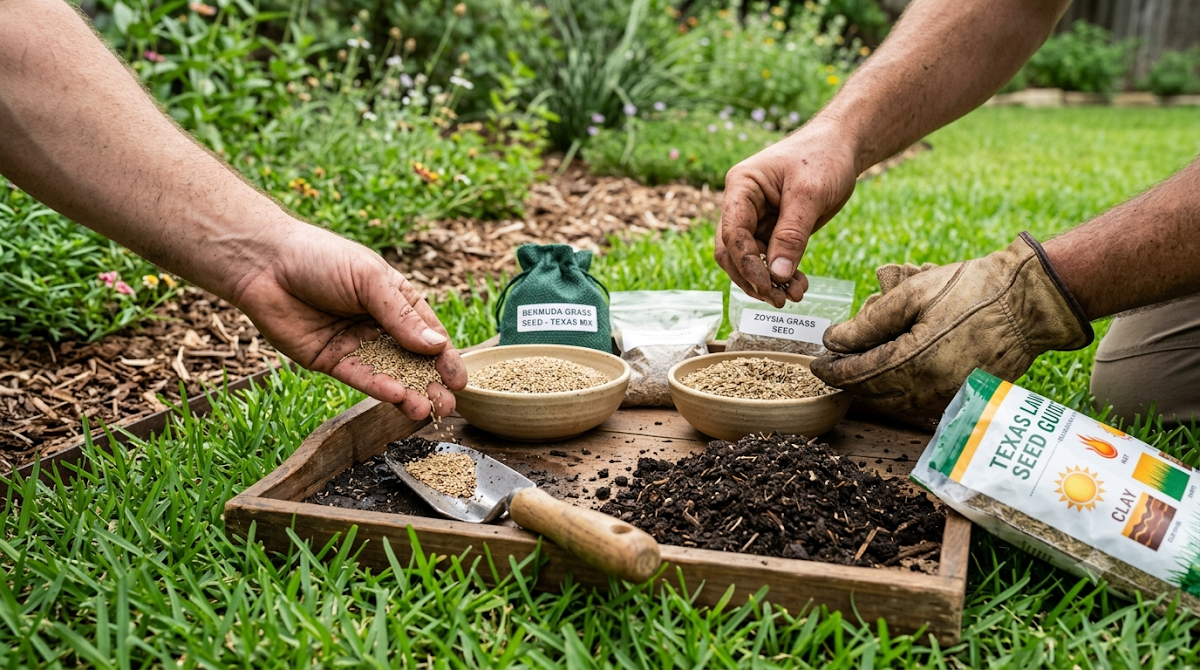
Follow this 60-second decision checklist:
- Do you have full sun (8+ hrs) and kids/pets? \u2192 Common Bermudagrass seed
- Do you have full sun but want zero watering/mowing? \u2192 Buffalograss seed
- Do you have 6 hours of filtered sun under oak trees? \u2192 Zoysiagrass seed (Compadre)
- Do you want green grass in January AND have clay soil? \u2192 Texas Bluegrass seed
- Do you have dense shade (less than 5 hrs)? \u2192 Stop: seed won’t survive. Use groundcovers or mulch
- Do you live in South Texas (Zone 9\u201310)? \u2192 Increase to Bermudagrass or a Bermuda/Buffalo blend
- Do you live in the Panhandle (Zone 6)? \u2192 Choose cold-tolerant Bermuda ‘Yukon’ or Buffalograss
When to Plant Grass Seed in Texas (Exact Dates & Soil Temps)
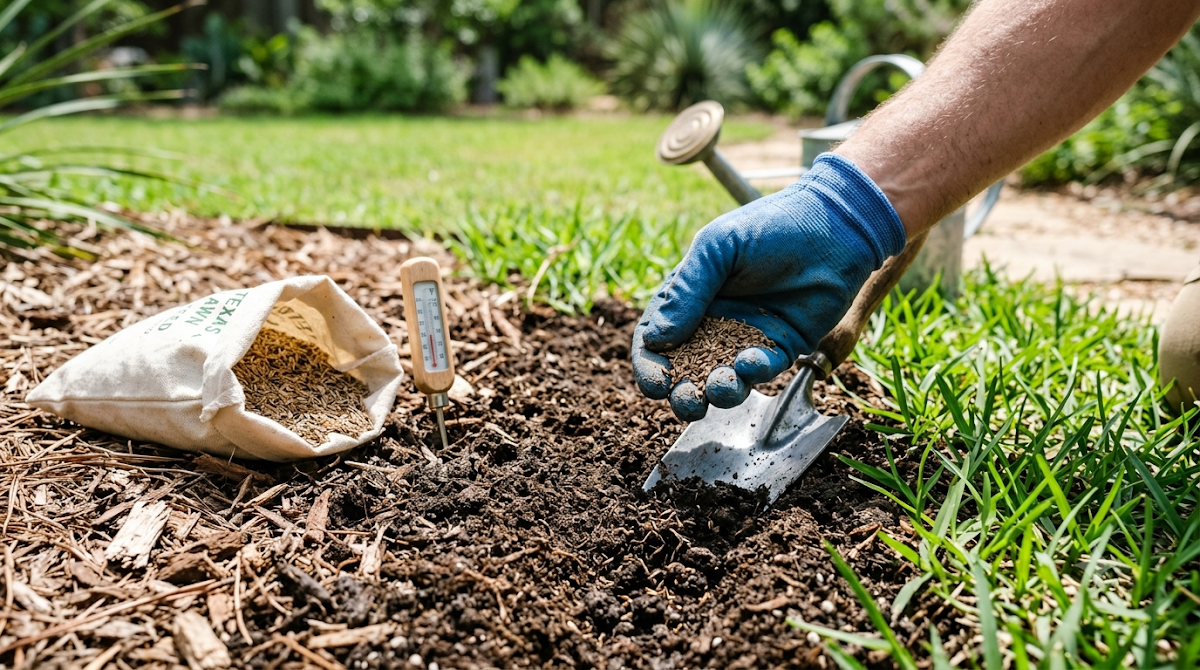
Timing is the #1 reason new lawns fail. Forget calendar dates; use soil temperature:
| Grass Type | Optimal Soil Temp | Best Planting Window (Central TX) | Days to Germination |
|---|---|---|---|
| Bermudagrass | 65\u201375\u00b0F (stable) | Apr 15 \u2013 Jul 15 | 10\u201321 days |
| Buffalograss | 60\u201380\u00b0F | Apr 20 \u2013 Jun 15 | 14\u201324 days |
| Zoysiagrass | 70\u201380\u00b0F (long window) | May 1 \u2013 Jul 15 | 21\u201345 days |
| Texas Bluegrass | 60\u201370\u00b0F | Sep 1 \u2013 Oct 15 (fall) OR Mar 15 \u2013 Apr 15 | 14\u201328 days |
You can plant in late August in Central Texas for Bermuda, but the lawn only has ~6 weeks to establish before the first frost. Best practice: Seed warm-season grasses in late spring (May) so you have 120 days before dormancy. Use a soil thermometer ($10) and check at 3 PM when soil temps are highest.
Step-by-Step: How to Seed a Texas Lawn (Professional Method)
Step 1: Prep the Soil (3 weeks before seeding)
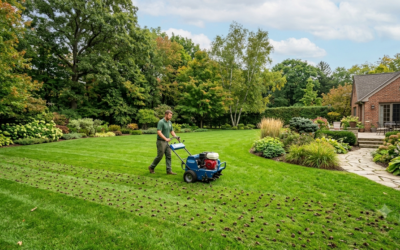
Test soil pH (aim for 6.0\u20137.0 for Bermuda/Zoysia, 7.0\u20138.0 for Buffalograss). Kill existing weeds with a non-selective herbicide (glyphosate) 2 weeks prior. Till or aerate the top 1\u20132 inches. Rake level and remove debris larger than a quarter.
Step 2: Amend & Fertilize
For clay-heavy Central Texas soil, add \u00bd inch of compost. Apply a starter fertilizer with 1 lb of nitrogen per 1,000 sq ft (use a 16-0-0 or 10-10-10). Do not use a weed-and-feed (pre-emergent) here\u2014it will block grass seeds.
Step 3: Sow the Seed
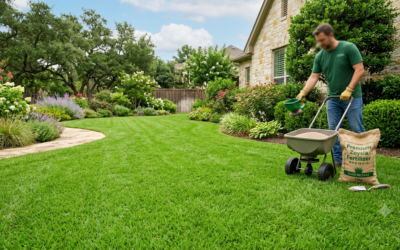
Calculate rate: Bermuda ~1\u20132 lbs per 1,000 sq ft; Buffalo ~2\u20133 lbs; Zoysia ~1\u20132 lbs; Texas Bluegrass ~3 lbs. Use a broadcast spreader. Split the seed in half and apply in two perpendicular passes for even coverage.
Step 4: Press & Mulch
Roll the area with a lawn roller (partially filled) to press seeds into soil contact. Cover with a thin layer of weed-free straw or a bit of topdressing (less than \u00bc inch). This prevents washing and birds from eating seeds.
Step 5: Irrigation & Germination
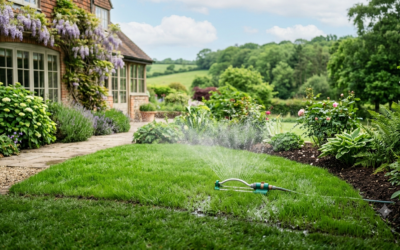
Water daily with a fine mist for 10\u201315 minutes (morning and afternoon) to keep the top \u00bd inch of soil moist. Do not let the soil dry out. You should see sprouts in the ranges listed above. Once the lawn reaches 3 inches tall, reduce watering to 2x per week and begin mowing at the specific grass height I listed earlier. Mow only when grass is dry, with a sharp blade to avoid tearing young roots.
Expert Troubleshooting: When Things Go Wrong
Problem 1: I Planted Too Early (April 1) and Grass Won’t Germinate
If soil temp dipped below 60\u00b0F for more than 3 nights, the dormant seeds may rot. Fix: Wait until soil stays above 65\u00b0F for 7 consecutive days Japan. Then rake the surface lightly, reseed at half the original rate, and roll. Do NOT add more nitrogen\u2014wait 4 weeks after the new sprouts appear.
Problem 2: Heavy Rain or a Cold Snap After Seeding
Clear, cold rain can wash seeds into puddles. Fix: Do NOT walk on the mud. After the soil dries (2\u20133 days), use a garden rake to redistribute any bare spots. Reseed washing seeding rate. For a cold front (below 50\u00b0F), cover new seeds with plastic sheeting overnight, removing it in the morning.
Problem 3: Birds or Fire Ants Are Eating the Seed
Birds will eat seed within 2 days. Fix: Cover the seeded area with a thin layer of straw or peat moss\u2014this is mandatory, not optional, in Texas. For fire ants, the bait before seeding\u2014never after\u2014because it kills beneficial organisms. Apply ‘Amdro’ a month before you seed.
Problem 4: It’s Mid-August and You’ve Waited Too Long
If you’re planting warm-season grass (Bermuda, Buffalo, Zoysia) after August 15 in Central Texas, your lawn likely won’t establish before the first frost tears. Fix: This fall, wait for a Texas Bluegrass fall planting (Sep 1\u2013Oct 15) OR overseed with annual ryegrass for winter color ja then plant Bermuda next May. Don’t waste seed on impossible odds.
For related insights, see our detailed guide on Lawn Mower Air Filter.
Frequently Asked Questions
1. What is the absolute best grass seed for full sun in Central Texas?
For full sun with heavy foot traffic, use common Bermudagrass seed cultivar ‘Princess-77’ or ‘Sahara.’ These handle 100\u00b0F heat, self-recover from wear, and establish in 10\u201314 days under ideal conditions (soil temp 70\u00b0F). If you want to mow only once a month, go with Buffalograss instead. Both are seeded and available at most Texas nurseries like Calloway’s or High Country Gardens.
2. Can I mix lawn grass seed types together in Texas?
Yes, but only strategic mixes. NEVER mix Bermuda and Zoysia\u2014they have different heights and growth rates; you’ll get a lumpy lawn. Good mixes: Bermuda + Buffalograss (for zone 8 areas), or Texas Bluegrass + Kentucky Bluegrass (for shade, zone 6\u20137). Zoysia ‘Zenith’ and Bermuda ‘Princess’ mix is also viable if both are seeded at half rate, but you must start mowing higher. Avoid mixing any of these