
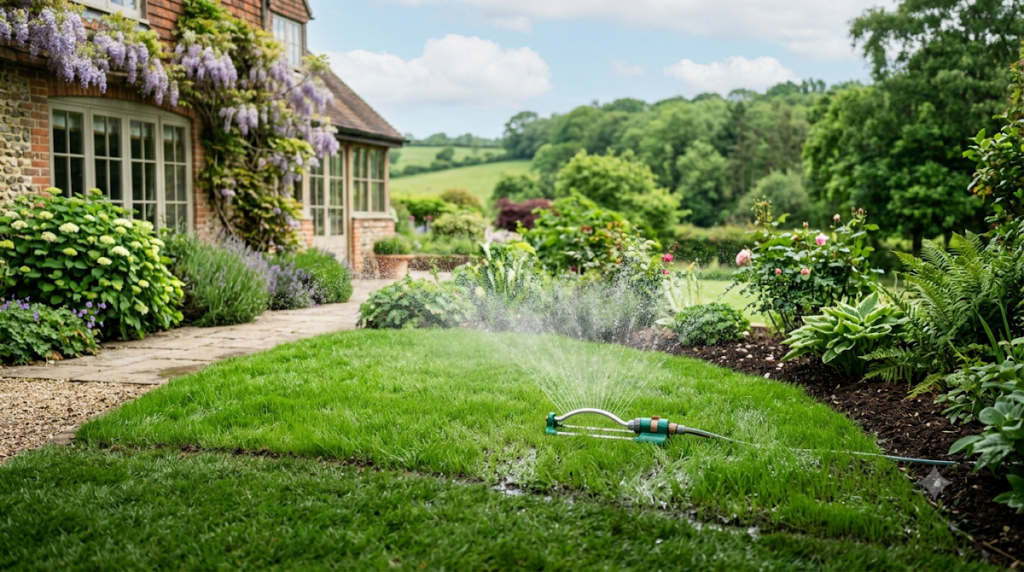
Quick Answer: Water new grass seed 2\u20134 times daily for 5\u201310 minutes per session, keeping the top 1.5 inches of soil consistently moist until germination (typically 7\u201321 days). After sprouts reach 2 inches tall, switch to deep, infrequent watering\u2014soaking 6\u20138 inches once daily, then 2\u20133 times weekly to encourage deep root growth.
The Golden Rule: Soil Moisture, Not Calendar Days
The single biggest mistake homeowners make is watering on a fixed schedule regardless of conditions. Grass seed doesn’t care what day it is\u2014it cares whether the seed coat stays hydrated. If the top 1.5 inches of soil dries out for even a few hours during germination, emerging roots desiccate and die. Your job is to maintain consistent moisture without creating puddles or runoff.
This guide covers exactly how much water for grass seeds, how long to water new grass seed, and how to adjust for soil type, weather, and lawn slope\u2014so you get a thick, uniform stand on the first try.
Before You Plant: Pre-Watering the Seedbed
Watering new grass seed starts before a single seed hits the soil. Pre-planting moisture ensures seeds make immediate soil contact and begin imbibing water the moment they land.
How to Pre-Water Correctly
Irrigate the seedbed 1\u20132 days before planting. Apply 1\u20131.5 inches of water\u2014enough to saturate the top 6\u20138 inches of soil. Use the screwdriver test: a clean screwdriver should push into the soil with moderate resistance to a depth of 6\u20138 inches. If it meets hard resistance, the soil is too dry. If it sinks easily and water pools, you’ve overdone it\u2014wait 24 hours for excess to drain.
| Soil Type | Pre-Water Depth (inches) | Drainage Warning Sign |
|---|---|---|
| Sandy (fast-draining) | 6\u20138 | Water disappears in under 10 min\u2014increase frequency later |
| Loam (ideal) | 6\u20138 | Moist to touch, no standing water after 15 min |
| Clay (slow-draining) | 4\u20136 | Puddles persist >30 min\u2014reduce watering duration |
Pro tip: If temperatures exceed 85\u00b0F, water early morning (5\u20137 AM) only. Pre-watering in midday heat can cause rapid evaporation and seedbed crusting.
How Often and How Long to Water Grass Seed: Phase 1 \u2013 Germination
From planting until seeds sprout (typically 7\u201321 days depending on grass type and soil temperature), the objective is simple: keep the top 1.5 inches of soil continuously moist. This requires light, frequent watering\u2014not long, deep soaks.
Should You Water New Grass Seed Every Day?
Yes\u2014and often multiple times per day. Water new grass seed 2\u20134 times daily for 5\u201310 minutes per session. The exact frequency depends on your environment:
- Hot, sunny, or windy conditions: 4 sessions daily (morning, midday, afternoon, early evening)
- Mild, overcast conditions: 2\u20133 sessions daily
- Sandy soil: 4 sessions (drains quickly)
- Clay soil: 2 sessions (retains moisture longer)
First Watering After Planting
Immediately after spreading seed, do a thorough initial watering. Apply enough to wet the top 2\u20133 inches of soil\u2014typically 10\u201315 minutes with a sprinkler or until you see light surface runoff. This settles the seed into the soil surface, creating the seed-to-soil contact necessary for germination. Do not wash seeds into clumps; if you see seed moving, stop and let the water soak in, then resume at lower pressure.
How Long to Water Grass Seed with Sprinkler
For the 5\u201310 minute maintenance sessions during germination, set sprinklers on a low-pressure or misting setting. Place a small, straight-sided container (like a tuna can) on the lawn to measure output. You’re targeting 0.1\u20130.2 inches of water per session\u2014enough to dampen the top 1.5 inches without creating runoff.
At soil temperatures of 60\u201375\u00b0F (the ideal range for cool-season grasses), expect:
| Grass Type | Germination Time | Soil Temp Range | Sessions/Day |
|---|---|---|---|
| Perennial Ryegrass | 5\u201310 days | 55\u201365\u00b0F | 2\u20133 |
| Tall Fescue | 7\u201312 days | 60\u201370\u00b0F | 2\u20133 |
| Kentucky Bluegrass | 14\u201321 days | 60\u201375\u00b0F | 3\u20134 |
| Bermudagrass (warm-season) | 7\u201314 days | 75\u201385\u00b0F | 3\u20134 |
Phase 2: Watering a Sprouted Lawn (Weeks 2\u20134)
Once you see grass blades at 1\u20132 inches tall, the watering strategy flips. You now want to encourage deep root growth, which requires less frequent but substantially longer watering sessions.
The Transition Schedule
- Days 14\u201321 (after sprouting): Reduce to 1 daily watering, 20\u201330 minutes, early morning (5\u20137 AM). Target 0.5\u20130.75 inches of water.
- Days 21\u201328: Water every other day for 30\u201345 minutes. Target 0.75\u20131 inch.
- After day 28 (or first mowing): Water 2\u20133 times weekly, 30\u201345 minutes, delivering 1\u20131.5 inches total per week. Adjust based on rainfall.
Step-by-Step Watering Procedure for New Grass Seed
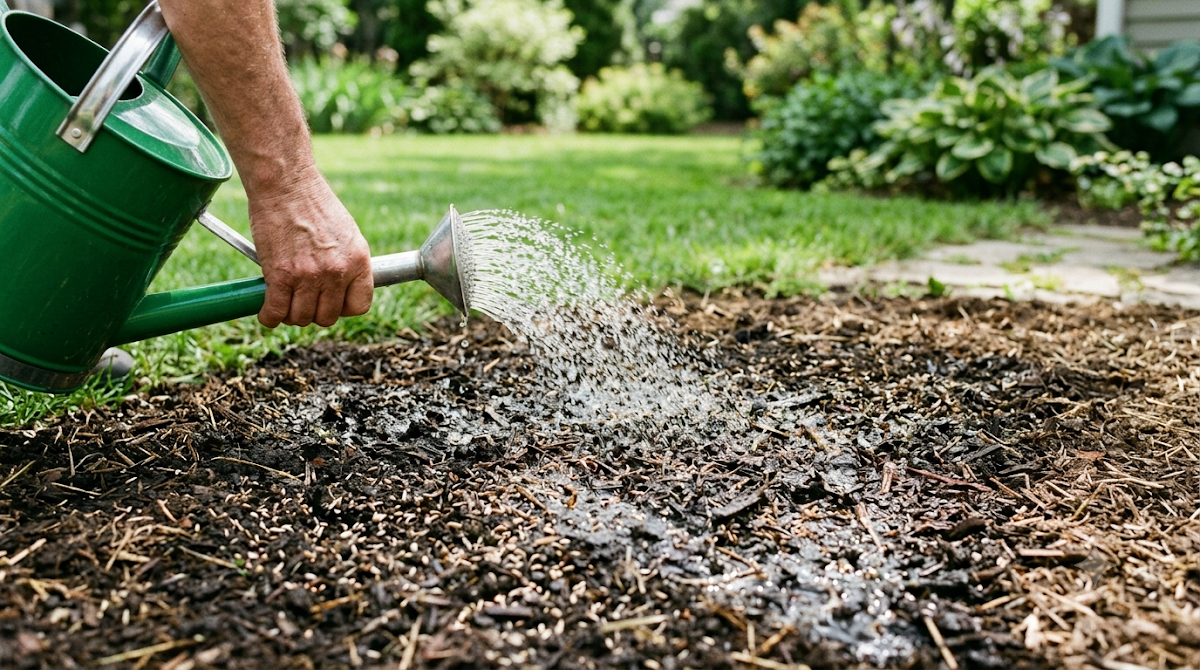
Follow this exact sequence for both new lawns and overseeding:
- Check soil moisture before each session. Push a screwdriver or finger 1.5 inches into the soil. If it’s dry, water now. If damp, delay 1\u20132 hours and recheck.
- Water early morning (5\u20137 AM) as your primary session. This allows leaf blades to dry before evening, reducing fungal disease risk. Evening moisture sitting overnight invites disease.
- Apply 5\u201310 minutes per zone during germination phase. Use a low-pressure setting to prevent seed displacement. Check for runoff every 2\u20133 minutes.
- Verify penetration. After watering, dig a small probe\u2014soil should be moist 1.5 inches deep but not muddy. Adjust session length accordingly.
- Monitor weather. If rainfall exceeds 0.5 inches, skip a maintenance session. If temperatures spike above 85\u00b0F, add one extra session in the mid-afternoon.
Watering for Overseeding, Bare Patches, and New Lawns
How to Water When Overseeding an Existing Lawn
Overseeding requires the same germination-phase schedule (2\u20134 daily sessions, 5\u201310 minutes) but only over the seeded areas. The existing grass will handle slightly less water, so you may need to hand-water or use targeted sprinklers. Stop watering existing lawn areas separately\u2014apply the germination schedule uniformly to the seeded zone only.
How to Water When Reseeding Bare Spots
Bare spots dry out faster because there’s no canopy shading the soil. Water 3\u20134 times daily for 4\u20136 minutes per session, and consider laying a thin layer of straw or erosion blanket to retain moisture. Hand-water with a hose-end sprayer for precision, and avoid hitting surrounding established grass.
How to Water a Newly Seeded Lawn (Full Area)
Full new lawns need the most water because bare soil evaporates quickly. Expect to use roughly 0.5\u20130.75 inches of water daily during germination, split into 3\u20134 sessions. Use oscillating or impact sprinklers for even coverage, and check for dry spots near walkways and foundations, which absorb moisture from adjacent soil.
Watering New Grass Seed in Summer: Special Considerations
Summer planting is a high-risk gamble, but sometimes unavoidable. At air temperatures above 85\u00b0F, evaporation rates spike. You’ll need 4\u20135 daily sessions of 5 minutes each, and even then, midday heat can cause surface crusting that blocks emergence. If soil temperatures exceed 90\u00b0F, cool-season grass seed will go dormant and refuse to sprout. Consider waiting for fall (soil temps 55\u201375\u00b0F) if your climate regularly exceeds these thresholds.
Expert Troubleshooting: When Things Go Wrong
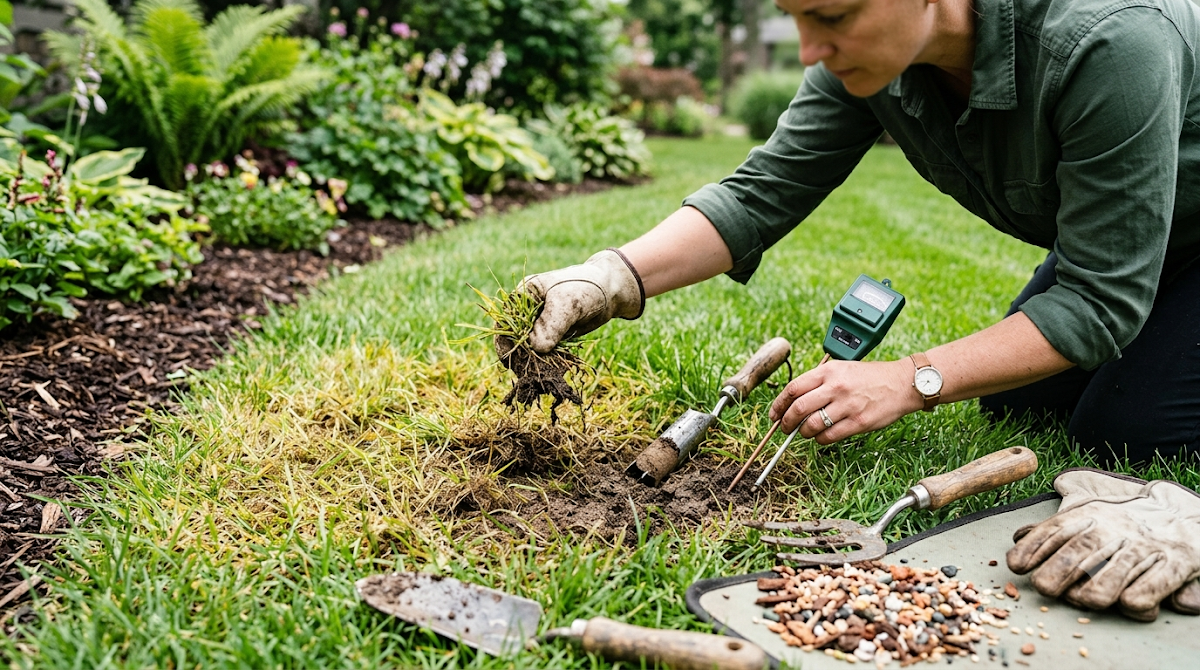
What If You Mowed Too Early?
If you mowed before grass reached 3 inches and 3\u20134 weeks old, you likely pulled up shallow-rooted seedlings. Stop mowing immediately. Water deeply (1 inch) to encourage root re-establishment, and overseed bare patches. Wait until the entire lawn averages 3.5\u20134 inches before mowing again, using a sharp blade to avoid ripping young roots.
Wet Weather Delays
Heavy rain is a double-edged sword. It provides moisture but can compact soil, displace seed, and promote fungal disease. If rain exceeds 0.5 inches in a day, skip your sprinkler sessions. If seed washes into clumps, wait until soil dries enough to walk on without denting, then rake gently to redistribute. If puddles persist for 24+ hours, you have drainage issues\u2014core aerate and top-dress with compost to improve infiltration.
What Happens If You Miss a Day of Watering?
During germination, a missed day in hot or dry conditions can dry out the seedbed and kill sprouting seeds within hours. Resume immediately with a normal session\u2014do not flood to “catch up.” If sprouts are already 2+ inches tall, one missed day is recoverable. Water slightly longer (add 5 minutes) on the next session.
Frequently Asked Questions
1. How much water does grass seed need per day?
During germination, grass seed needs roughly 0.3\u20130.5 inches of water per day, split into 2\u20134 light sessions of 5\u201310 minutes each. That’s about 0.1\u20130.2 inches per session. After sprouts reach 2 inches, reduce to 1\u20131.5 inches weekly, delivered in 1\u20132 deep soakings.
2. Is it better to water grass seed in the morning or evening?
Always prioritize morning watering (5\u20137 AM). This lets leaf blades dry before evening, dramatically reducing fungal disease risk. If you need a second or third session during germination, use late morning and early afternoon. Avoid evening watering entirely\u2014prolonged leaf wetness overnight invites damping-off and other pathogens.
3. Can you water new grass seed too much?
Yes. Overwatering causes shallow root growth, soil anaerobic conditions, puddling, seed rot, and fungal disease. Signs include standing water after 15 minutes, yellowing or mushy sprouts, and a sour smell from the soil. If you see these, cut watering frequency by half and thatch or aerate compacted areas.
4. How long can new grass seed go without water?
Before germination begins, dormant seed can survive days or weeks without water. However, once seeds begin imbibing water and germination proceeds, drying out for even a few hours in hot conditions can be fatal. After sprouts are 2\u20133 inches tall with roots 2+ inches deep, they can survive 1\u20132 days without water, though growth will stall.
Final Checklist for Watering Success
- \u2705 Pre-water seedbed to 6\u20138 inches depth before planting
- \u2705 Water 2\u20134 times daily for 5\u201310 minutes during germination
- \u2705 Keep top 1.5 inches of soil consistently moist\u2014never dry, never flooded
- \u2705 Transition to deep, infrequent watering after sprouts reach 2 inches
- \u2705 Always water early morning to prevent fungal disease
- \u2705 Adjust frequency for soil type, heat, wind, and rainfall
- \u2705 Stop mowing until grass reaches 3.5\u20134 inches tall
Mastering the watering schedule for new grass seed is about consistency, observation, and adjustment. Follow this guide, trust your moisture checks over your calendar, and your lawn will reward you with dense, healthy growth that lasts for years. For related insights, see our detailed guide on When to Apply Weed and Feed.