
What Does MTD Stand for in Lawn Mowers?
MTD stands for Modern Tool and Die, the original name behind MTD Products, a major manufacturer of lawn mowers and outdoor power equipment. Identifying an MTD-built mower helps you locate the correct manuals, replacement parts, warranty information, and service instructions—even when the machine carries another brand name.
Expert Summary>
– MTD means Modern Tool and Die, a company founded in 1932 that later became a major outdoor power equipment manufacturer. – An MTD-built mower may carry a different brand name, so the logo on the hood does not always identify the actual manufacturer. – The most reliable way to identify an MTD lawn mower is to check its model and serial number label. – MTD model numbers are essential because visually similar mowers may use different belts, blades, filters, and transmission parts. – Stanley Black & Decker completed its acquisition of MTD Holdings in 2021, but older machines and replacement parts may still display the MTD name.
Step 1: Understand What MTD Stands for in Lawn Mowers
Remember the full name: MTD is short for Modern Tool and Die. The initials come from the company’s original manufacturing identity rather than from a mower feature, engine technology, or cutting system.
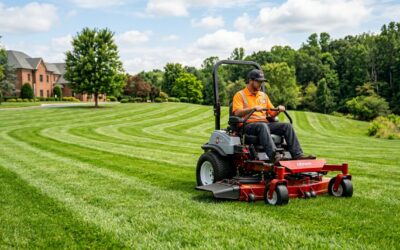
The company began as a tool-and-die manufacturer in 1932. It later expanded into lawn and garden equipment, including walk-behind mowers, riding mowers, lawn tractors, snow blowers, tillers, and related outdoor machines.
Is MTD a lawn mower brand or a manufacturer?
MTD has functioned primarily as a manufacturer and corporate name, although the MTD name has also appeared directly on equipment. The company produced machines sold under several consumer-facing brand names and retail labels.
This distinction matters because the name printed prominently on a mower may identify the brand, while the product label may identify MTD as the manufacturer.
| Term | What it identifies | Example |
|---|---|---|
| MTD | Manufacturer or corporate product family | MTD-built riding mower |
| Modern Tool and Die | Original meaning of MTD | Company name behind the initials |
| Retail brand | Name used to market the mower | A store-specific or licensed mower label |
| Engine manufacturer | Company that produced the engine | Briggs & Stratton, Kawasaki, or Kohler |
| Model number | Exact mower configuration | Used to match manuals and parts |
| Serial number | Individual production record | Used for age and service identification |
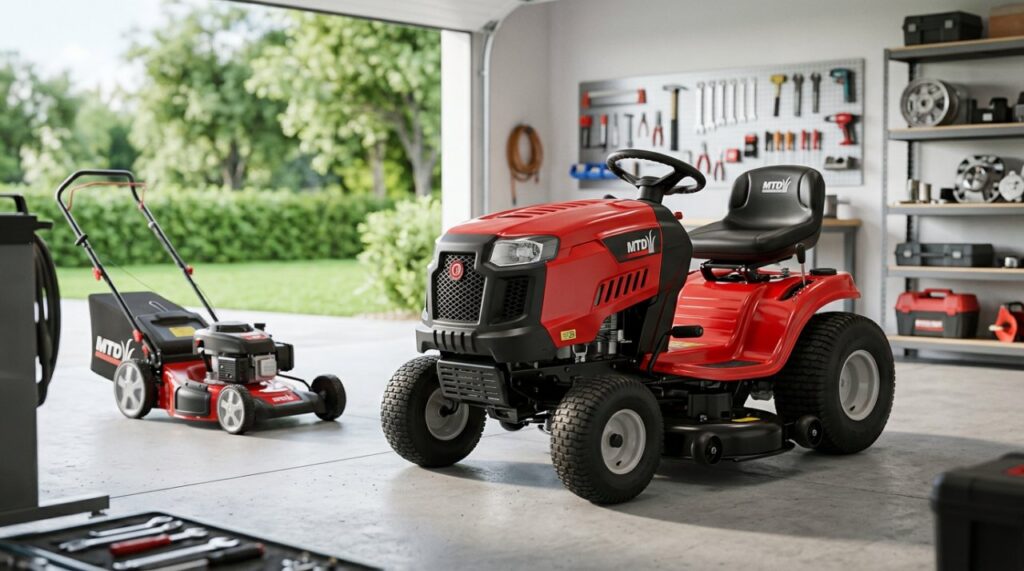
A mower can therefore have an MTD chassis, an engine from another company, and a completely different retail brand on the hood.
What this means for you is… you should not rely on the hood logo alone when buying parts or downloading a manual.
Step 2: Recognize the Company Behind the MTD Name
Separate company history from product identification. Knowing MTD’s background explains why its name appears on so many different lawn mowers.
Modern Tool and Die was established in 1932 in the Cleveland, Ohio, area. The business eventually evolved into MTD Products, becoming a large producer of residential outdoor power equipment.
In 2021, Stanley Black & Decker completed its acquisition of the remaining ownership interest in MTD Holdings. That corporate change does not make older MTD labels, manuals, model numbers, or parts references invalid.
Why does MTD appear on mowers with different names?
MTD produced equipment for multiple brands and retailers using shared manufacturing platforms. Manufacturers commonly adapt decks, frames, controls, engines, styling, and features for different price points or sales channels.
Two lawn tractors may look similar because they share a basic platform. However, they can still use different:
- Deck belts
- Drive belts
- Spindles
- Pulleys
- Blades
- Transmissions
- Electrical harnesses
- Engine components
- Control cables
- Safety switches
That is why “it looks like my mower” is not a reliable parts-selection method.
What this means for you is… an accurate model number is more useful than the mower’s color, age estimate, or visual appearance.
Step 3: Determine Whether Your Lawn Mower Was Made by MTD
Inspect the mower’s identification label before making assumptions. A manufacturer label or model-number plate provides stronger evidence than paint color, decals, or online photographs.
No special diagnostic equipment is normally required. You may need to clean the label carefully and photograph it in good lighting.
Tools and materials needed
| Tool or material | Purpose | Required? |
|---|---|---|
| Smartphone camera | Captures model and serial numbers | Recommended |
| Flashlight | Illuminates labels under seats or frames | Recommended |
| Soft cloth | Removes dry dust and grass residue | Recommended |
| Mild soapy water | Cleans a dirty label carefully | Optional |
| Owner’s manual | Confirms label location and specifications | Optional |
| Work gloves | Protects hands near decks and frames | Recommended |
| Pen and paper | Records numbers if a photo is unclear | Optional |
Do not use aggressive solvents, wire brushes, or pressure washing on an identification label. These methods can erase printed information or loosen the label.
1 Park the mower safely
Place the mower on a firm, level surface. Stop the engine, remove the ignition key, engage the parking brake, and wait for hot or moving components to cool.
For a walk-behind mower, disconnecting the spark-plug lead can reduce the risk of an accidental start while inspecting areas near the deck. Follow the safety instructions in the owner’s manual.
2 Check the most common label locations
MTD identification labels are usually attached to the mower’s frame, body, or deck. The exact position varies by product type and production period.
| Equipment type | Common identification-label locations |
|---|---|
| Riding mower or lawn tractor | Under the seat, beneath the seat pan, on the frame, or near the rear wheels |
| Zero-turn mower | Under the seat, on the frame rail, or near the engine compartment |
| Walk-behind mower | Rear of the deck, top of the deck, discharge area, or handle-mounting section |
| Rear-tine tiller | Frame, tine shield, or transmission housing area |
| Snow blower | Rear frame, side housing, or operator-control area |
These are common locations rather than universal rules. Always consult the machine’s documentation if the label is difficult to find.
3 Look for manufacturer wording
Read the full label instead of searching only for a large MTD logo. The label may include wording such as:
- MTD Products
- Manufactured by MTD
- Model number
- Serial number
- Product identification number
- A company address associated with MTD
- A manufacturing or compliance statement
A mower can be MTD-built even if the MTD name appears only in small print.
4 Record the complete model and serial numbers
Photograph the entire label straight on. Take a second close-up if the characters are small, faded, or partially damaged.
Record punctuation, letters, dashes, and leading zeros exactly as printed. One incorrect character can direct you to a different deck size, transmission, or production revision.
5 Verify the number through official documentation
Search the manufacturer’s support resources, the brand’s official parts portal, or an authorized service dealer. Match the model number to the machine type, deck width, engine configuration, and illustrated parts diagrams.
If the search result describes a different mower, recheck easily confused characters such as:
- 0 and O
- 1 and I
- 5 and S
- 8 and B
- 2 and Z
What this means for you is… a five-minute label inspection can prevent ordering a belt, blade, or filter that does not fit.
Step 4: Distinguish MTD from the Mower’s Brand and Engine
Treat the mower manufacturer, retail brand, and engine manufacturer as separate identities. They may all be different companies, and each controls a different category of parts or support.
For example, the mower’s chassis and cutting deck may have been produced within an MTD platform, while the engine has its own model, type, and specification numbers.
Which identification number should you use?
Use the number attached to the system you are repairing.
| Repair or information needed | Identification number to use |
|---|---|
| Deck belt | Mower model number |
| Drive belt | Mower model number |
| Blade or spindle | Mower model number and deck configuration |
| Wheel or steering component | Mower model number |
| Air filter | Engine model or specification number |
| Carburetor | Engine model, type, and specification |
| Spark plug | Engine documentation |
| Transmission component | Mower and transmission identification |
| Owner’s manual | Mower model number |
| Engine service manual | Engine identification number |
Do not enter the engine number into a mower parts catalog and expect it to identify the deck or chassis. Similarly, the mower model number may not identify the precise carburetor installed on the engine.
MTD versus an engine manufacturer
MTD does not automatically identify who made the engine. Residential mowers may use engines supplied by specialist engine manufacturers or engines marketed under another brand.
Check the engine shroud, valve cover, or engine identification plate separately. Engine labels often include a model, type, code, family, or specification number.
MTD versus a retailer
A retailer may sell a mower under a private or licensed label without manufacturing the machine. The actual manufacturer is normally disclosed on the compliance or product identification label.
This manufacturing arrangement is common across appliances, power tools, and outdoor equipment. It allows retailers and brands to offer products based on an existing equipment platform.
What this means for you is… you must match each replacement part to the company and identification number responsible for that component.
Step 5: Decode an MTD Model Number Correctly
Copy the model number exactly before trying to interpret it. MTD model-number formats vary by product category, brand, market, and manufacturing period, so no single decoding formula works for every machine.
Some labels provide a clearly marked model number and serial number. Others may show additional production, date, plant, or engineering codes.
Model number versus serial number
The model number identifies a machine configuration or product family. The serial number identifies an individual unit or manufacturing record within that product family.
| Identifier | Main purpose | Can multiple mowers share it? |
|---|---|---|
| Model number | Identifies design and configuration | Yes |
| Serial number | Identifies an individual production record | Usually no |
| Engine model number | Identifies the engine family | Yes |
| Part number | Identifies one replaceable component | Yes |
| Date or production code | Helps establish manufacturing period | Yes |
Both the model and serial number may be required when a product changed parts during a production run.
Why model-number suffixes matter
A suffix or revision code can indicate a production change. That change might affect belt length, pulley diameter, wiring, spindle design, or another fit-critical feature.
Never remove a suffix because a marketplace listing shows only the base number. Compare the complete number with the compatibility information in an official parts diagram.
Can a serial number reveal the mower’s age?
Sometimes, but the coding method is not universal across every MTD product or era. A serial number may contain production information, but it should be interpreted through official support documentation or a qualified dealer.
Avoid relying on an unverified internet formula. Coding conventions can change, and a confidently decoded but incorrect date may lead you to the wrong parts catalog.
What this means for you is… exact label data is safer than guessing the mower’s year from its design, paint, or condition.
Step 6: Use the MTD Identification to Find Correct Parts
Search by the complete mower model number first. Then confirm each component against an illustrated parts diagram and the physical part installed on the machine.
This process is more reliable than searching