

Can You Use Sea Foam in Lawn Mowers? The Direct Answer
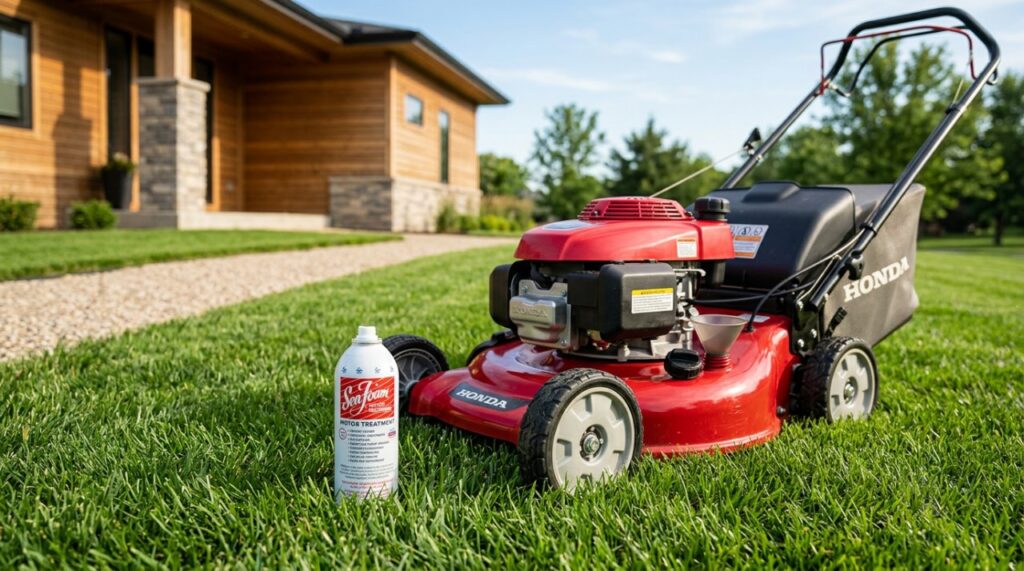
Yes, Sea Foam Motor Treatment can be used in most gasoline-powered lawn mowers when it is added in the correct amount. It can help stabilize fuel, control moisture, clean fuel-system deposits, and reduce problems caused by old gasoline, but it cannot repair damaged carburetor parts or other mechanical faults.
Expert Summary>
– Sea Foam Motor Treatment is generally compatible with two-stroke and four-stroke gasoline lawn mower engines. – For routine fuel treatment, follow the current dosage printed on the product label; a commonly published starting ratio is 1 ounce per gallon of gasoline. – A stronger cleaning mixture may help with minor gum or varnish, but excessive concentration can make troubleshooting harder and increase smoke. – Sea Foam is preventive maintenance and a cleaning aid—not a substitute for fresh fuel, carburetor repair, or correct oil. – Never pour it into the crankcase of a mower unless both the mower manufacturer and the current product directions allow that application.
Step 1: Confirm That Your Lawn Mower Is Compatible
Identify the engine and fuel type before adding anything. Sea Foam is intended for petroleum-based fuels and is commonly used in gasoline engines, but that does not mean every mower or every fuel system should be treated the same way.
Check whether the mower uses gasoline
I would first check the fuel cap, engine label, and owner’s manual. The treatment is potentially suitable if the machine is a:
- Four-stroke push mower
- Two-stroke mower
- Gasoline riding mower
- Gasoline zero-turn mower
- Gas-powered lawn tractor
- Carbureted or fuel-injected mower, where approved by the manufacturer
Do not add Sea Foam to:
- Battery-powered lawn mowers
- Corded electric lawn mowers
- Diesel equipment, unless the exact product label specifically approves diesel use
- A tank filled with an unknown chemical mixture
- A mower whose manufacturer prohibits aftermarket fuel additives
Distinguish a two-stroke engine from a four-stroke engine
A four-stroke mower normally has a separate engine-oil fill point. Gasoline goes into the fuel tank, while oil goes into the crankcase.
A two-stroke engine usually requires gasoline mixed with a specific amount of two-stroke oil. Sea Foam does not replace that oil.
| Engine type | Normal fuel setup | Where Sea Foam goes | Critical warning |
|---|---|---|---|
| Four-stroke | Straight gasoline; oil stored separately | Fuel tank or fuel can | Do not replace crankcase oil with Sea Foam |
| Two-stroke | Gasoline mixed with two-stroke oil | Prepared fuel mixture | Keep the required oil-to-gas ratio unchanged |
| Battery/electric | No liquid fuel | Nowhere | Do not use fuel additives |
| Diesel mower | Diesel fuel | Only if the current label approves it | Do not assume gasoline instructions apply |
Read the mower warranty and manual
The answer to “is Seafoam safe for lawn mowers?” depends partly on the equipment manufacturer’s instructions. Some manufacturers allow appropriate fuel stabilizers but discourage unapproved additives, especially during the warranty period.
I would treat the owner’s manual as the final authority. If the manual conflicts with advice on a bottle, forum, or video, I would stop and contact the engine manufacturer.
Step 2: Decide Whether Sea Foam Fits the Problem
Match the treatment to the mower’s actual symptoms. Sea Foam may help with fuel-related deposits or aging gasoline, but it will not fix every hard-starting or rough-running mower.
Problems it may help address
Sea Foam Motor Treatment may be useful when a gasoline mower has:
- Minor hesitation caused by fuel-system deposits
- Slightly rough idle or uneven running
- Fuel that needs short-term stabilization
- Gum or varnish beginning to form in the fuel system
- Moisture associated with ethanol-blended gasoline
- Seasonal equipment that sits unused for weeks
- A carburetor that is mildly dirty but not physically damaged
The realistic benefit is gradual cleaning while treated fuel moves through the system. I would not expect an instant transformation from a seriously clogged carburetor.
Problems it will not repair
Sea Foam cannot physically correct:
- A torn carburetor diaphragm
- A blocked fuel cap vent
- A cracked fuel hose
- A corroded carburetor bowl
- A stuck float or damaged needle valve
- A failed ignition coil
- A fouled or worn spark plug
- Low engine compression
- Incorrect valve clearance
- Contaminated engine oil
- A bent crankshaft
- A damaged blade or blade adapter
This distinction matters because additives are often blamed when the underlying problem is mechanical. If the mower does not start at all, I would inspect fuel, air, spark, and compression rather than repeatedly adding more treatment.
Does Seafoam work in lawn mowers?
Sea Foam can work as a fuel stabilizer and light fuel-system cleaner in lawn mowers, but results depend on the cause and severity of the problem. It is most useful for prevention and mild deposit buildup, not for a carburetor jet that is fully blocked.
| Mower condition | Likely usefulness | Better first action |
|---|---|---|
| Runs normally; stored between uses | Good preventive fit | Add the label-approved maintenance dose |
| Slight surging after sitting | May help | Use fresh treated fuel and inspect the air filter |
| Old fuel smells sour or looks dark | Limited | Drain and dispose of the old fuel properly |
| Carburetor jet fully clogged | Low | Remove and clean or replace the carburetor |
| No spark | None | Diagnose the ignition system |
| Fuel hose leaking | None | Replace the hose before operating |
| Engine smoking after overfilling oil | None | Correct the oil level and inspect the air filter |
Step 3: Gather the Tools and Materials
Prepare everything before opening the fuel tank. Careful measuring prevents overdosing, spills, and accidental contamination.
| Tool or material | Why it is needed |
|---|---|
| Sea Foam Motor Treatment | Fuel treatment and stabilizing additive |
| Fresh gasoline | Provides a clean base for treatment |
| Approved fuel container | Allows accurate and safer premixing |
| Graduated measuring cup or syringe | Measures small additive quantities |
| Funnel | Reduces spills around the mower |
| Nitrile gloves | Limits skin contact with fuel |
| Safety glasses | Protects against splashes |
| Clean shop towel | Wipes small spills |
| Owner’s manual | Confirms fuel and additive requirements |
| Fire extinguisher rated for flammable liquids | Provides emergency protection |
Use measuring equipment dedicated to workshop chemicals. I would never return a fuel-contaminated cup or syringe to a kitchen, food-preparation area, or medical kit.
Choose fresh gasoline
Fresh fuel matters more than any additive. If gasoline is already badly degraded, adding Sea Foam does not turn it back into new fuel.
Signs of questionable gasoline include:
- Darker-than-normal color
- Sour or varnish-like odor
- Visible water or separated layers
- Debris in the container
- Fuel stored longer than the equipment or fuel supplier recommends
If I cannot confirm the fuel’s age or condition, I prefer starting with fresh gasoline. That removes a major variable before troubleshooting.
Step 4: Calculate the Correct Amount
Use the current product-label dosage and measure the mower’s actual fuel volume. Do not estimate by pouring directly from the can, especially when treating a small mower tank.
Product formulations and label directions can change. Always verify the instructions printed on the specific container you purchased in August 2026.
Use a maintenance ratio for normal operation
A commonly published routine-treatment ratio for Sea Foam Motor Treatment is approximately 1 ounce per gallon of gasoline. The current label should override any ratio quoted in an article, video, or forum.
At that ratio, approximate amounts are:
| Gasoline volume | Sea Foam at 1 oz per gallon |
|---|---|
| 1 gallon | 1 ounce |
| 1/2 gallon | 1/2 ounce |
| 1 quart | 1/4 ounce |
| 2 gallons | 2 ounces |
| 5 gallons | 5 ounces |
Small-engine tanks often hold much less than one gallon. That is why premixing in a known quantity of fuel is more accurate than treating a partly filled tank.
Calculate a custom quantity
Use this simple formula when the label calls for 1 ounce per gallon:
Sea Foam needed in ounces = gallons of gasoline × 1
For example, 0.75 gallon of gasoline would receive 0.75 ounce at that ratio. If the current label specifies another dosage, substitute that number in the formula.
Do not confuse maintenance and cleaning doses
A stronger concentration is sometimes used for cleaning, but more is not automatically better. Heavy dosing can change how the engine runs during treatment and may create extra exhaust smoke.
I would begin with the normal label-approved treatment unless I had a clear reason to use a stronger mixture. If a standard dose does not help, I would diagnose the mower rather than keep adding additive.
Step 5: Mix Sea Foam With the Gasoline
Premix the measured treatment with fresh gasoline in an approved container. Premixing distributes the additive evenly and makes the dosage easier to control.
Add the treatment to a fuel can
Follow this order:
- Place the approved fuel container on the ground in a well-ventilated outdoor area.
- Measure the correct amount of Sea Foam Motor Treatment.
- Pour the measured treatment into the container.
- Add the required amount of fresh gasoline.
- Close the container securely.
- Gently move the container to blend the contents.
- Label it so no one mistakes it for untreated fuel.
Do not shake the container aggressively. Gentle mixing is enough and reduces unnecessary vapor buildup.
Treating fuel directly in the mower tank
Direct treatment is possible when the amount of fuel already in the tank is known. In practice, I find this less precise because most lawn mower tanks do not have accurate volume markings.
If treating the tank directly:
- Turn off the engine.
- Let the mower cool completely.
- Move it outdoors, away from flames and sparks.
- Determine approximately how much gasoline is in the tank.
- Measure the additive separately.
- Use a funnel to add it.
- Replace the fuel cap firmly.
- Wipe up any spilled liquid before starting.
Never add fuel treatment while the engine is running or hot. Gasoline vapor can ignite on hot engine parts.
Step 6: Protect the Oil Ratio in a Two-Stroke Mower
**Keep the manufacturer’s two-stroke oil ratio exactly the same