

Will Movers Move Lawn Mowers? Direct Answer
Yes, most professional moving companies will move lawn mowers when you prepare them correctly, empty fuel, secure blades, and declare them early. This matters because improper handling can lead to spills, damage claims denial, or refused service on moving day. Confirm policy in writing before booking.
Expert Summary
- Most full-service movers accept lawn mowers if gas is drained, oil checked, and the unit is clean and upright.
- Push mowers ship easier than riding mowers or zero-turns; expect extra fees for large equipment.
- Always get written confirmation—verbal “yes” often fails on load day.
- Self-haul or specialty equipment movers beat standard vans for heavy riding mowers.
- Prepare 48–72 hours ahead to avoid last-minute refusal and extra costs in 2026.
Tools and Materials Needed
| Item | Purpose | Notes |
|---|---|---|
| Fuel stabilizer / empty gas can | Drain or stabilize fuel | Required by most carriers |
| Socket set / screwdriver | Remove battery or blades if needed | Riding mowers often need battery disconnect |
| Tarps / moving blankets | Protect deck and paint | Prevent scratches |
| Zip ties / ratchet straps | Secure loose parts | Chutes, bags, handles |
| Absorbent pads | Catch residual oil/fuel | Protect truck floor |
| Camera / phone | Photo inventory | Document condition pre-move |
| Moving company inventory form | Declare the mower | Get signature |
Step 1: Confirm Policy with the Moving Company Early
Call or email every quote you receive and ask the exact question: “Will movers move lawn mowers with your service?”
1 Ask Specific Follow-Ups – Do you transport push mowers, self-propelled, and riding mowers?
- Is there a weight or size limit?
- Extra fee for lawn equipment?
- Any prep rules (fuel, oil, battery)?
2 Get It in Writing
Request the answer on the estimate or via email. Screenshot or save the reply. Verbal approval disappears when the crew arrives.
Why this step matters: Policies differ between national van lines, local movers, and budget carriers. Some ban gas equipment entirely; others accept only after full drain.
Step 2: Choose the Right Type of Mover
Match the mower size to the right carrier.
1 Standard Household Movers
Best for walk-behind mowers under 100 lbs. Most will load them with furniture if prepared.
2 Specialty Equipment or Auto Transport
Required for riding mowers, garden tractors, or zero-turn units over 300–400 lbs. These companies use ramps, winches, and open/enclosed trailers.
3 Hybrid Option
Some full-service movers partner with equipment haulers. Ask if they offer a “specialty add-on.”
Trade-off table:
| Mover Type | Accepts Push Mower | Accepts Riding Mower | Typical Extra Cost | Best For |
|---|---|---|---|---|
| Local full-service | Yes | Sometimes | $50–150 | Short moves |
| National van line | Usually | Rarely | $100–300 | Long distance |
| Equipment specialist | Yes | Yes | $200–600+ | Heavy machines |
| DIY truck rental | Yes | Yes (you load) | Fuel + time | Budget control |
Step 3: Prepare the Lawn Mower Correctly
Prepare the machine 48–72 hours before load day. This is the #1 reason movers refuse or charge more.
1 Drain or Stabilize Fuel – Run the mower dry or siphon remaining gas into an approved can.
- For short moves under 50 miles some carriers allow stabilizer; confirm first.
- Never leave fuel in the tank for long-distance transport—fire risk and policy violation.
2 Handle Oil and Fluids – Check oil level; top off only if low and non-leaking.
- Wipe all residue from the deck and engine.
- Place absorbent pads under the mower on the truck.
3 Disconnect Battery (Riding Mowers) – Remove or disconnect the battery cable.
- Tape terminals and secure the battery upright if removed.
4 Secure Loose Parts – Fold or remove handles if possible.
- Zip-tie grass bags, side chutes, and mulch plugs.
- Lower the cutting deck to lowest setting for stability.
5 Clean Thoroughly – Power-wash or scrape caked grass and dirt.
- Dirty mowers get refused or charged cleaning fees.
6 Photo Documentation
Take clear photos of all four sides, serial number, and any existing scratches. Timestamp them.
Step 4: Measure, Weigh, and Declare Accurately
Measure length, width, height, and approximate weight.
- Push mower: usually 50–90 lbs.
- Riding mower: 400–800+ lbs.
- Provide exact model if possible.
Add the mower to the official inventory list. Undeclared items often get left behind or create claim issues.
Step 5: Decide Loading Method and Placement
Decide how the mower will ride.
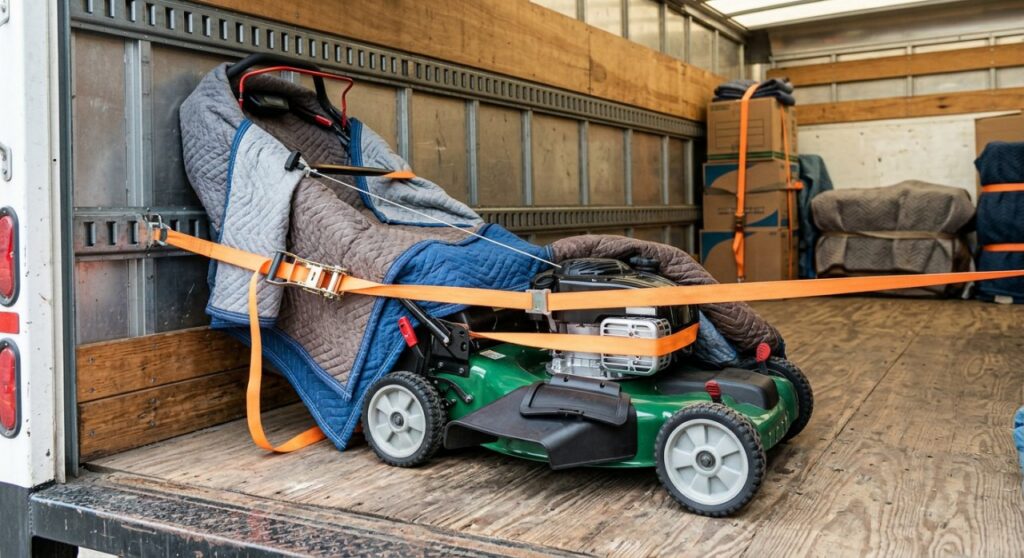
1 Inside the Moving Truck – Place upright on a clean section of floor.
- Use moving blankets and straps to prevent tipping.
- Keep away from boxes that could shift onto it.
2 On a Trailer or Open Carrier – Preferred for large riding mowers.
- Use wheel chocks and heavy-duty straps over the frame (never over the engine or deck alone).
3 Self-Load Option
If the crew refuses, you can load it yourself into a rental truck or trailer. Confirm insurance coverage first.
Step 6: Review Insurance and Liability Coverage
Review valuation coverage before signing.
- Basic released value protection is only $0.60 per pound—almost worthless for a $2,000 mower.
- Purchase full-value protection or third-party insurance that explicitly covers outdoor power equipment.
- Note any exclusions for “mechanical failure” or “fluid leaks.”
Document the mower’s condition on the bill of lading at pickup and delivery.
Step 7: Execute Move Day Protocol
Execute a clear hand-off.
- Walk the crew to the mower and show the prep work.
- Confirm it appears on the inventory sheet.
- Watch loading if possible—photograph placement.
- Keep fuel can and any removed parts with you or in a clearly labeled box.
- At delivery, inspect immediately before signing.
If the crew suddenly refuses: stay calm, show the written confirmation, and call the move coordinator. Have a backup plan (friend with truck or local equipment hauler).
Step 8: Unpack, Reassemble, and Test Safely
Reassemble only after the mower is on solid ground at the new home.
- Reconnect battery.
- Add fresh fuel.
- Check oil and air filter.
- Start in a well-ventilated area and test all safety features.
- Dispose of old fuel properly—never pour down drains.
Pro Tips from Professional Movers
- Schedule lawn equipment as a separate line item on the estimate so it cannot be “forgotten.”
- For moves over 200 miles, strongly prefer a specialty equipment transporter—they have better securement systems.
- Winterize the mower if the move happens in cold months; residual water can freeze and crack the engine.
- Keep the owner’s manual and any warranty cards with you, not in the truck.
- If selling the house, leave the mower until the last day so the lawn stays presentable for final walkthrough.
- Ask about “last on, first off” placement for easier unloading.
- Bundle with other outdoor gear (trimmers, blowers) to negotiate a package rate.
Common Mistakes to Avoid
- Leaving gas in the tank → automatic refusal or fire hazard.
- Failing to get written approval → crew says “we don’t haul those.”
- Wrapping the entire mower in plastic → traps moisture and hides leaks.
- Strapping over the cutting deck only → bends the deck or damages blades.
- Assuming HOA or apartment rules allow temporary storage of gas equipment → check first.
- Skipping photos → impossible to prove pre-existing damage.
- Booking the cheapest mover without asking the lawn-mower question → surprise fees or abandoned equipment.
FAQ
Do movers move lawn mowers?
Yes. Most professional movers move lawn mowers when fuel is drained, the unit is clean, and the item is declared in advance.
Will moving companies move lawn mowers that still have gas?
Almost never. Residual fuel is a safety violation. Drain it completely or use approved stabilizer only if the company explicitly allows it.
Do moving companies move lawn mowers that are riding models?
Many standard household movers decline large riding mowers. Use an equipment specialist or auto transport company instead.
Will movers move lawn mowers internationally or across state lines?
Yes for domestic long-distance if prepared correctly. International moves usually require specialized freight and customs documentation—budget extra time and cost.
What happens if the mover damages my lawn mower?
File a claim with photos and the bill of lading within the carrier’s deadline (usually 9 months for interstate). Full-value coverage is strongly recommended.
Conclusion
Yes—movers will move lawn mowers when you confirm policy early, prepare the machine properly, choose the right carrier type, and document everything. Follow the eight steps above and you eliminate the most common refusals and damage risks.
Take action today: pull out your current moving quotes and send one clear email asking “will movers move lawn mowers under your policy?” Get the answer in writing, then start the fuel-drain and cleaning process. Your mower arrives ready to cut the new lawn instead of sitting rejected on the old driveway.