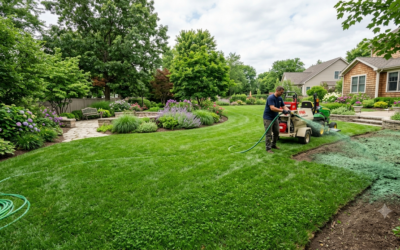

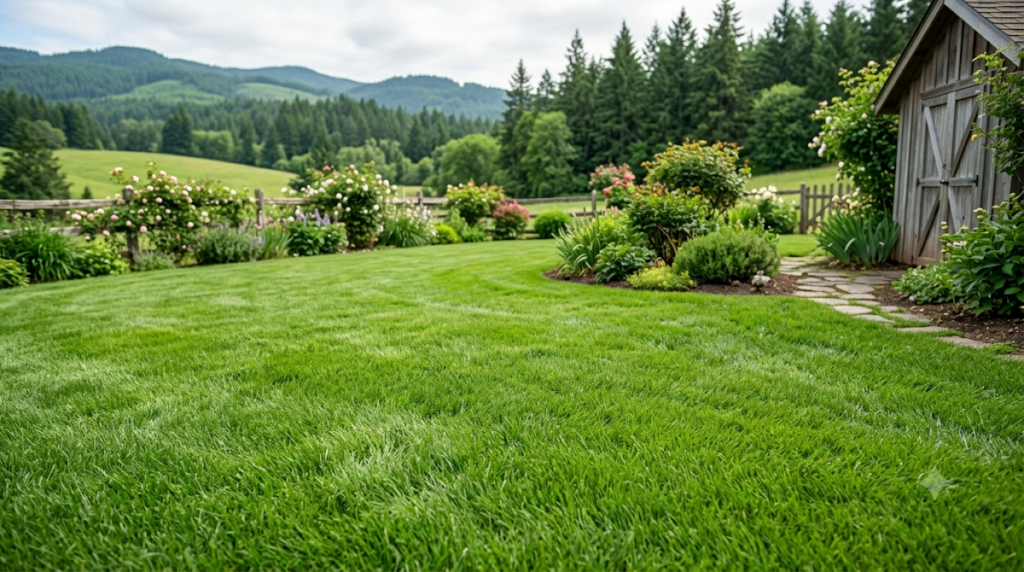
Quick Answer: The best grass seed for Washington State is a cool-season blend of tall fescue (40\u201360%), perennial ryegrass (20\u201330%), and fine fescue (10\u201320%). West of the Cascades, prioritize disease-resistant tall fescue for wet winters; east of the Cascades, add Kentucky bluegrass for drought and cold tolerance. Seed in late August to mid-September when soil temps hit 60\u201370\u00b0F.
Why Washington State Demands a Unique Grass Strategy
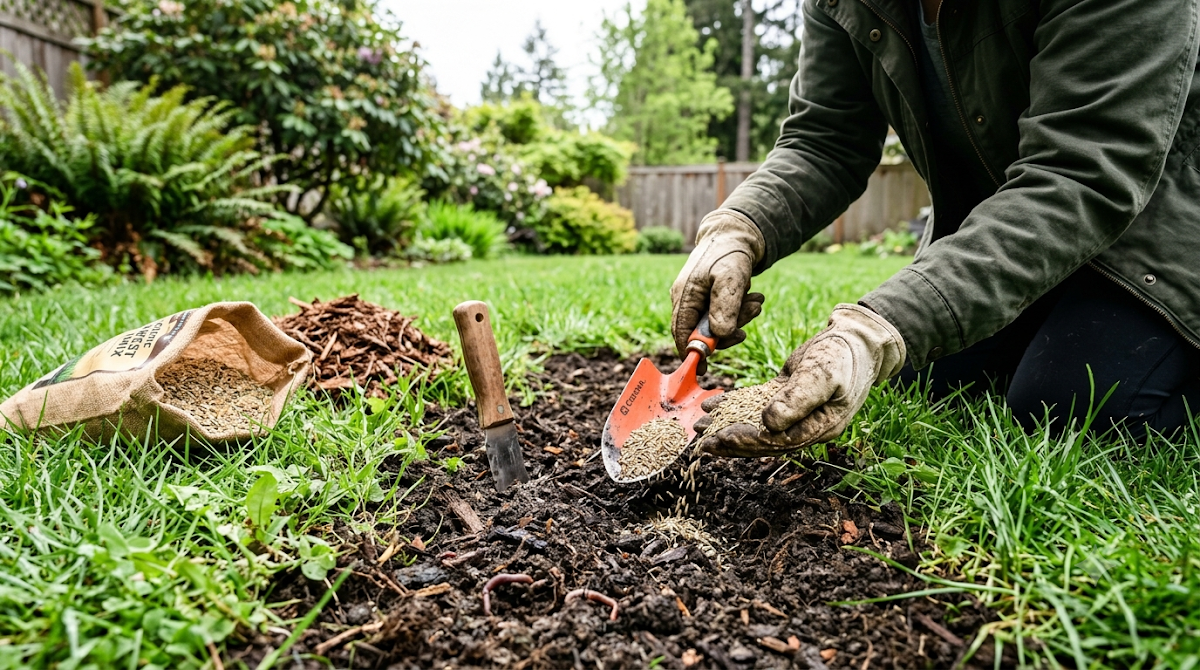
Washington is not one climate\u2014it’s two. The Cascade Range splits the state into dramatically different growing zones, and the “one-size-fits-all” Pacific Northwest advice most articles give will fail you in one half of the state. Western Washington (Seattle, Tacoma, Olympia) receives 35\u201360 inches of rain annually with mild, wet winters. Eastern Washington (Spokane, Yakima, Tri-Cities) gets just 6\u201315 inches, with scorching summers and bitter, dry winters. Your grass seed choice must match your side of the mountains first, and your soil and sun exposure second.
Best Grass Seed for Western Washington (Wet, Mild)
Western Washington’s cool, damp climate is ideal for cool-season grasses but brutal on varieties prone to fungal disease. The #1 killer of western Washington lawns isn’t drought\u2014it’s red thread, dollar spot, and snow mold thriving in cool, wet conditions. Your priority is disease resistance and shade tolerance, not heat survival.
Tall Fescue: The Western Washington Champion
Tall fescue is the undisputed best grass seed for western Washington. Its deep root system (up to 3 feet) tolerates both the wet winters and the occasional summer dry spell. Modern turf-type tall fescue varieties like Falcon IV, Rembrandt, and Houndog V offer superior disease resistance and a finer blade than older varieties. It thrives in full sun to moderate shade and handles foot traffic well. Mow at 3\u20134 inches\u2014never lower\u2014to protect the crown and encourage deep rooting.
Fine Fescues: The Shade Specialists
For the heavily treed yards common in Seattle and the Puget Sound, fine fescues (creeping red, chewings, hard, and sheep fescue) are the answer. They tolerate as little as 4\u20136 hours of dappled sunlight and thrive in acidic, low-fertility soils. Their only weakness: they go dormant in extended summer heat and can’t handle heavy foot traffic. Use them in a mix at 10\u201320%, not as a monostand.
Perennial Ryegrass: The Quick Germinator
Perennial ryegrass germinates in 5\u201310 days\u2014the fastest of any cool-season grass\u2014making it the perfect “nurse grass” in a blend. It establishes quickly to hold soil while slower fescues develop. However, it’s prone to red thread in wet winters and can thin out after 2\u20133 years. Keep it at 20\u201330% of your mix, never as the sole species.
Best Grass Seed for Eastern Washington (Dry, Extreme)
Eastern Washington’s climate is closer to Montana than to Seattle. You need grasses that survive 100\u00b0F summers with 0.5 inches of monthly rain and \u221210\u00b0F winters. Irrigation is non-negotiable for a green lawn, but the right seed minimizes your water bill.
Kentucky Bluegrass: The Drought Survivor
Kentucky bluegrass is the best grass seed for eastern Washington’s extremes. Its rhizomatous root system spreads underground, repairing damage and creating a dense sod. It enters summer dormancy (turning brown) during drought but recovers fully when water returns\u2014a survival strategy western grasses lack. It needs full sun (6+ hours) and regular fertilization. Choose improved varieties like Midnight, Mazama, or Bewitched bred for drought tolerance.
Tall Fescue: The Water-Saving Alternative
For eastern Washington homeowners who want green without daily watering, turf-type tall fescue is the smarter choice. Its deep roots access moisture other grasses can’t reach, requiring 30\u201340% less water than Kentucky bluegrass. It doesn’t spread like bluegrass, so overseed annually to maintain density.
Washington Grass Seed Comparison Table
| Grass Type | Best Region | Sun Requirement | Drought Tolerance | Disease Resistance | Foot Traffic | Mow Height | Germination |
|---|---|---|---|---|---|---|---|
| Tall Fescue | Western & Eastern | Full sun to light shade | Excellent | Excellent | Good | 3\u20134 in | 10\u201314 days |
| Kentucky Bluegrass | Eastern only | Full sun (6+ hrs) | Good (dormant) | Moderate | Excellent | 2.5\u20133.5 in | 14\u201321 days |
| Fine Fescue | Western (shade) | 4\u20136 hrs dappled | Poor | Good | Poor | 2.5\u20133.5 in | 10\u201314 days |
| Perennial Ryegrass | Western (mixes) | Full sun | Poor | Poor\u2013Moderate | Excellent | 1.5\u20132.5 in | 5\u201310 days |
| Colonial Bentgrass | Western (golf) | Full sun | Poor | Poor | Poor | 0.5\u20131 in | 10\u201314 days |
Colonial bentgrass is listed for completeness but is only suitable for golf greens and high-maintenance lawns\u2014avoid it for residential use.
Step-by-Step: How to Seed a Washington Lawn
Step 1: Test Your Soil (2\u20134 Weeks Before Seeding)
Washington’s acidic, volcanic soils often need lime. Test soil pH at your local extension office (WSU offers kits for ~$20). Target pH 6.0\u20137.0. If below 6.0, apply lime at the rate specified by your test results\u2014typically 20\u201350 lbs per 1,000 sq ft for western Washington. Amend with compost (1/4 inch layer) to improve moisture retention in sandy soils and drainage in clay.
Step 2: Choose the Right Date (Soil Temperature Is Key)
For western Washington, seed between August 20 and September 15. For eastern Washington, seed between August 25 and September 20. The ideal window is when soil temperature is 60\u201370\u00b0F at 2 inches deep. Use a soil thermometer\u2014air temperature is misleading. Seeding too late (after October 1) risks poor establishment before winter rains and frost. Seeding in spring (April\u2013May) is possible but requires aggressive summer watering.
Step 3: Prepare the Seedbed
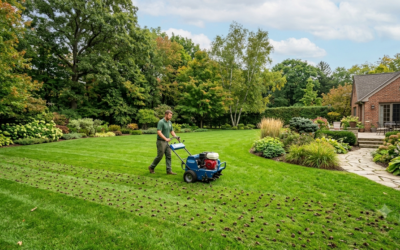
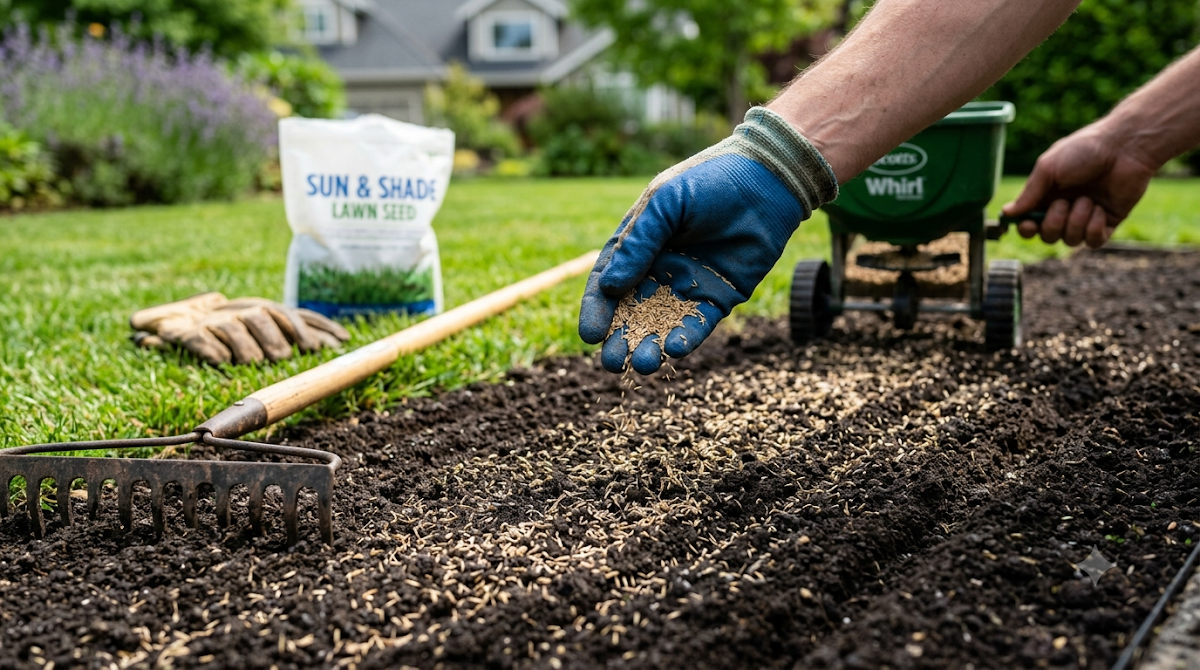
Kill existing weeds and old grass with a non-selective herbicide 14 days before seeding. Then mow low (1 inch), rake to remove thatch, and loosen the top 1/4 inch of soil. For bare soil, till to 4\u20136 inches and rake smooth. The goal is seed-to-soil contact\u2014seed that sits on top of thatch or hard soil will not germinate.
Step 4: Spread Seed and Fertilizer
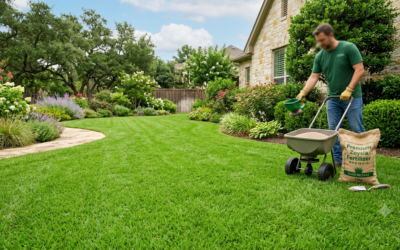
Use a broadcast spreader at half the recommended rate, spread in one direction, then spread the second half perpendicular (cross-hatch pattern). Application rates: tall fescue 6\u20138 lbs per 1,000 sq ft; Kentucky bluegrass 2\u20133 lbs per 1,000 sq ft; blends at 4\u20135 lbs per 1,000 sq ft. Apply a starter fertilizer high in phosphorus (e.g., 20-27-5) at 1 lb of nitrogen per 1,000 sq ft. Rake lightly to work seed 1/8\u20131/4 inch into soil.
Step 5: Water Correctly (The Most Common Failure Point)
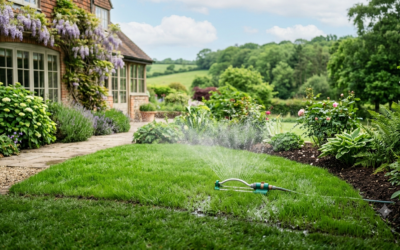
Keep the top 1 inch of soil consistently moist\u2014never saturated, never dry. Water 2\u20133 times daily for 5\u201310 minutes for the first 14 days. After germination, reduce to once daily for 15\u201320 minutes. By week 4, transition to deep, infrequent watering (1 inch per week in 2 sessions). Stop watering 2 hours before dusk to prevent fungal disease\u2014critical in western Washington’s damp climate.
Step 6: First Mow (Patience Pays)
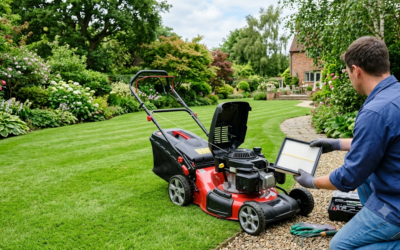
Wait until the grass reaches 3.5\u20134 inches before the first mow\u2014typically 3\u20134 weeks after germination. Mow at 3 inches, removing no more than 1/3 of the blade height. Ensure your mower blade is sharpened within the last 2 weeks; a dull blade tears young grass, inviting disease. Do not bag clippings for the first 3 mows\u2014they return nutrients and moisture.
Expert Troubleshooting
What If You Mowed Too Early?
If you mowed before the grass reached 3.5 inches, you likely scalped the crown\u2014the growing point. The grass will look brown and stunted. Stop mowing immediately. Water deeply (1 inch) and apply a light nitrogen fertilizer (0.5 lbs per 1,000 sq ft) to encourage recovery. Do not mow again until the grass regrows to 4 inches. In severe cases, you may need to overseed bare patches at 2\u20133 lbs per 1,000 sq ft.
Wet Weather Delays (Western Washington)
If an atmospheric river dumps 3 inches of rain on your new seed, don’t panic. Seed that hasn’t germinated can survive 3\u20135 days of saturation. Do not walk on the saturated soil\u2014compaction will suffocate roots. Once the soil drains, resume your watering schedule. If seed has germinated and you see yellowing, apply a fungicide containing azoxystrobin or propiconazole to prevent damping-off disease. For persistent wet spots, improve drainage with a 1/2 inch topdressing of compost.
Bare Patches After Germination
Bare patches 3 weeks after seeding usually mean poor seed-to-soil contact or bird damage. Rake the area, re-seed at the original rate, and cover with a 1/4 inch layer of weed-free straw or peat moss to hold moisture and deter birds. Keep the patch moist with daily light watering for 14 days.
Frequently Asked Questions
Can I plant the same grass seed across all of Washington?
No. Western Washington’s wet, mild climate favors tall fescue and fine fescue blends with strong disease resistance. Eastern Washington’s dry, extreme climate demands Kentucky bluegrass or drought-tolerant tall fescue. A blend designed for Seattle will struggle in Spokane’s summer heat and winter cold, and vice versa. Always match your seed to your side of the Cascades.
When is the absolute latest I can seed in Washington?
For western Washington, the hard deadline is October 1. For eastern Washington, September 20. Seeding later risks germination failure because soil temperatures drop below 50\u00b0F, halting cool-season grass growth. If you miss the window, wait for spring (April 15\u2013May 15) and plan for aggressive summer irrigation\u2014new lawns need 1.5 inches of water weekly in their first summer.
Should I choose a single grass type or a blend?
Always choose a blend. Monostands (single species) are vulnerable to disease, pests, and environmental stress. A blend of 40\u201360% tall fescue, 20\u201330% perennial ryegrass, and 10\u201320% fine fescue provides resilience: if one species fails, the others fill in. For eastern Washington, blend Kentucky bluegrass (50%) with tall fescue (50%) to combine bluegrass’s self-repair with fescue’s drought tolerance.
How much seed do I need for a typical Washington lawn?
A standard 5,000 sq ft lawn needs 20\u201325 lbs of tall fescue blend or 10\u201315 lbs of Kentucky bluegrass blend. Always buy 10% extra to account for overseeding bare patches. Check the seed tag for the Pure Live Seed (PLS) percentage\u2014a tag showing 85% PLS means you need 15% more seed than the label rate. Avoid bargain seed with weed seed content above 0.5%.
Final Verdict
Washington’s dual climate makes grass selection a regional decision, not a statewide one. Western Washington homeowners should prioritize disease-resistant tall fescue blends with fine fescue for shade. Eastern Washington homeowners should choose drought-tolerant Kentucky bluegrass or tall fescue. Time your seeding for late August to mid-September, prepare the soil properly, and water with discipline. Do this, and you’ll have the thickest, greenest lawn on your block\u2014on either side of the Cascades. For related insights, see our detailed guide on Soil for Green Grass.