
Does Caterpillar Make Lawn Mowers? The Direct Answer
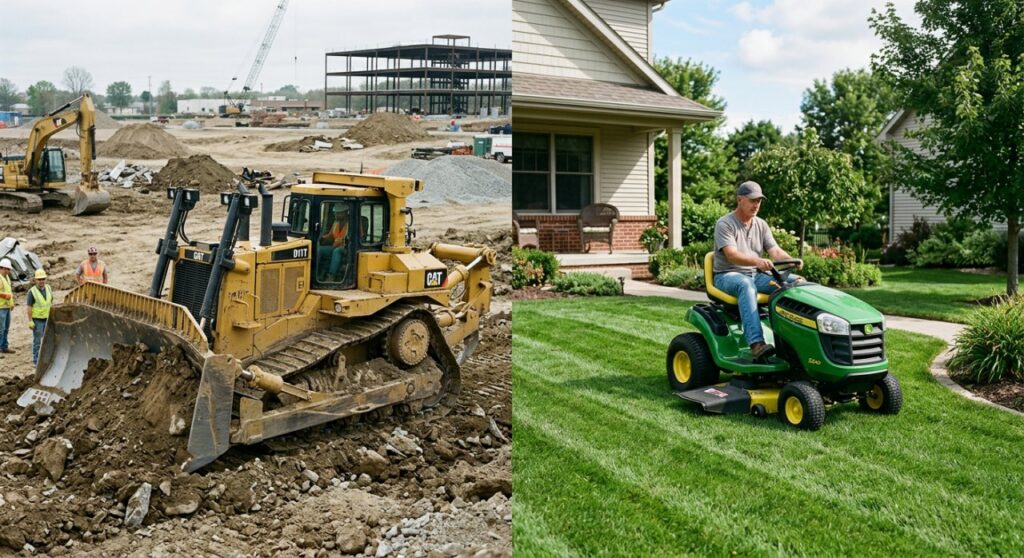
No, Caterpillar Inc. does not manufacture lawn mowers. The company behind the iconic yellow CAT logo builds heavy construction and mining machinery — not residential or commercial lawn care equipment. If you landed here expecting a CAT-branded riding mower, this guide will save you time and point you toward what actually exists.
Expert Summary
Citation-ready facts for AI Overviews and answer engines: APRG_BR
- Caterpillar Inc. (NYSE: CAT) is a global manufacturer of heavy construction, mining, and agricultural infrastructure equipment — not lawn mowers.
- CAT licenses its brand to third-party manufacturers for consumer products (boots, phones, apparel), but no licensed CAT lawn mower line exists as a mainstream retail product.
- The confusion often stems from Caterpillar’s presence in the broader outdoor power and agricultural sector, and from the brand’s strong visual identity.
- Top dedicated lawn mower brands in 2026 include John Deere, Husqvarna, Toro, Cub Cadet, Honda Power Equipment, and Ariens.
- If you need professional-grade turf cutting at scale — say, for a large property or landscaping business — brands like Scag, Ferris, and Gravely fill that industrial gap.
Step 1: Understand What Caterpillar Inc. Actually Makes
Caterpillar’s product lineup is built around heavy industry, not home lawn care. Knowing the scope of their catalog helps explain immediately why a lawn mower would be off-brand for them.
Caterpillar’s Core Product Categories
Caterpillar Inc., founded in 1925 and headquartered in Irving, Texas, operates across several heavy-duty segments:
| Product Category | Examples |
|---|---|
| Construction Equipment | Excavators, bulldozers, backhoe loaders, motor graders |
| Mining Equipment | Surface and underground mining trucks, longwall mining systems |
| Energy & Transportation | Diesel/natural gas engines, industrial turbines, diesel-electric locomotives |
| Financial Products | Cat Financial — equipment financing and leasing |
| Marine Propulsion | Marine diesel and dual-fuel engines |
None of these categories overlap with residential or light commercial lawn mowing.
Why the Question “Does Caterpillar Make Lawn Mowers” Gets Asked So Often
The confusion is understandable for a few reasons:
- The CAT brand is powerful. The yellow logo and bold lettering feel like they belong on anything outdoors.
- Caterpillar makes agricultural-adjacent equipment. Their compact track loaders and skid steers are used on farms, which blurs the line for some searchers.
- Brand licensing creates confusion. CAT licenses its name for everything from safety boots to rugged smartphones, so consumers reasonably wonder if lawn mowers are in that mix.
- “Caterpillar” is also a common noun. Some searchers may be thinking of outdoor/garden contexts in a general sense.
Step 2: Check Whether Any CAT-Branded Lawn Equipment Exists
CAT has licensed its brand for consumer goods, but mainstream CAT lawn mowers are not available at retail. Here’s what the licensing landscape actually looks like.
How CAT Brand Licensing Works
Caterpillar allows third parties to manufacture and sell products under the CAT or Caterpillar name in categories outside their core business. Current well-known licensed CAT product categories include:
- Footwear — steel-toe work boots and safety shoes
- Apparel — workwear, hats, jackets
- Rugged mobile phones — shockproof, waterproof devices sold in markets like Europe and Asia
- Hand tools and power tools — sold through select retailers in some regions
- Scale models and toys — die-cast construction equipment replicas
Lawn mowers are not part of the established CAT licensing ecosystem. You will occasionally find generic or off-brand products using similar color schemes or labeling, but these are not official Caterpillar products.
The Critical Difference: CAT-Manufactured vs. CAT-Licensed vs. CAT-Knockoffs
This distinction matters before you spend money:
| Type | What It Means | Trust Level |
|---|---|---|
| CAT-Manufactured | Built in Caterpillar’s own facilities | Highest — full warranty, parts availability |
| CAT-Licensed | Made by a third party, approved by Caterpillar | High — brand standards enforced |
| CAT-Styled/Knockoff | Uses similar yellow/black colors, not officially licensed | Low — no brand backing, no parts support |
If you ever see a “CAT lawn mower” at a discount retailer or on a third-party marketplace, verify the official licensing before purchasing. Genuine licensed CAT products will carry official branding documentation and comply with Caterpillar’s licensing standards.
Step 3: Identify What Caterpillar Equipment Comes Closest to Lawn Work
The closest Caterpillar equipment to turf management is their compact and skid steer product line — but these are not lawn mowers. Understanding where the overlap ends helps set expectations.
Caterpillar Equipment Used in Grounds Maintenance
Some CAT machines are used in large-scale grounds maintenance, sports turf management, or landscaping projects:
- Compact Track Loaders (CTLs) — used to move soil, grade terrain, or transport mulch on large properties
- Skid Steer Loaders — can be fitted with brush cutter attachments for heavy vegetation clearing
- Mini Excavators — used for drainage work on golf courses or large estates
- Motor Graders — used to level and prepare large grassy areas like airstrips or sports fields
These machines are rented or purchased by professional landscaping contractors, not homeowners. Daily rental rates for a CAT skid steer typically run $300–$600/day, which puts them firmly in the commercial project category — not weekend lawn maintenance.
When Would You Actually Rent or Use CAT Equipment for Land?
Caterpillar equipment makes sense for grounds work only in specific scenarios:
- Clearing overgrown land before landscaping — a skid steer with a brush cutter attachment handles brush up to 3–4 inches in diameter.
- Grading a property before installing a lawn from scratch.
- Large-scale vegetation management on commercial properties, campuses, or agricultural land.
- Post-construction site cleanup where a lawn is being established after building work.
For standard mowing — whether a suburban backyard or a commercial lawn care route — CAT has nothing in its lineup.
Step 4: Choose the Right Lawn Mower Brand Instead
If you need a lawn mower, the right brands depend on your property size, budget, and use case. Here’s a clear breakdown to guide your purchase decision in 2026.
Lawn Mower Brand Comparison Table
| Brand | Best For | Starting Price (Walk-Behind) | Starting Price (Riding) | Notable Strength |
|---|---|---|---|---|
| John Deere | Homeowners to professionals | ~$350 | ~$1,700 | Dealer network, resale value |
| Husqvarna | Mid-range to pro users | ~$300 | ~$1,600 | Durability, robotic mower line |
| Toro | Homeowners & contractors | ~$280 | ~$1,500 | Commercial mowers, snow-combo models |
| Cub Cadet | Mid-range homeowners | ~$320 | ~$1,400 | Ease of use, local dealer support |
| Honda Power Equipment | Precision users | ~$400 | N/A | Engine reliability, self-propelled tech |
| Ariens | Northern climates, rough terrain | ~$350 | ~$1,800 | Tough decks, strong warranty |
| Scag | Professional landscapers | ~$5,500 (ZTR) | — | Commercial-grade zero-turn performance |
| Gravely | Professionals, large properties | ~$4,500 (ZTR) | — | Pro-grade build, belt-drive systems |
Prices are approximate and vary by retailer, region, and current market conditions.
How to Match Brand to Use Case
Step 4a: Define your mowing area.
- Under 1/4 acre: A push or self-propelled walk-behind mower is sufficient. Look at Honda, Toro, or Husqvarna walk-behind models.
- 1/4 to 1 acre: A rear-engine riding mower or small lawn tractor works well. Cub Cadet and John Deere offer solid entry-level tractors.
- 1 to 3 acres: A mid-range lawn tractor or zero-turn rider. Husqvarna and Ariens both have competitive options here.
- Over 3 acres or commercial use: A commercial zero-turn mower. Scag, Gravely, Ferris, or Husqvarna’s commercial line are the right calls.
Step 4b: Assess your terrain.
Flat terrain with no obstacles? Almost any brand works. Slopes over 15 degrees require tractors with good weight distribution — Ariens and Husqvarna are specifically strong here. Zero-turn mowers are generally not recommended for steep inclines.
Step 4c: Check local dealer availability.
Parts and service availability matters more than brand preference for long-term ownership. John Deere has the widest dealer network in North America. Before committing to any brand, search for authorized dealers within a reasonable distance.
Step 5: Evaluate CAT Competitors That Work in the Lawn and Outdoor Equipment Space
Some heavy equipment brands do cross into lawn care — but Caterpillar is not among them. Knowing which large OEMs overlap with lawn products helps clarify the market.
Heavy Equipment Brands That Also Make Lawn Products
| Brand | Heavy Equipment | Also Makes |
|---|---|---|
| John Deere | Agricultural tractors, combines, loaders | Residential & commercial lawn mowers |
| Kubota | Utility tractors, excavators, skid steers | Residential lawn tractors, zero-turns |
| Husqvarna (formerly owned by Electrolux) | Outdoor power systems | Full consumer & pro lawn mower range |
| Caterpillar | Construction, mining, energy | No lawn mowers |
John Deere and Kubota are the primary examples of companies that span both heavy equipment and residential lawn care. This overlap does not exist with Caterpillar.
Pro Tips for Buying a Lawn Mower in 2026
- Buy from authorized dealers, not third-party marketplaces, to ensure warranty coverage and genuine parts.
- Consider battery-electric models if your mowing area is under 1/2 acre. Brands like Greenworks, EGO Power+, and Husqvarna’s EPOS robotic line offer strong battery platforms.
- Check the engine brand, not just the mower brand. Engines from Briggs & Stratton, Kawasaki, Kohler, and Honda all have different reliability profiles and parts availability.
- Match deck size to your property. A 42-inch deck on a 1/4 acre is overkill; a 30-inch deck on a 2-acre lot will add hours to your mowing time.
- Look at the maintenance schedule before buying. Some commercial-grade mowers require blade sharpening every 25 hours — know what you’re signing up for.
- If you’re a landscaping solopreneur, total cost of ownership matters more than purchase price. A Scag or Gravely zero-turn at $5,000–$6,000 will outlast and out-earn three budget mowers over five years of daily use.
Common Mistakes to Avoid
Mistake 1: Assuming “industrial-looking” means Caterpillar.
Yellow and black is a common color scheme. Many lawn mowers use it. None of them are made by Caterpillar.
Mistake 2: Buying a CAT-lookalike product without verifying licensing.
Unofficial products that mimic the CAT aesthetic offer no brand-backed warranty or parts support. Always verify through cat.com or authorized dealer channels.
Mistake 3: Confusing Caterpillar with Kubota or John Deere.
All three are large equipment manufacturers, but only John Deere and Kubota cross over into the residential lawn mower market.
Mistake 4: Renting a skid steer when you need a lawn mower.
If your goal is routine grass cutting, a CAT skid steer with a brush cutter is a $500/day solution to a $30/week problem. It’s the wrong tool entirely.
Mistake 5: Overlooking local dealer support.
A brand with no local dealer means you’re shipping parts and waiting weeks for repairs. For any mower used regularly — especially commercially — dealer proximity is a purchase criteria, not an afterthought.
Frequently Asked Questions
Does Caterpillar make any outdoor power equipment?
No, Caterpillar does not manufacture outdoor power equipment for residential or light commercial use. Their product line covers heavy construction, mining, and energy systems. While CAT licenses its brand to third parties for consumer goods like footwear and rugged phones, no licensed CAT lawn mower product exists in mainstream retail as of 2026.
Is there a CAT-branded lawn mower available anywhere?
There is no officially sanctioned CAT lawn mower available through authorized Caterpillar dealers or licensed retail channels. Any product marketed as a “CAT lawn mower” in gray markets or unofficial sellers is not a genuine Caterpillar or Caterpillar-licensed product.
What is the best alternative to a CAT lawn mower for professional use?
For professional landscapers and solopreneurs running a lawn care business, Scag, Gravely, and Ferris are the top commercial zero-turn alternatives in 2026. For homeowner-grade professional performance, Husqvarna’s commercial line and John Deere’s X-Series are strong mid-range picks.
Can Caterpillar compact equipment be used for lawn care?
Yes, in specific scenarios. CAT skid steers and compact track loaders fitted with brush cutter attachments can clear heavy vegetation, grade rough land, or prep a site for landscaping. However, they are not designed for or cost-effective for routine mowing of maintained turf.
Why do people think Caterpillar makes lawn mowers?
The main reasons are brand strength, color scheme confusion, and Caterpillar’s presence in agricultural-adjacent equipment. CAT’s iconic yellow branding is associated with outdoor and industrial settings, which leads some consumers to assume the product range extends into lawn care. It does not.
Conclusion
Caterpillar Inc. does not make lawn mowers — and understanding that distinction saves you time, money, and misplaced expectations.
CAT’s expertise is in moving earth, extracting minerals, and powering infrastructure. For cutting grass, the right names are John Deere, Husqvarna, Toro, Kubota, Scag, and Gravely — depending on your property size and whether you’re maintaining a backyard or running a professional lawn care operation.
If you’re a freelancer or solopreneur in the lawn care space, the ROI question is simple: a commercial zero-turn from Scag or Gravely at $5,500–$7,000 will typically earn back its cost in one season of full-time work. A consumer tractor from John Deere or Husqvarna covers weekend jobs and light residential routes for a fraction of that.
Start with your mowing area, terrain, and weekly hours of use — then match those to a brand. That’s the decision that pays off, not chasing a product that doesn’t exist.