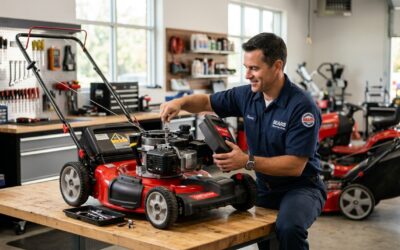

How to Make Hydrostatic Lawn Mowers Faster Safely
To achieve how to make hydrostatic lawn mowers faster, first restore the mower’s designed speed through transmission servicing, correct tire pressure, linkage adjustment, belt inspection, and reduced rolling resistance. Avoid governor removal, oversized pulleys, and unapproved transmission modifications because they can reduce braking control, damage the hydrostatic drive, and void the warranty.
Expert Summary
>
– A hydrostatic mower that has become slower usually needs maintenance or adjustment, not an engine modification.
– The safest improvements are correcting tire pressure, removing control-linkage restrictions, replacing a worn drive belt, and servicing the hydrostatic transmission according to the operator’s manual.
– Increasing engine RPM beyond the manufacturer’s specification can overspeed the cutting blades and create a serious projectile hazard.
– Faster ground speed does not always produce faster mowing; dense grass often requires a lower travel speed to maintain blade tip speed and cut quality.
– If the mower already reaches its published maximum speed, replacing it with a faster factory-engineered model is safer than modifying pulleys, governors, or internal transmission components.
Before You Start: Understand What Limits Mower Speed
A hydrostatic lawn mower’s speed is limited by its engine RPM, drive belt condition, control linkage, hydraulic transmission capacity, tire diameter, terrain, and total load. The goal should be to recover lost performance rather than force the machine beyond its engineered operating range.
Hydrostatic systems also behave differently from automotive transmissions. A mower can have full engine power but still move slowly if its belt slips, the bypass valve is not fully closed, or the motion-control linkage cannot reach its full-travel position.
What Are Hydrostatic Lawn Mowers?
Hydrostatic lawn mowers use hydraulic fluid pressure to transfer engine power to the drive wheels. Instead of shifting through fixed gears, the operator changes speed and direction continuously with a pedal or control levers.
Most systems contain:
- An engine-driven belt
- A hydraulic pump
- A hydraulic motor or integrated transaxle
- Control linkages or pedals
- Cooling fans and transmission housings
- Hydraulic fluid, which may be serviceable or sealed for life
This design provides smooth speed control and easy direction changes. Its main trade-off is that hydraulic systems generate heat and can lose performance when the belt, fluid, cooling system, or internal components deteriorate.
How Do Hydrostatic Lawn Mowers Work?
The answer to how do hydrostatic lawn mowers work is straightforward: the engine drives a hydraulic pump, and the pump sends pressurized fluid to a hydraulic motor that turns the wheels. Moving the control farther changes fluid flow and increases ground speed.
The engine must remain close to its specified operating RPM for the transmission and mower deck to perform correctly. However, raising RPM beyond specification is not a safe shortcut because the engine, transmission, belts, pulleys, and blades are designed around a controlled speed range.
What Is the Difference Between Automatic and Hydrostatic Lawn Mowers?
The answer to what the difference between automatic and hydrostatic lawn mowers is that “automatic” describes how speed changes are managed, while “hydrostatic” identifies a specific hydraulic drive system. Some automatic mowers use belts and variable-diameter pulleys rather than hydraulic pressure.
| Feature | Hydrostatic mower | Belt-driven automatic mower |
|---|---|---|
| Power transfer | Hydraulic pump and motor | Belts and variable pulleys |
| Speed changes | Smooth and continuous | Automatic but sometimes less smooth |
| Direction changes | Usually quick and simple | Depends on transmission design |
| Maintenance | Belt, cooling, linkage, and possibly fluid | Primarily belts, pulleys, and linkage |
| Typical repair cost | Often higher | Usually lower |
| Best use | Frequent maneuvering and variable terrain | Budget-focused residential mowing |
A hydrostatic transmission normally offers better control around landscaping. A belt-driven automatic mower may cost less to buy and repair, making it the better value when precise speed control is not essential.
Tools and Materials Needed
Most safe speed-restoration work requires basic tools rather than performance parts. Check the mower’s manual before buying fluid, filters, or belts because incompatible components can cause expensive transmission damage.
| Tool or material | Purpose | Lower-cost alternative | Important requirement |
|---|---|---|---|
| Digital tire-pressure gauge | Match left and right tire pressure | Pencil-style gauge | Use the pressure listed in the manual or on the tire within mower limits |
| Socket and wrench set | Remove guards and adjust linkage | Manufacturer-supplied tool kit | Use the correct size to avoid rounded fasteners |
| Torque wrench | Reinstall critical hardware | Borrow or rent one | Follow manual torque values |
| OEM-spec drive belt | Replace a stretched or glazed belt | Reputable aftermarket equivalent | Dimensions and construction must match exactly |
| Cleaning brush and compressed air | Clear transmission cooling areas | Soft brush and low-pressure air | Avoid forcing debris into seals |
| Approved transmission fluid | Service a serviceable transaxle | None unless the manual lists an equivalent | Never select fluid by viscosity alone |
| Wheel chocks and jack stands | Secure the mower during inspection | Ramps rated for mower weight | Never rely on a hydraulic jack alone |
| Tachometer | Verify governed engine speed | Dealer diagnostic service | Do not exceed manufacturer specifications |
| Safety glasses and gloves | Protect against debris and hot parts | None recommended | Wear during all inspections |
Do not purchase a “speed kit” until you identify the actual cause of slow travel. A belt or adjustment costing far less may restore the mower’s original performance without introducing new safety problems.
Step 1: Record the Mower’s Current Performance
Measure the mower before changing anything. A baseline helps distinguish a real mechanical problem from a mower that is already operating at its designed maximum speed.
Test on a flat, dry, open surface with the cutting deck disengaged. Avoid public roads, slopes, pedestrians, pets, and obstacles.
Measure Travel Speed
Mark a straight course of known length and time several passes at full forward control. Use the same operator, tire pressure, fuel level, and surface for every test.
Calculate speed with this formula:
Speed = distance ÷ time
A phone GPS application may provide a convenient estimate, but low-speed readings can fluctuate. Timed passes over a measured distance are often more consistent.
Compare the Result With the Manual
Look for the mower’s published forward and reverse ground-speed limits. Dealer specification pages can help, but the operator’s manual and model-specific service information should take priority.
If the machine reaches its factory specification, routine adjustments are unlikely to make it meaningfully faster. At that point, a faster mower platform is the safer solution.
Step 2: Correct Tire Pressure and Wheel Problems
Set all tires to the manufacturer-approved pressure before diagnosing the transmission. Underinflated tires increase rolling resistance, reduce effective tire diameter, and can make the mower feel sluggish.
Do not automatically inflate every tire to the maximum pressure printed on its sidewall. The mower manufacturer may specify a lower operating pressure for stability, traction, and ride control.
Match Pressure Side to Side
Unequal rear tire pressure can make the mower pull toward one side. On a zero-turn mower, this may be mistaken for an incorrectly adjusted control lever or a weak transmission.
Check tire pressure when the tires are cold. Recheck it after repairing leaks or replacing a tire.