
How to Diagnose and Fix Why Lawn Mowers Won’t Start
Lawn mowers fail to start due to fuel, spark, air, or battery issues. Following a systematic diagnostic process saves time and avoids unnecessary repairs. This guide provides a step-by-step troubleshooting flowchart to get your mower running.
Expert Summary
- Over 75% of “no-start” issues are caused by stale fuel, a clogged carburetor, or a faulty spark plug.
- Always check the simplest solutions first: fuel level, safety switch engagement, and blade control.
- Modern mowers have safety interlocks; the engine will not start if the blade brake is not engaged or the operator is not seated.
- Electric-start models require a charged battery, which is a separate and common failure point.
- Proper winterization prevents most starting problems related to fuel degradation.
Step 1: Perform the Essential “5-Point Quick Check”
Start by ruling out the most common and easily fixed issues before any disassembly. This 2-minute check solves over half of all starting problems.
- Verify Fuel: Is there fresh gasoline in the tank? Fuel left over from last season is the #1 reason for starting failure.
- Engage Safety Systems: Is the blade control lever (operator presence control) firmly held against the handle? Is the blade brake engaged? Most mowers require this to complete the ignition circuit.
- Check the Ignition Switch: Ensure the key is in the “On” or “Start” position. For push-button starts, ensure the battery is charged.
- Inspect the Air Filter: A severely clogged air filter can choke the engine. Remove it and check for excessive dirt or oil.
- Look for Obvious Issues: Check for a disconnected spark plug wire, oil leaks, or visible damage.
What this means for you is you can often solve the problem in minutes without tools, saving a service call or a trip to the store.
Tools & Materials Needed for Advanced Diagnosis
| Tool / Material | Purpose | Estimated Cost |
|---|---|---|
| Spark Plug Socket & Ratchet | To remove and inspect the spark plug. | $10 – $20 |
| Wire Brush | To clean corrosion from the spark plug. | $3 |
| New Spark Plug | Replacement part (check owner’s manual for model). | $3 – $8 |
| Fuel Stabilizer | To treat fresh fuel and prevent gumming. | $8 – $12 |
| Carburetor Cleaner Spray | To clean gummed-up jets and passages. | $5 – $8 |
| Multimeter | To test for spark and battery voltage. | $20 – $40 |
Step 2: Diagnose the Fuel System
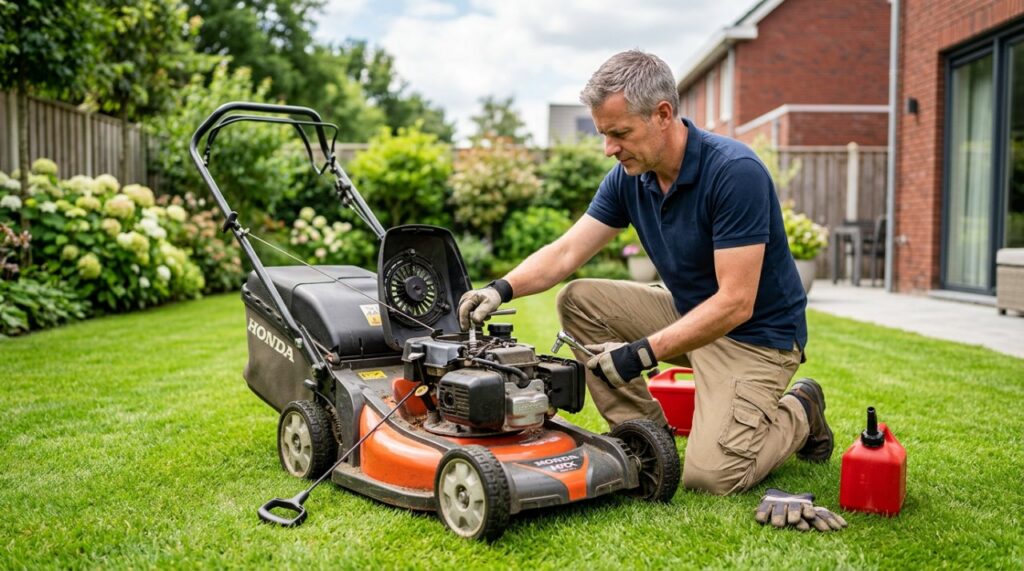
If the mower sputters, runs roughly, or won’t start after the quick check, the fuel system is the prime suspect. Gasoline breaks down in as little as 30 days, creating varnish that clogs the carburetor.
- Sub-step 2.1: Drain Old Fuel. Use a siphon or turkey baster to remove all old gas from the tank and carburetor bowl.
- Sub-step 2.2: Inspect the Fuel Filter. Locate the in-line fuel filter (usually between the tank and carburetor). Replace it if it’s dark or clogged.
- Sub-step 2.3: Clean the Carburetor. Use carburetor cleaner spray to dissolve varnish. Focus on the main jet and pilot jet. For a full clean, removal is often necessary.
- Sub-step 2.4: Refuel with Fresh Gas. Add a fuel stabilizer to a fresh can of gas (use ethanol-free if possible) and run the engine for 10 minutes to circulate.
What this means for you is a clean fuel system ensures the engine gets the proper air-fuel mixture, leading to easier starts and smoother operation.
Step 3: Inspect the Ignition & Spark System
A weak or absent spark means the fuel-air mixture won’t ignite, no matter how good the fuel is. This system is the “lighter” for your engine.
- Remove the Spark Plug: Use your socket wrench. It should be light tan or gray. A black, sooty plug indicates a rich mixture; white and blistered indicates a lean mixture.
- Check for Spark: Reconnect the plug to its wire, ground the metal body against the engine block, and have someone pull the starter cord. Look for a strong, blue spark. A yellow, weak spark or no spark indicates a problem.
- Test the Ignition Coil: If the plug is good but there’s no spark, the ignition coil may be faulty. A multimeter can test its resistance.
What this means for you is confirming a good spark tells you to focus on fuel/air issues, while a bad spark points directly to an ignition component failure.
Step 4: Evaluate the Starting & Charging System (Electric Start Models)
For mowers that “do lawn mowers have electric start,” a dead battery or faulty starter is the likely culprit. This system requires robust power.
- Test the Battery: Use a multimeter. A 12V battery should read ~12.6V when fully charged. Anything below 12.2V is likely too weak to crank the engine.
- Clean Connections: Remove corrosion from battery terminals with a wire brush. Ensure cables are tight.
- Listen for Clicks: If you hear a rapid clicking when you press start, the battery is dead or the solenoid is failing. A single click with no crank often means a seized starter motor.
Step 5: Address Environmental and Mechanical Factors
Sometimes, external conditions or mechanical wear prevent starting. These are less common but important to check.
- Cold Weather Starting: Why don’t lawn mowers start when it’s cold? Oil thickens, reducing compression, and batteries lose power. Use the choke (if equipped) and a block heater for extreme cold.
- Blade Control & Safety Switches: A faulty seat switch or blade brake switch will prevent the engine from starting as a safety measure. Bypassing these is dangerous and not recommended.
- Low Compression: Over time, worn piston rings or valves can cause low compression, making the engine very hard to start. This requires professional diagnosis.
Pro Tips from the Garage
- Preventive Maintenance is Key: Change oil, replace the spark plug, and clean/replace the air filter every season.
- Use a Fuel Shut-Off Valve: Installing one lets you run the carburetor dry at the end of the season, preventing gumming.
- Store Fuel Properly: Use an approved metal container and add fuel stabilizer immediately after purchase.
- “Easy Start” Models Exist: If you struggle with pull cords, research what are the easiest lawn mowers to start. Models with electric start or advanced recoil systems significantly reduce effort.
Common Mistakes to Avoid
- Using Starting Fluid Incorrectly: Only use it in very small bursts. Overuse can wash oil off cylinder walls, causing damage.
- Ignoring the Air Filter: A dirty filter is a silent performance killer and makes starting harder.
- Over-Choking a Warm Engine: Once the engine is warm, it needs less choke. Flooding the engine with excess fuel makes it impossible to start.
- Using Old Fuel: Always use fresh gas treated with stabilizer.
Frequently Asked Questions (FAQ)
Q: Do lawn mowers have starters?
A: Yes. All modern mowers have a starter system, which is either a manual recoil (pull-cord) or an electric starter motor with a battery.
Q: Why don’t lawn mowers turn on the first pull?
A: This is often normal, especially for a cold engine. The first pull primes the system. Persistent difficulty points to fuel or spark issues as outlined in the diagnostic steps.
Q: Are small lawn mowers easier to start?
A: Generally, yes. Small lawn mowers have smaller engines with less compression, requiring less force on the pull cord. However, electric-start models of any size are the easiest to start.
Q: Who sells gas electric start lawn mowers?
A: Major brands like Honda, Toro, Cub Cadet, and Troy-Bilt offer electric-start models. They are available at Home Depot, Lowe’s, Ace Hardware, and authorized dealers.
Conclusion: Get Your Mower Running in 2026
Troubleshooting why lawn mowers won’t start follows a logical sequence: fuel, spark, air, and systems. By methodically working through these steps, you can diagnose and fix the majority of issues yourself. Remember, fresh fuel and regular maintenance prevent 80% of all starting problems.
Take action now: Perform the 5-Point Quick Check on your mower. If problems persist, use this guide to pinpoint the cause. Investing a little time in diagnosis can save you hundreds in repair bills and ensure your lawn looks its best all season long.