
Will a Robot Mower Damage My Steep Lawn? The Direct Answer
A robot mower will not damage your steep lawn if you select a model rated for your specific gradient. In fact, robotic mowers are often safer for hills than traditional mowers because their lightweight design prevents soil compaction and turf scalping. However, using a model with insufficient traction can lead to wheel spinning, which tears grass roots and causes unsightly brown patches.
### 💡 Expert Summary: Robotic Mowers on Slopes* Weight Advantage: Most robots weigh under 30 lbs, significantly reducing the risk of soil erosion compared to 500-lb riding mowers.* Traction is Key: All-Wheel Drive (AWD) models are mandatory for slopes exceeding 35% (approx. 20 degrees) to prevent sliding and turf damage.* Safety First: Modern units utilize tilt sensors and ultrasonic object detection to stop blades instantly if the unit slips or tips.* Efficiency: Smaller, frequent cuts promote lateral grass growth, which actually strengthens the soil structure on inclines.
Understanding the Impact: Can a Robotic Lawn Mower Mow on Hill Sides?
Many homeowners worry that a robot will slide down a hill like a sled, destroying the landscape. In reality, robotic lawn mowers are engineered with a low center of gravity. This design allows them to maintain stability where a human-operated push mower might tip over.
When asking “can a robotic lawn mower mow on hill sides,” the answer depends on the coefficient of friction. On dry grass, high-grip wheels allow the mower to traverse inclines effortlessly. The damage only occurs if the mower loses grip, causing the wheels to dig into the mud. To avoid this, you must match your lawn’s steepest point to the mower’s maximum incline rating.
How to Prepare and Protect Your Steep Lawn for Robotic Mowing
Follow these steps to ensure your automated mower enhances your hill’s health rather than harming it.
Step 1: Measure Your Maximum Slope Gradient
Identify the steepest part of your yard before purchasing equipment. Most standard robot mowers handle up to 20 degrees (35%), but specialized models like the Husqvarna Automower 435X AWD can tackle up to 35 degrees (70%).
- Use a smartphone inclinometer app to get an accurate reading.
- Measure multiple spots, as “uneven lawns” often have hidden steep pockets.
- Check for “drop-offs” near the boundary where the mower might struggle to turn.
Step 2: Choose the Correct Drive System
Select a mower based on its drive configuration. If you are wondering what robot lawn mower works on 45 degree incline, you must look for All-Wheel Drive (AWD) or heavy-duty lugged tires.
- Front-Wheel Drive (FWD): Best for flat land; poor at climbing.
- Rear-Wheel Drive (RWD): Good for moderate hills (up to 25%).
- All-Wheel Drive (AWD): Essential for steep, complex terrain to prevent wheel spin and turf tearing.
Step 3: Optimize Boundary Wire Placement
Install your boundary wire with a “buffer zone” at the bottom of steep slopes. If a mower reaches a boundary at the bottom of a hill, it needs extra space to brake and turn without sliding past the wire.
- Leave a gap: Increase the distance between the wire and obstacles at the base of a slope.
- Avoid sharp turns: Run the wire at an angle rather than a 90-degree corner on inclines.
- Tension check: Ensure the wire is flush with the ground so the mower doesn’t snag it while climbing.
Step 4: Install Traction Enhancement Kits
Upgrade your mower’s wheels if you notice minor slipping. Many brands offer terrain kits or wheel weights that increase the surface area of the tire.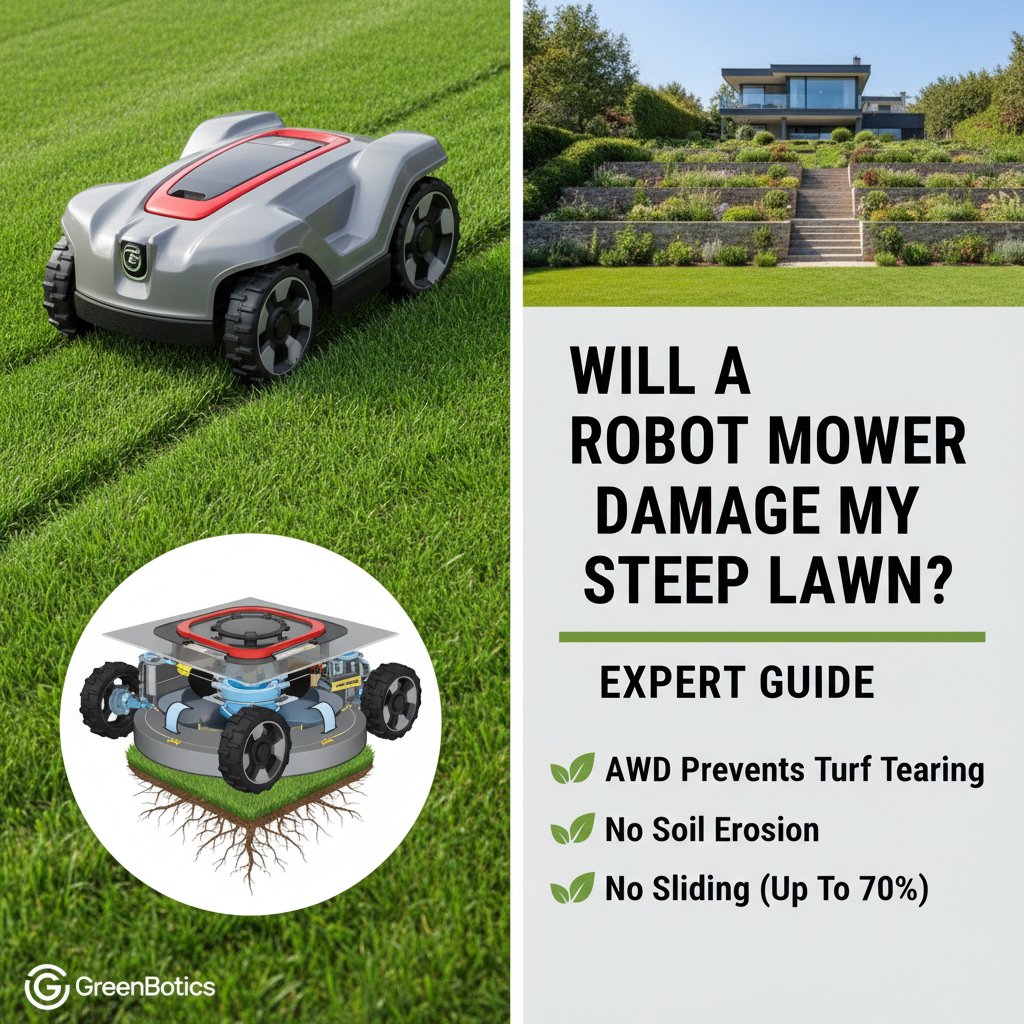
- Spiked wheels: These penetrate the upper thatch layer for better grip.
- Brush kits: These keep the wheels clean of mud and grass clippings, maintaining maximum friction.
Step 5: Configure Weather Constraints
Program your mower to avoid working during heavy rain. While many robots are waterproof, steep lawns become slippery when wet. Can robot lawn mower go uphill in the rain? Yes, but the risk of sliding and creating “skid marks” increases significantly. Use the mower’s app to set a “rain delay” to protect the turf.
Equipment Comparison: Slope Capabilities
| Mower Feature | Standard Robot Mower | High-Performance AWD Mower |
|---|---|---|
| Max Incline | 15° – 20° (25-35%) | 35°+ (70%) |
| Drive Type | 2-Wheel Drive | All-Wheel Drive (AWD) |
| Tire Tread | Standard Rubber | Deep Lug / Spiked |
| Best For | Suburban Flat Lawns | Steep Embankments / Hilly Estates |
| Turf Protection | Good (Dry Only) | Excellent (Multi-terrain) |
Do Lawn Mower Robots Work on Uneven Lawns?
Yes, lawn mower robots work on uneven lawns provided they have a “floating” cutting deck. An uneven lawn consists of bumps, divots, and ridges. If a mower has a fixed deck, it might “scalp” the high spots (cutting the grass down to the dirt).
To protect an uneven, steep lawn:
- Fill deep divots: Use a mix of sand and topsoil to level major holes.
- Set cutting height higher: A higher clearance (2.5 to 3 inches) prevents the blades from hitting the ground on sudden ridges.
- Check for “High-Centering”: Ensure the mower’s belly won’t get stuck on sharp peaks.
Pro Tips for Hill Maintenance
- The “Diagonal” Strategy: If your mower allows for custom paths, set it to mow diagonally across the slope. This reduces the strain on the motors and minimizes the chance of a vertical slide.
- Edge Trimming: Most robots cannot mow to the very edge of a steep drop-off for safety reasons. Plan to use a string trimmer for the final 6 inches of the boundary.
- Battery Management: Remember that climbing consumes more power. If your lawn is exceptionally steep, your mower will return to the charging station more frequently. Ensure the station is placed on flat ground for reliable docking.
Common Mistakes to Avoid
- Buying for “Average” Slope: Never buy a mower based on the average grade of your yard. You must buy for the steepest point. If 90% of your yard is flat but 10% is a 40% grade, a standard mower will fail and eventually damage that 10% area.
- Ignoring Wheel Cleaning: Mud buildup turns your high-tech mower into a “slick.” Clean the wheels weekly during the growing season to maintain traction.
- Over-mowing in Drought: On steep hills, grass is already stressed by water runoff. During a heatwave, reduce the mowing frequency to prevent the wheels from wearing down the dormant grass.
FAQ: Robotic Mowers and Steep Terrain
Can a robot lawn mower go uphill reliably?
Yes, most modern robotic mowers can go uphill reliably if the gradient is within their rated limit (usually 35% to 70%). AWD models are specifically designed to maintain constant torque on all wheels, preventing the mower from stalling or sliding backward.
What happens if the robot mower slides down a hill?
If a robot mower loses traction, its onboard sensors (accelerometers and gyroscopes) detect the uncontrolled movement. The system will typically shut off the cutting blades immediately and attempt to regain control or alert the owner via a smartphone app.
Will the wheels tear up my grass on the turns?
On steep slopes, a robot mower might tear the grass if it performs a “zero-turn” (spinning in place). High-end models for hills use articulated steering or sophisticated software to perform wide, gentle turns that protect the turf’s integrity.
Do I need a special robot for a 45-degree incline?
A 45-degree incline (100% grade) is extremely steep and exceeds the limit of almost all residential robot mowers. Most top-tier models max out at 35 degrees (70% grade). For a true 45-degree slope, you may need specialized industrial remote-control mowers rather than a standard autonomous robot.
Conclusion: Balancing Automation and Lawn Health
A robot mower is a powerful tool for maintaining steep lawns without the physical danger of manual mowing. By choosing an AWD model, properly installing boundary wires, and avoiding mowing in wet conditions, you can prevent any potential damage to your turf. These machines provide a consistent, lightweight cut that actually improves soil stability over time.
Ready to automate your hill maintenance? Start by measuring your steepest gradient today and choose a mower that offers at least a 5% “buffer” over your steepest slope for maximum safety.