
Are Lawn Mowers Farm Tax Exempt? The Direct Answer
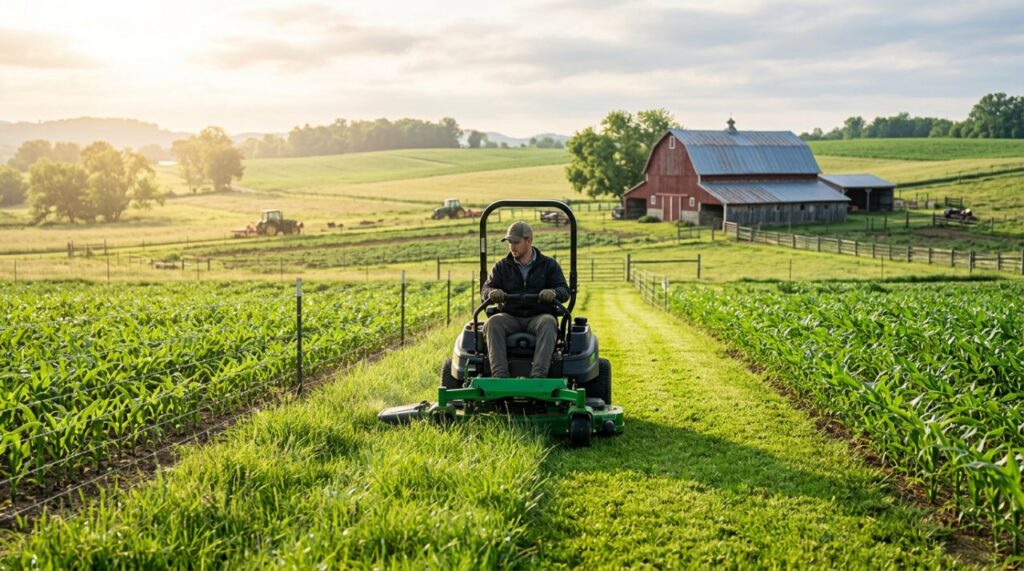
Lawn mowers are not automatically farm tax exempt. A mower may qualify for a sales tax exemption when it is used directly and primarily in commercial agricultural production, such as harvesting forage. A mower used for a farmhouse lawn, landscaping, recreation area, or general property maintenance is usually taxable.
Expert Summary>
– Farm ownership alone does not make a lawn mower tax exempt; the mower’s actual use controls eligibility. – A mower used directly to produce or harvest a marketable agricultural product has a stronger exemption claim than one used to maintain appearance. – Oklahoma, Ohio, and Missouri have different forms and definitions, but each generally requires a direct connection to agricultural production. – Mixed-use equipment may be fully taxable, partially exempt, or subject to allocation rules depending on state law. – The safest approach is to obtain the correct exemption documentation and written guidance before purchasing the mower.
Tools and Documents Needed to Determine Eligibility
Collect proof of agricultural use before asking a dealer to remove sales tax. A verbal statement that you own a farm is rarely enough to establish a valid exemption.
| Tool or document | Why you need it |
|---|---|
| State agricultural exemption certificate | Gives the seller a legal basis for not collecting sales tax |
| Farm tax or permit number | Identifies the qualifying agricultural purchaser where required |
| Written description of mower use | Explains how the equipment supports agricultural production |
| Field map or acreage records | Distinguishes production acreage from lawns and landscaped areas |
| Farm income and sales records | Supports the commercial nature of the operation |
| Equipment-use log | Documents farm use versus personal or maintenance use |
| Purchase invoice | Records the mower, price, purchaser, and tax treatment |
| State revenue guidance | Confirms current definitions and filing requirements |
| Written agency determination | Provides stronger protection when eligibility is uncertain |
Important: An IRS Schedule F, farm registration, or agricultural property classification does not automatically create a state sales tax exemption. Federal income tax treatment and state sales tax treatment are separate legal questions.
Step 1: Identify Which Tax Exemption You Mean
Determine whether you are evaluating sales tax, property tax, an income tax deduction, or a temporary tax holiday. These categories have different rules and should not be treated as interchangeable.
Sales tax exemption
A farm sales tax exemption allows a qualifying buyer to purchase certain equipment without paying state or local sales tax at checkout. This is the main issue behind the question are lawn mowers farm tax exempt.
The exemption normally depends on:
- The purchaser’s agricultural business
- The type of property purchased
- The equipment’s actual use
- The state’s definition of agricultural production
- Properly completed exemption documentation
Income tax deduction or depreciation
A taxable mower may still be deductible or depreciable as a business asset. Paying sales tax does not prevent a farmer from claiming an eligible business expense under federal or state income tax rules.
Potential income tax treatments may include:
- Regular depreciation
- A Section 179 deduction, if eligible
- Bonus depreciation, where available
- Deduction of repair and operating expenses
- Allocation between business and personal use
Consult a qualified tax professional because income tax limits, depreciation rules, and business-use requirements can change.
Personal property tax
Some jurisdictions impose annual personal property tax on business equipment. A mower’s exemption from sales tax does not necessarily exempt it from personal property tax.
Sales tax holiday
Consumers asking are lawn mowers tax free this weekend are usually referring to a state sales tax holiday. Most tax holidays are limited to categories such as clothing, school supplies, emergency equipment, or energy-efficient products.
Lawn mowers are usually excluded unless the state’s official holiday list specifically includes outdoor power equipment.
Step 2: Define the Mower’s Primary Use
Write down exactly where, how, and why the mower will be used. Tax agencies focus on function, not the product label printed on the machine.
A riding lawn mower can perform both taxable and potentially exempt work. Its appearance, horsepower, deck size, or sale through a farm dealer does not decide the result.
Uses that are usually taxable
A lawn mower is commonly taxable when used for:
- Mowing around a farmhouse
- Maintaining a residential yard
- Cutting grass beside a private driveway
- Beautifying a farm entrance
- Maintaining ornamental landscaping
- Mowing around an office or retail farm store
- Cutting recreational areas
- Maintaining rental property
- Providing commercial lawn care
- Controlling weeds on unused land
- General property upkeep unrelated to production
These activities may benefit the property, but they generally do not produce or harvest an agricultural commodity.
Uses that may support an exemption
Eligibility is stronger when the mower is used directly for:
- Cutting forage that will be sold
- Harvesting hay or feed crops
- Managing grass grown as a commercial crop
- Producing sod for sale
- Operating within a qualifying nursery production process
- Maintaining production areas where the activity is essential to the crop
- Performing a documented stage of livestock or crop production
The exact result depends on the state. Some states apply a narrow direct-use test, while others consider whether the machinery is used primarily or exclusively in agricultural production.
Use this practical test
Ask one question:
Does the mower directly produce, cultivate, protect, or harvest a commodity that the farm sells?
If the answer is no, the exemption claim is weak. If the mower merely makes the property safer, cleaner, or more attractive, it is generally a maintenance asset rather than production equipment.
Step 3: Separate Agricultural Production From Grounds Maintenance
Classify every mowing area as production, nonproduction, or mixed use. This prevents the common mistake of treating all acreage on a farm as exempt agricultural acreage.
| Mowing activity | Likely treatment | Reason |
|---|---|---|
| Cutting a residential lawn | Taxable | Personal grounds maintenance |
| Mowing around ornamental trees | Usually taxable | Landscaping rather than production |
| Harvesting forage for sale | Potentially exempt | Direct production or harvesting activity |
| Cutting hay used in livestock production | Potentially exempt | May be directly connected to qualifying production |
| Mowing between commercial nursery rows | State-specific | Must be necessary to production, not merely cosmetic |
| Maintaining a farm-store parking area | Usually taxable | Retail or facility maintenance |
| Mowing pasture weeds | State-specific | May be production-related, but the connection must be documented |
| Cutting grass for a sod business | Potentially exempt | Grass may be the product being produced |
| Lawn-care services for customers | Usually taxable purchase | Landscaping is generally not farming |
| Mowing roadsides and fence lines | Usually taxable or uncertain | Often treated as general property maintenance |
A farm can contain both production and nonproduction areas. The fact that a mower never leaves the farm does not prove that every use is agricultural.
Step 4: Calculate the Primary-Use Percentage
Estimate the percentage of operating time devoted to qualifying production. Mixed use is one of the most important factors in deciding whether lawn mowers are tax exempt.
Use this formula:
Agricultural-use percentage = qualifying production hours ÷ total mower hours × 100
Example calculation
Assume a mower operates 200 hours per year:
- 130 hours cutting forage or qualifying production areas
- 40 hours mowing the farmhouse lawn
- 30 hours maintaining lanes, parking areas, and ornamental grounds
The potential qualifying-use percentage is:
130 ÷ 200 × 100 = 65%
This number does not automatically establish an exemption. The applicable state may require direct use, primary use, exclusive use, or another legal standard.
Keep a practical equipment-use log
Record:
- Date
- Starting and ending hour-meter readings
- Field or location
- Task performed
- Crop or livestock activity supported
- Operator
- Production or nonproduction classification
An hour meter provides more credible evidence than an estimate created after an audit begins.
Step 5: Apply the Direct-Use Test
Connect the mower to a specific stage of agricultural production. A general statement such as “the mower is necessary for the farm” is usually less persuasive than a documented production function.
Stronger direct-use explanation
A stronger explanation might state:
“This machine cuts and conditions forage grown on 60 production acres. The forage is baled and fed to cattle raised for commercial sale.”
This identifies:
- The machine’s activity
- The agricultural commodity
- The production acreage
- The commercial purpose
- The connection to livestock production
Weaker maintenance explanation
A weaker explanation would be:
“The mower keeps the farm clean and prevents the grass from getting too tall.”
That statement describes maintenance rather than production. Cleanliness, convenience, fire prevention, and appearance can be valuable without satisfying a farm sales tax exemption.
Essential does not always mean exempt
A cost can be necessary for running a farm but still be subject to sales tax. Office furniture, break-room appliances, landscaping tools, and grounds-maintenance equipment may support the business without being used directly in production.
Step 6: Check Whether Lawn Mowers Are Farm Tax Exempt in Oklahoma
In Oklahoma, agricultural exemption eligibility generally depends on both the purchaser’s status and the item’s use in agricultural production. An agricultural sales tax exemption permit does not make every purchase by the permit holder tax free.
Are lawn mowers farm tax exempt in Oklahoma?
A mower used directly in agricultural production may qualify under applicable Oklahoma rules. A mower used for a residence, lawn, landscaping, roadside appearance, or general maintenance will generally have a weaker claim and may be taxable.
Before making the purchase:
- Verify that your Oklahoma agricultural exemption permit is active.
- Describe the mower’s specific agricultural function.
- Separate production use from home and grounds maintenance.
- Ask the seller which exemption documentation is required.
- Confirm uncertain uses with the Oklahoma Tax Commission.
- Retain the certificate, invoice, and use records.
Oklahoma example
A machine purchased to mow the lawn around a cattle ranch residence is likely taxable because it maintains residential property. A machine used to cut a forage crop for livestock production may have a stronger exemption claim.
Do not assume a farm tag, farm address, or agricultural permit is sufficient by itself. Misuse of an exemption permit may result in tax, interest, penalties, or permit consequences.
Step 7: Determine Whether Lawn Mowers Are Tax Exempt in Ohio
Ohio generally evaluates whether machinery is used directly in producing tangible personal property through farming. A mower used for ordinary lawn care or landscaping usually does not become exempt merely because the land is classified as agricultural.
Can lawn mowers be Ohio sales tax exempt?
A lawn mower can potentially qualify when its direct and qualifying use fits Ohio’s farming exemption. The purchaser should be able to show that the mower performs a production function rather than general grounds maintenance.
Relevant questions include:
- Is the grass itself being produced for sale?
- Is the mower harvesting a forage crop?
- Is the activity part of commercial crop or livestock production?
- Is the mower primarily maintaining a residence or landscaped grounds?
- Does the purchaser have records proving the claimed farming use?
Are lawn mowers tax exempt in Ohio for CAUV land?
Enrollment in Ohio’s Current Agricultural Use Value, commonly known as CAUV, concerns property valuation. It does not automatically exempt equipment purchases from sales tax.
Likewise, owning farmland or reporting farm income does not replace the required sales tax analysis.
Ohio example
A mower used by a sod producer to cultivate or harvest sod sold to customers may have a direct production connection. The same mower used by a landowner to cut open acreage for appearance or convenience is generally less likely to qualify.
Use the exemption certificate accepted by the seller and review current guidance from the Ohio Department of Taxation before claiming an uncertain exemption.
Step 8: Decide Whether Lawn Mowers Are Taxed in Missouri
Missouri may exempt qualifying machinery and equipment used in agricultural production, but ordinary lawn maintenance is generally not enough. The purchaser must connect the mower to a qualifying farming activity and provide proper documentation.
Are lawn mowers taxed in Missouri?
Yes, lawn mowers are generally taxable retail products unless a specific exemption applies. Agricultural ownership does not create a blanket exemption.
The mower may have a stronger claim when it is used directly and predominantly for:
- Producing a commercial crop
- Harvesting forage
- Supporting qualifying livestock production
- Producing grass, sod, or another marketable agricultural product
Can lawn mowers be tax exempt in Missouri?
A mower may be exempt if its actual use satisfies Missouri’s agricultural machinery or equipment requirements. A mower used around a home, barnyard, driveway, parking area, or decorative landscape is likely taxable.
Purchasers should:
- Identify the statutory agricultural use.
- Complete the applicable Missouri exemption certificate.
- Give the certificate to the seller.
- Keep evidence of how the mower is used.
- Request guidance from the Missouri Department of Revenue when mixed use creates uncertainty.
The search phrase can lawn mowers be tax exemptin Missouri often reflects a spelling error, but the legal answer remains use-specific: possible for qualifying production, not automatic for farm ownership.
Step 9: Verify Whether Lawn Mowers Are Tax Free This Weekend
Check the official state tax holiday list instead of relying on retailer advertising. A sale price, rebate, or “tax-free” promotion may not be a government sales tax exemption.
Why lawn mowers are usually excluded
Tax holidays commonly impose restrictions based on:
- Product category
- Maximum price per item
- Purchase date and time
- Consumer versus business use
- State and local participation
- Online order and delivery timing
Outdoor power equipment often falls outside school-supply, clothing, disaster-preparedness, and energy-efficiency holidays.
How to verify a tax-free promotion
- Open the state revenue department’s official website.
- Find the current sales tax holiday publication for August 2026.
- Search the qualifying product list for “lawn mower,” “outdoor power equipment,” or “farm machinery.”
- Review price caps and local tax rules.
- Ask whether delivery, accessories, warranties, and batteries are also exempt.
- Save a copy of the official guidance with the invoice.
Retailers sometimes advertise that they will “pay the tax.” That is a pricing promotion, not necessarily a legal tax exemption.
Step 10: Understand Whether Lawn Mowers Are Under Tariffs
Tariffs and sales taxes are separate charges. A lawn mower can be subject to import-related costs in its supply chain even when the purchaser qualifies for a state agricultural sales tax exemption.
The misspelled query are lawn mowers under tarrifs usually asks whether import duties increase mower prices. The answer depends on factors such as:
- Country of origin
- Customs classification
- Engine type
- Whether the unit is complete or imported as components
- Steel, aluminum, battery, or electronic content
- Trade measures in effect when the product enters the country
Consumers usually do not pay a separate tariff line at checkout. Manufacturers, importers, or distributors may incorporate tariff costs into the retail price.
A farm sales tax certificate does not remove embedded import costs from the mower’s price.
Step 11: Compare the Financial Value of Claiming the Exemption
Calculate the tax savings before accepting compliance risk. A legitimate exemption can reduce acquisition cost, but an unsupported exemption may become more expensive after tax, interest, and penalties.
Sales tax savings formula
Potential savings = taxable purchase price × combined sales tax rate
Suppose a commercial mower costs $12,000 and the combined sales tax rate is 7.5%:
$12,000 × 7.5% = $900
The valid exemption would reduce the initial purchase cost by $900.
Include taxable accessories
The tax treatment of related items may differ from the mower itself:
| Purchase item | Possible treatment |
|---|---|
| Base mower | Exempt only if statutory requirements are met |
| Replacement blades | May depend on agricultural use and state rules |
| Fuel | Governed by separate fuel-tax or sales-tax provisions |
| Delivery | Depends on state law and invoice structure |