
Can You Trade In Lawn Mowers? The Direct Answer
Yes, you can trade in a lawn mower, but acceptance depends on the dealer, mower type, condition, and local demand. Independent equipment dealers are more likely to accept trade-ins than national home-improvement retailers. Comparing several offers can help you receive more value or determine whether a private sale is financially smarter.
Expert Summary>
– Lawn mower trade-ins are usually handled by local power-equipment dealers, tractor dealerships, and participating manufacturer dealers. – Trade-in value depends primarily on age, operating condition, engine hours, brand, maintenance history, and local resale demand. – Large retailers may offer recycling or limited promotional events, but these should not be assumed to be permanent trade-in programs. – A private sale usually produces more cash, while a dealer trade-in offers greater speed, convenience, and lower selling risk. – Always negotiate the new mower’s price separately from the trade-in allowance to reveal the true financial value of the deal.
Tools and Information Needed Before Trading In a Lawn Mower
A successful trade-in starts with accurate mower information and basic proof of condition. You do not need professional appraisal equipment, but complete records can make your mower easier for a dealer to evaluate.
| Item | Why You Need It | Where to Find It |
|---|---|---|
| Brand and model number | Identifies specifications, parts support, and resale demand | Frame label, mower deck, owner’s manual |
| Serial number | Confirms the mower’s production details | Manufacturer identification plate |
| Engine hours | Helps estimate mechanical wear on riding mowers | Hour meter or service records |
| Purchase receipt | Supports age and ownership claims | Email, paper records, retailer account |
| Maintenance records | Shows that oil, filters, belts, and blades were serviced | Dealer invoices or personal log |
| Photos | Allows dealers to provide preliminary estimates | Take clear images in daylight |
| Basic cleaning supplies | Improves presentation without hiding defects | Brush, cloth, mild cleaner |
| Comparable listings | Provides a realistic local market range | Dealer websites and local marketplaces |
| Transportation plan | Prevents delivery costs from eroding the offer | Trailer, truck, or dealer pickup |
Bring all keys, attachments, chargers, batteries, grass bags, and manuals that came with the mower. Missing accessories can reduce its usefulness and trade-in value.
Step 1: Identify Who Takes Trade-Ins on Lawn Mowers
The best places to ask are independent outdoor power-equipment dealers, tractor dealers, and authorized mower-brand dealerships. Their policies vary because used equipment must be inspected, repaired, stored, and resold profitably.
Start with local power-equipment dealers
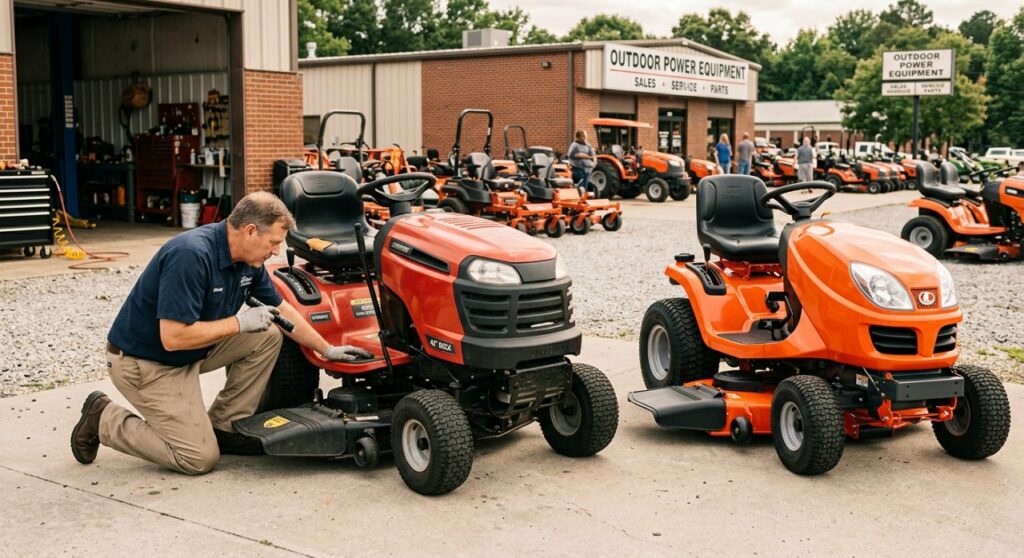
Local dealers are often the strongest option because they already service and resell lawn equipment. They may accept walk-behind mowers, zero-turn mowers, lawn tractors, or commercial machines depending on their inventory needs.
Ask whether the business:
- Accepts the mower’s brand and model
- Requires the mower to be operational
- Accepts trade-ins without a new purchase
- Offers pickup or requires delivery
- Charges an inspection or transportation fee
- Provides a written trade-in allowance
- Sells traded equipment or sends it to auction
A dealer may decline an otherwise usable mower if it lacks parts support or is difficult to resell locally. This is a business decision, not necessarily proof that the mower has no private-market value.
Contact authorized brand dealers
Dealers representing brands such as John Deere, Toro, Honda, Husqvarna, Cub Cadet, STIHL, or Exmark may consider trade-ins when you purchase replacement equipment. Acceptance is controlled by the individual dealership, not automatically guaranteed by the manufacturer.
Brand dealers may prefer:
- Equipment they are trained to service
- Models with readily available parts
- Riding mowers with documented engine hours
- Commercial equipment with maintenance records
- Mowers that can be reconditioned economically
Do not assume an authorized dealer will accept only its own brand. Some dealerships handle several brands or sell used equipment separately.
Check tractor and farm-equipment dealerships
Tractor dealerships are worth contacting for riding mowers, garden tractors, subcompact tractors, and zero-turn mowers. They are less likely to want inexpensive electric or push mowers because the inspection and resale costs may exceed the potential margin.
If you are purchasing a larger machine, the dealership may include your mower in a broader equipment deal. Request an itemized quote so you can see the mower’s actual allowance.
Look for seasonal manufacturer promotions
Manufacturers and dealers occasionally run limited-time upgrade, rebate, or trade-in promotions. These offers may apply only to selected products, participating locations, or qualifying equipment.
Before relying on a promotion, verify:
- The promotion’s start and end dates
- Eligible mower categories
- Minimum condition requirements
- Whether the offer is a true trade-in or purchase rebate
- Whether it can be combined with other discounts
A rebate advertised as an “upgrade offer” is not always payment for your old mower. Read the terms before transporting equipment.
Step 2: Verify Whether Lowe’s Takes Lawn Mower Trade-Ins
Do not assume Lowe’s offers a permanent nationwide lawn mower trade-in program. Store services, recycling options, delivery policies, and temporary promotions may vary by location and product category.
The safest approach is to contact the specific store before visiting. Ask the lawn and garden department or customer service desk for the current policy in August 2026.
Use these questions:
- “Does this location currently accept used lawn mowers as trade-ins?”
- “Is the offer available for push, riding, battery, or zero-turn mowers?”
- “Is this a trade-in credit, recycling service, or temporary promotion?”
- “Must I purchase a qualifying replacement mower?”
- “Do you accept gasoline-powered equipment containing fuel or oil?”
- “Does delivery include removal of the old mower?”
- “Are there disposal or haul-away fees?”
A haul-away service is not the same as a trade-in. Haul-away removes unwanted equipment, while a trade-in provides measurable credit toward a purchase.
If Lowe’s does not accept the mower, ask local equipment dealers before choosing disposal. A running mower may still have private-sale, consignment, donation, or parts value.
Step 3: Determine the Trade-In Value of a Used Lawn Mower
To determine trade-in value, estimate the mower’s likely retail resale price and subtract the dealer’s inspection, repair, storage, warranty, and profit costs. A dealer allowance will normally be lower than the price you might receive from a private buyer.
Record the mower’s essential details
Create a one-page equipment description containing:
- Manufacturer
- Exact model
- Serial number
- Approximate age
- Engine size or battery voltage
- Deck width
- Engine hours, if available
- Drive type
- Starting method
- Known defects
- Recent repairs
- Included attachments
Accuracy matters. Describing a mower as “like new” while omitting a slipping transmission or damaged deck can cause the dealer to withdraw the estimate after inspection.
Rate its mechanical and cosmetic condition
Use a consistent condition scale rather than relying on emotional attachment.
| Condition | Practical Description | Likely Dealer Response |
|---|---|---|
| Excellent | Starts easily, operates correctly, clean, low wear, records available | Strongest consideration |
| Good | Fully functional with normal scratches and wear | Common trade-in candidate |
| Fair | Runs but needs blades, tires, belts, battery, or routine repair | Reduced offer |
| Poor | Hard starting, smoke, deck corrosion, transmission issues, missing parts | Parts value or rejection |
| Non-running | Cannot be function-tested or needs major repair | Often declined |
A mower’s appearance affects buyer confidence, but mechanical condition carries more weight. Fresh paint does not compensate for engine smoke, structural rust, or a weak hydrostatic transmission.
Research comparable used mowers
Search for the same model, deck size, age range, and condition within your region. Local demand matters because a mower that sells quickly in one area may move slowly elsewhere.
Compare:
- Used-equipment dealer listings
- Local classified advertisements
- Auction results, when available
- Marketplace listings marked as sold
- Dealer-certified used inventory
Active asking prices are not proof of market value. Sellers can ask any amount, so completed sales and dealer quotes are more useful.
Use a realistic valuation formula
A practical estimate is:
Expected private-sale price − dealer reconditioning costs − dealer risk and margin = estimated trade-in range
Consider this hypothetical example:
| Valuation Component | Amount |
|---|---|
| Expected dealer resale price | $2,400 |
| Inspection and service | −$250 |
| Tires, belt, or battery | −$300 |
| Storage and selling costs | −$150 |
| Warranty risk and dealer margin | −$500 |
| Illustrative trade-in allowance | $1,200 |
These numbers are examples, not universal depreciation rates. Actual costs vary greatly between a basic push mower and a commercial zero-turn mower.
Account for repairs before accepting an offer
Ask whether a repair would generate more value than it costs. Routine work may help, but major repairs rarely return every dollar in a trade-in.
Suppose a dealer offers:
- $800 as-is
- $1,050 after a $400 transmission repair
Completing the repair would increase the allowance by only $250, producing a $150 net loss. Trading it as-is would be financially smarter unless the repair also makes a private sale substantially more profitable.
Step 4: Prepare the Lawn Mower for Appraisal
Clean the mower, confirm basic operation, and organize its accessories before appraisal. Proper preparation can improve confidence and prevent avoidable deductions, but you should not conceal defects.
Clean without disguising problems
Remove dry grass from the deck, footrests, wheels, and engine area. Use care around electrical connections, bearings, air intakes, and hot engine components.
Complete these basic tasks:
- Brush loose debris from the mower.
- Wipe exterior surfaces with a mild cleaner.
- Empty the grass bag.
- Remove personal stickers or accessories.
- Inflate tires to the recommended pressure.
- Charge the starter battery if appropriate.
- Organize keys, chargers, manuals, and attachments.
Avoid pressure-washing sensitive components immediately before inspection. Water intrusion can create starting or electrical problems that did not previously exist.
Perform only cost-effective maintenance
Low-cost maintenance can help the mower start and demonstrate correctly. Expensive cosmetic restoration is unlikely to produce an equal increase in trade-in value.
Reasonable preparation may include:
- Replacing stale fuel where safe and appropriate
- Checking engine oil
- Cleaning or replacing an inexpensive air filter
- Charging the battery
- Tightening loose hardware
- Replacing a missing key
- Cleaning battery terminals
- Confirming the blades engage correctly
Do not perform repairs beyond your skill level. Mower blades, fuel systems, batteries, and spring-loaded components can cause serious injury.
Disclose known faults
Tell the dealer about oil leaks, smoke, unusual noise, weak batteries, steering problems, deck vibration, and intermittent starting. Dealers usually inspect equipment before finalizing the allowance.
Honest disclosure saves time and reduces the risk of a revised quote. It also allows the dealer to estimate repairs more accurately.
Step 5: Request Written Quotes From Multiple Buyers
Obtain at least three comparable offers whenever the mower has meaningful resale value. One dealership may have excess used inventory, while another may actively need your mower category.
Send each business the same information:
- Model and serial number
- Age and engine hours
- Photos from all sides
- Photo of the mower deck
- Photo of the hour meter
- Service records
- Known defects
- Desired replacement model
- Pickup or delivery requirements
Ask whether the preliminary estimate is conditional. Most remote quotes will change if the physical inspection reveals undisclosed wear or damage.
Find who takes trade-ins on lawn mowers in Springfield, MO
For location-specific searches such as who takes trade-ins on lawn mowers Springfield MO, begin with authorized equipment dealers within a practical driving radius. Expand the search to nearby tractor dealerships, used-equipment businesses, and consignment auctions if local offers are limited.
Use a search process rather than relying on an outdated list:
- Search manufacturer dealer locators for your mower brand.
- Search maps for “outdoor power equipment dealer.”
- Review whether each business sells used equipment.
- Call and confirm its current trade-in policy.
- Ask about pickup charges and inspection requirements.
- Record the employee’s name and quote date.
Policies and ownership can change, so a phone confirmation is more reliable than an old directory entry. Never transport a riding mower until the business confirms it will inspect that equipment type.
Step 6: Compare a Trade-In With Selling, Repairing, or Keeping the Mower
The highest offer is not automatically the best financial choice. Compare net proceeds, time, risk, replacement cost, and the mower’s remaining useful life.
| Option | Typical Financial Outcome | Time and Effort | Best For |
|---|---|---|---|
| Dealer trade-in | Lower than private sale | Low | Fast, convenient replacement |
| Private sale | Often higher gross price | High | Sellers willing to advertise and meet buyers |
| Consignment | Moderate after fees | Moderate | Valuable equipment with specialist demand |
| Repair and keep | Can avoid a major replacement cost | Varies | Durable mower with an economical repair |
| Donation | Usually no direct cash | Low to moderate | Working equipment with community value |
| Recycling or disposal | Little or no return; possible fee | Low | Unsafe or economically unrepairable mower |
Calculate the true net value
Use this formula:
Net trade-in value = allowance − transport fees − inspection fees − lost discounts
Some dealers may offer a higher allowance while charging more for the replacement mower. Compare the complete transaction, not the trade figure alone.
For example:
| Deal | New Mower Price | Discount | Trade Allowance | Net Purchase Cost |
|---|---|---|---|---|
| Dealer A | $5,500 | $0 | $1,500 | $4,000 |
| Dealer B | $5,200 | $300 | $1,000 | $3,900 |
Dealer A advertises the larger trade-in, but Dealer B produces the lower net purchase cost. This is why trade allowances should never be evaluated in isolation.
Compare repair cost with five-year ownership cost
Replacing a repairable mower can cost more than keeping it. Calculate the expected five-year cost before treating a new machine as a bargain.
Consider this hypothetical comparison:
| Cost Over Five Years | Durable Replacement | Cheaper Replacement |
|---|---|---|
| Initial purchase | $3,000 | $1,200 |
| Expected replacements | $0 | 2 × $1,200 |
| Maintenance and repairs | $500 | $600 |
| Total five-year cost | $3,500 | $4,200 |
The mower with the lower sticker price costs $700 more if it must be replaced twice. Evaluate durability, repair access, parts availability, warranty terms, and expected service life—not marketing claims alone.
Claims such as “eco-friendly,” “maintenance-free,” or “built to last” do not prove lower ownership cost. Specific warranty coverage, battery replacement prices, repair documentation, and parts availability are more useful than vague green language.
Step 7: Negotiate the New Mower and Trade-In Separately
Negotiate the replacement mower’s cash price before discussing the trade-in whenever possible. This prevents a dealer from shifting money between the discount and trade allowance to make the deal appear stronger.
Follow this order:
- Ask for the replacement mower’s out-the-door cash price.
- Confirm delivery, setup, documentation, and other fees.
- Request a separate written trade-in allowance.
- Ask whether the trade changes any rebates or financing terms.
- Calculate the final amount due.
- Compare the same structure across dealers.
A large trade-in number may be funded by removing a discount that cash buyers receive. The only reliable comparison is the final net cost for the same replacement mower.
Review financing carefully
Promotional financing can affect rebates and negotiated prices. Ask whether choosing low-interest or deferred-interest financing eliminates a cash discount.
Check:
- Annual percentage rate
- Loan term
- Required down payment
- Origination or documentation fees
- Deferred-interest conditions
- Early payoff rules
- Total amount paid
A convenient monthly payment does not establish that the mower is affordable. Compare total ownership and financing cost.
Step 8: Finalize the Trade Safely
Complete the trade only after the mower passes inspection and all terms appear in writing. Keep copies of the appraisal, sales agreement, serial numbers, and payment records.
Before handing over the mower:
- Remove personal property.
- Provide only the agreed accessories.
- Photograph its final condition.
- Record the engine hours.
- Confirm that the serial number is correct.
- Obtain a receipt showing ownership transfer.
- Cancel any transferable service plan if required.
- Remove stored personal data from connected mower apps.
- Follow safe fuel-transport rules.
Never sign a blank equipment description or an agreement containing unexplained fees. Ask for corrections before completing the transaction.
Pro Tips for Getting a Better Lawn Mower Trade-In Offer
These strategies improve your negotiating position without wasting money on unnecessary restoration.
- Trade during active buying periods. Local demand may improve when homeowners and contractors are shopping for equipment, although dealer inventory also affects offers.
- Bring maintenance documentation. Records reduce uncertainty about neglected oil, filters, belts, batteries, and hydraulic systems.
- Include useful attachments. Mulching kits, baggers, weights, and compatible implements may add value if the dealer can resell them.
- Get a private-sale estimate. Knowing the likely private value reveals the convenience cost of trading.
- Ask for an as-is and repaired quote. This shows whether a repair will produce a positive return.
- Avoid last-minute dependency. Secure several offers before your current mower becomes completely unusable.
- Photograph identification labels. Exact model details prevent inaccurate comparisons and delayed quotes.
- Evaluate parts support. A durable, repairable mower can be cheaper to own than a low-priced model with scarce parts.
Common Lawn Mower Trade-In Mistakes to Avoid
The most expensive mistakes come from comparing allowances instead of complete transaction costs.
Accepting the first offer
A single quote does not establish market value. Dealers have different inventory, repair capacity, and customer demand.
Request multiple estimates, especially for commercial mowers, zero-turn models, and well-maintained lawn tractors.
Spending too much on repairs
A repair is worthwhile only when the resulting value increase exceeds the cost. Ask dealers for conditional values before authorizing major work.
Routine cleaning and inexpensive maintenance may help. Engine, transmission, battery-pack, or deck replacement requires a clear cost-benefit calculation.
Hiding mechanical defects
Dealers test equipment and may revise or cancel an offer after inspection. Concealing defects wastes time and can damage trust.
Describe known faults directly and request an as-is appraisal.
Confusing disposal with trade-in value
Retailer haul-away and recycling programs may charge fees rather than provide credit. Confirm whether the old mower creates a documented reduction in the purchase price.
If not, compare local donation, private sale, parts sale, and recycling options.
Shopping only by monthly payment
A longer loan can lower the monthly payment while increasing total interest. Compare the mower price, trade allowance, fees, APR, and total paid.
Falling for vague sustainability claims
A product is not automatically economical because it uses “green,” “clean,” or “eco” branding. Verify expected service life, battery cost, repairability, warranty exclusions, and replacement-part availability.
The financially greener option is usually the machine that performs the required work for the lowest verified lifecycle cost.
Frequently Asked Questions
Can you trade in lawn mowers that do not run?
Sometimes, but non-running mowers usually receive parts or scrap value. Dealers may decline them if diagnosis, transport, and repair costs exceed the expected resale margin.
Provide the model, photos, and known symptoms before arranging transportation. A private parts sale may produce more value for a desirable model.
Who takes trade-ins on lawn mowers?
Independent power-equipment dealers, authorized brand dealers, tractor dealerships, and some used-equipment businesses are the most likely options. Acceptance depends on mower type, condition, parts availability, and local demand.
Call each business because trade-in policies can change without notice.
Does Lowe’s take trade-in lawn mowers?
Do not assume Lowe’s has a permanent nationwide mower trade-in program. A location may offer recycling, haul-away, or a limited promotion, but availability and terms should be confirmed directly with the store.
Ask whether the program provides purchase credit or simply removes the old mower.
How do you determine trade-in value for a used lawn mower?
Estimate the mower’s likely resale price, then subtract repairs, inspection, storage, selling costs, warranty risk, and dealer margin. Age, engine hours, condition, brand reputation, service records, and local demand influence the final offer.
Compare at least three dealer quotes with realistic private-sale prices.
Is trading in a mower better than selling it privately?
Trading is better for convenience, while private selling often produces more money. A trade-in avoids advertising, buyer meetings, payment concerns, and post-sale disputes.
Calculate how much extra cash a private sale may produce and decide whether it justifies the added time and risk.
Conclusion: Is Trading In a Lawn Mower Financially Smart?
Trading in a lawn mower is financially smart when the allowance is competitive, the transaction preserves available discounts, and the convenience is worth more than the extra proceeds from a private sale. The correct comparison is the complete net replacement cost—not the advertised trade-in amount.
Document your mower, obtain at least three quotes, compare repair and five-year ownership costs, and negotiate each part of the purchase separately. Start by contacting local equipment dealers and requesting written estimates based on the exact model, condition, and engine hours.