
Do All Lawn Mowers Have a Prime Button?
1 direct answer: No, not all lawn mowers have a prime button, primer bulb, or manual priming system. What this means for you is: your mower may start with a primer bulb, an automatic choke, a manual choke, electronic fuel injection, or no gasoline system at all.
A prime button is most common on older or basic gas-powered walk-behind mowers. Many newer gasoline engines automatically manage the starting fuel mixture, while battery-electric and corded electric mowers do not use fuel primers.
Expert Summary>
– 1 key fact: A lawn mower needs a primer only when its engine and carburetor are designed for manual priming. What this means for you is: the absence of a primer bulb does not indicate a missing part. – 2 common alternatives are an automatic choke and a manual choke. What this means for you is: starting instructions depend on the engine design rather than the mower’s appearance. – 3 to 5 primer presses are common on many manually primed engines, but the correct number comes from the mower or engine manual. What this means for you is: excessive pressing can flood the engine. – 0 fuel primers are used on corded and battery-powered lawn mowers. What this means for you is: starting problems on electric models must be diagnosed through the battery, power supply, safety key, switches, or motor system. – 1 model number check is more reliable than guessing from brand or mower age. What this means for you is: identify the exact mower and engine before ordering a primer bulb or changing the starting procedure.
Identify What Type of Lawn Mower You Have
2 broad power categories determine whether you should even look for a prime button: gasoline and electric. What this means for you is: identifying the power source eliminates several incorrect troubleshooting steps immediately.
| Lawn mower type | Prime button expected? | Typical starting system | Main trade-off |
|---|---|---|---|
| Gas mower with carburetor | Sometimes | Primer bulb, manual choke, or automatic choke | Requires fuel-system maintenance |
| Gas mower with electronic fuel injection | Usually no | Computer-controlled fuel delivery | More complex electronic diagnosis |
| Battery mower | No | Battery, safety key, bail lever, and start button | Runtime depends on battery condition |
| Corded electric mower | No | Power cord, safety switch, and start control | Limited by cord access |
| Robotic mower | No | Battery and electronic controls | Setup and sensor faults replace fuel issues |
1 Check Whether the Mower Uses Gasoline
1 fuel cap is the quickest sign that you have a gasoline mower. What this means for you is: a fuel tank confirms that priming, choking, or fuel injection may be part of the starting process.
Look for these components:
- A gasoline tank and cap
- A recoil starter rope or electric starter
- A small combustion engine
- A carburetor or fuel-injection system
- An engine air-filter housing
- A spark-plug wire
A recoil rope alone does not prove that a primer is present. Some pull-start engines use an automatic choke instead.
2 Rule Out Battery and Corded Models
0 primer bulbs should be present on a fully electric mower. What this means for you is: do not search for a fuel-prime control on a machine without a combustion engine.
A battery mower commonly starts only when several conditions are met:
- The battery is charged and correctly seated.
- The safety key is installed.
- The handle is fully extended or locked.
- The bail lever is held against the handle.
- The start button or switch is activated.
If an electric mower does not start, inspect those interlocks before assuming there is an engine-style priming problem.
Locate the Primer Bulb or Prime Button
3 inspection areas usually reveal whether a gasoline mower has a manual primer: the carburetor, air-filter housing, and engine-control area. What this means for you is: you can often identify the starting system without removing engine parts.
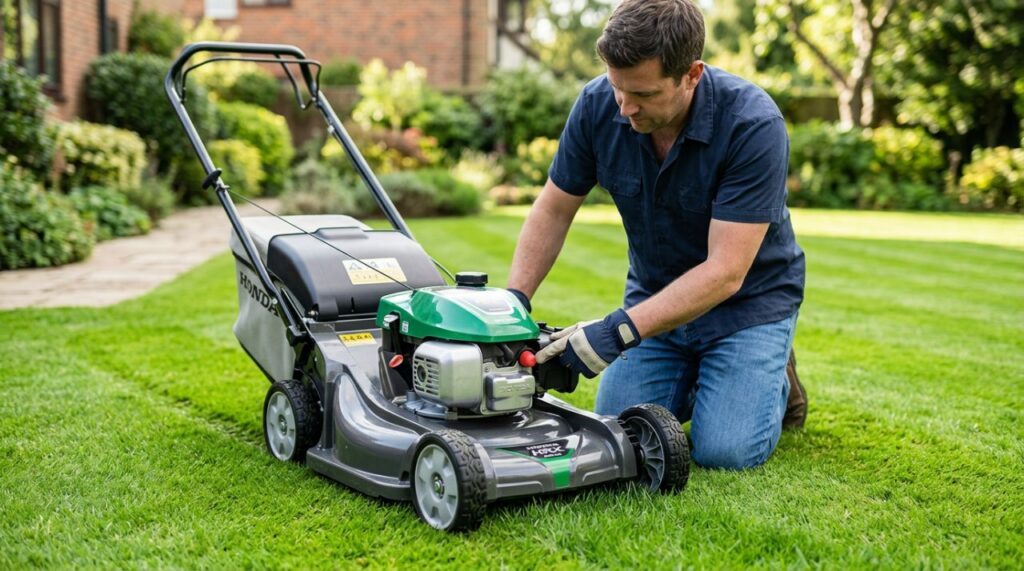
A lawn mower primer usually appears as a small, flexible bulb. It may be:
- Red, black, clear, or translucent
- Round or oval
- Mounted beside the carburetor
- Installed in the air-filter housing
- Labeled PRIMER, PRIME, or with a pressing instruction
1 Inspect Near the Air Filter
1 air-filter box often sits directly beside or over the carburetor. What this means for you is: checking around this housing is usually the fastest way to find a primer bulb.
Look along the front and sides of the engine. Do not confuse the primer with a rubber mounting plug, fuel hose, or carburetor drain.
A working primer should normally feel flexible and return to shape after you release it. A bulb that stays collapsed, feels hard, or has visible splits may need inspection or replacement.
2 Inspect the Carburetor Area
1 carburetor controls the air-and-fuel mixture on most small gasoline mower engines. What this means for you is: a manual primer, if fitted, usually connects directly or indirectly to this component.
The carburetor is commonly located behind the air-filter housing. You do not normally need to remove the carburetor to determine whether the mower has a primer.
Before touching the area:
- Turn off the engine.
- Let hot parts cool.
- Remove the spark-plug wire if your hands will be near the blade or moving controls.
- Work away from flames, heaters, cigarettes, and sparks.
3 Do Not Confuse a Primer with a Choke Control
2 controls can serve a similar cold-start purpose without being the same component: a primer and a choke. What this means for you is: identifying the wrong control can lead to flooding or an incorrect starting sequence.
A primer bulb helps move fuel or pressurize passages so the engine receives a richer starting mixture. A choke restricts incoming air, which also enriches the mixture during starting.
| Feature | Primer bulb | Choke control |
|---|---|---|
| Typical appearance | Flexible rubber bulb | Lever, knob, slider, or automatic linkage |
| User action | Press and release | Move to choke/start position |
| Main function | Assists initial fuel delivery | Restricts air for a richer mixture |
| Used on electric mowers | No | No |
| Can be automatic | Usually not as a pressable bulb | Yes |
Determine Whether the Engine Uses an Automatic Choke
1 automatic choke system can replace the user-operated prime button on many gasoline mowers. What this means for you is: a mower with no visible primer may still be operating exactly as designed.
An automatic choke adjusts the starting mixture without requiring you to press a bulb or move a choke lever. The usual sequence is to hold the blade-control bar and pull the starter rope, or use the electric-start control.
1 Look for a “Ready Start” Style System
0 manual priming actions may be specified on an engine with automatic starting controls. What this means for you is: pressing random rubber components will not improve starting and could damage them.
Labels vary by engine manufacturer and model. Look for wording such as:
- No prime
- No choke
- Easy start
- Automatic choke
- Ready-start system
- Just pull and start
Treat these labels as clues rather than universal instructions. The exact engine manual remains the best source.
2 Check for a Thermostatic or Linkage-Operated Choke
2 automatic-choke mechanisms are common: temperature-sensitive systems and air-vane or linkage systems. What this means for you is: starting performance can be affected by a sticking linkage even when there is no primer bulb.
A mower that starts cold but struggles after warming may have a different fault from one that refuses to start cold. Possible causes include stale fuel, a dirty carburetor, a sticking choke, restricted airflow, or an ignition problem.
Do not bend choke linkages unless the service documentation gives a specific adjustment procedure. Small changes can prevent the choke plate from opening or closing correctly.
Use the Model Number to Confirm the Starting System
1 exact model number provides stronger evidence than brand name, deck color, or approximate age. What this means for you is: two visually similar mowers may require completely different starting procedures.
The mower and engine can have separate identification labels. Record both when possible.
1 Find the Mower Model Label
3 common label locations are the rear deck, under the handle area, and near the discharge opening. What this means for you is: you may need to clean away grass residue before the full number becomes readable.
The label may show:
- Model number
- Serial number
- Product number
- Manufacturing code
- Safety and compliance information
Take a clear photograph before the label fades further. Avoid relying on memory when searching for manuals or parts.
2 Find the Engine Identification Code
1 engine code may be stamped into a metal housing or printed on a separate label. **What this means for