
Quick Answer / TL;DR: Yes, nearly every lawn mower—walk-behind, riding, zero-turn, robotic, and commercial—has a serial number that identifies that specific machine. It’s usually on a metal plate or sticker on the deck, frame, rear housing, or engine housing. You’ll need it for warranty claims, recalls, replacement parts, service records, and theft reports. Riding mowers use a PIN, not a car-style 17-character VIN.

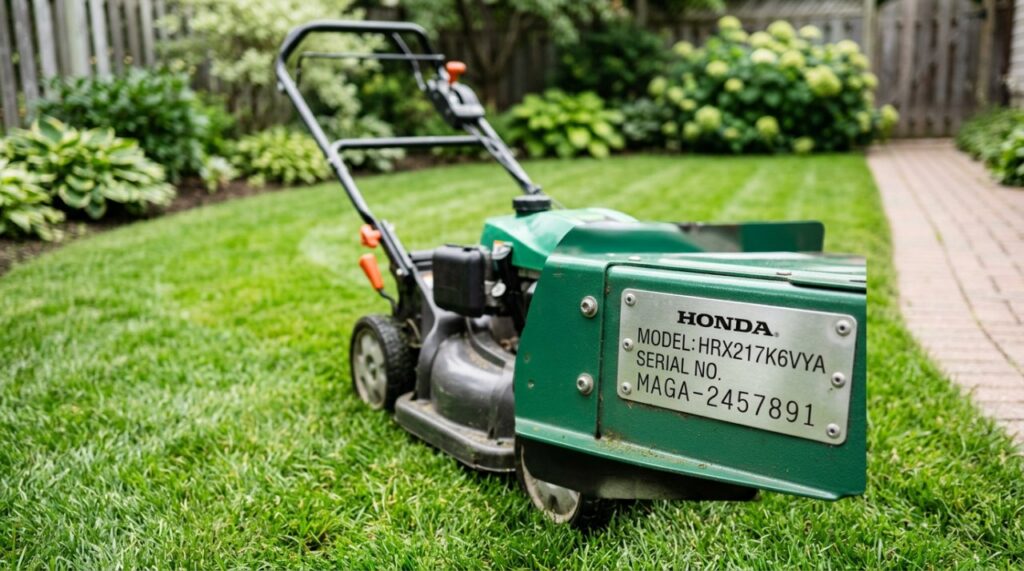
Locating the serial number plate on a lawn mower deck

What You Need

Finding and recording your mower’s serial number takes about five minutes. Here’s what to have on hand before you start:

  • Flashlight — serial plates are often tucked under the deck, behind the engine, or inside the rear housing where lighting is poor.
  • Rag or old towel — plates and labels get coated in grass clippings, grease, and dust.
  • Phone camera — photograph the plate as a permanent record; it beats transcription errors.
  • Phone or notepad — record both the model number and serial number; parts lookups usually require both.
  • Owner’s manual (if available) — most manuals include a location diagram for the ID plate.
  • Ramps or a helper (riding mowers only) — some ID plates sit under the seat, on the frame rails, or near the rear axle.

💡 Pro Tip: Record the engine’s model and serial numbers too. Mower makers and engine makers (Briggs & Stratton, Honda, Kawasaki) are usually different companies, and engine warranty claims go through the engine manufacturer—not the mower brand.

Step-by-Step Guide

Step 1: Understand What You’re Looking For

A serial number is a unique sequence of letters, numbers, or both that distinguishes your individual mower from every other unit of the same model. Some manufacturers call it a serial number; others use terms like product identification number (PIN) or unit identification number. Don’t confuse it with the model number—here’s the difference:

IdentifierWhat it identifiesCommon use
Model numberMower design or product seriesManuals, general specifications, compatible accessories
Serial numberOne individual mowerWarranty, recalls, service records, theft reports
Product numberSpecific version or retail configurationExact parts and production variations
Engine model numberEngine family or designEngine components and service instructions
Engine serial numberIndividual engineEngine warranty and manufacturing records
VIN or PINVehicle or machine identificationRegistration where required, theft tracing, manufacturer records

💡 Pro Tip: Serial numbers often encode the production date, factory, or batch—but there is no universal decoding method across brands. Check your manufacturer’s website rather than guessing.

Step 2: Check the Most Common Plate Locations

Serial number plates and labels are stuck or riveted where they survive vibration and weather. Search these spots in order:

  • Walk-behind mowers: rear of the deck, rear discharge door/housing, handlebar lower bracket, or the side of the deck near the engine.
  • Riding mowers and lawn tractors: under the seat, on the frame between the rear wheels, under the hood on the frame rail, or near the front axle.
  • Zero-turn mowers: frame rail on the operator’s side, under the seat pan, or on the engine tunnel.
  • Robotic mowers: underside of the chassis or inside the battery compartment.
  • Engines (all types): stamped into the blower housing, recoil starter housing, or valve cover, or on a label on the engine shroud.

⚠️ Warning: If you tip a walk-behind mower to check under the deck, disconnect the spark plug wire first and keep the carburetor/air filter side facing up—tipping the wrong way can flood the engine or start a fire from fuel contact with the hot muffler.

Step 3: Clean the Plate and Read It Carefully

Wipe the plate or label with a rag. Read the number character by character—serial numbers commonly contain ambiguous characters like O vs. 0 and I vs. 1. If the plate is partially corroded or sun-faded, use a flashlight at an angle to read the stamped characters, or try a pencil rubbing over a sheet of paper.

💡 Pro Tip: Take a photo of the plate from directly above, then zoom in on your phone screen to verify each character before writing it down. This eliminates most transcription mistakes.

Step 4: Record Both Numbers and Store Them Safely

Write down or photograph the model number and serial number together, plus the purchase date and retailer. Store the record somewhere you’ll actually find it later—a note in your phone, a photo album, or your email. You’ll need these numbers to:

  • Register a new mower or verify warranty coverage
  • Check for safety recalls
  • Order the correct replacement parts
  • Confirm the correct operator’s manual
  • Document ownership for insurance
  • Report a theft to police
  • Verify a used mower matches its paperwork before buying

If you’re shopping around for a replacement machine and want to know how retail and rent-to-own channels handle serial numbers and registration, our does Aaron’s have lawn mowers guide walks through the details. For EV-style zero-turn owners, our EGO Power+ Z6 rear bumper review puts that pick in context.

Step 5: Verify the Number Before Using It

Before ordering parts or filing a warranty claim, enter the serial number on the manufacturer’s website (Husqvarna, Toro, John Deere, Honda, EGO, and most major brands have lookup tools). If the site pulls up the correct model and production date, you’ve got the right number. If it returns “not found,” you’ve likely misread a character—go back to Step 3.

⚠️ Warning: Never order parts based on the model number alone. Mid-series production changes are common, and the serial number is how the manufacturer determines which revision of the machine you own. Ordering from the model number alone is the fastest route to the wrong blade, belt, or deck spindle.

Common Mistakes & Troubleshooting

  • Confusing the model number with the serial number. The model number identifies the design; the serial number identifies your individual unit. Dealers and parts catalogs need both. If a warranty claim is rejected, check that you didn’t submit two model numbers.
  • Misreading look-alike characters. O vs. 0, I vs. 1, S vs. 5, B vs. 8. If an online lookup fails, swap these characters before assuming the plate is wrong.
  • Using a worn or missing plate as the end of the story. If the label is destroyed, the serial number is often also stamped or printed on the frame near the plate location, or in the original sales paperwork. A dealer can sometimes trace the unit through the manufacturer with the model number and approximate purchase date.
  • Ignoring the engine’s separate ID. The mower and its engine usually come from different manufacturers. If your engine warranty claim gets bounced to the mower brand and back, you quoted the wrong number—find the engine’s own model/spec/serial stamp on the blower housing.
  • Forgetting the number before selling or scrapping the mower. Once the machine is gone, you can’t recover the serial number. Photograph every ID plate before sale, trade-in, or disposal—especially for insurance or theft-report purposes.

Troubleshooting: Can’t Find the Plate?

  • Plate missing entirely: Check under the seat pan and frame rails for a secondary stamped number. On riding mowers, the manufacturer identification number (PIN) is usually stamped into the frame itself.
  • Label faded but present: Try raking light across it at a low angle, or place clear tape over it and lift—sometimes this pulls degraded print off the surface intact.
  • Used mower with no paperwork: The manufacturer’s customer service line can often identify the model year and build spec from a partial serial number.
  • Robotic mower: Remove the battery compartment cover; the serial is usually printed inside.

Frequently Asked Questions

Do all lawn mowers have serial numbers?

Yes, essentially all walk-behind, riding, zero-turn, robotic, and commercial mowers carry both a model number and a serial number. Terminology varies—some brands print a “product identification number” or “unit number” instead—but every major manufacturer assigns a unique identifier to each machine for warranty, recall, and parts-tracking purposes.

Do lawn mowers have a VIN like a car?

No. Most lawn mowers do not use the 17-character road-vehicle VIN. Riding mowers may carry a manufacturer identification number (PIN) with a similar structure, but it isn’t a DOT vehicle VIN. The mower’s serial number and the engine’s serial number are the identifiers that matter for service and warranty work.

Where is the serial number on a riding lawn mower?

The most common locations are under the seat, on the frame between the rear wheels, on a frame rail under the hood, or near the front axle. On zero-turns, check the frame rail on the operator’s side and the engine tunnel. The engine has its own separate stamp, usually on the blower housing or recoil starter.

Can I look up a lawn mower by serial number?

Yes. Most major manufacturers (Toro, Husqvarna, John Deere, Honda, EGO, Craftsman, and others) offer online lookup tools where you enter the model and serial number to find the exact manual, parts diagram, and warranty status. A dealer can also trace the unit if the online tool fails.

What can someone do with my mower’s serial number?

Legitimate uses require proof of purchase or dealer involvement, so knowing a serial number alone doesn’t let someone claim your warranty or order parts charged to you. On the flip side, recording your serial number is what makes a theft report useful—police and insurers use it to identify recovered equipment, and the number can flag the machine if it’s later serviced or resold.

How do I find the serial number if the sticker is gone?

Look for a stamped or engraved number near where the label was mounted—manufacturers often duplicate it on the frame. Check your original sales receipt, registration card, or the box, which usually lists both numbers. As a last resort, contact the manufacturer with the model number and approximate purchase date; they can sometimes narrow down production runs, though they may not be able to recover the exact serial number.