
How to Identify What Are the Different Types of Lawn Mowers
Knowing what are the different types of lawn mowers lets you match machine power, cut quality, and lifespan to your yard size and budget. This step-by-step guide shows every major category so you buy once, avoid early failure, and cut true 5-year ownership cost.
Expert Summary
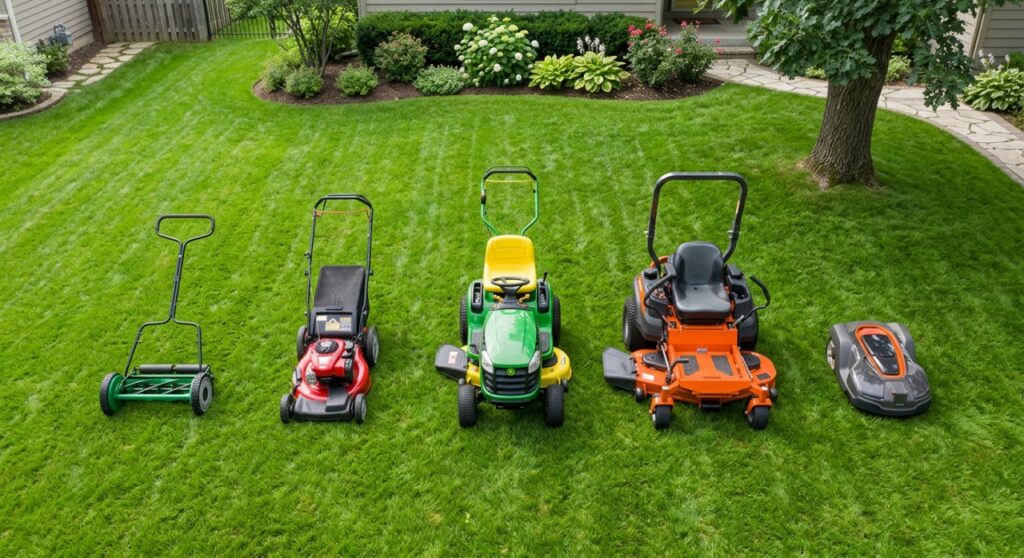
- 5 core types cover most homes: reel, rotary (push/self-propelled), riding/lawn tractor, zero-turn, and robotic.
- Lawn under ¼ acre → push reel or battery rotary; over 1 acre → riding or zero-turn.
- Higher-priced durable unit lasting 5 years costs less per year than cheap unit failing in 18 months.
- Dozens of major brands exist (Honda, Toro, John Deere, Ego, Husqvarna); total models number in the hundreds.
- Battery-electric share grows fast in 2026 because lower fuel + maintenance beats greenwashing claims.
Step 1: Measure Lawn Size and Terrain First
Measure total mowable area in square feet or acres before looking at any mower.
Why it matters: Undersized mower burns out; oversized wastes money and storage space. Use a measuring wheel, Google Earth, or free phone app. Note slopes steeper than 15°, trees, flower beds, and gate widths.
- Under 5,000 sq ft → walk-behind only.
- 5,000–20,000 sq ft → self-propelled or small rider.
- Over 1 acre → riding or zero-turn required for time savings.
Record soil type and grass species (fescue, Bermuda, zoysia). Thick warm-season grass needs higher torque rotary blades.
Step 2: Study Reel Mowers
Examine reel (cylinder) mowers for precision cutting.
Reel mowers use a spinning cylinder of blades that scissor against a fixed bedknife. They deliver the cleanest cut and healthiest grass. Manual push reels cost $100–$300 and weigh under 30 lb. Powered reel units (gas or battery) reach $800–$2,000.
Best for: Golf-course-style lawns, cool-season grasses, flat ground under ¼ acre.
Trade-off: Poor on tall or wet grass; requires frequent sharpening.
Durability note: Quality reel lasts 10+ years with blade grinding every 2 seasons → lowest lifecycle cost for small perfect lawns.
Step 3: Compare Rotary Mowers
Compare rotary walk-behind mowers — the most common type.
A single horizontal blade spins under a deck and creates suction. Sub-types:
- Manual push gas or electric
- Self-propelled (rear- or all-wheel drive)
- Corded electric
- Battery cordless
Price range 2026: $150 cheap plastic deck → $600+ commercial aluminum deck.
Battery models (40V–80V) now match gas power for lots under ½ acre and eliminate oil changes.
True 5-year cost example
Cheap $180 rotary dies after 18 months → replace 3 times = $540 + 3× disposal time.
$450 commercial-grade lasts 5–7 years with one blade + belt = $90/year. Durable wins.
Key features to demand: steel deck, ball-bearing wheels, easy height adjust, mulch/bag/side-discharge capability.
Step 4: Evaluate Riding Mowers and Lawn Tractors
Evaluate riding mowers when walk-behind time exceeds 45 minutes.
Lawn tractors use a front engine and rear-drive wheels; garden tractors accept tillers and carts. Cutting decks 42–54 inches. Engine 14–25 hp gas or growing battery options.
Best for: 1–3 acres, moderate slopes, multi-task yards.
Cost: $1,500 entry → $4,000 feature-rich.
Repairability: Belt and blade changes easy; look for models with accessible grease points and common parts.
Lifecycle math: $2,200 unit lasting 8 years = $275/year. Cheap $1,100 unit lasting 3 years needs two replacements → higher total cash plus downtime.
Step 5: Test Zero-Turn Mowers
Test zero-turn radius mowers for speed and agility.
Dual hydrostatic levers control each rear wheel independently; front casters free-spin. Top speed 7–10 mph and near-zero turning circle cut large open lawns 30–50 % faster than tractors.
Best for: 2+ acres of open ground, commercial operators.
Caveat: Less stable on slopes over 15°; higher sticker ($3,000–$8,000).
Durability signal: Commercial frames and fabricated decks outlast residential stamped decks by double.
Step 6: Review Robotic Mowers
Review robotic mowers for hands-off maintenance.
Boundary wire or GPS RTK keeps the bot inside the yard. It mows daily in random or mapped patterns, mulching clippings finely. Battery models handle 0.25–1.5 acres depending on price.
Price 2026: $800 basic → $3,500 large-yard smart models.
Pros: Quiet, schedules itself, low energy.
Cons: High upfront, needs clear yard free of toys, occasional lift over obstacles.
Greenwashing watch: Some claim “zero emission” yet use short-life batteries that land in landfill after 3 years. Choose replaceable-battery designs for true sustainability and lower 5-year cost.
Step 7: Consider Hover and Specialty Mowers
Consider hover mowers for awkward terrain.
Hover units float on a cushion of air like a hovercraft. Light, easy on slopes and ditches, but limited bagging and rough cut quality. Rare in North America; more common in Europe.
Other niches: tow-behind finish mowers for tractors, flail mowers for rough brush, wide-area mowers for estates. Skip unless you have specific rough terrain.
Step 8: Calculate True 5-Year Ownership Cost
Calculate total cost of ownership before purchase.
Formula:
(Purchase price + fuel/electricity + maintenance + repairs + replacement cost) ÷ years of service.
Concrete numbers:
- Cheap plastic-deck gas rotary $200, lasts 18 months, 3 replacements → $600 + $150 fuel/oil + $90 blades = $840 / 5 yrs ≈ $168/yr.
- Mid-tier steel-deck battery $550, lasts 5–6 years, one battery pack $150 → $700 / 5 yrs ≈ $140/yr plus quieter operation.
- Commercial zero-turn $4,500 lasting 10 years with $400 parts → $490/yr but saves 100 hours labor.
Durability + repairability always beats lowest sticker price. Look for cast-iron spindles, greaseable bearings, and brands with 5-year deck warranties.
Tools and Materials Needed
| Item | Purpose | Approx. Cost |
|---|---|---|
| Measuring wheel or app | Yard size | $0–$40 |
| Notebook or spreadsheet | Cost tracking | Free |
| Blade sharpener / balancer | Maintenance | $20–$60 |
| Multimeter | Battery health check | $15 |
| Owner’s manual PDF | Parts diagrams | Free |
| Torque wrench | Safe blade changes | $25 |
Pro Tips from Long-Term Owners
- Buy the deck size that finishes the job in under one hour; fatigue causes missed spots and accidents.
- Prioritize steel over plastic decks — impact resistance multiplies lifespan.
- Battery platforms that share tools (mower, trimmer, blower) drop total ecosystem cost.
- Schedule annual professional service for gas models; DIY oil + air filter every 25 hours.
- Store indoors or under cover; UV and moisture destroy plastics and belts fastest.
- In August 2026 shop end-of-season clearance for 20–40 % discounts on durable floor models.
Common Mistakes to Avoid
- Buying by horsepower alone — deck quality and transmission matter more.
- Ignoring slope rating — tip-overs cause injury and frame damage.
- Falling for “eco” claims without checking battery replaceability or repair network.
- Skipping mulching plug — bagging every time wastes time and fertilizer value.
- Choosing the cheapest online no-name brand with zero local parts support.
FAQ
What types of lawn mowers are there?
Five main consumer types: reel, rotary walk-behind, riding/lawn tractor, zero-turn, and robotic. Specialty hover and flail units exist for unique terrain.
How many types of lawn mowers are there?
Most guides list 5–7 practical categories. Commercial markets add wide-area and articulating mowers, pushing the total near ten.
How many brands of lawn mowers are there?
Over 50 recognizable brands sell in North America (Honda, Toro, John Deere, Cub Cadet, Ego, Greenworks, Husqvarna, Ariens, etc.). Global count exceeds 100 when including regional makers.
What are the types of lawn mowers best for small yards?
Manual reel or 40–60 V battery rotary. Both store easily, start instantly, and cost less over five years than gas equivalents.
Is a more expensive mower worth it?
Yes when it lasts 5+ years versus 18 months. Run the ownership-cost formula; durable units almost always win on pure dollars plus less frustration.
Conclusion
You now know what are the different types of lawn mowers and how to match each to yard size, terrain, and real 5-year cost. Durable construction plus easy repairability turns a higher sticker price into lower annual expense and less landfill waste. Measure your lawn, run the ownership math, and choose the category that finishes the job reliably for years.
Ready to buy? Visit a local dealer this August, test-drive the top two candidates, and demand the warranty in writing. Your wallet and your weekend will thank you.