
Who Makes Hyper Tough Lawn Mowers? The Direct Answer
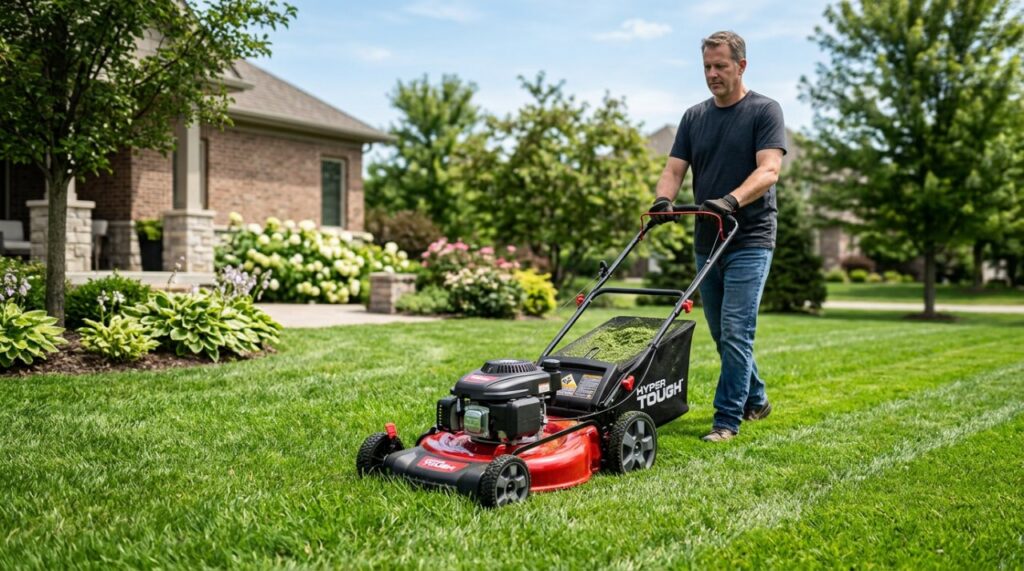
Hyper Tough is a private-label tool and outdoor-equipment brand sold primarily by Walmart, but Walmart does not necessarily manufacture its lawn mowers. Different original equipment manufacturers (OEMs) may build individual models under contract, so the actual maker must be verified through the mower’s rating label, owner’s manual, warranty provider, or regulatory records.
Expert Summary>
– Walmart owns or controls the Hyper Tough retail brand; it is not generally the factory that builds the equipment. – There is no reliable evidence that one manufacturer produces every Hyper Tough lawn mower. – The OEM, importer, warranty administrator, motor supplier, and battery-platform supplier may be different companies. – The most dependable identifiers are the model number, serial label, manufacturer statement, importer name, and warranty contact. – For buyers, parts availability and repair support matter more than the name of the factory alone.
Step 1: Understand Who Makes Hyper Tough Lawn Mowers
Separate the brand owner from the product manufacturer. Hyper Tough is positioned as a value-focused private-label brand associated with Walmart, while production can be outsourced to third-party factories.
This distinction explains why online answers to who makes Hyper Tough lawn mowers often conflict. A person may identify the brand owner, factory, importer, battery supplier, or warranty company and call that entity “the manufacturer.”
Brand owner versus OEM
A brand owner controls branding, retail positioning, packaging, and product specifications. An OEM physically manufactures all or part of the product under a commercial agreement.
The relationship may look like this:
- Walmart or its sourcing partner defines the product category and target price.
- A contracted supplier develops or adapts a mower for the Hyper Tough brand.
- One or more factories manufacture the mower and its components.
- An importer or distributor brings the product into the destination market.
- A separate company may administer warranty claims or replacement parts.
Therefore, the answer is usually not a single permanent company name.
Concise verdict
Who manufactures Hyper Tough lawn mowers? The most accurate general answer is that third-party OEMs manufacture them for Walmart’s Hyper Tough private-label program, and the responsible company can vary by model and production period.
Step 2: Gather the Information Needed to Identify the Manufacturer
Record the exact model and serial information before researching the mower. Looking up the brand name alone is rarely enough because visually similar Hyper Tough mowers may come from different product generations.
Tools and materials needed
| Item | Why you need it |
|---|---|
| Smartphone or camera | Photographs labels before they fade or become damaged |
| Flashlight | Helps locate labels under the deck, battery cover, or rear housing |
| Owner’s manual | May identify the supplier, importer, or warranty administrator |
| Model number | Distinguishes one mower design from another |
| Serial number | Helps identify the production batch or date |
| Battery and charger labels | May reveal a platform supplier or separate model family |
| Internet access | Allows searches of manuals, recalls, trademarks, and parts catalogs |
| Paper towel or soft brush | Removes dry debris without damaging the label |
Do not pressure-wash or use aggressive solvents on an identification label. Once its printing disappears, finding compatible parts becomes much harder.
Information to record
Photograph or write down:
- Full model number
- Full serial number
- Electrical voltage and amperage
- Battery model number
- Charger model number
- Manufacturing date or date code
- Country of origin
- “Manufactured for” statement
- “Distributed by” statement
- Importer or responsible-party name
- Warranty telephone number
- Certification or compliance numbers
A model number is more useful than a product nickname such as “20-inch Hyper Tough mower.” Cutting width alone does not identify the motor, blade, battery, controller, or wheel assembly.
Step 3: Inspect the Mower’s Rating Label
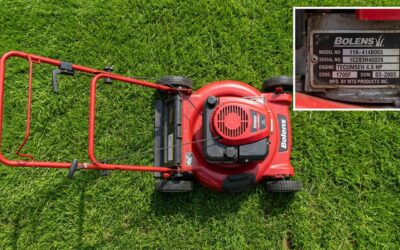
Find the permanent rating label on the physical mower. This is normally the strongest first-party evidence available to an owner.
Depending on the design, the label may be located:
- On the rear motor housing
- Beneath the battery cover
- Near the handle mounting point
- Behind the grass-discharge door
- On the underside or side of the deck
- Near the engine on a gasoline model
- Beside the serial-number barcode
Disconnect the battery, unplug the mower, or remove the spark-plug lead before reaching near the deck. Never turn over a mower while fuel or oil can leak.
Read the wording carefully
The label may use legally meaningful phrases:
| Label wording | What it usually means |
|---|---|
| Manufactured by | Strong indication of the named legal manufacturer |
| Manufactured for | The named company commissioned or markets the product but may not own the factory |
| Distributed by | Identifies the distributor, not necessarily the manufacturer |
| Imported by | Identifies the importer responsible for market entry |
| Made in | Identifies the country of origin, not the company |
| Service provided by | Identifies a service administrator rather than the OEM |
“Made in China” is not an answer to who manufactures Hyper Tough lawn mowers. A country-of-origin statement identifies a location, while many independent manufacturers can operate in that country.
Look beyond the main label
Battery-powered mowers often have separate labels on the:
- Mower body
- Battery pack
- Battery charger
- Brushless motor
- Electronic controller
These names may not match because suppliers frequently source electrical components from specialized manufacturers. A battery label can help trace compatibility, but it does not automatically prove that the battery company built the complete mower.
Step 4: Check the Owner’s Manual and Warranty Documents
Use the manual to identify the company legally responsible for support. Even when it does not disclose the factory, it can reveal the distributor, importer, warranty provider, or replacement-parts channel.
Search the PDF or printed manual for:
- “Manufactured”
- “Distributed”
- “Imported”
- “Warranty”
- “Service”
- “Replacement parts”
- “Responsible party”
- “Customer support”
The final pages often contain more useful corporate information than the product-description pages.
Match the manual to the exact model
Do not assume every Hyper Tough manual applies to every mower. Confirm that the model number on the cover or technical page exactly matches the rating label.
Retail listings may remain online after a product changes suppliers. An old manual attached to a similar listing could point to the wrong company or provide incorrect parts information.
Treat the warranty company as a clue, not final proof
A warranty administrator may handle multiple brands without manufacturing any of them. Similarly, a parts distributor may stock components sourced from several unrelated factories.
The manual can answer who supports the mower, which is often more useful to an owner than knowing who assembled it. However, support responsibility and physical manufacturing are not always the same.
Step 5: Search the Model Number, Not Just the Brand
Search the complete model number in quotation marks. This reduces irrelevant results and can uncover archived manuals, regulatory filings, recall notices, and parts diagrams.
Useful searches include:
"[model number]" mower manual"[model number]" manufacturer"[model number]" parts"[model number]" warranty"[model number]" recall"[model number]" battery"[model number]" importersite:walmart.com "[model number]"site:cpsc.gov "[model number]"
If the label includes spaces, hyphens, or a revision suffix, search several exact variations.
Compare technical fingerprints
OEM relationships sometimes become visible through shared design details. Compare:
- Deck shape and molded ribs
- Handle-adjustment mechanism
- Wheel hubs
- Battery rail and terminal layout
- Blade dimensions and center-hole pattern
- Grass-bag frame
- Safety key
- Charger output specifications
- Control-panel design
These similarities can suggest a common platform, but they are not conclusive proof. Multiple factories can use similar components, and one supplier may license a design to several brands.
Avoid identification by appearance alone
Two mowers can look nearly identical yet use different:
- Blade adapters
- Electronic controllers
- Motors
- Batteries
- Chargers
- Fasteners
- Firmware
- Safety switches
Visual comparison is useful for generating leads. It should not replace a model-number match or documented manufacturer statement.
Step 6: Verify the Manufacturer Through Regulatory Records
Use official records when the label and manual do not provide a clear answer. Product-safety notices and compliance databases may identify the importer, manufacturer, or responsible company associated with a specific model.
In the United States, useful sources can include:
- U.S. Consumer Product Safety Commission
- Federal Communications Commission, if a product contains regulated wireless electronics
- UL Solutions certification directories
- Intertek/ETL certification records
- State corporate registries
- Trademark databases
- Customs or import databases, where legally accessible
Not every mower appears in every database. Absence from a public search does not prove that the product lacks certification or that a suspected company did not manufacture it.
Use recall notices carefully
A recall notice may name several parties:
- Manufacturer
- Importer
- Distributor
- Retailer
- Recall administrator
Read the notice’s role descriptions rather than copying the first company name. The retailer listed in a recall is not automatically the factory.
Match all available identifiers
A credible identification should match several data points:
- Brand
- Exact model number
- Product description
- Voltage or engine type
- Production period
- Importer or distributor
- Country of origin
A company linked to one discontinued model should not be described as the universal maker of all Hyper Tough lawn mowers.
Step 7: Contact Hyper Tough or Walmart Product Support
Ask support a model-specific question instead of asking who makes the entire brand. A precise request is more likely to produce useful parts and warranty information.
Use wording such as:
“I own a Hyper Tough lawn mower, model [model number], serial [serial number]. Please identify the manufacturer or authorized supplier and provide the correct parts, warranty, and service contact.”
Attach clear photographs of:
- Mower rating label
- Serial number
- Battery label
- Charger label
- Damaged component, if applicable
- Proof of purchase
Ask the questions that affect ownership costs
The factory name alone may not help you maintain the mower. Also ask:
- Is the blade still available?
- Can the battery be purchased separately?
- Is the charger sold separately?
- Are wheels, switches, and handles replaceable?
- Is there an exploded-parts diagram?
- Is an authorized repair network available?
- How long is the warranty?
- Does the warranty cover the battery separately?
- Who pays return shipping?
- Is the mower replaced or repaired under warranty?
A manufacturer identity has practical value only when it helps you obtain support, compatible parts, or safety information.
Step 8: Distinguish Confirmed Facts From Online Claims
Classify each claim according to the quality of its evidence. Forums and retailer reviews can provide helpful clues, but they should not be treated as corporate documentation.
Evidence hierarchy
| Evidence source | Reliability | Best use |
|---|---|---|
| Product rating label | Very high | Identifying the listed manufacturer, importer, or distributor |
| Model-matched manual | High | Warranty, support, specifications, and legal statements |
| Official recall or certification record | High | Confirming responsible parties for a specific model |
| Written support response | Medium to high | Current parts and warranty guidance |
| Retail product page | Medium | Model features and seller information |
| Parts catalog | Medium | Identifying shared components or platform relationships |
| Repair forum | Low to medium | Finding leads and common failure patterns |
| Uncited blog or AI answer | Low | Starting point only |
A strong conclusion should be supported by at least two independent, model-specific sources.
Watch for outdated supplier information
Private-label sourcing can change when:
- A contract expires
- A model is redesigned
- A battery platform is replaced
- A retailer changes price targets
- Safety standards change
- A supplier leaves the market
- Production moves to another factory
An answer that was correct for an older corded mower may not apply to a newer cordless model.
Step 9: Evaluate Whether a Hyper Tough Mower Is Financially Smart
Compare five-year ownership cost rather than the shelf price alone. A low-priced mower is not a bargain if it must be replaced repeatedly or uses an expensive battery that becomes unavailable.
Use this formula:
Five-year cost = purchase price + batteries + repairs + maintenance + operating cost + replacement cost − resale value
The numbers below are illustrative, not quoted prices for a specific current model.
Example: cheap replacement cycle versus durable mower
| Five-year cost item | Budget mower lasting 18 months | Durable mower lasting 5 years |
|---|---|---|
| Initial purchase | $160 | $340 |
| Replacement purchases | $480 for three additional units | $0 |
| Blade and routine maintenance | $60 | $80 |
| Minor repairs | $0 because units are discarded | $70 |
| Estimated five-year total | $700 | $490 |
| Effective annual cost | $140/year | $98/year |
In this example, the $340 mower is $210 cheaper over five years, even though its purchase price is more than twice as high. Durability saves money when the product remains repairable and replacement parts stay available.
Break-even calculation
Suppose a $180 mower lasts 18 months and a $360 mower lasts five years.
Over five years, the buyer may need four budget mowers:
4 × $180 = $720
The durable mower’s initial cost is:
1 × $360 = $360
Before repairs and maintenance, the durable option saves $360. However, this comparison changes if the expensive mower needs a $250 proprietary battery after two years.
Cordless battery economics
For a cordless mower, calculate battery cost separately.
| Battery factor | Financial question |
|---|---|
| Replacement price | Does a new battery cost 30%, 50%, or 80% of the mower’s price? |
| Platform compatibility | Can the battery power a trimmer, blower, or chainsaw? |
| Availability | Is the same battery likely to remain on sale? |
| Warranty | Is battery coverage shorter than mower coverage? |
| Runtime | Will one battery complete the lawn, or are two required? |
| Repairability | Can a failed switch or controller be replaced without replacing the mower? |
A $200 mower requiring a second $90 battery is effectively a $290 purchase if one battery cannot finish the yard. Compare complete working systems, not bare advertised prices.
Step 10: Evaluate Durability and Repairability Before Buying
Inspect serviceability before treating a low price as a good value. The most financially sensible mower is usually the least expensive model that can reliably handle the lawn and remain supportable for the intended ownership period.
Check these durability indicators
- Metal or impact-resistant deck construction appropriate for the mower’s weight
- Secure handle hinges with replaceable fasteners
- Readily available blade
- Standardized nuts, bolts, and wheel hardware
- Protected battery compartment
- Accessible safety switch
- Clear parts diagram
- Separate battery and charger availability
- Warranty terms that state who provides service
- Local or mail-in repair process
- Consistent owner reports after multiple mowing seasons
A heavier mower is not automatically more durable. Good engineering, corrosion protection, motor cooling, and parts support matter more than weight alone.
Check repairability
A repairable mower should allow common wear items to be replaced, including:
- Blade
- Blade adapter
- Wheels
- Handle hardware
- Grass bag
- Safety key
- Battery
- Charger
- Drive belt on self-propelled models
- Switches or cables where offered
If no model-specific parts diagram exists, assume repairs beyond the blade and battery may be difficult.
Consider lawn size and workload
A budget mower can be financially rational for:
- Small, flat lawns
- Infrequent mowing
- Light seasonal use
- Buyers already using the same battery platform
- Owners who can store the mower indoors
A more durable model may cost less over time for:
- Large lawns
- Thick or wet grass
- Frequent mowing
- Sloped terrain
- Commercial or rental-property use
- Areas where repair downtime is expensive
Durability must be judged against workload. A light-duty mower is not defective simply because it wears quickly under commercial use, but it may still be the wrong financial choice.
Step 11: Identify Greenwashing and Misleading Value Claims
Demand measurable claims instead of accepting vague environmental language. Terms such as “eco-friendly,” “green,” or “clean” do not reveal product lifespan, battery replacement cost, repairability, or electricity source.
Replace vague claims with numbers
| Marketing claim | Better question |
|---|---|
| “Eco-friendly mower” | What is its expected service life under normal residential use? |
| “Zero emissions” | Does this mean zero exhaust emissions during operation? |
| “Long-lasting battery” | How many charge cycles are specified, and under what conditions? |
| “Maintenance-free” | Which parts still require cleaning, sharpening, or replacement? |
| “Sustainable design” | Are replacement batteries, blades, wheels, and switches available? |
| “Recyclable battery” | Where can the owner actually return it locally? |
A cordless mower can eliminate tailpipe emissions during use, but it still has manufacturing, electricity, shipping, and end-of-life impacts. Financially, the more immediate concern is whether the battery remains usable and replaceable.
Example of hidden lifecycle cost
Consider two mowers:
- Mower A: $220, replacement battery $150, expected battery replacement in year three
- Mower B: $330, replacement battery $110, battery shared with three existing tools
The five-year acquisition and battery cost is:
- Mower A: $220 + $150 = $370
- Mower B: $330 + $110 = $440
Mower A still appears cheaper by $70. But if Mower B’s shared battery avoids buying a separate $100 blower battery, its effective system cost falls to $340, making it the better platform investment.
This is why environmental slogans are less useful than a complete lifecycle calculation.
Step 12: Make a Model-Specific Buying Decision
Choose based on documented support, workload, and five-year cost—not brand assumptions. Knowing who makes a mower is useful, but the model’s parts ecosystem is more important than the prestige of the OEM.
Use this buying checklist
Score one point for each “yes”:
- Is the exact model number clearly documented?
- Is the warranty provider identified?
- Is the blade available separately?
- Is the battery available separately?
- Is the charger available separately?
- Are replacement wheels or hardware listed?
- Can support identify a repair process?
- Can one charge cover your normal lawn?
- Is the battery compatible with other tools you use?
- Is the five-year cost competitive?
Interpret the score
| Score | Buying interpretation |
|---|---|
| 8–10 | Strong support profile for a value-priced mower |
| 5–7 | Acceptable if the price and workload are modest |
| 3–4 | High lifecycle-cost risk |
| 0–2 | Treat as potentially disposable unless exceptionally inexpensive |
This is not a laboratory durability rating. It is a practical way to measure the financial risk created by missing parts, batteries, and service information.
Who Makes Hyper Tough Lawn Mowers by Model?
**The manufacturer must be identified model by model because Hyper Tough is a private-label brand rather than proof of one