
Why Do Lawn Mowers Have Large Rear Wheels?
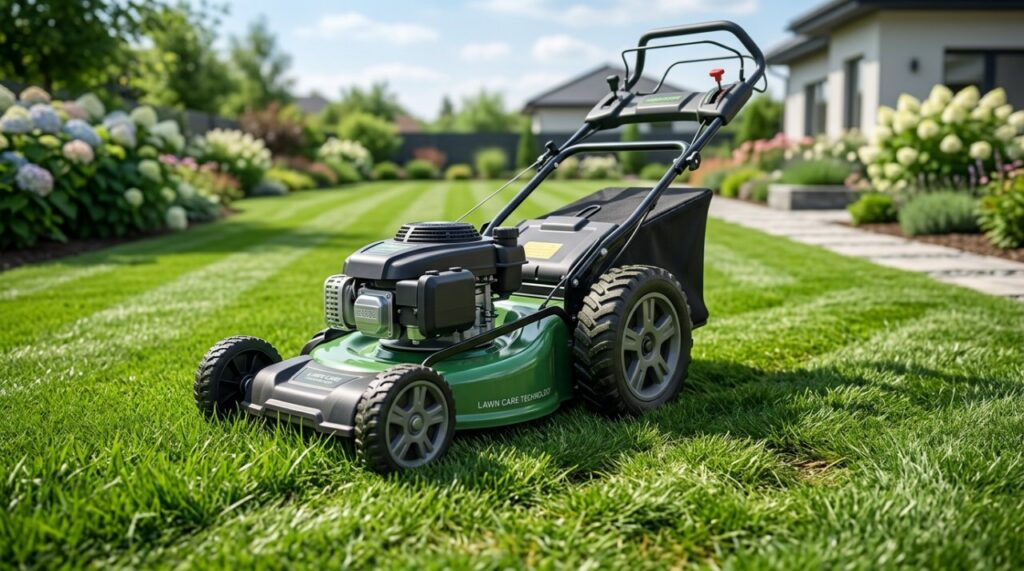
Lawn mowers have large rear wheels because a larger wheel rolls over bumps, roots, ruts, and thick grass more easily than a smaller wheel. High rear wheels can improve maneuverability and reduce deck bouncing on uneven ground, but they do not automatically increase cutting power, traction, durability, or mowing speed.
Expert Summary>
– Large rear wheels improve obstacle clearance because their wider rolling radius approaches bumps at a shallower angle. – A high-wheel lawn mower is most useful on rough, sloped, root-filled, or irregular terrain. – Large wheels do not guarantee better traction; tire tread, mower weight, drive system, and weight distribution matter more. – On smooth, level lawns, standard wheels are often easier to turn and may deliver equally consistent cutting results. – Wheel diameter should be evaluated alongside bearing design, axle strength, replacement-part availability, and long-term ownership cost.
Step 1: Understand Why Do Lawn Mowers Have Large Rear Wheels
Recognize the mechanical advantage first. Large rear wheels help a walk-behind mower roll over surface irregularities with less resistance and less vertical movement at the cutting deck.
When a small wheel meets a bump, it contacts the obstruction at a relatively steep angle. The operator must apply more forward force to push the wheel upward and over it.
A larger wheel reaches the same bump at a shallower angle. This creates a smoother transition and reduces the sensation that the mower is catching, stopping, or diving into the lawn.
What large rear wheels actually change
Large rear wheels primarily affect four aspects of mower operation:
- Obstacle rollover
- Deck stability
- Maneuverability on rough terrain
- Operator effort
They do not directly increase engine torque, blade speed, or cutting width.
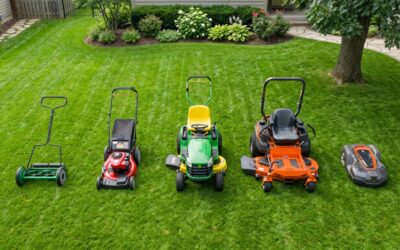
Typical wheel configurations
Exact dimensions vary by manufacturer, but walk-behind mowers commonly use one of these layouts:
| Wheel configuration | Typical design | Best suited to | Main trade-off |
|---|---|---|---|
| Equal-size wheels | Similar front and rear diameters | Flat, maintained lawns | Less effective over deep ruts and exposed roots |
| Moderately larger rear wheels | Rear wheels slightly taller than front wheels | Mixed residential terrain | Modest improvement rather than a dramatic change |
| High rear wheels | Rear wheels noticeably larger than front wheels | Rough, sloped, or irregular lawns | Can feel less agile during tight turns |
| Large wheels at all four corners | Taller wheels front and rear | Utility mowing and rough ground | Higher deck position and added component cost |
Citation-ready answer: Large rear wheels do not make a lawn mower more powerful; they make it easier for the mower to travel across uneven ground.
Step 2: Identify Why Big Wheels on Lawn Mowers Handle Bumps Better
Compare the wheel radius with the obstacle height. The closer a bump is to the radius of a wheel, the more difficult that obstacle is for the wheel to cross.
A small twig may be insignificant to both wheel sizes. A raised tree root, shallow hole, or lawn edge can produce a much larger difference.
How wheel radius affects rollover
Imagine pushing two carts toward the same raised edge. One has small caster wheels, while the other has large utility wheels.
The small wheel tends to strike the edge and stop. The large wheel begins climbing sooner because its contact point is farther forward and lower relative to its axle.
The same principle explains why big wheels on lawn mowers can help with:
- Exposed tree roots
- Molehills
- Shallow ruts
- Thick clumps of grass
- Uneven soil
- Lawn-to-path transitions
- Small fallen branches
- Rough drainage areas
Why the mower deck may bounce less
A wheel moving sharply upward can tilt or lift part of the mower deck. That movement changes the blade’s height relative to the grass.
Larger rear wheels can reduce abrupt rear-deck movement. This may help limit isolated scalping or patches of grass left too tall, especially when the operator maintains a steady pace.
However, wheel size cannot correct a badly uneven lawn by itself. Deep depressions, steep ridges, and soft ground can still cause an inconsistent cut.
Pro Tip: Walk the lawn before mowing and remove branches, stones, wire, and other debris. Large wheels improve rollover, but they should never be treated as protection against objects that the blade could strike.
Step 3: Determine Why Do Some Lawn Mowers Have Big Rear Wheels
Match the wheel design to the mower’s intended terrain. Manufacturers usually install big rear wheels on models marketed for uneven residential lawns, slopes, obstacles, or less frequent mowing.
Standard-wheel mowers are often designed for smoother, routinely maintained yards. They can be lighter, simpler, and easier to pivot in confined spaces.
High-wheel designs target difficult ground
A high-wheel mower may be a practical fit when a lawn contains:
- Mature trees with surface roots
- Uneven grading
- Sloped sections
- Repeated wheel ruts
- Rough borders
- Mixed grass density
- Hard transitions between lawn zones
- Areas that are not rolled or leveled regularly
The feature is less valuable on a flat, compact lawn with few obstacles. In that setting, the extra wheel diameter may add cost without producing a noticeable improvement.
Marketing also influences wheel size
Some mowers have oversized rear wheels because the design is visually associated with rough-terrain capability. A large wheel is easy for shoppers to notice, but diameter alone does not prove that the mower is durable or easy to push.
Inspect the complete wheel assembly rather than relying on appearance.
Key components include:
- Wheel hub material
- Axle diameter
- Bearing or bushing type
- Tread depth
- Height-adjustment mechanism
- Drive gears on self-propelled models
- Availability of replacement wheels
A tall wheel attached to a flexible plastic adjuster may be less durable than a smaller wheel supported by a strong axle and replaceable bearing.
Step 4: Decide Whether High Rear Wheels Improve Traction
Separate rollover ability from traction. Large rear wheels may maintain contact over rough terrain, but wheel diameter alone does not create grip.
Traction depends on the force pressing the tire against the ground and the friction generated at the contact surface.
Factors that matter more than wheel diameter
The following features often influence traction more than wheel height:
| Traction factor | Why it matters | What to inspect |
|---|---|---|
| Tire tread | Bites into grass and loose soil | Deep, defined tread rather than smooth plastic |
| Mower weight | Increases downward force | Balanced weight without making the mower exhausting to push |
| Drive system | Transfers torque to powered wheels | Front-wheel, rear-wheel, or all-wheel drive |
| Weight distribution | Keeps driven wheels in contact | Rear weighting is helpful for rear-wheel-drive models |
| Tire material | Affects grip on wet or sloped grass | Rubberized tread may grip better than hard plastic |
| Ground condition | Changes available friction | Wet grass, mud, leaves, and loose soil reduce grip |
Large rear wheels can help a manual push mower continue moving over bumps. That is not the same as increasing traction on a wet slope.
Rear-wheel drive and large rear wheels
On a rear-wheel-drive mower, larger rear wheels can complement the drive layout. The operator’s handle pressure and the mower’s rearward weight may help keep the powered wheels planted.
This combination is often useful on slopes and rough terrain. It can also make tight turns more demanding because the drive wheels may resist pivoting.
Front-wheel drive and high rear wheels
A front-wheel-drive mower is usually easy to turn because the operator can lift the front wheels slightly while pivoting. Large rear wheels provide a stable pivot point and may roll smoothly over uneven ground.
The disadvantage is that the driven front wheels can lose traction when the handle is pushed down or when the front of the mower rises over a bump.
Concise verdict: Choose the drive system for traction and choose wheel diameter for terrain clearance; do not assume large rear wheels solve both needs.
Step 5: Evaluate Why Do Some Lawn Mowers Have High Rear Wheels on Slopes
**Assess the slope, surface condition, and drive layout