
What Is Torque in Lawn Mowers? A Complete Beginner’s Guide
Torque in a lawn mower is the rotational force that spins the blade. The higher the torque, the better the mower handles thick, wet, or overgrown grass without slowing down or stalling. Understanding torque helps you choose the right mower for your yard and avoid frustrating mid-mow shutdowns.
Expert Summary
- Torque is the twisting force an engine produces to spin the mower blade — measured in foot-pounds (ft-lbs) or Newton-meters (Nm).
- A mower with higher torque cuts through dense, wet, or tall grass more effectively than a high-horsepower mower with low torque.
- Residential walk-behind mowers typically produce 4–7 ft-lbs of torque; riding mowers range from 10–26 ft-lbs depending on engine size.
- Torque and horsepower are related but different: horsepower measures how fast work is done, while torque measures the raw cutting muscle.
- Choosing the correct torque level for your lawn size and grass type directly affects cut quality, engine longevity, and fuel efficiency.
Step 1: Understand What Torque Actually Means
Torque is rotational force — think of it like the grip strength of the mower’s engine.
Imagine you’re trying to unscrew a stuck bolt. You apply force to a wrench in a twisting, circular motion. That twisting force is torque. In a lawn mower, the engine applies that same kind of twisting force to spin the blade at high speed.
The blade doesn’t just need to spin — it needs to keep spinning even when it slams into thick clumps of grass. That resistance to slowdown comes from torque.
Why Torque Matters More Than You Might Think
Most people focus on engine horsepower (HP) when buying a mower, but torque is often the more practical number.
Think of it this way: horsepower tells you how fast you can do a job, but torque tells you how hard the engine can push through resistance. For cutting grass — especially thick, wet, or uneven grass — you want pushing power, not just speed.
A mower with low torque will bog down, stall, or produce an uneven cut when it hits tough spots. A mower with adequate torque moves through cleanly.
Step 2: Learn How Torque Is Measured
Torque in lawn mowers is measured in foot-pounds (ft-lbs) in the US, or Newton-meters (Nm) internationally.
These units describe how much force is applied at a set distance from the center of rotation.
- 1 foot-pound (ft-lb) = the force of1 pound applied at the end of a 1-foot wrench
- 1 Newton-meter (Nm) = roughly 0.74 ft-lbs (they measure the same thing in different unit systems)
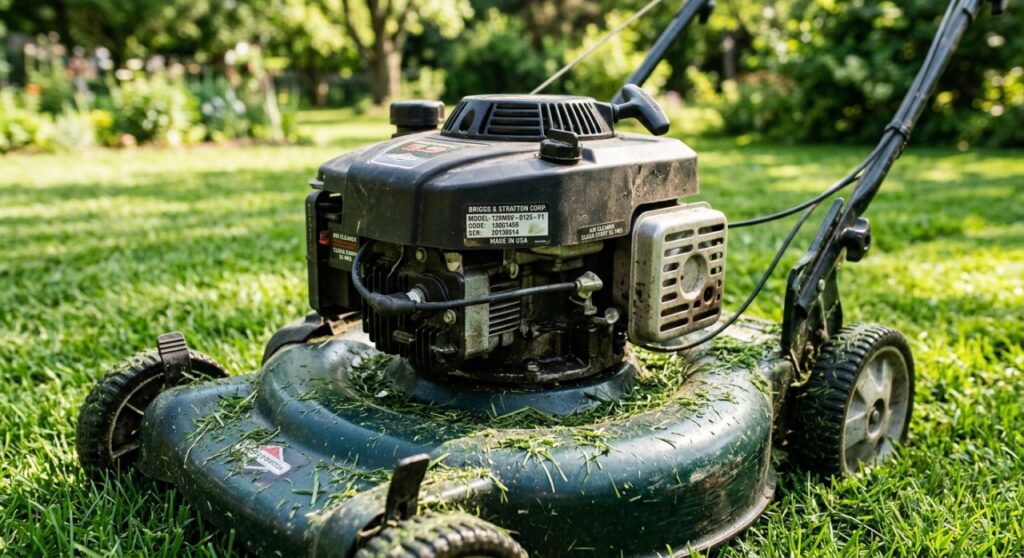
You will usually find the torque rating printed on the engine label of the mower or listed in the product specifications page.
Tools/Materials Needed to Check Your Mower’s Torque Specs
| What You Need | Where to Find It | Why You Need It |
|---|---|---|
| Mower owner’s manual | Inside the mower box or manufacturer’s website | Lists exact engine torque and HP specs |
| Engine model number | Stamped on the engine block (usually near the air filter) | Lets you look up specs online |
| Manufacturer’s website | Briggs & Stratton, Kawasaki, Honda, Kohler portals | Provides downloadable spec sheets |
| Retailer product page | Home Depot, Lowe’s, Amazon listings | Shows quick-comparison torque figures |
Step 3: Understand the Difference Between Torque and Horsepower
Torque and horsepower are two different ways to describe engine performance — and confusing them is one of the most common buyer mistakes.
Here is the simplest way to separate them:
- Torque = raw twisting force (the muscle)
- Horsepower = how quickly that force is delivered over time (the speed of the work)
Mathematically, horsepower is actually calculated from torque: HP = (Torque × RPM) ÷ 5,252 (where RPM is engine revolutions per minute).
This means a mower can have high horsepower at high RPM but still feel “weak” in thick grass because it lacks low-end torque — the force available at slower, loaded speeds when the blade meets resistance.
Torque vs. Horsepower: Side-by-Side Comparison
| Feature | Torque | Horsepower |
|---|---|---|
| What it measures | Rotational force | Rate of work done over time |
| Unit of measurement | ft-lbs or Nm | HP or kW |
| Most useful for | Cutting through resistance | Measuring overall engine output |
| When it matters most | Thick, wet, or tall grass | Mowing speed and large area coverage |
| Where to find it | Engine spec sheet | Engine spec sheet / product listing |
| Typical residential range | 4–7 ft-lbs (walk-behind) | 140–190cc engine displacement |
Pro Tip: When comparing mowers, prioritize torque if your lawn has thick grass, slopes, or wet conditions. Prioritize horsepower (and cutting width) if your main concern is covering a large, relatively flat lawn quickly.
Step 4: Know What Torque Levels Are Right for Your Lawn
The right torque depends on your lawn size, grass type, terrain, and mowing frequency.
Not every yard needs the same cutting muscle. Buying more torque than you need wastes money. Buying too little means constant stalling and engine strain.
Matching Torque to Lawn Type
| Lawn Type | Recommended Torque | Best Mower Type |
|---|---|---|
| Small, flat, well-maintained lawn (under 1/4 acre) | 4–5 ft-lbs | Electric or basic gas walk-behind |
| Medium lawn with occasional thick patches | 5–7 ft-lbs | Mid-range gas walk-behind |
| Large lawn or frequently missedowing cycles | 7–10 ft-lbs | Self-propelled gas walk-behind |
| Riding mower territory (1/2 acre or more) | 10–18 ft-lbs | Riding mower / lawn tractor |
| Commercial or very large properties | 18–26+ ft-lbs | Zero-turn or commercial riding mower |
Grass Types That Demand Higher Torque
Some grasses are simply harder to cut. If your lawn contains any of the following, lean toward a higher torque rating:
- St. Augustine grass — thick, broad blades that resist cutting
- Zoysia grass — dense and tough, especially when dry
- Bahiagrass — fibrous seed heads that challenge low-torque blades
- Overgrown or wet cool-season grasses (Kentucky bluegrass, tall fescue)
Step 5: Read the Engine Label and Spec Sheet Correctly
The torque number you need is the “gross torque” figure listed on the engine, not the net or running torque.
Mower engines from brands like Briggs & Stratton, Kawasaki, Honda, and Kohler all list specifications slightly differently. Here is how to read them correctly.
How to Find Torque on a Briggs & Stratton Engine
- Locate the engine model number — it is stamped on a silver or black label on the engine body, usually near the air filter housing.
- Visit BrigsAndStratton.com and enter the model number in the “Find My Engine” tool.
- Look for “Gross Torque” in the specification table — this is the peak force the engine can produce.
- Note the RPM at which peak torque is achieved — lower RPM torque is generally more useful for cutting through resistance.
How to Find Torque on a Honda Engine
- Find the engine model on the valve cover (the flat top of the engine). It starts with “GCV” or “GXV.”
- Visit PowerEquipment.Honda.com and navigate to the engine spec section.
- Look for “Maximum Torque” listed in Nm — convert to ft-lbs by multiplying by 0.737.
Pro Tip: “Gross torque” is measured without accessories attached. Real-world torque delivered to the blade will be slightly lower due to friction and the blade adapter. Still use gross torque for comparing mowers — just know every mower is measured the same way.
Step 6: Understand How Torque Affects Cutting Performance
Higher torque directly translates to a cleaner, more consistent cut — especially in challenging conditions.
This is the most practical outcome of understanding torque. Here is what changes in real mowing situations based on torque:
What Happens With Too Little Torque
- The blade slows down when it hits thick grass, leaving uneven, ragged cuts
- The engine bogs down or stalls completely in wet or tall grass
- You end up double-cutting sections of the lawn, wasting time and fuel
- Repeated stalling puts excessive heat and strain on the engine, shortening its life
What Happens With Adequate or High Torque
- The blade maintains speed through thick, wet, and uneven grass
- You get a clean, single-pass cut across the entire lawn
- The engine runs cooler and with less strain, extending its service life
- Self-propelled drive systems work more effectively because the engine isn’t already struggling
Step 7: Compare Electric vs. Gas Mower Torque
Electric mowers deliver torque differently than gas mowers — and in some cases, they deliver it better.
This is one of the most misunderstood areas of mower shopping. Let’s clear it up.
Gas Engine Torque
Gas engines produce torque in a curve — they build torque as RPM increases up to a peak, then it drops off. The torque rating on the label is only achievable at a specific RPM range.
Peak torque for a typical residential gas mower engine: 5–7 ft-lbs at 2,400–2,800 RPM
Electric Motor Torque
Electric motors — including battery-powered mowers — produce maximum torque instantly from zero RPM. This is called “flat torque curve” behavior, similar to electric cars.
In practical terms: when an electric mower’s blade hits thick grass, the motor immediately delivers full force rather than neding to rev up.
| Specification | Gas Mower | Battery Electric Mower |
|---|---|---|
| Torque delivery | Builds with RPM | Instant, full torque from start |
| Peak torque range | 5–7 ft-lbs (residential) | Equivalent to 6–8 ft-lbs (varies by voltage) |
| Torque consistency | Drops when bogged down | Maintains better under load |
| Runtime limit | Unlimited (refuel) | Battery capacity (40–90 min typical) |
| Maintenance impact | Oil, air filter, spark plug | Minimal mechanical maintenance |
| Best for | Large lawns, heavy use | Small-medium lawns, low maintenance preference |
Pro Tip: A40V or 60V battery mower from brands like EGO, Greenworks, or Milwaukee** can match or outperform many gas mowers in real-world torque feel, especially for lawns under half an acre.
Step 8: Avoid Common Torque-Related Buying Mistakes
Most mower buyers either ignore torque entirely or misread the specs — here is how to avoid both.
Common Mistakes to Avoid
Mistake 1: Choosing HP instead of torque as your main comparison number
Horsepower can be inflated by running the engine at very high RPMs. Torque is a more honest measure of usable cutting power. Always check both, but weight torque more heavily.
Mistake 2: Assuming more torque is always better
Oversized torque ratings on a small flat lawn just add weight, cost, and fuel consumption. Match the torque to the actual demands of your yard.
Mistake 3: Ignoring blade condition
A high-torque engine paired with a dull or bent blade will still cut poorly. The blade transfers the torque into cutting action — damaged blade wastes all of it. Sharpen or replace blades every season.
Mistake 4: Confusing engine displacement (cc) with torque
Engine displacement (measured in cubic centimeters, or cc) describes engine size, not force output. A 190cc engine does not automatically produce more torque than a 163cc engine — it depends on the engine’s design and tuning.
Mistake 5: Not accounting for terrain slope
On slopes, the engine works against gravity in addition to grass resistance. Add approximately 15–20% to your torque requirement if your lawn includes grades steper than 15 degrees.
Step 9: Use Torque Knowledge to Maintain Your Mower Better
Understanding torque also helps you get more life out of the mower you already own.
Once you understand what torque does, mower maintenance makes much more sense. Every maintenance task either preserves or restores torque output.
Maintenance Tasks That Directly Protect Torque Output
| Maintenance Task | How Often | Why It Protects Torque |
|---|---|---|
| Sharpen the mower blade | Every 20–25 hours of use | A sharp blade cuts cleanly; dull blades force the engine to work harder, draining torque |
| Change engine oil | Every 50hours or once per season | Clean oil reduces internal friction, keeping full torque available at the blade |
| Clean/replace air filter | Every 25hours or once per season | Restricted airflow causes the engine to run rich and lose power output |
| Replace spark plug | Once per season | A worn plug causes incomplete combustion, directly reducing torque output |
| Clean the underside of the deck | After every 5–10 mows | Grass buildup creates drag that the blade must fight through, robing effective torque |
Frequently Asked Questions About Torque in Lawn Mowers
What is a good torque for a lawn mower?
For most residential walk-behind mowers, 5–7 ft-lbs of gross torque is adequate for lawns up to half an acre with normal grass conditions. If your lawn has thick, wet, or frequently overgrown grass, look for 7ft-lbs or higher. Riding mowers should offer 12–18 ft-lbs for typical residential use.
Is higher torque always better in a lawn mower?
No. Higher torque adds cost, weight, and fuel consumption. Match torque to your specific lawn conditions — overpowered mowers waste resources on simple flat lawns. Higher torque becomes genuinely valuable only when the lawn has density, moisture, slope, or irregular mowing schedules that create resistance.
Does torque matter for electric lawn mowers?
Yes, and arguably more so. Electric motors deliver instant maximum torque from the moment they encounter resistance, which gives them a real-world cutting advantage over gas engines that need to rev up. When comparing electric mowers, look for voltage ratings (40V, 56V, 60V, 80V) as a proxy — higher voltage generally correlates with higher torque capacity.
Can I increase the torque of my existing lawn mower?
Not meaningfully without replacing the engine. Minor gains are possible by keeping the blade sharp, air filter clean, and the oil fresh — all of which prevent torque loss. But the fundamental torque ceiling is set by the engine design. If your mower consistently stalls in thick grass, the right fix is matching the mower to the lawn, not modifying the engine.
What is the difference between torque and blade tip speed?
Torque is the rotational force applied to the blade. Blade tip speed is how fast the outer edge of the blade travels — typically 18,000–19,000 feet per minute on residential mowers. A high-torque engine maintains that blade tip speed even under resistance. A low-torque engine lets the speed drop when the blade meets thick grass, causing uneven or incomplete cuts.
Conclusion: Torque Is the Real Measure of Mowing Muscle
Torque in a lawn mower is not a technical detail reserved for engineers — it is the single most practical number for predicting how well a mower will handle your actual yard conditions.
To summarize what you now know:
- Torque = twisting force that keeps the blade spinning through resistance
- It is measured in ft-lbs or Nm and found on the engine spec sheet
- More torque matters most for thick, wet, overgrown, or sloped lawns
- Electric mowers deliver torque more consistently than gas engines under load
- Maintenance directly protects your mower’s ability to deliver its rated torque
Before your next mower purchase, check the torque spec alongside the horsepower — or voltage if you are shopping electric. Your lawn will tell you the difference on the first mow.
###✅5-Question Checklist: Is This the Right Torque Level for You?
Answer honestly. If you say Yes to at least 3, you need a higher-torque mower (7+ ft-lbs for walk-behind, 14+ ft-lbs for riding):
- Does your grass grow thick and require effort to push through even with a good mower?
- Do you sometimes skip mowing weeks, letting grass grow taller than usual before cutting?
- Is any part of your lawn on a slope or uneven terrain?
- Do you mow in the morning or after rain, when grass is still wet?
- Have you experienced stalling, bogging down, or uneven cuts with a previous mower?
If you answered Yes to 3 or more — prioritize torque over price when choosing your next mower. It will save you frustration from the very first use.