
What Lawn Mowers Do Landscapers Use: The Complete Guide
Professional landscapers rely on commercial-grade mowers built for speed, durability, and daily use — not the residential models sold at big-box stores. Understanding which machines pros choose helps homeowners and aspiring landscapers make smarter, cost-effective equipment decisions.
Expert Summary
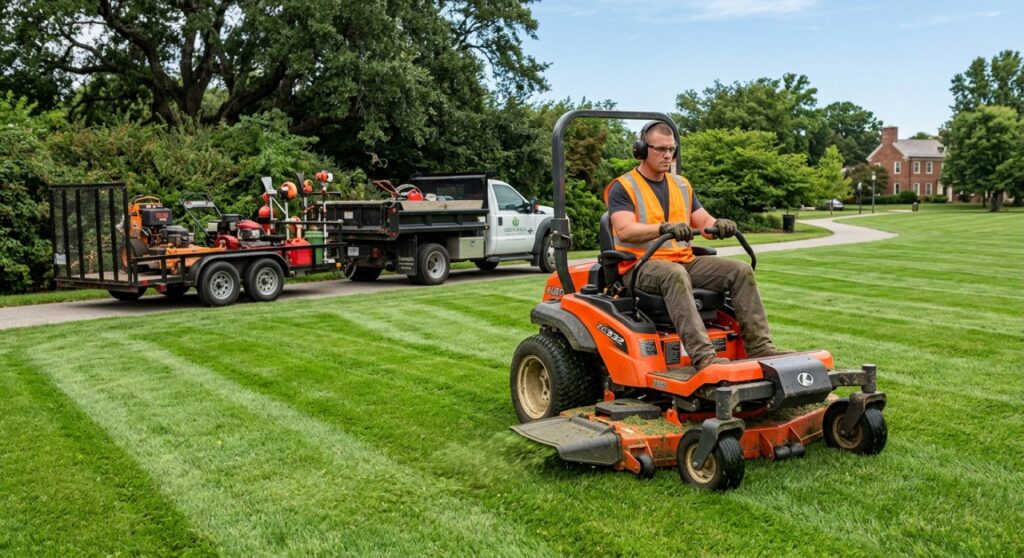
- Commercial zero-turn mowers (brands like Hustler, Exmark, and Scag) dominate professional landscaping due to their speed (up to 15 mph) and tight turning radius.
- Landscapers typically run 3mower categories: zero-turns for open areas, stand-on mowers for slopes and mid-size properties, and walk-behind mowers for tight or gated spaces.
- A commercial zero-turn costs $8,000–$18,000, roughly3–5× more than a residential model — but the durability justifies the cost when running 40–60 hours per week.
- Engine brands matter: Kawasaki, Kohler, and Briggs & Stratton Commercial Series are the most common in pro-grade machines.
- Blade tip speed, deck gauge thickness (7-gauge steel vs. residential 18-gauge), and hydrostatic transmission quality are the three specs that separate commercial from consumer mowers.
Step1: Understand Why Landscapers Don’t Use Residential Mowers
Commercial mowers are enginered for volume. A landscaper may cut20–40 lawns per day, logging 300–500 hours per season — conditions that destroy a residential mower within weeks.
Key differences that matter in the field:
- Frame and deck thickness: Commercial decks use 7–10 gauge steel; residential decks use 16–18 gauge.
- Engine displacement: Commercial engines run 25–37 hp versus17–22 hp for residential.
- Hydrostatic transmissions: Pro units use independent dual hydrostats for precise, durable control.
- Spindle bearings: Commercial spindles are greaseable and built for continuous high-RPM operation.
⚠️ Warning: Using a residential mower for commercial work voids most manufacturer warranties and typically leads to premature failure within one season.
Step 2: Identify the 4 Core Mower Types Landscapers Use
Most professional landscaping crews carry 2–3 mower types on every trailer. Each machine handles a specific job that the others can’t do as efficiently.
Zero-Turn Riding Mowers (The Workhorse)
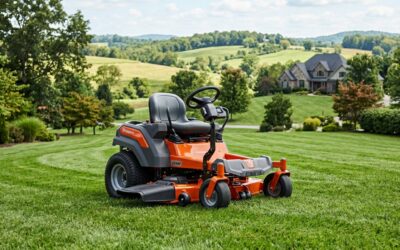
Zero-turn mowers are the primary production machine for most landscaping companies. They get their name from their ability to spin180° on the spot, eliminating wasted passes.
| Feature | Commercial Zero-Turn | Residential Zero-Turn |
|---|---|---|
| Engine Power | 25–37 hp | 17–24 hp |
| Deck Width | 48–72 inches | 42–54 inches |
| Ground Speed | 10–15 mph | 6–8 mph |
| Frame Steel | 7–10 gauge | 16–18 gauge |
| Daily Use Rating | 40–60 hrs/week | 2–4 hrs/week |
| Price Range | $8,000–$18,000 | $2,500–$5,500 |
Top commercial zero-turn brands landscapers actually use:
- Exmark Lazer Z — industry benchmark for cut quality; extremely popular in the eastern US
- Scag Turf Tiger — favored for heavy-duty commercial use and rough terrain
- Hustler Super Z — fastest ground speed in class, preferred for large flat properties
- Feris IS3200Z — suspension system makes it the top pick for bumpy or uneven lawns
- Toro Titan Commercial — strong dealer network, reliable parts availability
Stand-On Mowers (The Versatility Machine)
Stand-on mowers — also called stander mowers — are the fastest-growing segment in professional landscaping. The operator stands on a platform behind a compact deck.
Why landscapers love them:
- Smaller footprint fits through 36–48 inch gates that block zero-turns
- Faster to load/unload from trailers than riding mowers
- Better sight lines on slopes and around obstacles
- Lower purchase price: $6,000–$10,000
Top stand-on brands:
- Wright Stander — the original stander; still a top choice for reliability
- Exmark Staris — newer entry with strong cut quality
- Scag V-Ride II — excellent on slopes, popular with companies doing residential work
- Toro GrandStand — versatile, with a foldable platform for tight storage
Walk-Behind Mowers (The Detail Machine)
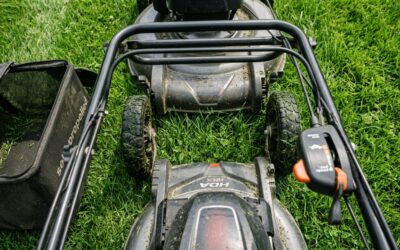
Walk-behind mowers handle fenced yards, tight residential lots, and detail work that riding mowers can’t reach. Most crews carry at least one.
Two sub-types exist:
- Self-propelled walk-behinds: Operator walks behind and controls drive speed. Best for small to mid-size residential lawns.
- Velke/sulky walk-behinds: Operator rides a trailing platform (called a sulky) behind a large-deck walk-behind. Effective on mid-size properties where a zero-turn won’t fit.
Top walk-behind brands:
- Exmark Metro — reliable belt-drive entry for budget crews
- Scag SW (Hydro-Drive) — hydrostatic walk-behind with commercial-grade power
- Toro Proline — consistent performer, widely available parts
- Bob-Cat HB Series — competitive pricing for multi-machine fleets
Robotic and Battery-Electric Mowers (The Emerging Option)
Robotic mowers are gaining traction in commercial landscaping, particularly in Europe, and increasingly in the US for subscription-based lawn maintenance models.
Current commercial robotic leaders:
- Husqvarna EPOS — GPS-guided, no perimeter wire, used by larger commercial operators
- Scag Cheetah E — battery zero-turn targeting crews wanting lower fuel costs
Honest caveat: In 2026, battery-electric commercial mowers still struggle with run time on large properties and higher upfront costs. Most landscaping crews use them as supplemental tools, not primary machines.
Step 3: Match the Mower to the Property Type
Choosing the wrong mower wastes fuel, time, and money. Landscapers match equipment to property characteristics before purchasing or loading a trailer.
| Property Type | Best Mower | Why |
|---|---|---|
| Large open lawns (1+ acre) | Commercial zero-turn (60–72″ deck) | Maximum speed, fewest passes |
| Residential lots with gates | Stand-on or36–48″ walk-behind | Fits through standard36″ gates |
| Slopes over 15° | Stand-on or stiff-frame walk-behind | Lower center of gravity, safer |
| Heavily landscaped beds | 21″ walk-behind + trimer combo | Precision around obstacles |
| Golf courses / sports fields | Reel mowers or wide-area riding units | Low cut height, professional finish |
| Apartment complexes | Zero-turn + stand-on combo | Speed on open areas, access to tight zones |
Step 4: Evaluate the Key Specs That Actually Matter
Don’t buy based on brand alone. These are the five specs professional landscapers evaluate before any purchase.
Deck Width
- 36–48 inches: Gates, tight residential yards
- 52–61 inches: Balanced production on mid-to-large residential properties
- 61–72 inches: Maximum production on open commercial or large residential properties
A wider deck cuts more grass per pass but makes the machine harder to maneuver in tight spaces.
Engine Brand and Displacement
The three most trusted commercial engines:
- Kawasaki FX Series — preferred for longevity; most commercial crews report 2,000–3,000+ hours with proper maintenance
- Kohler Command Pro / EFI — strong torque, EFI models reduce fuel consumption by 20–25%
- Briggs & Stratton Commercial Turf Series — cost-effective, widely available parts
Pro Tip: Fuel-injected (EFI) engines save $500–$1,500 in fuel per season on a full-time commercial operation. The premium pays back within 1–2 years.
Hydrostatic Transmission Type
- Belt-drive: Cheapest, lowest maintenance, but less responsive — fine for light commercial use
- Gear-drive: Durable but requires manual gear changes
- Hydrostatic (single pump): Smooth, no gear changes, suitable for light commercial
- Dual hydrostatic (independent): Standard on commercial zero-turns; provides independent wheel control for zero-radius turns
Deck Gauge and Construction
- 7-gauge steel (~0.179inches): Commercial standard; resists rocks, curb strikes, and daily impact
- 10-gauge steel: Mid-range commercial
- 16–18 gauge: Residential only; dents easily under commercial use
Ground Speed
Higher ground speed means more properties per day. Commercial zero-turns top out at 12–15 mph, compared to 6–8 mph for residential models. Over an 8-hour day, that difference translates to 3–5 additional lawns serviced.
Step 5: Know the Price Ranges and Where to Buy Smart
Commercial mowers are a capital investment, not a commodity purchase. Landscapers buying smart time their purchases to maximize value.
Price Ranges by Category(2026)
| Mower Type | Entry Commercial | Mid-Range | Top-Spec |
|---|---|---|---|
| Zero-Turn Riding | $7,500 | $11,000–$14,000 | $16,000–$18,000+ |
| Stand-On | $5,500 | $7–$9,000 | $10,000–$12,000 |
| Walk-Behind (hydro) | $3,500 | $4–$5,500 | $6,500+ |
| 21″ Commercial Push | $800 | $1,200–$1,500 | $2,000+ |
When to Buy for the Best Price
- Late fall (October–November): Dealers discount current-year inventory to clear floor space. Savings of 10–20% off MSRP are common.
- Pre-season dealer events (February–March): Some dealers offer early-order programs with 0% financing for 12–24 months.
- Model year transitions: When a new model is announced, prior-year units drop. Exmark, Scag, and Hustler typically refresh models every 3–4 years.
- Auction/dealer demo units: Demo machines with50–150 hours often sell for 25–35% less than new and carry limited warranty.
⚠️ Skip It If: A dealer offers a deep discount on a mower with no local service support. Parts and service access matters more than upfront price on commercial equipment.
Step 6: Build a Trailer Setup Like a Professional Crew
A professional landscaping trailer is a mobile equipment system, not just transport. The mower combination determines trailer size and daily capacity.
Common2-Mower Crew Setup (Most Residential Companies)
- 1× commercial zero-turn (61″ deck) — primary production mower
- 1× stand-on or walk-behind (36–48″ deck) — gates and tight areas
- 2–3 string trimmers + 1 edger — detail work
- 1 backpack blower — cleanup
This setup fits a 16-foot enclosed or open trailer and handles 12–25 residential lawns per day, depending on lot size.
Mower Setup (Mid-Size Companies)
- 1× 72″ zero-turn — large open properties
- 1× 52–61″ zero-turn — standard residential
- 1× 36–48″ walk-behind — gates and detail
- Requires an 18–20 foot trailer
Pro Tips From Working Landscapers
- Buy your second mower first: Most experienced landscapers say they wish they’d bought commercial-grade equipment from day one rather than upgrading after burning through a residential machine.
- Maintenance is the real cost driver: A $12,000 mower with proper maintenance (blade sharpening every 8–10 hours, grease fittings serviced every 25 hours, air filters checked daily) will outlast a $15,000 mower that’s neglected.
- Blade tip speed beats deck width for cut quality: A narrower deck running at the correct blade tip speed (18,000–19,000 SFPM) produces a cleaner cut than a wide deck withull or slow blades.
- Demo before you buy: Reputable dealers offer demo days. Always test a machine on terrain similar to your actual job sites.
- Stick to 1–2 brands per fleet: Matching brands simplifies parts inventory, blade compatibility, and mechanic training.
Common Mistakes Landscapers Make When Choosing Mowers
| Mistake | Why It Costs You | What to Do Instead |
|---|---|---|
| Buying residential mowers for commercial use | Failure within one season; no warranty coverage | Buy commercial-rated machines only |
| Over-specing deck width for property size | Poor maneuverability; slower on tight jobs | Match deck width to your most common lot size |
| Ignoring dealer support network | Long downtime when parts are unavailable | Prioritize brands with dealers within 30 miles |
| Buying used without inspection | Hidden hours, worn spindles, bent decks | Always get a pre-purchase inspection or buy dealer-certified used |
| Financing too much equipment at startup | Cash flow problems in slow months | Start with one quality zero-turn + one walk-behind; expand with revenue |
Frequently Asked Questions
Q: What is the most popular lawn mower brand among professional landscapers?
Exmark, Scag, and Hustler consistently rank as the top three brands used by professional landscaping companies in the US, based on industry surveys and dealer sales data. Exmark holds a particularly strong position in the eastern US due to its cut quality and dealer network.
Q: Do landscapers use riding mowers or walk-behind mowers?
Most professional landscapers use both. A commercial zero-turn riding mower handles open areas for speed, while a walk-behind or stand-on mower accesses gated or narrow spaces. Running both types on one trailer maximizes daily productivity.
Q: What size mower deck do most landscapers use?
The 52–61 inch deck is the most common range for residential landscaping companies. It balances production speed with the ability to maneuver around typical residential obstacles. Larger 72-inch decks are reserved for commercial properties and large estate lawns.
Q: How long do commercial lawn mowers last?
A well-maintained commercial zero-turn typically lasts 2,000–3,000 engine hours before requiring a major rebuild. At 40hours per week, that’s 4–6 seasons. Residential mowers are rated for 250–500 hours total.
Q: Is a zero-turn mower worth it for a new landscaping business?
Yes, if you’re servicing more than 8–10 lawns per week. A commercial zero-turn pays for itself through time savings alone — cutting a one-acre lawn takes 45minutes with a zero-turn versus 90+ minutes with a standard riding mower. At that volume, the machine is revenue-generating, not just a cost.
Conclusion
Professional landscapers use commercial zero-turn mowers, stand-on mowers, and walk-behind mowers — often in combination — because residential equipment simply can’t survive the daily demands of the job.
The smartest buying decision starts with matching machine type to your most common property size, prioritizing commercial-grade engine and deck specs, and buying from a dealer with strong local service support.
Best time to buy: Late fall or during model-year transitions for the deepest discounts on commercial equipment.
Decision Table: Buy Now / Wait for Sale / Skip
| Scenario | Recommendation Alternative | |
|---|---|---|
| Starting a landscaping business now | Buy Now — commercial zero-turn + walk-behind combo | Dealer-certified used units save25–35% |
| Have a residential mower, growing client list | Wait for Fall Sale — buy commercial before next season | Demo units available February–March |
| Homeowner cutting own1–2 acres | Skip commercial — residential zero-turn is sufficient | Husqvarna MZ61 or Cub Cadet Ultima ZT2 at $3,000–$4,500 |