
Commercial vs. Residential Lawn Mowers: What’s the Real Difference?
Commercial and residential lawn mowers differ primarily in engine power, build durability, cutting width, and daily usage capacity. Choosing the wrong type means either overspending on a machine you don’t need or burning out equipment that wasn’t built for the job.
###🟩 Expert Summary
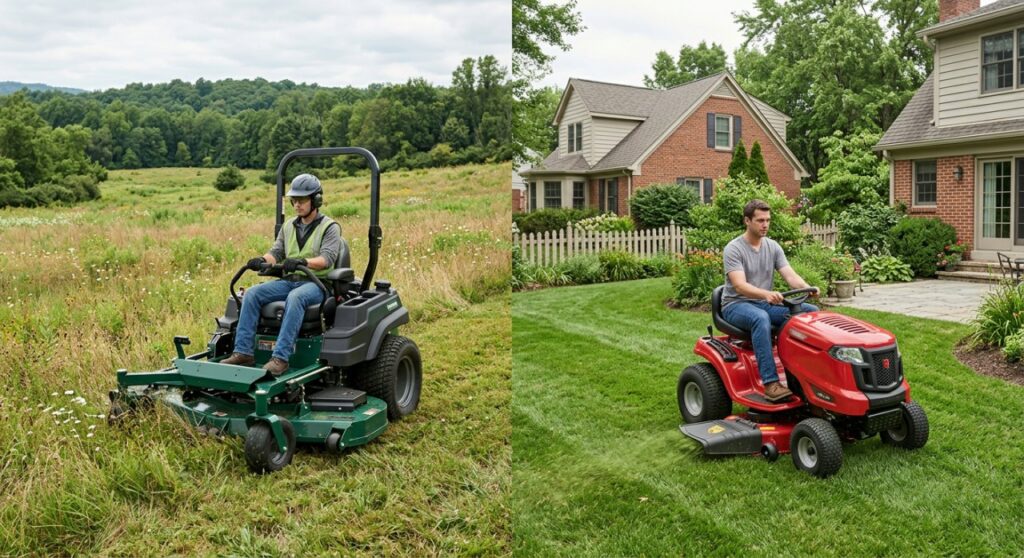
- Commercial mowers are enginered for 6–10+ hours of daily use, heavy-duty terrain, and professional results across large or complex properties.
- Residential mowers are built for 1–3 hours of weekly use on standard home lawns under 1 acre.
- The core difference between commercial and noncommercial lawn mowers is engine displacement, frame construction, and cutting deck thickness — not just price.
- Commercial units typically cost $3,000–$15,000+, while residential models range from $200–$2,500.
- Misusing a residential mower commercially voids warranties and accelerates mechanical failure within one season.
Step1: Understand What “Commercial” Actually Means in Lawn Mowers
Commercial doesn’t just mean “more expensive.” It’s a specification standard tied to duty cycle — how many hours per day a machine is designed to run continuously without overheating or breaking down.
A commercial mower is certified or enginered to operate 6–10 hours daily,5–6 days a week. A residential mower is designed for 30–90 minutes per week on a typical suburban lawn.
What Defines a Commercial-Grade Mower
- Engine type: Commercial units use Kawasaki FX, Kohler Command Pro, or Briggs & Stratton Commercial Series engines with oil coolers and cast-iron cylinder liners
- Frame: Welded steel or reinforced tubular steel — not stamped sheet metal
- Deck thickness: 7–10 gauge steel vs. residential 11–14 gauge
- Spindle bearings: Sealed, greaseable heavy-duty bearings rated for constant load
- Warranty: Commercial warranties typically cover 2–3 years commercial use vs. residential-only coverage
What “Residential” Actually Covers
Residential lawn mowers are optimized for cost-efficiency, ease of use, and occasional operation. They’re enginered to be lightweight, simple to maintain, and affordable replace.
Brands like Honda, Toro, Husqvarna, and Craftsman produce both lines — the chassis, engine specs, and materials differ significantly even within the same brand family.
Step 2: Compare Engine Power and Performance Specs Side by Side
Engine power is the clearest technical dividing line between commercial and residential lawn mowers.
| Specification | Residential | Commercial |
|---|---|---|
| Engine displacement | 140–190cc (push) / 382–500cc (riding) | 540–999cc (zero-turn/stand-on) |
| Horsepower | 3–7 HP (push) / 17–24 HP (riding) | 23–37 HP |
| Fuel tank capacity | 0.5–1.5 gal | 2–5 gal |
| Cutting width | 20–54 inches | 36–72 inches |
| Ground speed | 3–6 mph | 8–15 mph |
| Daily duty cycle | 1–2 hrs/week | 6–10 hrs/day |
| Engine brand examples | Briggs & Stratton 550E, Honda GCV200 | Kawasaki FX850V, Kohler ECV940 |
| Typical price range | $200–$2,500 | $3,000–$15,000+ |
Why Engine Displacement Matters for Your Decision
Higher displacement means the engine produces more torque at lower RPMs — critical for cutting through thick, wet, or overgrown grass without bogging down.
A residential190cc engine will stall or overheat within minutes in commercial conditions. A Kawasaki FX850V (852cc) can sustain full load for an entire workday.
Step 3: Evaluate Cutting Deck Construction and Quality
The cutting deck is where lawn care results are actually made — and the difference between commercial and home lawn mowers is dramatic here.
Residential Deck Construction
Residential decks are typically stamped from a single sheet of steel (11–14 gauge). They’re lighter and cheaper to produce but flex under impact and dent easily against rocks or roots.
Most residential decks are side-discharge or mulch-only designs with limited blade overlap, which can leave uncut strips at higher speeds.
Commercial Deck Construction
Commercial decks use fabricated (welded) construction from7–10 gauge steel plate. They’re reinforced at stress points and designed to handle debris impact without deforming.
Key commercial deck advantages:
- Wider cutting paths (52–72″) reduce pass count significantly
- Triple-blade or overlapping blade systems ensure zero uncut strips even at high ground speeds
- Anti-scalping rolers and adjustable deck pitch for consistent cut quality on uneven terrain
- Replaceable blade spindle housings — field-swappable without full deck removal
Step 4: Assess Transmission and Drivetrain Differences
Transmission type directly determines how long a mower lasts under heavy use — and this is a major difference between commercial and noncommercial lawn mowers.
Residential Transmissions
Most residential riding mowers use Tuff Torq or Hydro-Gear consumer-grade hydrostatic transmissions. These are sealed units — when they fail, the entire unit is replaced, typically at $400–$800+.
Push mowers use basic self-propelled cable-and-gear systems rated for light terrain.
Commercial Transmissions
Commercial zero-turn mowers use independent dual hydrostatic pumps and wheel motors — typically Parker, Hydro-Gear ZT-3400, or Hydro-Gear 3100 series.
These are individually serviceable, meaning a failed pump can be replaced without scrapping the drivetrain. Commercial stand-on and walk-behind units use heavy-duty pistol-grip or ECS control transmissions rated for daily full-load operation.
Step 5: Compare Total Cost of Ownership — Not Just Sticker Price
The price difference between commercial and residential mowers is real, but sticker price is only part of the cost equation.
Residential: Lower Upfront, Higher Replacement Rate
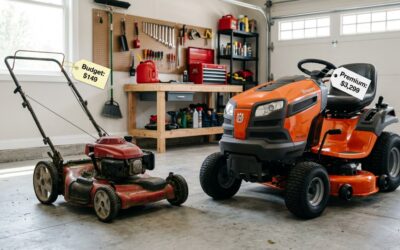
A Husqvarna YTH24V54 riding mower costs around $2,199. Under residential use, it may last 8–12 years. Under commercial use, expect failure within 1–2 seasons.
Most residential warranties explicitly void coverage for commercial use — a critical caveat buyers often miss.
Commercial: Higher Upfront, Lower Per-Hour Cost
A Husqvarna MZ61 commercial zero-turn runs approximately $6,499. Over a10-year commercial lifespan at 1,500 hours/year, that’s roughly $0.43/hour in capital cost.
Compare to replacing a $2,000 residential unit every 2 years under commercial load: $1.00+/hour plus increased downtime and lost revenue.
Total Cost of Ownership Comparison
| Cost Factor | Residential | Commercial |
|---|---|---|
| Purchase price | $200–$2,500 | $3,000–$15,000 |
| Expected lifespan (home use) | 8–15 years | 10–20 years |
| Expected lifespan (commercial use) | 1–2 seasons | 10–15 years |
| Annual maintenance cost | $50–$200 | $300–$800 |
| Fuel efficiency | Higher (smaller engine) | Lower (larger engine) |
| Downtime cost risk | Low (personal use) | High (lost jobs) |
| Warranty (commercial use) | Void | Covered |
Step 6: Match Mower Type to Property Size and Terrain
Property size and terrain complexity are the two most reliable indicators of which mower class you actually need.
Residential Use Cases — When a Home Mower Is Enough
- Lawn size under 1 acre with flat or gently sloped terrain
- Mowing once per week during growing season
- Standard grass types: fescue, bluegrass, zoysia, St. Augustine
- Budget priority over performance
Best residential options by lawn size:
- Under¼ acre: Push mower (Honda HRX217VKA, ~$599)
- ¼–½ acre: Self-propelled mower (Toro TimeMaster 30″, ~$749)
- ½–1 acre: Riding mower (Cub Cadet XT1Enduro, ~$1,699)
Commercial Use Cases — When You Need a Professional-Grade Machine
- Maintaining 5+ properties per week
- Lawns 1acre or larger per property
- Rough terrain, steep slopes, or heavily roted areas
- Revenue depends on mowing speed and reliability
Best commercial options by application:
- Flat large lawns: Hustler Super Z60″ (~$10,499)
- Slopes and irregular terrain: Feris IS3200Z with suspension (~$13,999)
- Gated residential/commercial: Wright Stander X 48″ (~$7,299)
- Entry-level landscaper: Exmark Lazer Z X-Series52″ (~$8,999)
Step 7: Evaluate Ergonomics, Safety, and Operator Comfort
For professional landscapers running a mower 8hours a day, operator fatigue is a real productivity and safety factor — and commercial mowers are enginered around this reality.
Commercial Ergonomic Features
- Suspension seats with lumbar support (standard on Ferris, Scag, Exmark)
- Vibration-dampened platforms on stand-on units
- Low-effort lap bar or joystick controls calibrated for all-day use
- ROPS (Roll-Over Protection Structures) standard on most commercial riders
- Hour meters for maintenance tracking
Residential Ergonomic Features
Residential mowers prioritize ease-of-start and simple controls over ergonomic endurance. Features like cruise control, cup holders, and electric deck engagement are common — useful for occasional use, irrelevant for commercial operation.
⚠️ Common Mistakes to Avoid
1. Buying commercial specs for a home lawn under½ acre
You’ll overspend by $3,000–$8,000 and operate oversized equipment that’s harder to maneuver in tight residential spaces.
2. Using a residential mower for a landscaping business
Voids the warranty immediately and leads to catastrophic failure — typically mid-season when repair wait times are 3–6 weeks.
3. Confusing “heavy-duty residential” with commercial-grade
Terms like “professional” or “heavy-duty” on residential packaging are marketing language. Check actual engine displacement, deck gauge, and warranty terms.
4. Ignoring blade tip speed ratings
Commercial mowers maintain 18,000–19,000 ft/min blade tip speed for clean cuts. Some residential units drop to 16,000 ft/min — visibly worse cut quality on thick grass.
5. Skipping the demo before a commercial purchase
Always demo a commercial mower on your actual terrain before committing. Ground conditions, slope gradient, and grass density affect which unit performs best for your specific workflow.
🛠️ Tools and Materials Reference Table
| Item | Residential Need | Commercial Need |
|---|---|---|
| Engine oil | SAE 30 or 10W-30 | Varies by engine — check OEM spec |
| Blade sharpener | Manual file or bench grinder | Electric blade grinder (Magna-Matic) |
| Air filter replacements | Annual | Every 25–50 hours |
| Hydrostatic fluid | Sealed (no service) | Service every 500 hours |
| Grease gun | Rarely needed | Weekly on all zerk fittings |
| Hour meter | Not standard | Standard — track by hours, not calendar |
| Spare blades | 1 backup set | 2–3 sets per mower minimum |
💡 Pro Tips from Landscaping Professionals
Pro Tip 1: Run the 500-hour test mentally.
Multiply your weekly mowing hours by 52 weeks. If you’ll hit 500 hours within 3 years, you’re in commercial territory — buy commercial-grade or plan to replace the unit.
Pro Tip 2: Deck size drives profitability, not just speed.
Going from a 48″ to a 60″ deck reduces mowing time on a 1-acre lawn by approximately 20%. At10 lawns per day, that’s 2 extra lawns without adding hours.
Pro Tip 3: Buy previous-year commercial models in September–October.
Dealers discount outgoing inventory by 10–20% as new model years arrive. The mechanical changes between model years are typically minor.
Pro Tip 4: Check MSRP vs. street price on commercial units.
Scag, Husqvarna, Exmark, and Ferris all have MSRP — but authorized dealers routinely negotiate 5–12% off on commercial units, especially for fleet purchases.
Pro Tip 5: For homeowners on the fence — rent before you buy.
Renting a commercial zero-turn for a day (~$150–$250) lets you compare actual cut quality and speed against your current residential mower before spending $5,000+.
Frequently Asked Questions
Can I use a residential lawn mower for a small landscaping business?
No — not sustainably. Residential mowers are not built for daily commercial operation, and most manufacturer warranties explicitly void coverage for commercial use. Even “light” commercial use (3–4 lawns per day) will cause premature failure of the deck spindles, transmission, and engine within one season.
What’s the difference between commercial and noncommercial lawn mowers in terms of warranty?
The warranty terms are the clearest legal distinction. Commercial mowers carry warranties valid for commercial use, often 2–3 years or a set number of hours (e.g., 1,000 hours). Residential warranties are strictly for personal, non-revenuegenerating use — using them commercially voids coverage immediately.
Is a zero-turn mower always commercial-grade?
No. Zero-turn mowers exist in both residential and commercial categories. Residential zero-turns (e.g., Husqvarna Z254, ~$2,599) use consumer-grade transmissions and lighter decks. Commercial zero-turns (e.g., Scag Tiger Cat II, ~$9,499) use fabricated decks, commercial-grade hydro systems, and professional engines. Don’t assume “zero-turn” equals commercial.
At what lawn size should I consider a commercial mower?
For personal use, residential equipment handles up to 3–5 acres if terrain is manageable and you’re mowing weekly. For professional landscaping, commercial equipment becomes cost-effective at 5+ properties per week or any single property over 2acres requiring fast turnaround.
What are the cheapest commercial-grade mowers available in 2026?
Entry-level commercial mowers start around $3,000–$4,500. The Exmark Radius E-Series 48″ (~$3,299) and Husqvarna MZ52 (~$3,499) are considered the most affordable true commercial-grade units. Both use fabricated decks and commercial engines, making them legitimate entry points for professional landscapers on a budget.
Conclusion
The difference between commercial and residential lawn mowers comes down to one question: how many hours will this machine run, and does your livelihood depend on it working every time?
For homeowners with lawns under 1 acre mowing once a week, a quality residential mower is the right financial decision — spending $5,000+ on commercial equipment is unnecessary and impractical.
For landscaping professionals, the math flips. Commercial mowers have lower cost-per-hour over their lifespan, are covered under warranty for actual use conditions, and directly protect revenue by minimizing downtime.
The key takeaways:
- Engine displacement, deck gauge, and transmission type are the real differentiators — not brand names or marketing labels
- “Heavy-duty residential” is not the same as commercial-grade
- Always verify warranty terms before using any mower for revenue-generating work
- Commercial units bought in September–October can save 10–20% off peak-season pricing
Ready to choose? Use the comparison tables above to match your weekly hours, property size, and budget to the right mower class — then demo before you buy.
📊 Decision Table: Buy Now / Wait for Sale / Skip
| Buyer Profile | Recommendation Best Alternative if Skipping | |
|---|---|---|
| Homeowner, lawn under ½ acre | Buy residential now — Honda HRX217 or Toro 30″ | N/A — residential is correct class |
| Homeowner, 1–3 acres, flat terrain | Wait for September sale on residential ZTR (save $200–$500) | Rent for large seasonal cuts |
| Part-time landscaper, 3–5 lawns/week | Buy entry commercial now — Exmark Radius E or Husqvarna MZ52 | Skip residential zero-turn — it won’t last |
| Full-time landscaper, 8+ lawns/day | Buy commercial now — Scag Tiger Cat II or Ferris IS2100Z | No viable residential substitute at this duty cycle |
| Curious homeowner eyeing commercial ZTR | Skip — overspend of $3,000–$6,000 with no benefit | Cub Cadet Ultima ZT2 54″ (~$2,499) handles residential needs |