
What Happened to Lawn-Boy Mowers: The Complete Story
Lawn-Boy mowers were discontinued by Toro in 2022, ending a 75-year legacy of American lawn care innovation. Understanding what happened to Lawn-Boy helps current owners make smarter replacement decisions and helps new buyers avoid purchasing orphaned products with no future parts support.
Expert Summary
- Lawn-Boy was founded in 1934 and became one of the most recognized push mower brands in the United States by the 1950s.
- Toro acquired Lawn-Boy in 1989 and continued producing the brand for over three decades before quietly retiring it.
- Toro officially discontinued the Lawn-Boy brand in 2022, citing portfolio consolidation and shifting consumer demand toward riding mowers and robotic systems.
- Staggered-wheel mower models were among the first to be phased out, disappearing from retail shelves years before the full brand shutdown.
- Existing Lawn-Boy owners can still find OEM parts through authorized Toro dealers and third-party suppliers, but availability is shrinking annually.
Step 1: Understand the Origin of Lawn-Boy Mowers
Lawn-Boy was born from engineering ambition, not marketing strategy. The brand’s story explains why its discontinuation was such a significant event in the outdoor power equipment industry.
1 Trace the Brand’s Founding
Lawn-Boy was established in 1934 by the Outboard Marine Corporation (OMC), the same company behind Evinrude and Johnson outboard motors.
OMC applied its two-stroke engine expertise to lawn mowers, producing lightweight, powerful machines that outperformed heavier competitors. This engineering DNA made Lawn-Boy mowers a premium choice for decades.
2 Recognize the Golden Era (1950s–1980s)
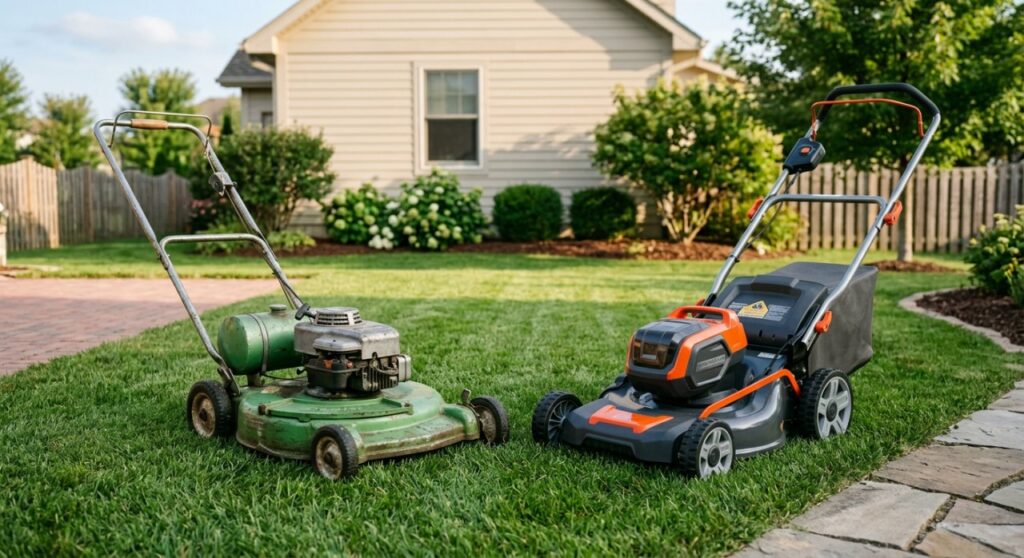
By the 1960s, Lawn-Boy held a dominant position in the walk-behind mower market. The brand was known for its reliable two-stroke engines, innovative self-propelled systems, and the iconic staggered-wheel design.
The staggered-wheel configuration — where the rear wheels sat outside the front wheel track — allowed homeowners to mow flush along edges without a separate string trimmer pass. This was a genuine competitive advantage that built fierce brand loyalty.
Step 2: Track the Toro Acquisition and Brand Transition
Toro’s 1989 purchase of Lawn-Boy was the pivotal moment that set the brand on its eventual path to discontinuation.
1 Understand Why Toro Bought Lawn-Boy
Toro acquired Lawn-Boy from OMC in 1989 for approximately $85 million, primarily to gain market share in the residential walk-behind mower segment.
At the time, Toro was stronger in commercial and riding mower categories. Lawn-Boy gave them instant consumer brand recognition and a loyal customer base.
2 Observe the Post-Acquisition Changes
After the acquisition, Toro gradually shifted Lawn-Boy’s manufacturing and engineering resources. Two-stroke engines were phased out in favor of four-stroke Briggs & Stratton and Honda engines by the early 2000s.
This change was partly driven by EPA emissions regulations, which made two-stroke engines increasingly difficult and expensive to certify for sale in the United States.
| Era | Engine Type | Key Feature | Market Position |
|---|---|---|---|
| 1934–1989 (OMC) | Two-stroke (proprietary) | Lightweight, staggered wheels | Premium residential |
| 1989–2005 (Toro) | Two-stroke transitioning | Brand maintained, features reduced | Mid-market |
| 2005–2022 (Toro) | Four-stroke (B&S/Honda) | Generic design, Lawn-Boy badge | Budget/entry-level |
| 2022–present | Discontinued | No new production | Legacy/parts only |
Step 3: Learn Why Lawn-Boy Staggered Wheel Mowers Were Discontinued First
Staggered-wheel mowers were phased out well before the Lawn-Boy brand itself disappeared, and the reasons reveal a broader industry trend worth understanding.
1 Identify the Engineering Cost Problem
Staggered-wheel decks required a unique chassis design that was expensive to manufacture at scale. As Toro repositioned Lawn-Boy as a budget-friendly brand, the cost of maintaining specialty tooling for staggered-wheel platforms became difficult to justify.
Mainstream mower decks use a symmetrical four-wheel layout that shares tooling across multiple product lines, reducing per-unit manufacturing cost significantly.
2 Understand the Market Shift
Consumer buying behavior shifted toward string trimmers and robotic mowers for edging tasks, reducing the perceived value of the staggered-wheel design.
By the mid-2000s, the STIHL, EGO, and Husqvarna string trimmer markets had expanded dramatically. The staggered-wheel’s primary selling point — flush edge mowing — was now addressed by inexpensive, widely available tools.
3 Recognize the Retailer Pressure Factor
Big-box retailers like Home Depot and Lowe’s pushed for simplified, lower-cost SKUs. Specialty mower configurations like staggered-wheel models required dedicated shelf space and consumer education, which large retailers were unwilling to invest in.
This retail consolidation pressure accelerated the removal of the staggered-wheel lineup from Lawn-Boy’s catalog years before the brand’s final discontinuation.
Step 4: Understand the Final Discontinuation in 2022
Toro announced the end of the Lawn-Boy brand in 2022, with the last units clearing retail channels by late 2022 and early 2023.
1 Identify Toro’s Strategic Reasoning
Toro’s official rationale centered on portfolio simplification and resource reallocation. Maintaining two separate consumer walk-behind mower brands — Toro and Lawn-Boy — created internal competition, duplicated supply chains, and confused consumers at retail.
Consolidating under the Toro brand allowed the company to invest more heavily in battery-powered mower technology, a segment growing at over 20% annually entering the mid-2020s.
2 Assess the Competitive Landscape Pressure
EGO Power+, Greenworks, and Ryobi had aggressively captured the battery mower market by 2020–2022, putting price and feature pressure on entry-level gas mowers — the exact segment Lawn-Boy occupied.
Lawn-Boy’s final product lineup offered little technological differentiation from competing brands at the same $200–$350 price point.
3 Note What Was NOT Discontinued
Toro’s core residential and commercial mower lines remain fully active as of 2026. The discontinuation was brand-specific, not a retreat from the walk-behind mower market.
Toro continues to sell self-propelled, push, and battery-powered mowers under the Toro name, with active R&D investment and full dealer support.
Step 5: Evaluate Durability and True Cost of Lawn-Boy Ownership After 18 Months
The real test of any mower isn’t month one — it’s whether it still performs reliably after 18 months of seasonal use.
1 Assess Lawn-Boy’s Build Quality Honestly
Lawn-Boy’s final generation (2015–2022) used mid-grade materials appropriate for the $250–$350 price segment. Decks were stamped steel (not cast), which is standard at this price but susceptible to rust if not maintained.
The Briggs & Stratton 550e and 675exi engines used in late-model Lawn-Boy units are reliable for 5–8 years with proper oil changes, but are not considered commercial-grade.
2 Calculate True Annual Cost of Ownership
| Cost Category | Estimated Annual Cost |
|---|---|
| Oil changes (2x per season) | $15–$25 |
| Air filter replacement | $8–$15 |
| Spark plug | $5–$10 |
| Blade sharpening or replacement | $10–$30 |
| Carburetor cleaning (every 2–3 years) | $0–$60 (DIY vs. shop) |
| Total Annual Maintenance | $38–$80 |
Parts availability is the hidden risk. As of 2026, OEM Lawn-Boy parts are becoming harder to source, with some deck components and proprietary brackets already discontinued at the manufacturer level.
3 Evaluate Software and Support History
Lawn-Boy mowers are purely mechanical — there is no firmware or software component. However, “support history” in this context means dealer network and parts ecosystem.
Toro has committed to supporting Lawn-Boy parts through authorized dealers for a defined period post-discontinuation, but independent repair shops report increasing difficulty sourcing specific components, particularly deck wheels, height adjustment levers, and OEM blade adapters.
Step 6: Make the Right Decision — First-Time Buyer vs. Current Owner
This is the most actionable section: two clear paths based on your situation.
1 Path A — First-Time Buyers: Is Lawn-Boy Still Worth Buying in 2026?
No. Do not purchase a new or “new old stock” Lawn-Boy mower in 2026. The brand is discontinued, meaning no warranty support from the manufacturer, shrinking parts availability, and no future model updates.
Better alternatives at the $250–$400 price point:
| Brand & Model | Engine/Battery | Best For | Price Range |
|---|---|---|---|
| Toro Recycler 22″ (21465) | Briggs 163cc | Gas reliability, Toro support | $350–$400 |
| EGO LM2135SP | 56V 7.5Ah battery | Zero emissions, quiet | $549 (kit) |
| Honda HRN216VKA | Honda GCV170 | Long-term durability | $449–$499 |
| Ryobi 40V HP | 40V 6Ah battery | Budget battery option | $299–$349 |
| Greenworks 60V | 60V 4Ah battery | Best battery runtime | $379–$429 |
Verdict for first-time buyers: The Toro Recycler 22″ is the most direct Lawn-Boy replacement — same price bracket, same parent company, full dealer support, and active parts availability.
2 Path B — Current Owners: What to Do When Your Lawn-Boy Fails
If your Lawn-Boy is approaching failure, the replacement decision depends on what failed and your budget.
Decision framework:
- Engine failure on a mower under 5 years old → Engine replacement cost ($150–$300) often exceeds the machine’s value. Replace the mower.
- Deck rust or structural damage → Not worth repairing on a discontinued platform. Replace the mower.
- Carburetor, blade, or filter issues → Repair cost is low ($15–$60). Repair and extend life 1–2 more seasons.
- Self-propel drive belt or cable failure → Borderline. Parts may still be available. Repair if under $50 in parts.
Best replacement for current Lawn-Boy owners:
The Toro Recycler 22″ (Model 21465 or 21466) is the top recommendation. It uses familiar Briggs engines, shares dealer infrastructure with Lawn-Boy’s former support network, and offers comparable cutting performance.
For owners ready to transition to battery power, the EGO LM2135SP offers the strongest runtime-to-price ratio and a 5-year tool warranty.
Pro Tips for Lawn-Boy Owners and Buyers
- Stock up on consumable parts now if you plan to run your Lawn-Boy for 2–3 more seasons. Blades, air filters, and spark plugs are still widely available but won’t be forever.
- Cross-reference Toro part numbers — many late-model Lawn-Boy components share Toro part numbers due to shared manufacturing, making sourcing easier than it appears.
- Avoid purchasing used Lawn-Boy mowers from private sellers unless you can verify compression and confirm the carburetor is clean. Repair costs on a discontinued platform can quickly exceed the machine’s value.
- Document your model and serial number before it becomes unreadable. This information is critical for parts sourcing as availability narrows.
- Consider battery mowers seriously if your Lawn-Boy fails. The total cost of ownership over 5 years is now competitive with gas, and support ecosystems for brands like EGO and Greenworks are actively expanding.
Common Mistakes to Avoid
❌ Buying “new old stock” Lawn-Boy units from online marketplaces. These may have stale fuel systems, degraded carburetors, and expired warranties — with no manufacturer recourse.
❌ Assuming Toro dealers will always stock Lawn-Boy parts. Dealers are already deprioritizing Lawn-Boy inventory. Call ahead before assuming availability.
❌ Repairing a Lawn-Boy with a cracked or heavily rusted deck. Structural deck repairs are rarely cost-effective on any mower, and especially not on a discontinued platform.
❌ Overlooking battery mower total cost of ownership. First-time buyers often focus only on purchase price. Battery mowers eliminate oil, fuel, spark plugs, and carburetor maintenance — lowering true annual cost significantly.
❌ Confusing Lawn-Boy discontinuation with Toro’s discontinuation. Toro is fully operational and actively investing in its product lines. Only the Lawn-Boy sub-brand was retired.
Frequently Asked Questions
Are Lawn-Boy mowers still being made?
No. Lawn-Boy mower production officially ended in 2022. Toro, the brand’s owner since 1989, discontinued the Lawn-Boy line to consolidate its consumer mower portfolio under the Toro brand name.
Can I still buy a Lawn-Boy mower?
You may find remaining inventory at some retailers or through private sellers, but purchasing a new Lawn-Boy is not recommended in 2026. The brand is discontinued, meaning no active warranty support and shrinking parts availability. Better-supported alternatives exist at the same price point.
Why did Lawn-Boy stop making staggered wheel lawn mowers?
Lawn-Boy discontinued staggered-wheel mowers due to high manufacturing costs, retailer pressure for simplified SKUs, and declining consumer demand as string trimmers became the preferred edging solution. The staggered-wheel design disappeared from Lawn-Boy’s lineup in the mid-2000s — well before the brand’s full discontinuation in 2022.
Are Lawn-Boy parts still available?
Yes, but availability is declining. Consumable parts like blades, air filters, and spark plugs remain widely available through Toro dealers and third-party suppliers. Structural and proprietary components are increasingly difficult to source as of 2026.
What is the best replacement for a Lawn-Boy mower?
The Toro Recycler 22″ is the most direct gas-powered replacement, offering comparable performance, the same parent company’s dealer network, and active parts support. For buyers open to battery power, the EGO LM2135SP offers superior long-term value and a strong warranty.
Conclusion
Lawn-Boy’s discontinuation in 2022 closed the chapter on one of America’s most beloved lawn mower brands. From its two-stroke origins at Outboard Marine Corporation in 1934, through Toro’s acquisition in 1989, to the final phase-out of staggered-wheel models and ultimately the entire brand, Lawn-Boy’s story reflects the broader forces reshaping the outdoor power equipment industry: emissions regulations, retail consolidation, battery technology disruption, and portfolio rationalization.
For first-time buyers: Do not invest in a discontinued platform. The Toro Recycler 22″ is your best like-for-like replacement, and the EGO LM2135SP is your best forward-looking choice.
For current Lawn-Boy owners: Evaluate repair costs honestly against replacement value. Stock consumable parts now, and plan your transition to a supported platform within the next 1–2 seasons.
The smartest move in 2026 is to honor what Lawn-Boy was — and choose a mower that gives you the same reliability, with full manufacturer support behind it.