
How It’s Made Lawn Mowers: The Manufacturing Process Explained
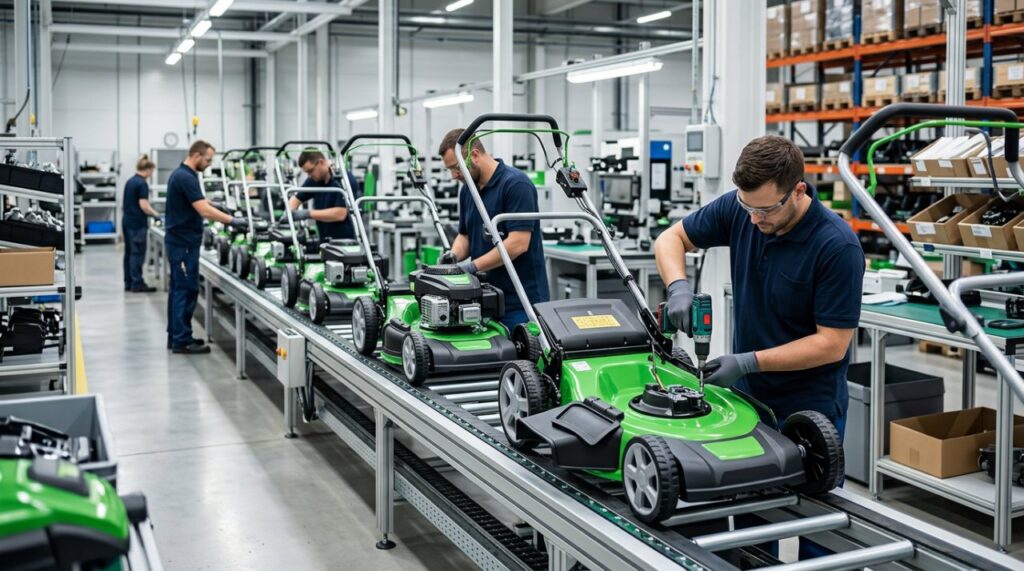
How it’s made lawn mowers begins with engineering, material selection, metal forming, and corrosion protection. Manufacturers then build the cutting deck, blade, engine or electric drive system, wheels, controls, and safety equipment before completing final testing. Understanding these steps helps buyers compare durability, repairability, weight, and long-term value.
Expert Summary>
– Most walk-behind mower decks are made from stamped steel, fabricated steel, aluminum alloy, or impact-resistant composite. – A mower blade requires harder, more wear-resistant steel than the deck because it must withstand repeated impacts and maintain a cutting edge. – “Steel deck” is incomplete marketing language unless the manufacturer also identifies its thickness, construction method, coating, and warranty. – A heavier mower is not automatically more durable; deck geometry, reinforcement, corrosion resistance, and assembly quality also matter. – Lawn-Boy and Craftsman materials vary by model and production period, so buyers should verify the model number rather than relying on brand-level claims.
Step 1: Define the Type of Lawn Mower Being Made
The first manufacturing decision is whether the machine will be a reel mower, walk-behind rotary mower, riding mower, zero-turn mower, robotic mower, or electric mower. Each design requires a different frame, cutting system, power source, and assembly process.
A typical residential rotary mower uses a horizontal blade rotating beneath a protective deck. A reel mower cuts grass between a rotating cylinder and a fixed bed knife, more like scissors than a high-speed impact cutter.
Compare the main lawn mower designs
| Mower type | Cutting mechanism | Common construction materials | Main manufacturing challenge |
|---|---|---|---|
| Push rotary mower | Horizontal rotating blade | Stamped steel, aluminum, composite | Balancing strength, weight, and cost |
| Self-propelled mower | Rotary blade plus wheel transmission | Steel or composite deck, metal drivetrain | Integrating propulsion without excess weight |
| Reel mower | Helical reel and bed knife | Hardened steel, steel frame | Maintaining precise blade alignment |
| Riding mower | One or more rotary blades | Welded steel frame and deck | Supporting operator and drivetrain loads |
| Zero-turn mower | Multi-blade deck | Fabricated or stamped steel | Managing vibration and commercial workloads |
| Robotic mower | Small pivoting or fixed blades | Composite housing, steel blades | Protecting electronics from moisture and impact |
| Battery mower | Rotary blade and electric motor | Steel, aluminum, or composite | Cooling the motor and protecting the battery |
The intended customer also affects the design. A low-cost residential mower may prioritize light weight and simple storage, while a commercial model usually prioritizes service access, reinforcement, and daily operating life.
Tools and materials used in lawn mower manufacturing
The following list covers common industrial equipment rather than tools required by a home user.
| Manufacturing stage | Typical tools or equipment | Common materials |
|---|---|---|
| Product design | CAD and simulation software | Digital specifications |
| Deck forming | Hydraulic press and stamping dies | Sheet steel or aluminum |
| Frame fabrication | Laser cutter, brake press, welding cell | Tubular or plate steel |
| Blade production | Cutting press, heat-treatment furnace, grinder | Hardenable steel |
| Corrosion protection | Wash line, phosphate treatment, powder-coating system | Coatings and pretreatment chemicals |
| Plastic production | Injection-molding machine | Engineering thermoplastics |
| Assembly | Torque-controlled tools, fixtures, conveyors | Fasteners, bearings, cables |
| Quality control | Balance tester, gauges, electrical testers | Completed components |
Step 2: Design the Deck, Blade, and Power System
Engineers create a digital model that defines cutting width, blade clearance, wheel position, discharge path, handle geometry, and safety zones. These dimensions determine whether the mower cuts evenly, moves air efficiently, and protects the operator from debris.
Design teams commonly use computer-aided design, structural analysis, airflow simulation, and physical prototypes. Simulation can identify weak areas, but it does not replace real testing on wet grass, slopes, uneven terrain, and hidden obstacles.
Design the cutting chamber
A rotary mower deck does more than cover the blade. Its internal shape controls airflow, clipping movement, mulching performance, and discharge behavior.
Engineers must account for:
- Blade-tip clearance
- Cutting height range
- Grass discharge direction
- Mulching circulation
- Bagging airflow
- Structural reinforcement
- Motor or engine mounting
- Wheel and axle placement
- Debris containment
- Cleaning and drainage
Marketing terms such as “optimized airflow” or “advanced cutting system” are vague without test data. Useful evidence includes cut-quality comparisons, bag-filling performance, blade speed under load, or testing under defined grass conditions.
Match the power source to the workload
Gas mowers combine an internal-combustion engine with a blade adapter and crankshaft. Electric mowers use a motor, controller, wiring system, and either a battery pack or power cord.
The power system must deliver enough torque to avoid severe speed loss in dense grass. However, peak horsepower, voltage, or wattage alone does not reveal total cutting performance.
Important variables include:
- Motor or engine torque
- Blade diameter and shape
- Governed operating speed
- Battery discharge capability
- Electronic load management
- Deck airflow
- Mower weight
- Cutting width
- Grass density and moisture
A high-voltage battery platform is not automatically more powerful than every lower-voltage system. Voltage is only one part of electrical power, battery capacity, thermal control, and sustained output.
Step 3: Select What Lawn Mowers Are Made Of
If you are asking what are lawn mowers made of, the short answer is steel, aluminum, engineering plastics, rubber, copper, and electronic components. The exact combination depends on the mower category, price point, production period, and expected workload.
The deck receives the most attention, but mower durability also depends on the blade, crankshaft or motor shaft, wheel bearings, handle joints, transmission, fasteners, and protective coatings.
What materials are lawn mowers made of?
Common lawn mower materials include:
- Low-carbon sheet steel: Often used for stamped cutting decks and guards
- Fabricated steel plate: Common in heavier riding and commercial decks
- Hardenable blade steel: Used for rotary blades and reel cutting components
- Aluminum alloy: Used for corrosion-resistant decks and housings
- Engineering thermoplastic: Used for decks, covers, discharge chutes, and battery housings
- Rubber or synthetic elastomer: Used for tires, grips, seals, and vibration isolation
- Copper: Used in motors, wiring, switches, and charging systems
- Foam or paper filter media: Used in engine air filters
- Composite friction materials: Used in brakes, clutches, and selected drive components
A product page that says only “rugged construction” does not identify what material the mower uses. Buyers should look for a specific deck material, construction method, corrosion warranty, and replacement-part availability.
Compare mower deck materials
| Deck material | Advantages | Trade-offs | Best fit |
|---|---|---|---|
| Stamped steel | Affordable, rigid, widely repairable | Can rust if coating is damaged | General residential mowing |
| Fabricated steel | Reinforced and suitable for heavy loads | Heavy and often more expensive | Large properties and commercial use |
| Aluminum alloy | Corrosion-resistant and relatively light | Can cost more; severe damage may be difficult to repair | Humid or coastal conditions |
| Engineering composite | Rustproof, light, and easy to shape | Repair options may be limited after cracking | Residential electric mowers |
| Hybrid construction | Places different materials where needed | Quality varies by design | Buyers seeking balanced weight and durability |
Composite does not automatically mean “cheap plastic.” A properly engineered polymer deck can resist corrosion and ordinary impacts, but its performance depends on resin formulation, reinforcement, wall thickness, rib design, and temperature resistance.
Likewise, steel does not automatically mean “commercial grade.” Thin, poorly protected steel can deteriorate faster than a well-designed aluminum or composite deck.
Step 4: Form the Lawn Mower Deck
Most mass-produced steel decks begin as flat sheet metal cut into blanks. A large hydraulic or mechanical press forces each blank between matched dies, creating the curved cutting chamber, mounting surfaces, and structural ribs.
This process is called stamping or deep drawing. The number of forming operations depends on the complexity and depth of the deck.
Stamp a steel deck
A typical steel-deck production sequence includes:
- Uncoil or load sheet steel.
- Cut the sheet into correctly sized blanks.
- Lubricate the blank for forming.
- Press it into the primary deck shape.
- Trim excess metal.
- Punch mounting and discharge openings.
- Form edges, flanges, and reinforcement features.
- Inspect dimensions and surface quality.
Stamped decks are attractive for high-volume production because one press cycle can create a complex shape quickly. The main disadvantage is the high initial cost of designing and manufacturing the dies.
Fabricate a heavy-duty deck
Fabricated decks are assembled from multiple cut and bent steel sections. Workers or robotic cells weld the shell, top plate, side walls, brackets, and reinforcement pieces together.
Fabrication allows manufacturers to use thicker sections in high-load areas. However, the label “fabricated deck” does not guarantee superior performance unless weld quality, material thickness, spindle support, and reinforcement are also appropriate.
Mold a composite deck
Composite decks are commonly produced by injection molding. Heated polymer is forced under pressure into a mold, cooled, and then ejected as a near-finished housing.
Molding can integrate ribs, cable guides, fastener bosses, ventilation paths, and decorative surfaces into one part. This reduces secondary assembly, although the tooling can be expensive.
Cast an aluminum deck
An aluminum deck may be produced using a casting process that fills a shaped mold with molten alloy. After cooling, excess material is removed and critical mounting surfaces may be machined.
Aluminum offers strong corrosion resistance, but the alloy and casting quality matter. Porosity, thin sections, or poor reinforcement can weaken an otherwise promising design.
Step 5: Manufacture and Heat-Treat the Blade
A lawn mower blade is cut or stamped from steel, formed to create lift, heat-treated where required, sharpened, and balanced. Blade manufacturing is safety-critical because an uneven or cracked blade can create destructive vibration at operating speed.
The blade’s curved or angled sections generate airflow. This airflow lifts grass before cutting and moves clippings toward a bag, discharge opening, or recirculation path.
What kind of steel are lawn mowers made from?
Decks are frequently made from formable low-carbon sheet steel, while blades use steel selected for greater hardness, toughness, and wear resistance. Exact grades vary by manufacturer, supplier, blade design, and production period.
There is no single universal